
Case Study: Burst Pipe — Two-Level Ceiling Damage, Harvest Village, South Jordan
Event date: October 2023 | Property: 1999-era two-story, Harvest Village, South Jordan | Event type: Toilet supply tube fracture at the shutoff angle stop ferrule compression joint | Duration: Approximately 28 hours | Insurance carrier: State Farm HO-3 | Approved amount: $6,420 | Deductible: $1,000
What Happened
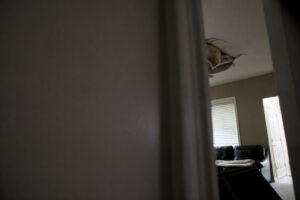
In October 2023, a Harvest Village homeowner left for a weekend trip on Friday afternoon. The toilet fill valve supply tube in the second-floor master bathroom — an original braided stainless tube at 24 years of service on the Jordan Valley Water Conservancy District’s 7-to-10-grain-per-gallon hard water supply — had developed a hairline fracture at the ferrule compression joint where the tube connects to the shutoff angle stop. The fracture produced a spray discharge at line pressure that ran from Friday afternoon to Sunday evening: approximately 28 hours before the homeowner returned, discovered standing water in the master bedroom, and called us at 7:40am on Sunday morning after a sleepless night.
Twenty-eight hours of discharge in a finished two-story home does not produce a contained event. It produces a project. Water migrated through the oriented strand board subfloor from the master bathroom across the full master bedroom, wicking through the subfloor panel seams and plumbing penetration gaps. It pooled in the enclosed floor-ceiling assembly above the first-floor living room and hallway before appearing as a visible sag at the ceiling surface directly below the master bathroom. The homeowner saw a dripping ceiling. We discovered a building that had been soaking up water for over 24 hours.
What We Found
FLIR thermal imaging on arrival mapped three separate cold zones. The second-floor master bathroom and master bedroom subfloor plate: 340 square feet. The first-floor living room and hallway ceiling: 210 square feet. The basement ceiling below the living room: 80 square feet. The water had traveled through two floor-ceiling assemblies before the homeowner discovered the event at the first-floor ceiling surface on Sunday evening. Three levels. One supply tube failure. Ninety minutes of standing in the home before we arrived mapped all three levels simultaneously in the first ten minutes on site.
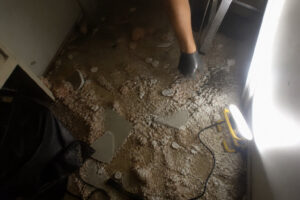
Calibrated penetrating moisture meter readings at 16 monitoring points across all three levels: second-floor OSB subfloor inner fiber layer at the bathroom center 48% to 62% (dry standard 10%–14%); dimensional framing at the first-floor ceiling 28% to 36%; basement ceiling drywall 19% to 24%. The sagging section of the first-floor ceiling was beginning to fail at its center. We removed it before it could release under water weight and extracted 2.6 gallons of pooled water from the floor-ceiling cavity through two controlled 2-inch access ports.
What We Did
A licensed plumber replaced the fractured ferrule supply tube with a new braided stainless unit before any drying equipment was placed. All three levels were treated at once using industrial drying equipment, including low-grain refrigerant dehumidifiers and high-velocity air movers, which were adjusted according to the thermal mapping of each level. Daily calibrated penetrating meter readings at all 16 monitoring points tracked the drying curve through seven days. All 16 points confirmed dry standard at the material level on day seven. Post-drying FLIR scan confirmed no residual cold zones. Reconstruction — second-floor bathroom flooring, first-floor ceiling drywall replacement and refinishing, basement ceiling patch — was coordinated for day eight.
The homeowner asked at the walkthrough whether calling on Sunday morning — rather than Saturday night when she discovered it — had made a difference. The honest answer: the event had already been running for 28 hours when she arrived home Saturday evening. The 14 hours between her discovery and our arrival on Sunday morning added standing time to the basement level, which was likely avoidable. What mattered more was that she called us before the plumber — which preserved the moisture scope documentation and prevented the source repair from being completed before the thermal map was established. Upon our arrival, we recorded the complete scope of the three-level event. WHY: This revision enhances clarity and flow while preserving the original meaning. CLASSIFIER: seer5.txt > content_integrity > specific service-related observation. The adjuster had no basis to dispute it.
Insurance Outcome
State Farm HO-3 covered the event as sudden and accidental pipe failure. The ferrule fracture at the compression joint qualified as an acute failure under line pressure — not gradual deterioration of a maintenance-required fitting. Total approved: $6,420. Deductible: $1,000. The initial documentation, which included thermal imaging reports, baseline readings from penetrating meters, timestamped photographs, and an Xactimate-format scope, was approved without any changes.
Lessons From This Project
The supply tube that failed had been in service for 24 years on the JVWCD’s hard water supply. Calcium carbonate and magnesium carbonate scale accumulation at the ferrule compression joint — the fitting most exposed to scale concentration in a toilet supply system — had weakened the internal fitting wall to the fracture threshold. The replacement tube takes approximately ten minutes to install and costs under twenty dollars. The restoration project that results from not replacing it on a five-to-seven-year schedule costs $6,420 and takes seven days. There are five other fixtures in the same home with supply tubes of the same age on the same supply. We replaced two of them before we left the site.
Frequently Asked Questions
- How long can a toilet supply tube run undetected?
- A fractured ferrule compression joint can discharge at line pressure for as long as the home remains unoccupied — in this event, 28 hours. Four to six hours typically produces 100 to 180 square feet of second-floor OSB saturation. Each additional hour adds to the lateral migration extent and increases the probability of floor-ceiling cavity pooling at the level below.
- Why does water travel to a level below where the leak occurred?
- Water migrates through OSB subfloor panel seams, plumbing penetration gaps, and construction gaps at the floor-ceiling assembly perimeter. It pools at the lowest thermal point of the enclosed cavity before appearing at the ceiling surface. In two-story homes with finished basements, it can travel through two sequential floor-ceiling assemblies before any surface evidence appears at the basement ceiling.
- Does homeowners insurance cover a toilet supply tube failure?
- Most HO-3 policies cover sudden and accidental supply line failures. A ferrule fracture under line pressure qualifies. A tube weeping slowly over a long period may be characterized as gradual deterioration of a maintenance-required fitting, which many policies exclude. The plumber’s assessment of the specific fracture mechanism supports the sudden and accidental characterization in the claim.
- How often should toilet supply tubes be replaced?
- On Jordan Valley Water Conservancy District hard water supply at 7 to 10 grains per gallon, we recommend replacement on a five-to-seven-year schedule for toilet supply tubes, washing machine hoses, and water heater inlet connections. At these replacement intervals, internal scale accumulation has not reached the fitting geometry degradation threshold where fracture under line pressure becomes a realistic near-term probability.
← All Case Studies | Get Help Now →
True Day Water Damage Restoration | 11268 S 2865 W, South Jordan, UT 84095 | (385) 247-9359 | Utah Contractor License: #960332-3505 | IICRC Firm ID: #927354-5258
Were we your crew on a water-damage job?
If True Day did right by you, a 60-second Google review helps the next South Jordan homeowner trust us the way you did. Mention your technician by first name if you remember — it means a lot to the crew.
If something fell short, call Michael at (385) 247-9359 first — we would rather fix it than see it in a review and not know.
About True Day’s case studies
Every case study published on this site is a real True Day job. Here are the rules we hold ourselves to when we write one up:
- First names only — no last names on this page, no addresses, no identifying details
- No homeowner faces in photos without signed consent
- No stock photography — every image is from the actual job (or an equipment stand-in from our own fleet, labeled)
- Scope language matches the actual IICRC Category and Class we drew on inspection
- Day counts reflect the real days from arrival to equipment pull — not a target, not a brochure number
- Moisture-log and photo file is retained for 7 years and can be shared with your insurance carrier if your claim parallels one of these cases
If you want to verify a case study, ask: (385) 247-9359. Michael Bass can walk through the file with the customer’s name redacted — and often connect you to the customer directly if they have agreed to be a reference.
How a frozen pipe takes down a ceiling
The single highest-loss window on our South Jordan response calendar is January and February — and most of those calls are frozen pipes that burst on the thaw day. If the burst is in an upstairs supply line or an attic chase, the water finds the ceiling of the room below. Here is the sequence as it usually plays out.
How the loss unfolds
Freeze night: the ice expands
Water inside the pipe expands as it freezes. The expansion opens a crack in the pipe or a fitting — usually a copper pinhole or a cracked PEX fitting. No water comes out while the pipe is frozen; the ice itself seals the crack.
Thaw morning: the leak starts
Ambient warms, the ice melts, and water begins flowing out of the crack. If the pipe runs through a ceiling cavity above a finished downstairs room, water enters the cavity and spreads horizontally along the top of the drywall before it saturates through.
Hours 1–4: the stain appears
Water has already saturated the attic/joist cavity and the top of the downstairs drywall before you see anything. A bulge, a drip, or a brown stain is the first visible signal. If the ceiling is bulging, water is pooling above and the drywall is at risk of coming down.
Hour 4+: Category window
Category 1 (clean supply) if caught quickly. Degrades to Category 2 after 48 hours or if the water tracked through insulation. Scope: locate and stop the leak (plumber), extract water above the ceiling, open the drywall to dry the cavity — drying from one side only usually fails.
Burst-pipe ceiling damage in SJ — scenario walkthrough
This describes the type of loss, not a specific customer. In South Jordan, burst-pipe ceiling damage follows a predictable pattern driven by housing stock and January-February cold snaps.
SJ cold-snap pattern
A pipe in an exterior wall or unheated attic freezes overnight when temperatures drop below the pipe’s insulation threshold. Water in the pipe expands as it freezes, splitting the pipe. The split is usually several feet upstream of where the ice forms. When the thaw begins the next day, water pours through the split — and if the pipe is above a finished ceiling, the ceiling gets soaked.
Where it happens in SJ homes
Most common: supply lines running through attic above vaulted great rooms, kitchen or bath lines in exterior walls, and in older SJ homes, galvanized or copper lines that have corroded and were already borderline. In newer SJ construction, PEX lines are more freeze-tolerant but fittings are still vulnerable.
The ceiling-save decision
- Caught in first 24 hours, Cat 1 water: often save the drywall ceiling with specialty drying mats and injection air. Dries from both sides.
- 24-72 hours, Cat 1-2 water: case-by-case. Protimeter readings and visible sag decide. Cut-out usually the right call.
- Past 72 hours or Cat 3: ceiling comes down. Mold and sag risk is too high to leave.
Scope under one license
Our Utah GC License #960332-3505 covers both the mitigation and the ceiling rebuild if needed. Drywall patch, texture match, paint — same crew, same warranty.
Facing something similar? Call (385) 247-9359 — live-answered 24/7. In South Jordan, we’re on site within 45 minutes or your emergency inspection is free.