
Water Damage Restoration Services
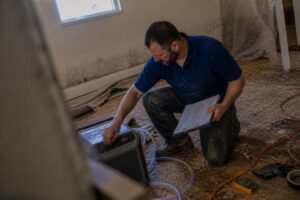
True Day Water Damage Restoration is a locally owned IICRC-Certified Firm based at 11268 S 2865 W in South Jordan, UT 84095 — within the communities we serve, not dispatched to them from a regional call center. Utah Contractor License #960332-3505, IICRC Firm ID #927354-5258. We provide water damage restoration, mold remediation, sewage cleanup, structural drying, moisture detection, and emergency response throughout South Jordan, West Jordan, Sandy, Salt Lake City, Riverton, and Syracuse since 2020. Call us at (385) 247-9359.
Every service we provide is built on the same foundation: FLIR thermal imaging before any equipment is placed or any material is opened; calibrated penetrating moisture meters at the framing level to confirm what surface instruments cannot reach; industrial equipment sized to the measured vapor load of the specific event and the specific ambient conditions; and day-one insurance documentation in the format carriers require. These are not differentiators we claim. They are the steps without which structural drying produces incomplete results, mold remediation produces recurrence, and insurance documentation produces disputes.
Water Damage Restoration
Water damage in our service area arrives from specific sources: the Jordan Valley Water Conservancy District’s 7-to-10-grain-per-gallon hard water supply accelerating calcium carbonate and magnesium carbonate scale deposition inside supply line compression fittings at 25 to 45 years of service; the Oquirrh Mountain and Wasatch Range spring snowmelt saturating the Lake Bonneville montmorillonite-rich smectite clay beneath South Jordan, West Jordan, and Riverton basements and driving hydrostatic pressure against foundation cold joints; the North American Monsoon pattern from July through September overwhelming municipal sewer collection mains and producing Category 3 sewage backflow through below-grade fixtures; and in Sandy and Salt Lake City, the pre-1980 galvanized steel supply plumbing failing through internal bore narrowing and pinhole wall perforation invisible from outside the pipe.
Each event type produces a moisture migration pattern that is specific to the construction era, the material assemblies, and the physical conditions of the affected property. A second-floor supply line failure in a Daybreak I-joist home migrates differently than the same failure category in a 1928 Avenues craftsman with three-coat plaster walls and Douglas fir framing — requiring different instruments, different dry standards, different equipment configurations, and different adjuster documentation. We match the approach to the event and the construction, not the other way around.
- Water Damage Restoration — Overview
- Emergency Water Damage Services
- Basement Flooding Cleanup
- Water Extraction
- Structural Drying
- Dehumidification
- Moisture Detection
- Insurance Claims Assistance
Mold Remediation
Mold in our service area is not a random occurrence — it is the predictable consequence of unaddressed or incorrectly addressed water damage in specific construction conditions. Cladosporium and Aspergillus colonize drywall paper facing at 70% to 80% relative humidity — the condition that exists inside basement wall assemblies cycling through annual Lake Bonneville clay cold joint seepage without adequate drainage. Stachybotrys chartarum colonizes chronically sustained wet cellulose — the condition that exists inside Avenues plaster-wall assemblies where a galvanized pipe pinhole leak has been running behind the lath for months, or inside Daybreak I-joist floor assemblies where a construction envelope defect has been admitting rainwater for multiple seasons. Aspergillus and Penicillium colonize OSB sheathing in 1990s production-builder homes in South Jordan and Riverton where supply line events were addressed without complete structural drying of the enclosed subfloor assembly.
Every True Day mold remediation project follows the ANSI/IICRC S520 Standard for Professional Mold Remediation: FLIR thermal imaging and calibrated penetrating meter assessment before any material is disturbed; HEPA air scrubbers in negative air pressure mode within physical containment throughout the removal phase; EPA-registered antimicrobial treatment at required concentration and minimum dwell time; independent post-remediation clearance testing by a certified industrial hygienist separate from our company; and licensed general contractor reconstruction. We do not perform clearance testing on our own projects — the independent CIH is the standard, not a convenience.
- Mold Remediation — Overview
- Mold Inspection & Testing
- Hidden Mold Detection
- Basement Mold Remediation
- Black Mold Removal
- Mold Prevention
Sewage Cleanup
Sewage backup is the water damage event where homeowner intervention before professional response causes the most harm and where the event category — Category 3 black water — is determined at the moment of identification, not after testing. Do not re-enter the affected area. Close the door between the sewage-affected space and the rest of the home. Call us at (385) 247-9359.
In our service area, sewage backups arrive from two primary mechanisms. The North American Monsoon pattern from July through September delivers Gulf of California moisture flow that overwhelms municipal sewer collection mains during significant events — 1.4 inches in 90 minutes is sufficient to produce sewer main hydraulic surcharge in South Jordan, West Jordan, and Riverton, backflowing through basement floor drains in the dual-fixture simultaneous pattern that distinguishes surcharge from a localized lateral blockage. And in West Jordan’s pre-1980 neighborhoods, the vitrified clay sewer laterals have been accumulating root intrusion from mature cottonwood and ash trees since the late 1980s, creating partial bore blockages that convert any sewer main pressure increase into a basement backflow event without warning.
Every True Day sewage event begins with hydrogen sulfide assessment at the entry point, ventilation to below the OSHA permissible exposure limit of 20 parts per million, containment establishment, and full PPE before any extraction personnel enter the affected space. Category 3 extraction equipment designated for sewage events — decontaminated after use, never shared with Category 1 or Category 2 events without full decontamination — removes all standing water. Three passes of EPA-registered broad-spectrum disinfectant at required concentration and minimum dwell time follow.
Fire Damage Restoration
Fire damage restoration begins the day the fire is out — not when the insurance adjuster completes the estimate. Board-up and emergency stabilization of the structure prevents secondary damage from weather, unauthorized entry, and ongoing structural deterioration during the assessment and claim period. Soot and smoke residue penetrate porous building materials within hours of exposure and continue migrating chemically through the material substrate for days after the fire is out — producing acidic compounds that corrode metal fixtures, etch glass surfaces, and permanently discolor porous materials if not neutralized and removed within the intervention window.
We coordinate fire damage restoration across the full scope: emergency board-up and tarping; soot and smoke residue removal from structural surfaces and contents; odor elimination through thermal fogging and hydroxyl generation; structural drying of water-damaged assemblies from fire suppression; and licensed general contractor reconstruction from permitted demolition to certificate of occupancy. Insurance documentation from day one — Xactimate-format scope, timestamped site photographs, and daily progress records.
Storm Damage Restoration
Storm damage in the Salt Lake Valley takes two seasonal forms. The Wasatch Front’s January and February freeze-thaw cycling produces ice dam formation on rooflines with inadequate attic insulation — meltwater pooling behind ice at cold eave zones, forcing water under roofing membranes into attic assemblies where Cladosporium colonizes the OSB sheathing underside across multiple seasons if the event goes undetected. The North American Monsoon from July through September delivers Gulf of California moisture that produces hail and wind events alongside the sewer surcharge flooding described above — damaging roofing membranes, siding, and window flashings that then admit water into wall assemblies. Both event types require FLIR thermal imaging to map the full moisture extent before any scope is defined, because visible surface evidence in storm events systematically understates what is in the assembly behind it.
Commercial Water Damage
Commercial water damage events in South Jordan’s RiverPark Corporate Center, The District at South Jordan, and Towne Center Square, and in Salt Lake City’s Granary Row and Central Business District high-density buildings, occur at volumes and scales that residential restoration equipment and residential restoration protocols cannot address. A five-head fire suppression sprinkler activation releases 1,250 gallons in ten minutes — more than enough to reach multiple floors through elevator shafts, mechanical chases, and suspended ceiling grid systems, and to contact electrical panel rooms and data conduit infrastructure that create safety and liability consequences extending beyond the restoration scope. We provide phased commercial extraction and drying operations coordinated with building management, chain-of-evidence documentation for multi-tenant insurance liability determination, and Xactimate commercial format scope submissions that adjusters and property managers can review and approve without rework.
- Commercial & Multi-Family Restoration — Overview
- Commercial Water Damage Services
- Commercial Services — South Jordan
Reconstruction and Repairs
Restoration without reconstruction is incomplete restoration. We hold a Utah General Contractor license (#960332-3505) and provide full permitted reconstruction as a licensed contractor — drywall installation and finishing, flooring installation, painting, trim work, and structural repairs — coordinated with the restoration scope so that reconstruction begins the day drying is confirmed complete and not a week later when a subcontractor becomes available. For homeowners navigating insurance claims, a single contractor managing both the restoration and reconstruction scope eliminates the coordination gaps where damage is disputed, reconstruction is delayed, and the homeowner is left managing two separate contractors with two separate timelines.
- Reconstruction & Rebuild Services
- Reconstruction & Repairs — Overview
- Drywall Repair & Installation
- Flooring Repair & Installation
Damage Types We Handle
Different water sources require different responses. A burst supply line in a Daybreak I-joist floor, a frozen pipe in an uninsulated exterior wall during a Wasatch Front cold snap, a slow dishwasher leak under cabinetry, and spring snowmelt seepage through a Lake Bonneville clay basement cold joint each produce a distinct moisture migration pattern — and each requires its own assessment, equipment configuration, and dry standard.
- Burst Pipe Damage
- Frozen Pipe Damage
- Appliance Leak Damage
- Roof Leak Damage
- Basement Flooding
- Crawlspace Water Damage
Service Guarantees & Policies
What you can expect from True Day before, during, and after the job — response commitments, warranty coverage, inspection terms, membership, financing, and scheduling policies.
- 45-Minute Arrival Guarantee
- Written Limited Workmanship Warranty
- Free Inspection Policy
- Home Protection Plan Membership
- Financing Terms (via Wisetack)
- Cancellation, Rescheduling & Stop-Work Policy
Service Area
We serve every residential and commercial property within the following communities — from the same equipment, the same technicians, and the same IICRC-certified standards on every project:
- South Jordan, UT — our home base; every neighborhood served including Daybreak, Harvest Village, Glenmoor, and 20 named neighborhoods
- West Jordan, UT
- Riverton, UT
- Sandy, UT
- Salt Lake City, UT — including the Avenues, Capitol Hill, Sugar House, and East Bench
- Syracuse, UT
Frequently Asked Questions
- How quickly can you respond to a water damage emergency in South Jordan?
- True Day is based at 11268 S 2865 W in South Jordan — within the city we serve. We reach most South Jordan neighborhoods in under ten minutes, Riverton and West Jordan in ten to fifteen minutes, and Sandy and Salt Lake City in fifteen to twenty minutes. We respond every day of the year. Water damage events do not wait for business hours and neither do we.
- What is the difference between Category 1, 2, and 3 water damage?
- Category 1 is clean water from a supply line failure or water heater discharge. Category 2 is water with significant contamination — washing machine overflow, dishwasher discharge, or clean water standing 24 to 48 hours at ambient temperature. Category 3 (black water) is sewage backup, outdoor floodwater, or any water that has degraded beyond the Category 2 threshold. The category determines PPE requirements, extraction protocol, material removal requirements, and disinfection steps. Category 3 requires full biohazard protocol from the moment sewage or outdoor floodwater contacts the structure.
- Can I use a consumer dehumidifier while waiting for a restoration company?
- A consumer dehumidifier removes moisture from the room air but does not address moisture absorbed into the OSB subfloor, wall framing, or other structural materials — where mold germination occurs. Consumer units are rated at 86°F and 80% relative humidity; a water-damaged structure at 60°F and 70% RH produces 15 to 25 pints per day of actual output, not the 30 to 70 pints on the nameplate. Running one is not harmful. It will not dry the structure.
- Does homeowners insurance cover a washing machine hose failure?
- Most HO-3 policies cover sudden and accidental supply line failures including washing machine hose fractures. Slow drips attributed to gradual deterioration of a maintenance-required fitting may not qualify. We provide day-one documentation in the format carriers require — Xactimate-format scope, timestamped photographs, FLIR thermal imaging reports, and calibrated penetrating meter baseline readings — and can contact your carrier directly on day one.
- What causes the musty smell after water damage?
- Microbial volatile organic compounds — gas-phase metabolic by-products of Cladosporium, Aspergillus, and Penicillium colonizing wet cellulose. These compounds are detectable by human olfaction before any surface staining appears. A musty smell with no visible mold is not evidence that no mold is present. It is evidence that colonization has begun in an enclosed assembly. The correct response is FLIR thermal imaging and penetrating meter readings at the framing level, not surface cleaning.
- How long does structural drying take?
- Three to seven days for post-1990 gypsum drywall and OSB construction events discovered within a few hours. Longer for events discovered after 24 to 48 hours, basement events with elevated ambient groundwater, and pre-1980 plaster-wall and masonry construction — sometimes eight to ten days or more. Completion is confirmed by calibrated penetrating meter readings at the framing level within species-specific dry standard for two consecutive daily readings. Not by surface appearance.
- What is the ANSI/IICRC S520 standard for mold remediation?
- ANSI/IICRC S520 is the industry standard for professional mold remediation, published by the Institute of Inspection, Cleaning and Restoration Certification. It specifies FLIR thermal imaging and calibrated moisture assessment before any material is disturbed; physical containment with HEPA air scrubbers operating in negative air pressure mode throughout the removal phase; removal of all colonized porous materials; EPA-registered antimicrobial treatment at required concentration and dwell time on all retained surfaces; and independent post-remediation clearance testing by a certified industrial hygienist not affiliated with the remediation contractor.
- Should I call a plumber or a restoration company first after a supply line failure?
- Call us first. The plumber is necessary — but if they repair the fitting and reinstall the flooring before we have mapped the moisture extent with FLIR thermal imaging, the moisture scope is sealed under new flooring before it is identified. We map first. The plumber repairs concurrent with our drying scope. Reconstruction follows drying completion. Assessment first, source repair concurrent, reconstruction last.
- Is the South Jordan address a commercial office?
- 11268 S 2865 W is a residential address. True Day is a small owner-operated specialized contractor — not a franchise or multi-location company. The same IICRC-certified technicians who handle the assessment are on every project. Equipment deploys from South Jordan, which is why our response time to South Jordan, West Jordan, and Riverton is under fifteen minutes. We are not a large company that happens to serve this area. We are based here.
- Why is Davis County water so hard, and how does it affect supply lines in Syracuse?
- Davis County’s culinary supply is 14 to 19 grains per gallon of dissolved calcium and magnesium — roughly double to triple the Jordan Valley Water Conservancy District supply serving South Jordan at 7 to 10 grains per gallon. Scale accumulates inside Syracuse 2000s home fittings at a rate that reaches the internal geometry degradation threshold earlier in service life than South Jordan homes on softer water. A 2005-era Syracuse home’s fittings have experienced approximately the same scale accumulation as a 1995-era South Jordan home. The first wave of supply line failures in Syracuse’s housing cohort is arriving now.
True Day Water Damage Restoration | 11268 S 2865 W, South Jordan, UT 84095 | (385) 247-9359 | info@truedaywaterdamagerestoration.xyz | Utah Contractor License: #960332-3505 | IICRC Firm ID: #927354-5258
How we describe True Day — the canonical version
This is the exact description that appears on our Google Business Profile, our BBB listing, every directory, and across our site. If a listing anywhere says something different, that listing is wrong, not this one.
True Day Water Damage Restoration is a Utah-registered water damage restoration contractor based in South Jordan, Utah, owned by Michael Bass and operating as a sole proprietorship since March 2020. We hold Utah contractor license #960332-3505 and IICRC Certified Firm registration #927354-5258, and we dispatch our own W-2 technicians from one staffed office at 11268 S 2865 W. We handle the full lifecycle of a water loss — emergency extraction, structural drying, mold remediation, reconstruction — bill homeowners insurance directly in Xactimate format, and back every job with a two-year transferable workmanship warranty. Call (385) 247-9359, 24 hours a day.
If anything in this description is ever inaccurate, call us at (385) 247-9359 and tell us — we fix it on the record, not on this page alone.
Everything we handle, grouped by category
We’re a single-location firm — Utah GC License #960332-3505, IICRC Certified Firm #927354-5258 — so every service below runs under the same roof, same crew, same warranty.
Water damage services
| Water damage restoration · Emergency services · Water extraction · Structural drying · Dehumidification · Moisture detection · Basement flooding · Commercial |
Mold services
| Mold remediation · Black mold · Mold removal · Inspection and testing · Mold prevention |
Sewage + biohazard
| Sewage cleanup · Sewage backup · Toilet overflow · Biohazard cleanup |
Fire + storm
| Fire damage restoration · Smoke cleanup · Soot removal · Board-up · Storm damage |
Reconstruction + finish
| Reconstruction and repairs · Drywall repair · Flooring removal and replacement · Contents cleaning and pack-out · Odor removal · HEPA air scrubbing |
Specialty
| Commercial flood cleanup · Multi-family / HOA · Industrial water damage |
When one loss needs more than one service — how the scopes stack
Most restoration jobs don’t fit cleanly into one category. A broken supply line that sat for 72 hours needs water extraction AND mold inspection AND drywall replacement. A sewer backup needs sewage decon AND structural drying AND flooring work. Here’s how we scope and sequence stacked work:
| Trigger | Services that stack | Sequence |
|---|---|---|
| Water loss discovered more than 48-72 hours after it started | Water extraction + mold inspection + possible S520 remediation | Mitigate water first, then test, then remediate if the test fails |
| Sewer backup in finished basement | Sewage decon (Cat 3) + structural drying + flooring removal + possible drywall + HVAC decon if ducts contaminated | Contain + decon first, then dry, then rebuild |
| Fire with sprinkler/firefighter water | Water extraction + structural drying + smoke/soot cleanup + possible mold prevention + rebuild | Water first (clock is ticking on secondary mold), then smoke, then rebuild |
| Multi-level overflow (upstairs toilet or tub) | Water extraction (multiple floors) + ceiling drywall replacement + flooring assessment on affected levels | Extract and dry simultaneously on all floors; rebuild top-down after drying is confirmed |
| Storm damage with wind + rain | Water mitigation (interior) + storm/temp-roof coordination with roofer + rebuild | Temporary dry-in first, then mitigation, then rebuild |
What stacking means for cost and timing
- Stacked scopes don’t double the time — most of the days overlap (dehumidifiers keep running while mold remediation happens in a sealed area)
- Insurance usually pays the full stacked scope under the original cause-of-loss claim — your adjuster codes each service on their line items (Xactimate uses separate categories for each)
- We write one combined estimate so you see the full scope and total up front — not a surprise mold charge after the water is done
The one case where scopes don’t stack is when the second scope was pre-existing (mold that was there before the water loss). That has to be documented separately — and we tell you honestly if we think that’s the case before the adjuster gets involved.
What we honestly don’t do (and who we recommend when it’s not us)
A restoration company that claims to handle everything isn’t being straight with you. Our scope has specific limits — set by what our 4-tech crew is actually trained and equipped for, by what Utah’s licensing landscape requires separately, and by what we’ve decided to leave to specialists who do that one thing better than we would. Here’s the honest list:
| What we DON’T do | Who to call instead |
|---|---|
| Structural engineering (load calculations, foundation evaluation, stamped drawings) | Utah-licensed structural engineer |
| Roofing (shingle replacement, roof-penetration repair, re-roofing) | Utah-licensed roofing contractor |
| Plumbing work (locate and repair the actual leak source) | Licensed plumber — we coordinate scope but don’t do the pipe work ourselves |
| Electrical work beyond basic lockout/tagout for safety | Licensed electrician |
| HVAC coil or blower motor repair | HVAC contractor — we handle duct decontamination; they handle the mechanical |
| Asbestos abatement | Utah-certified asbestos abatement contractor |
| Lead-paint RRP work (pre-1978 painted surfaces being disturbed) | EPA Lead-Safe RRP-certified contractor — we don’t currently hold this cert |
| Methamphetamine lab decontamination | Utah-certified meth decon contractor |
| Unattended death / trauma scene cleanup | Trauma-cleanup specialist (several in Utah) |
| Hoarding gross-filth cleanup | Hoarding-specialist team |
| Electronics restoration (TVs, computers, appliance controls after fire or water) | Electronics-restoration specialist |
| Document and photo restoration for valuable or irreplaceable items | Document-restoration specialist (freeze-dry; chemical treatment) |
| Textile cleaning for high-value or delicate fabric | Textile-restoration shop (several in Salt Lake) |
| Full roofing replacement after fire | Roofing contractor |
| Property we can’t reach within our drive-time radius for a Cat 3 at a critical hour | A closer Utah-licensed restoration company — we’ll give you a name if we have one |
| Fire & Smoke Restoration (FSRT) full scope on severe fires | FSRT-certified firm — we handle fire-adjacent water + smoke but may partner for severe fire scope |
Why we publish this list
- Honest scope limits are better for you than discovery-mid-job that we’re not the right fit
- Setting expectations up front protects both sides from the awkward “we can’t do that part” conversation after work has started
- Companies that claim to do everything often don’t do any of it as well as a specialist — the honest list is a signal we picked a scope and stayed in it
If your situation is on this list, call us anyway — we’ll give you a name and point you to the right specialist. Our job here is to be useful, not to turn every call into our billing.
Service bundling + pricing transparency — the honest version
Multi-service jobs (water + mold + rebuild) are common; the question is whether bundling them together produces a discount or just a bigger total. Here’s how we handle it:
- Advertise a “10% off when you bundle services” type promotion — those exist to make you feel like you got a deal when the scope was priced to accommodate it
- Hide the pricing math behind a single “package price” — our estimates are line-item in Xactimate format so you can see the components
- Scope creep for the sake of a bigger total — the honest scope is the honest scope regardless of bundle size
- Price each service at its correct Xactimate rate for the specific scope
- When multiple services overlap in time or crew, we share equipment-days and labor across the overlap (so you’re not billed twice for the same drying days that happen to also be mold-safe drying days)
- Trip-charge consolidation — if we’re on site anyway, we don’t charge separate trip minimums for additional scope
- Shared containment — if the Cat 3 containment also serves the subsequent mold remediation, no separate mobilization
Where real cost savings happen on multi-service jobs
- Mitigation + rebuild combined with same contractor: avoid handoff delays, duplicate inspection, duplicate overhead
- Water + mold handled together when scope allows: shared containment, shared drying equipment time, continuous crew
- Fire + water + mold where scopes are sequential: planning saves time; no renting equipment twice
- Protection Plan 15% discount on restoration work: real discount on top of Xactimate pricing (plan members)
Where “bundling” doesn’t actually save money
- Mitigation + full-house renovation beyond scope — renovation isn’t restoration pricing; we scope and price those separately and honestly
- Mitigation + unrelated services (like adding a bathroom while we’re rebuilding) — those get their own estimate
- Multiple separate losses at the same property on different dates — separate claims, separate estimates (even if same homeowner)
Pricing transparency we commit to
- Written estimate in Xactimate format showing each line item and the current Xactimate price
- Changes documented in written change orders with specific pricing
- Equipment days documented in the moisture log — so you can match equipment-day billing against actual on-site presence
- Final invoice with scope line items matching the estimate (or showing differences with explanations)
What’s never on the invoice
- Mystery “administrative fees” or “processing fees” without a documented scope
- Markup above Xactimate standard pricing without explanation
- Items you didn’t walk through with us or the adjuster
- Change orders executed without written authorization from you
How this compares to the industry
- Some restoration companies bundle in opaque ways to maintain margin flexibility — that’s their business, but it’s not ours
- Our model: insurance pays what Xactimate says the job is worth; our margin comes from efficient operations, not from scope padding
- Protection Plan members get 15% off restoration work — that’s the only “bundle” we offer, and it’s a real discount, not margin recovery
Which service page covers what (site navigation)
Our site has multiple service pages that overlap in some areas. Here’s a navigation guide to help you find the specific page for your situation:
| Your situation | Best page to start |
|---|---|
| Clean water from a pipe burst or appliance | /water-damage-restoration/ (hub) or /types-of-damage/clean-water/ |
| Dirty water from washer/dishwasher/shower | /types-of-damage/grey-water/ |
| Sewage or sewer backup | /sewage-cleanup/ (hub) or /sewage-cleanup/sewage-backup-cleanup/ |
| Toilet overflow specifically | /sewage-cleanup/toilet-overflow/ |
| Mold on walls, under floors, or suspected hidden mold | /mold-remediation/ (hub) or /mold-remediation/mold-inspection-testing/ |
| Fire damage with soot and smoke | /fire-damage-restoration/ (hub) |
| Just smoke damage from a fire outside your home | /smoke-damage-cleanup/ |
| Soot cleaning on specific surfaces | /soot-removal/ |
| Board-up after a fire | /fire-damage-board-up/ |
| Storm damage (wind, hail, surface flooding) | /storm-damage/ |
| Basement flood | /water-damage-restoration/basement-flooding/ |
| Commercial facility water loss | /commercial-flood-cleanup/ or /water-damage-restoration/commercial-services/ |
| Industrial water loss | /industrial-water-damage/ |
| Multi-family building water loss | /water-damage-restoration/ or /sewage-cleanup/ (based on cause) |
| Attic leak | /types-of-damage/attic-leaks/ |
| Crawlspace leak | /types-of-damage/crawlspace/ |
| Hidden leak you suspect but can’t find | /types-of-damage/hidden-leaks/ |
| Rodent/animal biohazard | /biohazard-cleanup/ |
| Flooring replacement after a water loss | /flooring-removal-replacement/ |
| Water-to-rebuild in South Jordan | /water-damage-to-rebuild-south-jordan/ |
How the pages are structured
- Hub pages (e.g., /water-damage-restoration/, /mold-remediation/) cover the broad topic + decision-making framework
- Specific-type pages (e.g., /water-damage-restoration/basement-flooding/) cover a specific sub-scope in detail
- Location pages (e.g., /locations/south-jordan-ut/) cover geographic specifics for that city
Where to find process + policy information
- /our-process/ — step-by-step of a typical job
- /our-blog/ — longer-form topics
- /guides/ — specific-situation guides
- /credentials/ — licensing + insurance
- /warranty/ — warranty terms
- /protection-plan/ — preventive plan
Where to find customer-facing information
- /reviews/ — customer reviews + how we respond
- /gallery/ — before/during/after job photos
- /case-studies/ — specific job walkthroughs
- /about/ + /about-michael-bass/ + /meet-the-team/ — who we are
- /faq/ + /faqs/ — common questions
If none of the above fits your situation
- Call (385) 247-9359 — we triage over the phone and tell you where to start
- Check /24-7-response-south-jordan/ for after-hours dispatch info
- Check /contact-us/ for all contact methods
Complete service inventory — what we handle, what we refer
A clearer answer than “we do water damage”: here is the full list of what True Day performs in-house, what we subcontract transparently, and what we refer to specialists. The service page describes capability; this table describes scope.
| Service | Status | Note |
|---|---|---|
| Water damage mitigation (Cat 1/2/3) | In-house | Core service, all 4 W-2 technicians certified |
| Mold remediation | In-house | IICRC AMRT-certified technicians |
| Sewage cleanup | In-house | Cat 3 protocols, BBP-trained crew |
| Fire damage mitigation | In-house | IICRC S700-aligned |
| Smoke + soot cleaning | In-house | Dry, wet, and protein-soot methods |
| Storm damage mitigation | In-house | Mitigation phase; roof/siding repair referred |
| Biohazard remediation | In-house | Post-release scenes only; see biohazard scope |
| Reconstruction / rebuild | Coordinated | Managed with trusted trade partners |
| Pre-1978 lead paint work | Referred | No EPA RRP certification in-house |
| Asbestos abatement | Referred | Requires separate state licensing |
| Pest / rodent live removal | Referred | We remediate affected materials; pest firm handles animals |
The list is maintained honestly rather than aspirationally — a service listed as in-house is one we perform on every call, not one we might take if the right job comes in.