
Crawl space water damage: standing water or damp soil under the house raises humidity in the whole home and can lead to mold on joists and subfloor. True Day extracts water, dries the space with LGR dehumidifiers and checks the framing with moisture meters. Live-answered 24/7 from South Jordan, UT.
Crawl Space Moisture Damage in South Jordan, UT
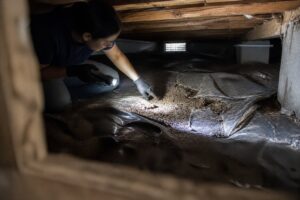 The crawl space is the most consistently underinspected moisture environment in South Jordan residential construction — and frequently the primary source of the musty odors that homeowners attribute to basements, HVAC systems, or causes they never identify. The combination of unencapsulated dirt floor surfaces, South Jordan’s expansive clay soils, and the seasonal groundwater fluctuations driven by Lake Bonneville basin hydrology creates a crawl space moisture environment that supports aggressive mold colonization on floor joists and distributes that contamination to the living space above through the stack effect — regardless of whether the crawl space access hatch is ever opened.
Crawl space problems have a specific quality that makes them easy to postpone. The problem is below the floor. Nothing looks wrong in the rooms above it. The smell is intermittent — stronger in spring, less noticeable in dry summer months — and easy to attribute to something else. We have assessed crawl spaces in South Jordan where the floor joists had active Cladosporium and Chaetomium growth across 60% of the lower chord surface area, where the kraft-faced insulation was visibly colonized throughout, and where the homeowner had been living above it for three or four years without ever connecting the chronic musty smell in the living room to what was directly beneath their feet. The crawl space does not announce itself. That is precisely what makes it worth inspecting before it does.
True Day Water Damage Restoration is a licensed Utah Contractor (#960332-3505) and IICRC-Certified Firm (ID #927354-5258). Call us at (385) 247-9359.
The crawl space is the most consistently underinspected moisture environment in South Jordan residential construction — and frequently the primary source of the musty odors that homeowners attribute to basements, HVAC systems, or causes they never identify. The combination of unencapsulated dirt floor surfaces, South Jordan’s expansive clay soils, and the seasonal groundwater fluctuations driven by Lake Bonneville basin hydrology creates a crawl space moisture environment that supports aggressive mold colonization on floor joists and distributes that contamination to the living space above through the stack effect — regardless of whether the crawl space access hatch is ever opened.
Crawl space problems have a specific quality that makes them easy to postpone. The problem is below the floor. Nothing looks wrong in the rooms above it. The smell is intermittent — stronger in spring, less noticeable in dry summer months — and easy to attribute to something else. We have assessed crawl spaces in South Jordan where the floor joists had active Cladosporium and Chaetomium growth across 60% of the lower chord surface area, where the kraft-faced insulation was visibly colonized throughout, and where the homeowner had been living above it for three or four years without ever connecting the chronic musty smell in the living room to what was directly beneath their feet. The crawl space does not announce itself. That is precisely what makes it worth inspecting before it does.
True Day Water Damage Restoration is a licensed Utah Contractor (#960332-3505) and IICRC-Certified Firm (ID #927354-5258). Call us at (385) 247-9359.
Why South Jordan Crawl Spaces Have a Specific Moisture Problem
The subsoil in South Jordan primarily contains montmorillonite-rich smectite clay, a type of expansive sediment formed from the deposits of ancient Lake Bonneville, which once covered this area to depths reaching hundreds of feet. This clay has two moisture-related characteristics that directly affect crawl space conditions: it swells significantly when saturated — creating the hydrostatic pressure against foundations that drives basement seepage — and it retains moisture for extended periods after precipitation and snowmelt events, maintaining elevated soil moisture content through much of the year. An unencapsulated dirt-floor crawl space in South Jordan sits directly above this moisture-retaining clay substrate. Soil vapor evaporation from the crawl space floor surface occurs continuously — at a rate determined by the clay’s moisture content and the vapor pressure differential between the soil surface and the crawl space air. In spring and early summer, when snowmelt has saturated the clay, this evaporation rate is highest — introducing substantial moisture into the crawl space air and maintaining relative humidity levels above 70% to 80%, the germination threshold for Cladosporium, Penicillium, and Chaetomium on wood substrates. Chaetomium — identifiable by its musty odor that is more pungent and distinctive than the earthy character of Cladosporium — is a strong indicator of sustained chronic crawl space moisture. It produces a smell that occupants often describe as “musty” or “earthy” in the rooms directly above the crawl space, with no visible explanation at the room level because the source is below the floor they walk on every day.What Crawl Space Mold Damage Looks Like
Dark staining on the lower surfaces of floor joists — typically Cladosporium in gray-green to black tones — and on the faces of rim joists. Kraft-faced insulation batts installed between joists with the kraft paper facing downward toward the crawl space air may show Penicillium growth on the paper facing. In advanced cases, structural wood surfaces show visible mycelial growth and the musty odor compounds are present at concentrations detectable from the living space above without entering the crawl space. The stack effect — the thermodynamic tendency of air in a structure to flow upward from lower to upper levels, driven by temperature differentials between interior and exterior — draws crawl space air into the living space through gaps in the subfloor assembly around pipe penetrations, floor vents, and construction gaps. Mold spores and microbial volatile organic compounds from the crawl space travel with this air movement, contributing to the indoor air quality and odor conditions in the rooms above.A Crawl Space Project Near the Jordan River Corridor
In the spring of 2023, we were contacted by a homeowner in an established South Jordan neighborhood west of 700 West — a 1994-era split-entry home on a street two blocks from the Jordan River Parkway Trail. The homeowner had noticed a musty odor in the main floor living room for approximately two years. An HVAC company had serviced the system twice during that period, replacing filters and cleaning the coil. A general contractor had checked the basement for water intrusion and found none. Nobody had looked in the crawl space. On arrival we opened the crawl space hatch and detected the Chaetomium odor — the pungent, distinctively fermented musty character that distinguishes chronic crawl space colonization from the lighter earthy smell of surface Cladosporium — before entering. The crawl space was an unencapsulated dirt floor with no vapor retarder of any kind. Relative humidity measured 84% at the center of the space on a mild April morning. The floor joists showed dark surface colonization across approximately 70% of their lower chord surface area — Cladosporium confirmed by tape lift analysis, with Chaetomium present on approximately 30% of affected surfaces. The kraft-faced insulation batts installed between the joists were colonized on the paper facing throughout the south half of the crawl space, which sat above the area of highest soil moisture adjacent to the Jordan River basin groundwater influence. The remediation involved HEPA air scrubbers in negative air pressure mode within the crawl space throughout all removal and treatment work; full removal of all colonized insulation; wire brushing of all affected joist surfaces; two applications of EPA-registered broad-spectrum antimicrobial at required dwell times; and a film-forming encapsulant applied to all treated structural wood. Following remediation and independent clearance testing — which returned spore counts within normal background — we installed a continuous 20-mil reinforced polyethylene vapor retarder across the full crawl space floor and up the foundation walls, sealed at all seams, pipe penetrations, and foundation wall transitions. A dedicated crawl space dehumidifier was sized to the vapor load of the specific space and installed on the encapsulation surface. Three weeks after the dehumidifier reached steady-state operation, the homeowner called to say the musty smell in the living room was gone. Not reduced — gone. She had attributed it to “old house smell” for two years. It was not old house smell. It was Chaetomium and Cladosporium microbial volatile organic compounds migrating from the crawl space to the living room through the stack effect, every day, through every gap in the subfloor assembly. The insulation that was supposed to be protecting the floor was the primary colonization substrate. The two service calls that missed the crawl space cost her two years of living with a problem that a single hatch opening would have identified.Our Crawl Space Moisture Damage Response
Mold remediation in the crawl space: HEPA air scrubbers in negative air pressure mode, removal of contaminated insulation, wire brushing and antimicrobial treatment of colonized structural wood, and post-remediation clearance testing. Encapsulation: Installation of a continuous 10-to-20-mil reinforced polyethylene vapor retarder across the crawl space floor and up the foundation walls — sealed at all seams and penetrations — to interrupt soil vapor evaporation as the primary moisture source. Combined with a dedicated crawl space dehumidifier, encapsulation maintains conditions below the mold germination threshold year-round.- Why does my crawl space smell musty only in spring?
- Oquirrh Mountain snowmelt raises the groundwater table against crawl space vapor barrier seams from March through May, elevating crawl space ambient humidity above the Cladosporium germination threshold. The smell comes from microbial volatile organic compounds from mold colonizing the OSB floor sheathing underside. The smell recedes in summer when groundwater drops — the mold colonization does not.
- What vapor barrier specification is adequate for Oquirrh bench crawl spaces?
- 20-mil polyethylene with minimum 12-inch seam overlaps, all seams taped, extended 6 to 12 inches up perimeter foundation walls and mechanically fastened. Standard 6-mil or 10-mil tears at access traffic puncture points and seam gaps from annual hydrostatic pressure.
Crawlspace water + moisture damage
A wet crawlspace is a whole-house problem, not an isolated one. The stack effect pulls air from the lowest conditioned space of the home upward through the living areas and out the roof. Whatever is in the crawlspace air — mold spores, musty volatiles, pest droppings — ends up in the breathable air upstairs.
Acute vs. chronic crawlspace moisture
Acute moisture is a defined water event: a plumbing failure above the crawlspace, a sewage lateral break, groundwater pushed in by a storm. The scope is the event footprint — extraction, dry-out, antimicrobial, verify.
Chronic moisture is a condition rather than an event: ground-water seepage, missing vapor barrier, no exterior drainage, poor ventilation, high indoor humidity escaping into an unconditioned space. The scope involves solving the moisture driver, not just drying the current state.
What we handle in the crawlspace
- Water extraction and antimicrobial treatment after an acute event
- Mold remediation under IICRC S520 when visible growth is present
- Moisture mapping with FLIR + Protimeter to establish a baseline
- Documentation of the moisture source(s) for your insurance claim
What we don’t do (and will refer)
Permanent crawlspace encapsulation (continuous vapor barrier + sealed vents + conditioned-air supply) is a specialty trade with its own contractors. We’ll remediate the water event, address the mold, and refer you to an encapsulation specialist when that’s the right next step for a chronic driver. Treating the symptom without naming the cause isn’t honest work.
Vented crawlspace vs encapsulated crawlspace — different damage, different fix
Not all crawlspaces are built the same, and the type you have changes what a water event looks like and how we remediate it. Here’s the difference in plain terms:
| Element | Vented crawlspace (older homes) | Encapsulated crawlspace (newer or retrofitted) |
|---|---|---|
| How it’s built | Open to outside air via vents around the perimeter; often dirt floor with partial poly ground cover | Sealed to outside with closed vents; fully poly-wrapped floor and walls; conditioned by HVAC or dehumidifier |
| Normal moisture state | Tracks outdoor humidity — high in spring and summer, dries in winter | Controlled low RH year-round (dehumidifier target 50-60% RH) |
| When water enters | Standing water on dirt or poly; wicks into joists above | Standing water on sealed poly; may puddle but doesn’t absorb into ground; joists above affected if saturation is high |
| Drying scope | Remove standing water, replace saturated poly, aggressive drying with air movers + dehu (open to outside is counterproductive; need temporary containment) | Remove water, inspect poly for breach, dry the sealed envelope, verify dehumidifier operation |
| Mold risk | Higher — dirt + organic debris + humid air + wet wood = classic growth conditions | Lower if encapsulation stays intact; breaches of the vapor barrier are the common failure point |
Vapor-barrier scope when we remediate
- Damaged poly (torn by water flow, pulled away from walls) is replaced with 6-mil minimum (10-mil for a full encapsulation retrofit)
- Overlap seams minimum 12 inches, taped with butyl or encapsulation-grade tape
- Wall termination 6 inches above the exterior grade line, mechanically fastened
- Sump pump or drainage considered if water intrusion is a repeat pattern
What we don’t do in a crawlspace
- Full encapsulation retrofit on an unretrofitted vented crawlspace — that’s a specialty scope with its own contractors; we scope the water mitigation and recommend an encapsulation specialist if a retrofit makes sense
- Soil excavation or waterproofing on the exterior foundation — that’s an exterior waterproofing scope
- Structural repair of saturated joists if the engineering review calls for it — structural engineer scope first, then the repair
Crawlspaces: safely accessing + inspecting + diagnosing moisture
Crawlspaces come with specific hazards attics don’t, and the inspection process has to account for them. Here’s the safety protocol + what we’re actually looking for on a crawlspace moisture inspection:
- Standing water confirmed depth-wise before entering — electrical hazard if deep
- Snake and insect activity assessed — especially in Utah bench-area homes
- Rodent evidence inspected (hantavirus caution; see our biohazard page)
- Spider webs and wasp activity around the opening noted
- Carbon monoxide / air quality: fuel-burning equipment (water heater, furnace) nearby; ventilation check
- Access-point structure confirmed (foundation vents, soil condition, poly condition at entry)
- Respirator mandatory (dust, insulation particles, rodent-dust aerosol)
- Head lamp + flashlight (both)
- Partner on the surface
What we inspect visually
- Overall moisture state: wet, damp, or dry — comparative humidity to outside
- Dirt-floor sections: standing water, puddling signs, efflorescence
- Poly ground cover condition: intact, torn, pulled away from walls
- Floor joists and subfloor: moisture staining, mold growth, rot, structural damage
- Insulation condition: wet, sagging, mold on batts or kraft paper, rodent nesting
- Plumbing: visible pipes for leaks, condensation on cold lines, pipe insulation condition
- HVAC duct: duct insulation condition, flex-duct integrity
- Foundation walls: cracks, water staining, efflorescence patterns
- Vent openings: blocked, missing screens, animal entry evidence
- Sump pit if present: condition of pump, water level, discharge path
Moisture-meter checks
- Floor joists at various points (far corners, under bathrooms, under kitchens)
- Subfloor underside at specific suspect areas
- Sill plate (where structure sits on foundation)
- Insulation moisture content
Common moisture signatures we find
- Standing water: grading issue, downspout issue, or interior plumbing leak — need to find the source before cleanup
- Chronic damp without standing water: vapor rising from dirt + inadequate ventilation; may need vapor barrier or encapsulation scope
- Localized wet area under a bathroom: drain line or supply failure above; plumber scope
- Localized wet near foundation wall: exterior drainage issue
- Condensation on cold pipes: inadequate pipe insulation; not a leak but worth addressing to prevent eventual framing moisture
What we handle in the crawlspace
- Water extraction
- Removal of saturated insulation
- Damaged poly vapor barrier replacement
- Framing drying + antimicrobial
- Documentation of condition before and after
What we don’t handle in the crawlspace
- Foundation structural repair — refer to engineer and structural contractor
- Full encapsulation retrofit — specialist contractor; we scope the water mitigation and recommend separately
- Plumbing repair — coordinate with plumber
- Exterior waterproofing — specialist contractor
- Pest control — refer to pest control contractor
What makes crawlspace work slower than attic work
- Limited standing room — everything is done crawling or lying down
- Limited equipment access — air movers and dehumidifiers have to fit through the hatch
- Snake/insect watchfulness slows work
- Dust and particulate exposure means more frequent breaks
Long-term crawlspace moisture management (after remediation)
Remediating a crawlspace water event is only half the problem. The other half is keeping the moisture state stable over the years that follow. Here’s practical guidance on ongoing crawlspace moisture management:
- Relative humidity (RH) at the crawlspace midpoint: should stay below 60% ideally
- Standing-water presence: should be none; any accumulation signals a drainage or vapor issue
- Insulation condition: should stay dry; sagging or discolored batt insulation signals moisture issue
- Framing MC: periodic checks should show ≤16% MC on wood framing
- Odor presence: musty or earthy smell indicates ongoing microbial activity
Vented crawlspace management (traditional)
- Seasonal vent operation: closed in winter (prevent frozen pipes), open in summer (ventilation)
- Vapor barrier (poly ground cover) maintained in good condition — replace if torn or dislodged
- Insulation batt in rim-joist areas or between joists: periodically inspected for sagging or discoloration
- Perimeter drainage: downspouts extending 6+ feet from foundation; grading sloped away
Encapsulated crawlspace management
- Vapor barrier integrity — monthly visual check for tears, seam separation, pulled-away wall termination
- Dehumidifier operation — set to maintain 50-60% RH; drain line monitored
- Perimeter sealing — check annually at access door, vent-closure, utility penetrations
- HVAC integration if applicable — some encapsulations are conditioned via HVAC supply/return
Common issues over time
- Dehumidifier failure: encapsulated crawlspaces depend on continuous dehumidification; failure means moisture builds within days
- Rodent damage to vapor barrier: rodents can tear poly; monitor regularly for signs
- Plumbing leaks: slow drip from a supply or waste line can go unnoticed in crawl for weeks
- Drainage drift: exterior grading settles over years; what drained away years ago may now drain toward the foundation
- Vent operation drift: homeowners stop opening/closing vents seasonally; year-round-open or year-round-closed is suboptimal
Our Protection Plan + crawlspace monitoring
- Semi-annual inspections include crawlspace access + moisture check + visible condition
- Baseline readings documented during year-1 onboarding
- Delta-from-baseline tracked year-over-year
- Specific issues flagged proactively before they become water-damage events
DIY vs professional
- Visual check from the access hatch — DIY, every few months (no need to enter)
- Full crawl-through inspection — professional annually; occasional DIY if you have the gear
- Dehumidifier maintenance in encapsulated spaces — follow manufacturer schedule; often DIY
- Vapor barrier repair — small repairs DIY; large damage calls for a specialist
What triggers a professional call
- Visible standing water in the crawlspace
- Musty smell detectable from above (through floor registers or in nearby rooms)
- Insulation visibly sagging or discolored when viewed from access
- Known plumbing event upstairs that may have reached the crawl
- Rodent activity detected
- HVAC changes that may affect crawlspace conditioning
Long-term costs of neglect vs maintenance
- Regular monitoring + small fixes: minimal annual cost; prevents large events
- Ignoring developing issues: eventually $5,000-25,000+ remediation + rebuild + mold
- Protection Plan inspection cost roughly matches 1-2 crawl-only inspection visits per year
When crawlspace water work overlaps with pest and rodent cleanup
Many crawlspace jobs we respond to have both a moisture issue AND rodent activity. The two often overlap because rodents prefer damp sheltered environments. Here’s how we handle the combined scope:
- Rodents prefer damp environments — a crawlspace with moisture issues is attractive to them
- Rodent nests + droppings decompose organic material + add nitrogen — feeds microbial growth, which signals mold
- Rodent chewing damages vapor barrier + insulation — creates more moisture + nesting opportunity
- The combination is a positive feedback loop: moisture attracts rodents; rodents accelerate moisture issues
Specific health risks of combined scope
- Hantavirus: deer-mouse droppings in Utah are the known reservoir; disturbing dry droppings aerosolizes virus
- Leptospirosis: rat urine on wet surfaces increases risk; standing water contact
- Salmonellosis: rodent fecal contamination of surfaces
- Mold cross-sensitization: occupants with mold sensitivity may react more to combined contamination
How we scope a combined job
- First: identify active vs inactive rodent presence. Active rodents must be ended before cleanup — otherwise recontamination
- Pest control coordination: we work with a Utah-licensed pest contractor to end active rodent presence (we don’t do the trapping/baiting)
- Containment setup: poly at access hatch; negative air if contamination is severe
- PPE: full Tyvek + full-face respirator + nitrile gloves + boot covers
- Pre-wetting: affected areas sprayed with EPA-registered disinfectant to prevent dust aerosolization
- Insulation removal: contaminated insulation bagged as biohazard waste
- Water work: extraction, structural drying, vapor-barrier repair/replacement
- Surface disinfection: all affected framing wiped with EPA-registered disinfectant
- Rodent-exclusion scope: we recommend sealing entry points but typically coordinate with pest contractor for the actual exclusion
- Final insulation replacement: new blown-in or batt to original R-value or higher
Insurance treatment of combined scope
- Rodent damage: typically EXCLUDED under homeowner’s insurance as vermin damage
- Water damage: covered if cause-of-loss qualifies (sudden pipe, etc.)
- Mold tied to water damage: may be covered up to policy mold sublimit
- Pest control fees: not covered by homeowner’s; separate expense
Typical cost structure
- Water + mold mitigation portion: covered by insurance (if cause qualifies)
- Rodent cleanup + biohazard portion: usually out-of-pocket (if combined with water, insurance may dispute)
- Pest control (trapping, baiting, exclusion sealing): separate contractor + separate payment
- Insulation replacement: covered to the pre-loss R-value under water-damage claim; upgrades out-of-pocket
What we don’t do on these jobs
- Pest trapping or baiting (pest contractor’s licensed scope)
- Soffit or exterior-sealing work beyond crawlspace access (handyman or roofer scope)
- Specific rodent-identification lab work (not needed in most cases; standard cleanup applies)
Order of operations when both are present
- Pest contractor confirms active rodents ended (trap-out or similar)
- Access hatch opened; containment set up
- Visual + instrument assessment; scope confirmed
- Removal of contaminated insulation + vapor barrier
- Water work (if active moisture issue): extraction + drying
- Surface disinfection + antimicrobial
- Pest contractor returns if exclusion sealing wasn’t done earlier
- New insulation installed
- New vapor barrier installed
- Documentation + photos + sign-off
Protection Plan tie-in
- Our semi-annual inspections include crawlspace rodent-activity check
- Early-detection of signs catches scope while it’s smaller
- Specific partnerships with Utah pest contractors referenced for plan members
If you suspect both water and rodent activity in your crawlspace, mention both on the first call. The scope + coordination is different from a water-only or rodent-only response.
Vapor barrier after crawlspace remediation — scope and sequence
After a crawlspace water or mold loss has been remediated, the vapor barrier question comes next. Here is how we handle it, and why skipping it or doing it wrong can bring the next loss back fast:
Vapor barrier work isn’t usually in the mitigation phase — it’s often in the rebuild phase. We flag it in mitigation scope documentation so it doesn’t get forgotten when the rebuild contractor takes over.
Mold in the crawlspace — different drivers, different fix
Crawlspace mold rarely comes from a single water event. It comes from sustained relative humidity above 60% over a long period, usually driven by soil moisture, ventilation choices, and whether a vapor barrier is intact. Here is how the fix differs from aboveground mold:
True Day scopes crawlspace mold as a two-phase job: remediate the current growth, then address the conditions that produced it. Scoping only the first phase is a job that comes back on us in year two — and that is money lost on both sides.
Crawlspace mold — signs, causes, and fixes
Air from a crawlspace moves up into the living space above. Mold down there often shows up as a smell upstairs first.
When the crawlspace water is sewage
Not all crawlspace water is groundwater. A leaking drain line or a backed-up cleanout can put sewage under the house. Signs: a sewage smell in rooms above, wet insulation hanging from joists, or a dark wet patch on the crawlspace floor. Treat it as Category 3 and stay out of the space.