
Dehumidification: LGR dehumidifiers pull moisture out of the air so wet materials can release theirs. True Day monitors humidity and material moisture daily and moves equipment as the job dries. Live-answered 24/7 from South Jordan, UT.
Structural Dehumidification Services in South Jordan
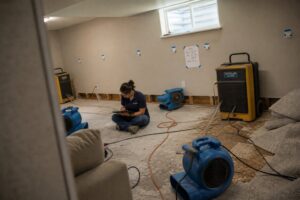
LGR dehumidification on a real South Jordan job. Filmed by our crew.
Why Hidden Atmospheric Moisture Is the Real Threat
After a water intrusion, the standing water is just the beginning. Porous building materials such as drywall (gypsum board), wood framing, and subflooring absorb moisture through capillary action and release it slowly into the surrounding air. This process drives indoor relative humidity upward — often well beyond safe levels — creating an environment where microbial growth, condensation, and material degradation begin quietly and continue long after the visible damage is gone. In South Jordan homes, this is where problems escalate. In one Daybreak townhome we responded to, a minor supply line leak had already been cleaned up before we arrived. The surfaces were dry, but the air wasn’t. Within days, the homeowner reported a faint odor. Moisture trapped inside the wall cavity had raised internal humidity levels enough to support mold colonization — something that would have continued spreading without controlled dehumidification. When indoor humidity exceeds 60%, mold spores already present in the environment can colonize organic materials within 24–48 hours. The air itself becomes the problem — saturated air slows evaporation, traps moisture inside assemblies, and allows damage to extend beyond the original source. This is why dehumidification is not a secondary step. It is the control point that determines whether damage stabilizes — or spreads into a much larger issue.The Equipment Difference: LGR Dehumidifiers vs. Store-Bought Units
Many homeowners attempt to manage moisture with standard dehumidifiers. The limitation is not just capacity — it is performance under real drying conditions. Consumer-Grade Dehumidifiers: Typically remove 30–50 pints per day under ideal conditions and lose efficiency rapidly as humidity drops below 60%. They are designed for comfort, not restoration. Commercial LGR Dehumidifiers: Our teams deploy Dri-Eaz Revolution LGR and AlorAir Storm units capable of removing 100–190+ pints per day. More importantly, they remain effective at low humidity levels, allowing drying to continue beyond surface conditions and into structural materials. South Jordan’s water supply, often ranging between 8–18 grains per gallon hardness, contains dissolved minerals that slow evaporation and leave residue within materials. LGR systems counteract this by aggressively removing water vapor while increasing ambient temperature — accelerating drying through controlled psychrometric conditions. The difference is not speed alone — it is achieving complete drying at the structural level.Our IICRC S500-Guided Dehumidification Protocol
We follow a structured, measurement-driven protocol based on IICRC S500 standards. Every stage is documented and verified. Baseline Moisture Mapping: We begin with a full assessment using FLIR thermal imaging and Protimeter moisture meters to detect hidden moisture within structural assemblies. Moisture detection services Strategic Equipment Placement: Using psychrometric calculations, we determine equipment placement to create a controlled vapor pressure differential — continuously pulling moisture out of materials and into the air. Daily Monitoring & Adjustment: Drying conditions shift as moisture levels change. Our technicians return daily to measure humidity, temperature, and material moisture content. In Glenmoor properties, especially those near irrigation-heavy zones, we frequently detect moisture rebound from slab edges, requiring targeted adjustments. Drying Verification: Drying is complete only when humidity stabilizes between 30%–50% and materials return to equilibrium moisture content (EMC). All results are verified using calibrated instruments.Where Dehumidification Meets Mold Remediation
Dehumidification is directly tied to mold prevention and remediation. Without proper humidity control, even small water losses can evolve into full-scale microbial contamination. When conditions require it, we implement containment and air control protocols as part of the drying process:- Structural Containment: Isolating affected areas using sealed barriers to prevent cross-contamination.
- Negative Air Pressure Systems: Controlling airflow direction to contain airborne particles.
- HEPA Filtration: Removing airborne particulates, spores, and contaminants from the indoor environment.
Critical Scenarios for Dehumidification in the Salt Lake Valley
- Basement Flooding: Spring snowmelt and hydrostatic pressure in expansive clay soils introduce moisture into foundation systems.
- Frozen & Burst Pipes: Freeze-thaw cycles cause failures in exterior walls and crawl spaces during winter months.
- Appliance Failures: Mineral buildup from hard water contributes to line deterioration and sudden leaks.
- New Construction Moisture Issues: In areas like Daybreak, incomplete grading and irrigation runoff often lead to early-stage moisture intrusion.
Emergency Response That Prevents Escalation
Timing is often the difference between mitigation and major reconstruction. In one South Jordan commercial property near The District, a water line failure occurred overnight. By the time staff arrived, humidity levels had already risen significantly. Our 24/7 response team deployed immediately. Within hours, we stabilized the environment using high-capacity LGR systems and air movers, preventing moisture from spreading into adjacent tenant spaces. Without that response window, the loss would have expanded into a multi-unit contamination issue involving business interruption and structural repairs. Fast response is not about convenience — it directly limits the scale of damage.Your Local, Licensed South Jordan Restoration Partner
True Day Water Damage Restoration is a locally operated firm focused on water damage mitigation and mold remediation. Our work is based on measurable results, not assumptions or surface-level drying. Our 5.0-star rating, built across 33 verified customer reviews, reflects consistent outcomes in real-world conditions — not controlled scenarios. Call us at (385) 247-9359 for immediate response.Frequently Asked Questions
How long does dehumidification take? Most projects require 3–5 days of continuous operation, depending on saturation levels and environmental conditions. What is the target humidity level? We maintain indoor relative humidity between 30%–50% to prevent microbial growth and stabilize materials. Can air conditioning replace dehumidification? No. HVAC systems cannot handle the moisture load introduced during water damage and may redistribute contaminants. Is dehumidification necessary for small leaks? Yes. Even minor leaks can introduce hidden moisture through capillary absorption, requiring controlled drying conditions.Contact Our Certified Team
Moisture that is not removed does not disappear — it spreads. Contact True Day Water Damage Restoration for a controlled, data-driven drying process backed by verifiable results. True Day Water Damage Restoration 11268 S 2865 W, South Jordan, UT 84095 Phone: (385) 247-9359 Email: info@truedaywaterdamagerestoration.xyzWhat True Day guarantees on every job
Drying in Utah’s arid climate: what the psychrometrics actually tell us
Most restoration drying guides are written for Southern or Midwestern humidity, where ambient outdoor air sits at 60–80% relative humidity. Utah is nothing like that. Outdoor RH along the Wasatch Front spends most of the year in the teens to the low thirties. That one difference changes how we set drying equipment and what the risks are.
The IICRC S500 drying standard works off grain depression — how much moisture (in grains per pound of dry air) a dehumidifier removes from the room air versus what the air already holds. In a humid-climate job, dehumidifiers do most of the work because the ambient grains are high. In Utah, outdoor air already has very low grain content, so the LGR (low-grain refrigerant) dehumidifier gets to its target faster, but you have to be more careful about a different problem: warm, dry room air hitting cold cavity surfaces behind drywall.
What that means for how we set drying equipment on a Utah job:
— Air movers are placed to push warm room air along the wet material, not into cold wall cavities. If a cavity is involved, we open the cavity and dry it directly rather than relying on indirect warming.
— We log both material moisture readings and cavity air temperature daily. A material that reads dry while the cavity air is at or near dew point will re-wet overnight.
— In winter, we may slow the dehumidifier down intentionally to keep room-to-cavity temperature differential below the condensation threshold, even if that extends the drying job by a day. Faster is not always better here.
Any crew that places equipment the same way in Utah as they would in Houston is doing it wrong. The physics is different because the air is different.
How many air movers and what size dehumidifier does your loss actually need?
Competitors rarely publish the sizing math — but it is public, written into IICRC S500 and AHAM standards. Here is how we size the equipment on arrival, and why under-equipping is the single most common reason a dry fails and mold shows up a month later.
+ 1 per affected inside wall corner
+ 1 per 10–16 linear ft of wet wall
A 400 sq ft wet basement with two inside corners and 20 ft of affected baseboard needs roughly 7–9 air movers. We adjust up for IICRC Class 3 and 4 losses (saturated materials or wet wall cavities).
LGR class: 90–180 AHAM pints/day
Industrial class: 230+ AHAM pints/day
For the same 400 sq ft wet basement at IICRC Class 2, the math points to one 130–180 AHAM-pint LGR running continuously. Larger losses or cold-cavity drying triggers a step up to the next capacity class.
AHAM nameplate vs. real-world performance
Dehumidifier capacity is rated at AHAM standard conditions (80°F, 60% RH). Real conditions are rarely those. Here’s how we size against reality, not nameplate.
AHAM vs. real conditions
| Condition | AHAM standard | Typical real condition |
|---|---|---|
| Temperature | 80°F | 65-75°F in Utah structural drying |
| Relative humidity | 60% RH | 35-55% RH (lower in winter) |
| Air exchange | Standard chamber conditions | Actual room with air mover circulation |
| Material load | No wet structure | Wet drywall, framing, subfloor releasing moisture |
Actual pint-output under real conditions
- Nameplate 150 PPD unit at AHAM: actual output ~90-110 PPD in typical Utah conditions
- Nameplate 180 PPD unit at AHAM: actual output ~110-140 PPD
- Lower temp = lower output — refrigerant-based dehu loses efficiency as air cools
- Lower RH = lower output — LGR technology mitigates this but not completely
How we size against this reality
Our sizing math applies a real-world derate factor (typically 0.6-0.8 of nameplate) to the AHAM-rated capacity. The 150 PPD unit effectively counts as 90-120 PPD for sizing purposes. This matters because sizing by nameplate alone leaves jobs under-equipped.
Signs a job was under-sized
- Drying days stretching past normal 3-5 day window on Cat 1 loss
- Dehumidifier running at 100% duty cycle continuously (no capacity reserve)
- Indoor RH stuck above target range despite continuous operation
- Protimeter readings plateauing before reaching baseline
Why vendors don’t publish derated numbers
Industry convention is to spec dehumidifiers at AHAM standard. Buyers compare specs on identical conditions. That makes commercial sense; it just doesn’t help you size for actual Utah structural drying. Experienced restoration firms apply the derate themselves — it’s part of the sizing craft.
Three dehumidifier types — and when each is actually the right one
Not every dehumidifier is the same, and the kind that works best depends on temperature, humidity, and the moisture load you’re trying to pull. Here’s the three-type matrix we use when selecting equipment for a specific job:
| Type | Best for | Not suitable for |
|---|---|---|
| Standard refrigerant (home-type, 20-40 pints/day real) | Small spot jobs; above-grade rooms at normal temperature; residential ambient 65-80°F / RH 50-70% | Basement cold temps below 65°F; large jobs; low grain-depression needed (post-drying stabilization) |
| LGR (Low Grain Refrigerant) (commercial, 90-150 AHAM pints/day) | Standard drying jobs 500-2,000 sq ft; moderate temperature; most Cat 1 and Cat 2 water losses in homes | Cold environments below 55°F; very large jobs (5,000+ sq ft); situations needing extremely dry air (desiccant territory) |
| Desiccant (truck-mounted or trailer; silica/zeolite-based) | Cold environments; large commercial losses; situations needing very low RH; drying hardwood or similarly moisture-sensitive materials; drying concrete slab moisture | Standard residential small-scope jobs (overkill, inefficient); jobs where humid exhaust can’t be vented |
How we pick for your specific job
- Measure room cubic feet, affected material load, ambient temperature and RH
- Calculate “grain depression required” (how dry the air needs to get for the material to release moisture)
- Match the dehumidifier type to the depression required at the ambient temperature
- Document the calculation on the drying plan so you can see why we chose what we chose
What the AHAM pint rating tells you (and what it doesn’t)
- AHAM rating is measured at 80°F / 60% RH — a condition that’s warmer and more humid than most drying zones
- Real-world capacity at 70°F / 50% RH is typically 50-60% of AHAM
- A “150-pint AHAM” dehumidifier usually pulls 75-90 pints/day on a real job — the 150-pint number is marketing, not operational
- We calculate equipment counts based on real-world output, not nameplate — that’s why “over-equip” isn’t us wasting your money, it’s the actual number of units required
Where desiccants come in that LGRs don’t
- Below 55°F ambient — refrigerant coils ice up and efficiency drops; desiccants work the same at any temperature
- Trying to drive air to below 30% RH for drying hardwood or stabilizing after drying — desiccants can push the RH lower than refrigerants can economically
- Large-scale commercial where the dehumidifier square-footage would exceed what multiple LGRs can achieve — one truck-mount desiccant covers 5,000-10,000 sq ft
If a company shows up with one small refrigerant dehu for a 1,500 sq ft job, that’s the wrong equipment and the dry won’t finish in standard timeline. Equipment selection is where right-sizing starts.
Where to put the dehumidifier (and why it matters more than you’d think)
A dehumidifier can be the right size and still underperform if it’s placed wrong. Placement affects how efficiently it pulls moisture from the drying zone and how well the air movers and dehu work together. Here’s the placement science:
Placement principles
- Dehumidifier intake positioned to receive the output air from the air movers — not opposite the airflow
- Centrally located in the drying zone when possible — moist air has shorter travel to reach the dehu
- Away from exterior doors or windows that may leak outside air — dehumidifier shouldn’t be dehumidifying outside air that leaked in
- Drain line routed to a legitimate drain (floor drain, utility sink, outside) — not back onto the floor
- Clearance around intake and exhaust — typically 12-18 inches minimum from any surface
- Not against a wall if the air mover is also against that wall — dead-zone of airflow
Common placement mistakes
- Dehumidifier in a closet or adjoining room — air exchange with the drying zone is poor; dehu dehumidifies an isolated space
- Dehumidifier intake pointed at the air mover — the dehu’s output goes right back into the air mover, circulating warm dry air without reaching the wet materials
- Dehu blocking the room’s natural air flow path — forces air around rather than through the drying zone
- Drain line kinked or on upward slope — dehu stops pulling water when the collection tank fills; may run idly without actually dehumidifying
- Multiple dehumidifiers close together — they fight each other for intake air; one is dehumidifying what the other just exhausted
Multi-level drying placement
- Each affected floor gets its own dehu — moist air doesn’t rise or sink efficiently between floors
- Basement dehu: positioned in the main drying zone, not in a utility room; drain to the floor drain or utility sink
- Main-floor dehu: central, away from stairwells (which exchange with other levels)
- Upstairs dehu: typically only needed if there’s an upstairs loss; most upstairs drying is handled with air movement to the main floor
Placement that signals a right-sized job
- You can see the air-flow pattern — wet materials in one direction, dehu intake in the opposite direction
- Equipment positioned with intention, not just “plugged in near an outlet”
- Drain line is routed and secured, not just coiled behind the unit
- Lead tech can explain why each piece of equipment is where it is
What you can safely do with the placement
- Nothing — let the lead tech place it, and don’t move it to make the room look less cluttered
- If you need to walk around the equipment, tell the tech so they can replan placement for your traffic path
- If you need to use a specific outlet, mention it — power load matters, and tech may need to run extension or temp power
Equipment placement is one of the pieces of a drying setup where the difference between “OK” and “right” is 1-2 extra drying days. We spend the time to place it right.
Dehumidifier drain lines — how they work + why routing matters
A commercial dehumidifier running at 90-150 AHAM pints per day can pull 7-15 gallons of water out of the air daily on a job. That water has to go somewhere. How we route the drain line is more technical than it looks, and getting it wrong can slow the drying or create a secondary problem. Here’s the detail:
- Direct drain — hose from dehu outlet to a floor drain, utility sink, or outside; water goes directly out without manual emptying
- Condensate pump — small pump on the dehu outlet pushes water uphill or horizontally longer distances to reach a drain
- Collection tank — built-in or external tank; emptied periodically by crew (usually 2-3 times per day at full output)
How we decide which to use
- Direct drain: ideal when a floor drain or utility sink is within reasonable hose run (typically within 30 feet)
- Condensate pump: necessary when drain is uphill, far away, or across obstructions; pump adds reliability concern (can fail; needs monitoring)
- Collection tank: fallback when drain isn’t accessible; requires crew visits to empty, extends drying time if emptying is missed
What goes wrong with drain lines
- Kinked hose: drain flow stops; dehu continues running but internal tank fills; eventually trips the full-tank sensor and dehu shuts off
- Blocked drain: same effect; water backs up into dehu
- Freezing drain line (if routed outside in winter): water freezes, blocks flow, same effect
- Backflow from drain: rare but can happen if drain is clogged; water flows back through the hose
- Loose hose connection: water drips at the dehu rather than flowing to the drain — creates its own small water loss
How we verify the drain is working
- Visual check at setup: run water through the hose by removing from drain and holding it over a container
- Check the dehu’s cycle count or hour meter: should match the equipment-day log
- Daily check at moisture-visit: verify water is still flowing; empty tank if applicable; look for drip signs
- If a dehu that was pulling 10 gallons/day suddenly shows a dry tank or no drain flow, there’s an issue
Where we route drain lines in a typical SJ home
- Basement job: to the basement floor drain or utility sink in the laundry area
- Main-floor job: through a doorway to a nearby bathroom tub or shower drain; sometimes through a window with a hose extension
- Multi-floor: often requires condensate pump + routing through stairwell to a lower-level drain
- Commercial: typically to a mechanical-room floor drain or dedicated condensate drain already present
Specific routing we try to avoid
- Across walkways where someone could trip on the hose
- Through doorways where closing the door would kink the hose
- To an outside location in winter without heat-tape protection
- To a drain that’s not rated for continuous water (some decorative drains are undersized)
What happens if the drain fails mid-job
- Dehu shuts off when internal tank is full (safety feature)
- Drying stalls in the dry zone while dehu is offline
- We troubleshoot: usually unkink or unblock; occasionally swap to a different drain route; worst case, swap dehu with a different unit
- Time lost to drain failure is minimal if caught at daily moisture visit; up to 24 hours if it fails between visits (why continuous monitoring data loggers help)