
Moisture detection: FLIR thermal imaging shows where water has spread behind walls and under floors, and GE Protimeter meters confirm how wet each material is. That map decides what can be dried in place. The inspection is free. Live-answered 24/7 from South Jordan, UT.
Certified Moisture Detection Services in South Jordan
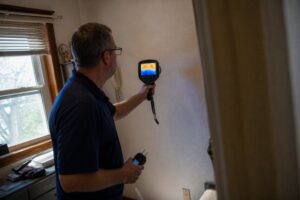
FLIR thermal imaging + moisture meter reveal on a real job. Filmed by our crew.
Moisture Behavior in South Jordan Structures
Moisture movement across the Wasatch Front is shaped by regional conditions — including freeze–thaw cycles, irrigation patterns, and expansive clay soils that retain and redistribute water. In Daybreak developments, many homes are built with tight building envelopes, spray foam insulation, and engineered I-joists. These materials improve energy efficiency but can also trap moisture internally when water intrusion occurs. Without proper detection, moisture can remain suspended within these assemblies long after surfaces appear dry. In contrast, Glenmoor and older South Jordan neighborhoods often experience moisture intrusion driven by irrigation runoff and lateral movement along slab-on-grade foundations. In these areas, we frequently detect moisture along slab edges where water accumulates and migrates inward over time. One homeowner in Glenmoor explained the situation after testing: “We kept repainting the same wall every few months. We didn’t realize the moisture was coming from below the slab.”- Mold Proliferation: Moisture trapped within enclosed assemblies supports microbial growth within 24–48 hours under the right temperature and humidity conditions.
- Structural Deterioration: Elevated moisture levels reduce the strength of wood framing and subfloor systems, particularly when repeated wet-dry cycles occur.
- Hidden Moisture Migration: Water travels laterally through materials, often extending several feet beyond the original source.
- Soil & Foundation Interaction: Expansive clay soils common in South Jordan absorb water, expand, and place pressure on foundation systems, contributing to moisture intrusion.
Diagnostic Equipment Applied in Real Conditions
Thermal Imaging Cameras (Infrared)
Thermal imaging is used to track evaporative cooling patterns — not simply temperature differences. These patterns indicate where moisture is actively moving through a structure. On a Daybreak project involving a second-story leak, thermal imaging revealed vertical moisture pathways inside the wall framing, even though the drywall surface showed only minimal staining. This allowed targeted drying instead of unnecessary demolition. Thermal imaging detects temperature variation, not moisture directly. Accurate interpretation requires distinguishing moisture-related anomalies from insulation gaps, thermal bridging, and airflow effects.Calibrated Moisture Meters
Moisture meters provide precise readings of material moisture content. In several South Jordan homes, we have recorded readings above 22% in framing that appeared visually dry — confirming that surface inspection alone is not reliable.Non-Invasive Capacitance Meters
These meters detect changes in dielectric properties beneath surfaces, allowing rapid scanning across flooring systems and wall assemblies without penetration.Thermo-Hygrometers
By measuring temperature and relative humidity, we calculate psychrometric variables such as vapor pressure differential and dew point — key factors that determine whether moisture will evaporate or remain trapped.From Detection to Action: Our Process
- Initial Assessment: Identification of visible indicators such as staining, deformation, and surface irregularities.
- Thermal Scan: Full structural scan to identify moisture pathways and anomalies.
- Moisture Confirmation: Quantitative readings taken across all affected materials.
- Environmental Analysis: Measurement of humidity and temperature conditions affecting drying potential.
- Documentation: Structured reporting for restoration planning and insurance documentation.
- Drying Verification: During structural drying, readings are tracked daily to confirm moisture reduction.
Where Moisture Actually Hides in South Jordan Homes
- Under Engineered Flooring Systems (Daybreak Homes): Moisture becomes trapped between subfloor layers and vapor barriers, spreading laterally beneath the surface.
- Slab Edges in Irrigated Properties (Glenmoor): Irrigation water saturates soil and migrates inward through foundation edges.
- Wall Cavities with Spray Foam Insulation: Moisture becomes encapsulated within sealed cavities, delaying detection.
- Ceiling Voids Below Bathrooms and Laundry Areas: Water accumulates above drywall before visible damage appears.
- Behind Tile and Wet Area Backing Materials: Moisture penetrates through grout and accumulates behind surfaces.
- Cabinet Toe-Kick Areas: Slow leaks remain hidden and allow long-term moisture buildup.
Moisture Detection in Real Estate Transactions
In South Jordan’s real estate market, moisture detection often identifies issues that standard inspections miss. During one pre-purchase assessment, elevated moisture levels were detected beneath newly installed flooring in a recently renovated home. Further testing confirmed incomplete drying from a prior water loss. The buyer later stated: “Without that inspection, we would have moved into a problem we didn’t even know existed.” This allowed the buyer to renegotiate repairs before closing, preventing significant post-purchase costs. Call (385) 247-9359 to schedule an assessment anywhere in Salt Lake County.Service Area Includes Daybreak, Glenmoor, and The District
- Daybreak
- Glenmoor
- The District
- West Jordan
- Riverton
- Sandy
Frequently Asked Questions
How do you detect moisture inside walls without cutting them open?
We combine thermal imaging with moisture meter verification to map hidden moisture with minimal invasive access.Can hidden moisture always be detected non-invasively?
In most cases, yes. Complex structures may require limited access for confirmation.I had water damage months ago. Can you still detect moisture?
Yes. Residual moisture and secondary effects such as mold growth can still be identified.Do you offer standalone moisture detection?
Yes. We provide standalone assessments separate from full restoration services.Schedule a Moisture Assessment with a Licensed Utah Contractor
Moisture does not stay where it starts. It moves through structural systems and often remains hidden until damage becomes visible. We provide the data required to identify and confirm moisture conditions before they escalate. True Day Water Damage Restoration 11268 S 2865 W, South Jordan, UT 84095 Phone: (385) 247-9359 Email: info@truedaywaterdamagerestoration.xyzWhat True Day guarantees on every job
What our daily moisture log actually looks like
Below is the layout of the moisture log you’ll receive after each on-site day. Values shown are a sample for format reference only — your real log will have your readings. Dry benchmark for each material is set from an unaffected area on day one and does not move.
| Location | Material | Benchmark | Day 1 | Day 2 | Status |
|---|---|---|---|---|---|
| Basement NE corner, floor | Carpet pad | 12% | 42% | 28% | Wet |
| Basement NE corner, wall 0–24″ | Drywall | 0.4% | 18% | 7% | Closing |
| Basement NE wall cavity | Framing stud | 14% | 26% | 18% | Closing |
| Basement center, floor | Carpet pad | 12% | 34% | 15% | Closing |
| Basement S wall 0–24″ | Drywall | 0.4% | 8% | 0.6% | At benchmark |
| Stair stringer (ambient) | Pine | 12% | 14% | 12% | At benchmark |
Equipment stays on until every row reads “At benchmark.” Your adjuster receives this log as a running document — not a bundle at the end — so there’s no scope-change surprise at closeout.
Moisture documentation beyond the insurance claim
Moisture readings documented at your job sometimes end up as evidence in situations beyond the original insurance claim. Here’s where that matters.
Scenarios where moisture documentation gets used later
- Sale of the home within a few years — disclosure requirements under Utah law. Documented remediation protects both parties on the title transfer.
- Dispute with a prior landlord after moving out — proving tenant wasn’t responsible for pre-existing moisture conditions.
- Dispute with a prior seller — proving water-event history that may have been undisclosed at purchase.
- HOA common-element dispute — proving the source was HOA plumbing, not unit-owner plumbing.
- Mold-exposure claim if you later have health issues related to a known or suspected mold source. Documentation establishes timeline.
- Insurance recoupment lawsuit — if your carrier later tries to recover from a third party (plumber who installed failed fitting, builder, manufacturer), your documentation becomes supporting evidence.
- Divorce proceedings — proving extent of damage + repair costs for property division.
What our documentation includes
- GPS + timestamp on every photo
- Protimeter readings as specific numbers (not categorical “wet” or “dry”)
- FLIR thermal images with annotation
- Daily drying log with equipment inventory + runtime
- Signed category-and-class determination by IICRC-certified tech
- Scope documentation in Xactimate format
- Final dry-verification readings matching unaffected baseline
Record retention + access
7-year retention standard. Your complete job file is accessible to you anytime by calling (385) 247-9359. We provide copies to attorneys with your written authorization. We do not share documentation with third parties without authorization.
When documentation is NOT legally bulletproof
Our documentation is strong evidence of what we observed during our job. It doesn’t prove source causation beyond what we observed, doesn’t prove health effects (physician + lab testing covers that), and doesn’t prove responsibility (attorneys argue that from the facts). We’re documenting conditions, not making legal conclusions.
Reading moisture-meter numbers (and the false-positive traps)
Moisture meters give specific numeric readings, but the number alone doesn’t mean the material is wet. The reading has to be interpreted against baseline (what dry would read), material type, and known false-positive conditions. Here’s how we actually interpret meter readings — so you understand what the numbers in your inspection report mean.
What the numbers typically mean on common materials
| Material | Dry baseline (Protimeter) | Wet threshold | Action threshold |
|---|---|---|---|
| Framing lumber (SPF) | 7-12% MC | >16% MC | >19% MC = active mitigation needed |
| Drywall | <0.5% MC on Protimeter dedicated scale | >1% MC | >1.5% MC = flood cut usually warranted |
| Hardwood flooring (oak, maple) | 6-10% MC | >12% MC | >14% MC = cupping imminent if not dried fast |
| Carpet pad (foam) | near-zero on surface | any detectable surface moisture | Pin reading penetration + visual = determine salvage |
| Concrete slab | No universal number; context-dependent | Relative humidity probe in slab is the better measure |
Common false-positive patterns
- Foil-backed insulation — pinless meters read the foil as moisture; verify with pin meter
- Metal wall studs — pinless meters read metal as wet; pin meter in nearby wood is the control
- Painted drywall with high-humidity ambient — surface reads elevated when room RH is 70%+; dropping room RH confirms it’s not wall moisture
- Mineral content in concrete — some aggregates read elevated on pinless meter but aren’t wet; use RH probe in slab
- Treated lumber (ACQ, CCA) — the chemistry of the treatment can give elevated meter reads; cross-check with a comparable untreated piece if possible
Thermal camera limitations
- Thermal cameras show temperature differentials, not moisture directly — wet areas look cooler because of evaporative cooling, but a shaded cool spot can look the same
- If the house hasn’t been at steady temp for several hours, interior temperature gradients can mimic moisture signatures
- Thermal imaging is a scanning tool to find suspect areas — meter confirmation on the suspect spot is what makes it a diagnosis
- We always verify thermal findings with moisture meter before writing them as wet
What a thorough report should show you
- Specific readings at specific locations (photographed with the meter in place, if there’s dispute potential)
- Baseline comparison — a nearby dry area’s reading as a control
- Trends over time — day-1 vs day-3 vs day-5 so the drying progression is visible
- Clear thresholds for “dry” vs “still wet” so the pass/fail is unambiguous
If your inspection report just says “moisture detected” without specific readings and locations, it isn’t documentation — it’s an impression. Our reports include the actual numbers at specific points.
Why daily moisture logs matter years after the job is done
Moisture logs look like routine documentation — a sheet of numbers from each meter reading each day. Years later, that same document can decide a sale, an insurance dispute, or even a lawsuit. Here’s what makes the log valuable long-term and what to make sure yours includes:
- Specific meter readings at specific locations — not “dry” or “OK”
- Timestamp on each reading (date + time of day)
- Technician name or initials on each entry
- Meter model and calibration date noted in the log header
- Baseline/control reading from a known-dry area, same day as the suspect reading
- Photo of meter in position for suspect readings
- Signed completion statement at the end of the drying period
Three scenarios where this matters
1. Sale of home
- Buyer’s inspector finds a stain or soft spot in a formerly-affected area
- Buyer asks about past water damage; seller discloses the job
- Buyer’s agent asks for documentation that materials returned to dry standard
- Moisture log + before/after photos is the documentation that resolves the question — sale moves forward
- Without the log: dispute, re-inspection costs, possible scope creep in the sale
2. Insurance claim dispute
- Later water event in the same area — carrier questions whether the earlier job was properly done
- “Was this fully dried before new damage occurred?”
- Moisture log shows readings at dry standard at end of job — new damage is new, not a continuation of old
- Without the log: ambiguity may allow carrier to deny or reduce the new claim
3. Mold claim or health complaint
- Occupant has health concerns months later; claims mold from previous water damage
- Moisture log shows materials returned to dry standard within standard timeline
- Combined with post-remediation verification (if mold was involved) and clearance records, provides the defense
- Without the log: harder to establish that remediation was adequate
What to ask us to include in your log
- All suspect-material readings for each day
- Baseline readings from known-dry areas on same day
- Equipment running log (which equipment, when, where positioned)
- Written notes on scope decisions (why we flood-cut here but not there)
- Photos of specific locations where readings were taken
What we keep in our records
- Complete job file including moisture log, photos, estimate, change orders, communications
- Retained for at least 7 years per our standard practice (longer for commercial jobs)
- Available on request for any legitimate request (homeowner, successor-in-interest with proof, adjuster, attorney with subpoena)
What a thorough log looks like per day
- Date and time
- Technician initials
- 5-10 specific readings at specific points (not just “room is drying”)
- Change from previous day (showing trend)
- Equipment adjustments if any
- Notes on anything unusual
Keep your copy of the moisture log in a safe place for the life of the property. If you ever need it, you’ll want it.
What you get at job completion (the moisture-report package)
At the end of a water-damage mitigation job, we deliver a complete documentation package. This is more than a “job’s done” sign-off — it’s the file you’ll want to keep for insurance records, future sale of the home, and warranty reference. Here’s what’s in it:
- Scope narrative — what happened, when, what we did, how long
- Daily moisture log — day-by-day readings at specific locations with meter model noted
- Before/during/after photos — each room, each major scope step
- Equipment deployment log — what equipment was where, how long
- Change orders (if any) — signed, dated, with reasoning
- Final moisture verification — readings at the end confirming dry-standard
- Warranty documentation — our 2-year workmanship warranty terms applied to this specific job
- Insurance scope reconciliation — estimate vs actual (if claim-involved)
How you receive it
- Email: PDF attached, standard delivery within 24-48 hours of job completion
- Printed copy: on request, printed and delivered or mailed
- Shared folder: for commercial customers or multi-stakeholder jobs
- Insurance adjuster CC: if claim-involved, same document forwarded to adjuster for file closure
What a thorough moisture log looks like
- Each day has its own entry with date and time of reading
- Technician initials or name on each entry
- Specific location readings (not just “room was checked”)
- Baseline/control readings from known-dry areas
- Trend comparison with previous days
- Notes on equipment adjustments or issues
- Final sign-off entry stating “dry-standard achieved on [date]”
Why complete documentation matters
- Sale of home 3-5 years later: buyer’s inspector finds a mark in a formerly-affected area; your documentation shows it was dried to standard
- Later water event in same area: carrier questions whether first job was done properly; log is your defense
- Mold claim or health concern: documentation supports that remediation was adequate at the time
- Warranty call years later: both parties know what was in scope and what wasn’t
What we won’t do with your documentation
- Sell or share with marketing or lead-generation companies
- Edit or alter after delivery (if there’s a correction, we send an addendum rather than reissuing)
- Delete from our files for at least 7 years (longer for commercial)
- Share with third parties without your authorization (except court subpoena or your insurance adjuster)
Getting a copy later
- Email request with your name, address, and approximate date of service — typically retrieved and emailed within 2 business days
- No charge for retrieval of your own documentation
- Third-party request (new homeowner at the address, attorney, etc.) requires written authorization or legal process
What differentiates our documentation from industry average
- Specific numeric readings (not “dry” or “OK”)
- Technician accountability on each entry
- Daily trend showing progression — not just a start-and-end snapshot
- Photos matched to the moisture log entries
- Insurance-ready format (Xactimate reconciliation)
If you’ve worked with us and want to request a copy of your job documentation, email (385) 247-9359 line or ask any of our techs. We keep this on file to help you long after the job ends.