
Structural drying: True Day sets Phoenix and Dri-Eaz air movers and LGR dehumidifiers, then takes daily moisture-meter readings until walls, floors and framing reach their drying goal under the IICRC S500 standard. Live-answered 24/7 from South Jordan, UT.
Expert Structural Drying Services in South Jordan, UT
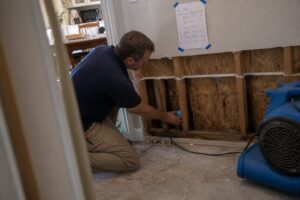
Real structural drying setup on a South Jordan job. Filmed by our crew.
Beyond Surface Dry: Tackling Moisture You Can’t See
When a pipe bursts or a water heater fails in a South Jordan home, the visible water is only the beginning. The real threat is the moisture that migrates into wall cavities, saturates subfloor layers beneath engineered flooring, and becomes trapped within framing members. Long after surfaces feel dry, this hidden moisture alters the internal moisture balance of building materials — leading to wood rot, microbial amplification, and mold colonization inside enclosed assemblies. True Day Water Damage Restoration is a locally operated, family-run South Jordan company with over a decade of hands-on mitigation experience in Salt Lake County. We are not a rotating crew or a franchise dispatch — we are the same technicians working in the same neighborhoods year after year. As an IICRC-Certified Firm (ID: 927354-5258) and licensed Utah Contractor (License: 960332-3505), we verify drying through measurable data, not assumptions. Every structure has a normal equilibrium moisture content (EMC), and our job is to return materials to that exact baseline — not just make them “feel dry.”The High Cost of “Good Enough” Drying in Salt Lake County Homes
Across South Jordan neighborhoods like Daybreak and Glenmoor, we routinely encounter properties that were “dried” using consumer equipment but never restored at a structural level. The consequences rarely show up immediately — but they always show up. Insufficient Airflow: Consumer fans circulate air but fail to create directional pressure. In newer Daybreak construction — where tighter building envelopes, dense insulation, and layered floor systems are common — moisture becomes locked inside assemblies without high-velocity airflow designed for structural drying. Inadequate Dehumidification: South Jordan’s water supply, sourced from mountain reservoirs and groundwater systems managed by the Jordan Valley Water Conservancy District, typically measures 7–10 grains per gallon in hardness with a slightly alkaline pH around 7.7–7.8. This mineral-heavy water leaves deposits inside porous materials and slows evaporation rates. Residential dehumidifiers cannot keep up with this load, especially during high humidity conditions after water intrusion. Commercial LGR systems are required to continuously extract moisture at the rate it is released. No Verification: A dry surface is misleading. Without thermal imaging and moisture mapping, framing behind drywall can remain above 18–22% moisture content — a threshold where microbial growth accelerates. This is the stage where many homeowners believe the issue is resolved, when in reality it has only been delayed.Our Scientific Drying Process for South Jordan Properties
Our drying protocol is built around real-world conditions specific to Salt Lake County — from winter freeze-thaw pipe failures to hydrostatic pressure pushing moisture into basement structures during spring runoff and irrigation cycles. Step 1: Moisture Mapping & Baseline Assessment We begin with a full structural scan using FLIR thermal imaging and Protimeter meters. In a recent Daybreak townhome, this process identified moisture migration behind cabinetry and into adjacent wall cavities that showed no visible staining. In Glenmoor properties, we often identify slab-edge moisture influenced by irrigation systems and landscaping drainage patterns. Moisture detection services Step 2: Strategic Equipment Deployment Using psychrometric calculations, we determine the exact number and placement of air movers and dehumidifiers required. The objective is balance — ensuring the rate of evaporation never exceeds the rate of moisture removal. Without this balance, moisture can redistribute deeper into structural materials instead of leaving the system. Step 3: Daily Monitoring & Adjustment Drying is dynamic. Each day, we return to measure moisture levels, compare readings to established EMC baselines, and adjust airflow patterns. In homes near irrigated zones or golf course boundaries, we often observe moisture rebound from concrete slabs — requiring targeted drying adjustments that are not obvious without data. Step 4: Drying Verification & Completion Drying is complete only when all structural materials — including wood framing, drywall cores, and subfloor assemblies — return to their documented dry standard. We provide a full drying report with logged readings, ensuring your insurance carrier has verifiable proof of proper mitigation.The Tools We Bring to Every Job Site
- High-Velocity Axial Air Movers: Create controlled laminar airflow across surfaces and within cavities to accelerate evaporation.
- Commercial LGR Dehumidifiers: Remove water vapor efficiently even under low humidity conditions common in Utah’s climate. Learn more
- Thermal Imaging Cameras: Detect hidden moisture patterns through temperature differentials caused by evaporative cooling.
- Calibrated Moisture Meters: Provide exact readings for drywall, wood, and concrete materials.
Knowing When Saturated Materials Must Be Removed
While preservation is always the goal, some materials cannot recover once saturation exceeds certain thresholds. Saturated Insulation: Fiberglass and cellulose lose structural integrity and insulating value once compressed by water. Compromised Drywall: Extended exposure weakens the gypsum core and promotes microbial contamination. Flooring Systems: Engineered flooring and laminate products frequently delaminate due to uneven moisture expansion and contraction. All necessary removal and reconstruction work is completed under our reconstruction and repair services.Serving Neighborhoods Across South Jordan and Salt Lake County
We operate locally, with direct experience in:- Daybreak (multi-story construction, modern materials, tight envelopes)
- Glenmoor (older builds, irrigation and slab moisture factors)
- South Jordan residential developments
- West Jordan, Riverton, and Sandy
Your Structural Drying Questions Answered
How long does structural drying take? Most projects take 3 to 5 days, but material density, moisture saturation, and environmental conditions can extend the timeline. What happens if drying isn’t done right? Moisture trapped inside structural materials leads to mold growth, wood decay, odor issues, and delayed structural damage that often appears weeks later. How do you know it’s truly dry? We confirm drying using calibrated moisture readings and compare results against established EMC baselines for each material type.Contact Your Licensed South Jordan Drying Specialists
Hidden moisture is the most expensive form of water damage because it goes unnoticed until it spreads. Contact True Day Water Damage Restoration for a fully monitored and verified structural drying process backed by real data. True Day Water Damage Restoration 11268 S 2865 W, South Jordan, UT 84095 Phone: (385) 247-9359 IICRC Certified Firm ID: 927354-5258 Utah Contractor License: 960332-3505What True Day guarantees on every job
What a True Day drying log actually looks like
Every drying job generates a daily record. Equipment-days have to be justified to the carrier, dry standard has to be documented before we pull equipment, and three parties (homeowner, adjuster, us) all need the same picture of what’s happening. Here is a sample sheet from a Daybreak basement extraction, anonymized but structurally identical to the one your adjuster will receive.
| Reading Point | Day 0 (initial) | Day 1 | Day 2 (today) | Dry Standard | Status |
|---|---|---|---|---|---|
| N wall drywall @ 12" | 38.2% WME | 22.4% | 15.1% | ≤16% | ✓ Met |
| N wall drywall @ 36" | 34.8% | 19.9% | 14.7% | ≤16% | ✓ Met |
| Subfloor OSB (center) | 24.1% | 16.3% | 13.2% | ≤12% | In progress |
| Baseboard framing (SW) | 28.5% | 17.1% | 14.4% | ≤13% | In progress |
| Room ambient (RH) | 82% | 54% | 38% | ≤50% | ✓ Met |
| Room ambient (temp) | 61°F | 78°F | 80°F | 70-90°F | ✓ In range |
The same log goes to the homeowner and the adjuster, every day, until the readings meet the IICRC S500 dry standard. We pull equipment on readings, not on a fixed day count — that is why some jobs finish in 3 days and some need 5. The log is what tells the difference.
What arrives on the truck, and what we can pull from the shop
The 45-minute arrival time only matters if the truck arrives with the right equipment. The response fleet is set up so the lead tech can start extraction, drying, and documentation immediately on arrival; anything specialized gets pulled from the South Jordan shop within another 30-45 minutes without stopping the job. Here is what that actually means in equipment.
On every emergency-response truck
Pulled from the South Jordan shop as needed (30-45 min follow-on)
- Additional air movers and dehumidifiers for Class 3 jobs where the truck’s complement isn’t enough.
- Hardwood floor drying mats for specialty Class 4 drying on hardwood that the homeowner wants to save.
- Hydroxyl / ozone generators for fire and smoke deodorization work.
- Specialty mold containment materials — 6-mil poly rolls, zippered flap doors, inflatable duct plugs for HVAC isolation.
- Antimicrobial supply — EPA-registered mold-specific and sewage-specific products for Category 2 and 3 scope.
- Reconstruction materials — once the job moves from mitigation to rebuild, drywall, texture, flooring, baseboard, paint arrive from the shop or supplier.
Why the setup is deliberate
A truck that shows up with the extractor but needs to go back for air movers has already lost the first 2-3 hours of drying time — and in a Category 1 loss, hours matter. The truck configuration above means every emergency call starts with extraction, drying setup, and S500 Chapter 10 inspection running in parallel from minute one on scene.
The psychrometric science behind professional drying
The IICRC S500 standard devotes its longest chapter to drying — not because the physics is complicated but because the measurements matter. Chapter 13 is the reason we calculate dehumidifier count rather than guess, read moisture at specific depths rather than feel the surface, and pull equipment on readings rather than days. Here is what the standard actually requires and why.
The three psychrometric readings on every drying job
Why dehumidifier count is a calculation, not a guess
Chapter 13 provides a formula for dehumidifier sizing based on affected area, water class, and the specific LGR dehumidifier’s rated capacity in pints per day at your drying conditions. A typical South Jordan drying job looks like this:
Class 2 moisture load ≈ 2.0 pints per hour per 100 sq ft of affected area.
Hourly load = 850 × 2.0 / 100 = 17 pints per hour.
Daily load = 17 × 24 = 408 pints per day.
Required dehumidifier capacity = 408 pints/day at the drying conditions.
A single LGR at 100 pints/day effective rating would need 4 units; a higher-capacity unit at 150 pints/day effective rating needs 3.
Equipment count on your scope is this calculation showing its work. Guessing produces either over-equipment (wasted scope line) or under-equipment (dry standard not reached in time, mold risk emerges).
Why air mover count is a calculation too
Air movers evaporate moisture off wet surfaces into the air; dehumidifiers remove that evaporated moisture from the air. The two have to be balanced — too many air movers and the dehumidifier can’t keep up; too few air movers and the dehumidifier runs with low humidity it can’t efficiently remove water from.
S500 Chapter 13 provides air-mover placement by wet linear foot of perimeter — typically one air mover per 10-16 wet linear feet of wall or floor, placed to create a vortex of air across the wet surfaces. A room with 60 wet linear feet of perimeter needs 4-6 air movers positioned at the IICRC-recommended 10-15° angle to the wall.
Dry standard — the specific MC target
| Material | Dry Standard | Meter Type |
|---|---|---|
| Drywall | ≤16% WME | Pin meter in drywall core |
| Framing lumber | ≤15% MC | Pin meter in framing |
| Subfloor OSB | ≤12% MC | Pin meter in subfloor |
| Hardwood flooring | ≤12% MC | Pin meter at specific depth |
| Carpet (face) | Dry to touch + ambient target | Non-penetrating moisture meter |
| Ambient air (drying zone) | ≤50% RH, GPP matched to outside | Thermo-hygrometer |
The three dehumidifier types we deploy — and when each one is right
"Dehumidifier" on your Xactimate scope is not one piece of equipment. There are three operating technologies, each with a specific temperature and humidity range where it performs well. On most Utah water-damage jobs we use LGR units; the other two technologies come out for specific scenarios where LGRs don’t produce the drying result we need.
LGR (Low-Grain Refrigerant)
How it works: refrigerant-cooled coil at colder temperature than a conventional dehumidifier, with a secondary heat-exchange step that condenses moisture out of air that has already been pre-dried. The result is dry output air (around 35-40% RH) and strong moisture removal even in moderately-humid rooms.
Capacity: typical commercial LGR units pull 100-150 pints per day under typical drying conditions.
Best for: most Utah water-damage drying jobs. Works effectively in the 65-90°F temperature range and down to 35% RH, which covers the drying environment we create with heaters and the airflow from air movers.
Limitation: performance drops at ambient below 60°F — the refrigerant cycle loses efficiency. We supplement with heating equipment on cold-ambient jobs (unconditioned basements, crawl spaces, winter jobs with HVAC out).
Conventional refrigerant dehumidifier
How it works: single-stage refrigerant cycle — the same technology in a home dehumidifier, just larger. Condenses moisture out of air passed across a cold coil.
Capacity: commercial units pull 60-90 pints per day under typical conditions — less than LGR per unit.
Best for: small Category 1 drying jobs where equipment-day count matters less than acquisition cost. Rarely deployed on Class 2+ jobs anymore — LGR has replaced conventional refrigerant as the industry default.
Limitation: doesn’t dry air below about 50% RH effectively, which limits how low the ambient humidity can be driven. For Class 2+ or multi-day drying, LGR is almost always more efficient per equipment-day.
Desiccant dehumidifier
How it works: air passes through a desiccant wheel (typically silica gel or lithium chloride) that absorbs moisture directly. A separate airstream regenerates the desiccant with heat, releasing moisture outside the drying space. No refrigerant cycle, so it works independent of ambient temperature.
Capacity: very high — commercial desiccant units pull 200-800+ pints per day. Trailer-mounted desiccants on large commercial losses can hit several thousand pints per day.
Best for: cold-ambient jobs where LGR efficiency drops (winter crawlspace drying, unheated basements, exterior structural drying), very low RH target scenarios (Class 4 specialty drying), large commercial losses where the pint-per-day capacity of multiple LGRs doesn’t scale, and loss events where ventilation to outdoor exhaust is practical.
Limitation: expensive to rent, requires ducted exhaust to outside, higher power draw. On most residential Utah jobs, LGR is both sufficient and more cost-effective.
Structural drying — frequently asked questions
Drying in Utah’s arid climate: what the psychrometrics actually tell us
Most restoration drying guides are written for Southern or Midwestern humidity, where ambient outdoor air sits at 60–80% relative humidity. Utah is nothing like that. Outdoor RH along the Wasatch Front spends most of the year in the teens to the low thirties. That one difference changes how we set drying equipment and what the risks are.
The IICRC S500 drying standard works off grain depression — how much moisture (in grains per pound of dry air) a dehumidifier removes from the room air versus what the air already holds. In a humid-climate job, dehumidifiers do most of the work because the ambient grains are high. In Utah, outdoor air already has very low grain content, so the LGR (low-grain refrigerant) dehumidifier gets to its target faster, but you have to be more careful about a different problem: warm, dry room air hitting cold cavity surfaces behind drywall.
What that means for how we set drying equipment on a Utah job:
— Air movers are placed to push warm room air along the wet material, not into cold wall cavities. If a cavity is involved, we open the cavity and dry it directly rather than relying on indirect warming.
— We log both material moisture readings and cavity air temperature daily. A material that reads dry while the cavity air is at or near dew point will re-wet overnight.
— In winter, we may slow the dehumidifier down intentionally to keep room-to-cavity temperature differential below the condensation threshold, even if that extends the drying job by a day. Faster is not always better here.
Any crew that places equipment the same way in Utah as they would in Houston is doing it wrong. The physics is different because the air is different.
IICRC S500 drying Classes 1–4: what size of drying job yours is
Water category (1 clean, 2 grey, 3 black) tells us how contaminated the water is. Drying class (1 through 4) tells us how big and how deep the drying job is — which drives equipment load and timeline. Both numbers get called on day one.
| Class | What it looks like | Typical drying load |
|---|---|---|
| Class 1 | Small area, minimal wet porous material (a wet corner of carpet, a soaked baseboard). Most of the room is unaffected. Low evaporation rate. | A few air movers, one dehumidifier, 1–3 day timeline. |
| Class 2 | Full-room porous material wet (whole-room carpet + pad, drywall wet up to about 24″, substantial cushion saturation). Moderate evaporation. | Multiple air movers, LGR dehumidification sized to the cubic footage, 3–5 day timeline. |
| Class 3 | Water came from above (burst upstairs pipe, overflow from a second floor). Ceilings, walls, insulation and floors all saturated. High evaporation. | Heavy air mover count, two or more LGRs, likely ceiling and insulation removal, 4–7 day timeline. |
| Class 4 | Specialty drying — low-permeability materials deeply saturated (hardwood, concrete, plaster, stone, structural wood members). Looks dry on the surface, isn’t. | Specialty drying mats, injectidry systems, extended desiccant dehumidification, 7+ day timeline. |
Your invoice is driven primarily by the class, not just the category. A Category 1 Class 3 (clean burst-pipe water saturating a whole upstairs floor) is a bigger drying job than a Category 2 Class 1 (small grey-water puddle under a dishwasher). We call both on day one and set equipment accordingly.
Reviewed by True Day’s IICRC-certified crew
Each page covering specialty work is signed off by the technicians who hold the matching IICRC credentials. Numbers below are IICRC Registrant IDs, verifiable on the public registry.
- Marcus Rivera — Lead Restoration Technician
IICRC WRT · ASD · AMRT — Registrant #246893 - Sofia Mendoza — Mitigation & Remediation Specialist
IICRC WRT · AMRT — Registrant #305127 - Daniel — Water Mitigation Technician
IICRC WRT · ASD — Registrant #274615 - Alex — Restoration Technician
IICRC WRT · ASD — Registrant #318742
Signed off: Michael Bass, Owner, True Day Water Damage Restoration · reviewed October 2026 · WRT = Water Damage Restoration Technician · ASD = Applied Structural Drying · AMRT = Applied Microbial Remediation Technician.
Need help now? Call (385) 247-9359 — live-answered 24/7. Inside South Jordan, we’re on site within 45 minutes or your emergency inspection is free.