
Water extraction: removing standing water fast is the first step in limiting damage. True Day extracts from carpet, pad, hard floors and basements, then sets drying equipment and moisture monitoring. Live-answered 24/7 from South Jordan, UT.
Emergency Water Extraction Services in South Jordan
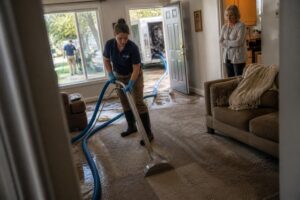
Real water extraction on a South Jordan job. Filmed by our crew.
Your Licensed & Certified Local Restoration Team
When water intrudes on your South Jordan property, the situation changes minute by minute. Liquid water spreads, humidity rises, and materials begin absorbing moisture almost immediately. The difference between controlled damage and widespread structural impact often comes down to how quickly extraction begins — and how precisely the extraction equipment is matched to the water volume, the material types involved, and the water category.
True Day Water Damage Restoration is an IICRC Certified Firm (ID: 927354-5258) and holds a Utah Contractor License (ID: 960332-3505). We follow the ANSI/IICRC S500 Standard for Professional Water Damage Restoration — applying extraction, moisture mapping, and structural drying based on real measurements, not surface conditions.
Water moves through structures via capillary action, gravity flow, and vapor diffusion. In modern South Jordan homes — especially in Daybreak developments with engineered wood systems, OSB subfloors, and tightly sealed envelopes — this movement becomes more complex. Moisture does not simply sit; it redistributes through interconnected materials and enclosed spaces, often migrating 10 to 20 feet from the visible flood boundary within the first hour.
We are located at 11268 S 2865 W, South Jordan, UT 84095, and serve South Jordan, Daybreak, Herriman, Bluffdale, Riverton, Draper, West Jordan, and the Salt Lake Valley. Call us at (385) 247-9359 for immediate dispatch.
Why Water Weight Matters — The Load Physics of Extraction
One gallon of water weighs 8.34 pounds. That number is unremarkable until you start applying it to the scale of a real flooding event. Five hundred square feet of standing water just one inch deep — a modest basement flood by Salt Lake Valley standards — represents 311 gallons and roughly 2,600 pounds of water that has to be removed before any drying can begin. A full one-inch flood across a 1,500 square foot finished basement is nearly four tons of water weight sitting on structural flooring and seeping into every porous assembly below.
This load physics determines which equipment can be deployed. Consumer wet-vacs sold at big box stores typically have 5 to 10 gallon tanks and vacuum motors rated at 1 to 3 horsepower — adequate for a kitchen sink spill, inadequate by two orders of magnitude for an actual structural flood. Our truck-mounted extraction units generate 150 to 300 inches of water-column vacuum pressure and remove hundreds of gallons per hour, with on-board waste tanks sized for industrial response. The pressure differential is what matters most: it is not just vacuum force, it is vacuum force applied with enough airflow to actually lift and carry water out of material pores and capillary networks, not just skim the surface.
This is also why extraction time matters so much. Water that is sitting on a surface at hour one can be lifted off that surface in a single pass with high-capacity equipment. Water that has been in contact with carpet, padding, and subfloor for four hours has migrated into the material matrix — and extraction at hour four removes substantially less water per pass than extraction at hour one, because much of the water has already crossed from the “free” state (gravity-removable) into the “bound” state (molecularly held). The sooner extraction begins, the less water the subsequent drying phase has to evaporate.
The First 60 Minutes: Why Immediate Extraction Changes Everything
Water damage follows predictable progression curves that are well-documented in the IICRC S500 reference literature. Understanding these curves is why True Day treats on-site arrival time as a measurable variable rather than a marketing claim.
- Minute 1 to 15: Water is almost entirely in the free state — sitting on surfaces, pooling in low spots, and beginning to penetrate the first millimeter of porous materials. This is the window of maximum extraction efficiency. Every gallon removed in these first 15 minutes is a gallon that does not have to be evaporated during the multi-day drying phase that follows.
- Minute 15 to 60: Capillary action begins drawing water into porous materials at surprising speeds. Drywall paper facing wicks water upward at approximately 1 inch per hour. Carpet padding absorbs water at near its full capacity within 30 to 45 minutes. OSB subfloor begins swelling at the surface layer. Extraction at the 60-minute mark removes less total water than extraction at the 15-minute mark because a measurable percentage has crossed the state boundary.
- Hour 1 to 4: The first signs of secondary damage appear. Baseboards begin lifting as paint seals release. Lower cabinet bases begin swelling in particle-board construction. Extraction remains essential but demolition decisions begin to enter the scope.
- Hour 4 to 24: Conditions for microbial growth build in warm, low-airflow areas. Materials saturated beyond their recoverable threshold cross into the non-salvageable category. Hygroscopic materials like drywall and insulation have absorbed enough moisture that their internal fiber structure begins to degrade. The scope of a project assessed at hour four is materially different — and more expensive — than the scope of the same project assessed at hour one.
- Hour 24 to 48: Mold spore germination becomes probable rather than possible on wet cellulose materials at room temperature. Metal fasteners, hardware, and HVAC components begin visible oxidation, especially in environments exposed to South Jordan’s mineral-rich hard water. Materials that could have been dried in place at hour one may now require removal and replacement.
This progression curve is why True Day guarantees 45-minute arrival in South Jordan in writing. The guarantee is not an abstract commitment — it is a direct response to the physics of what happens in the first hour of a water loss.
The First 48 Hours: Halting Damage in South Jordan Homes
Water damage follows predictable physical and biological patterns — but the rate of change is influenced by local conditions such as temperature, material composition, and water chemistry.
- Within 1 Hour: Hygroscopic materials like drywall (gypsum board) begin absorbing moisture through capillary action. In homes with laminated or engineered flooring, adhesives begin softening as moisture penetrates bonding layers.
- Within 24 Hours: Moisture content rises in wood framing and subfloor systems. Relative humidity increases, reducing evaporation efficiency. Metal fasteners and fixtures begin oxidizing, especially in environments exposed to South Jordan’s mineral-rich hard water.
- Within 48 Hours: Microbial activity begins. Mold spores activate in damp, low-airflow environments. At this stage, materials may cross from salvageable to non-salvageable depending on saturation levels and duration.
In one South Jordan basement flood following rapid snowmelt — common during late winter transitions when temperatures fluctuate around freezing — moisture readings exceeded 22% within a single day. Rapid extraction contained the spread and prevented damage to adjacent finished areas.
With annual snowfall in the Salt Lake Valley reaching up to 60 inches and winter temperatures frequently dropping below freezing, frozen pipe failures and snowmelt-related flooding remain among the most common water damage events in the area.
Our Extraction Equipment for Salt Lake County Properties
Effective extraction depends on both capacity and pressure differential — the ability to remove water not only from surfaces but from within material layers.
Truck-Mounted Extraction Units: These systems generate high vacuum pressure and airflow, enabling removal of hundreds of gallons per hour. Extracted water is transferred into sealed containment tanks, preventing reintroduction into the environment. This is essential for large-scale water events such as basement flooding and storm-related intrusion. The waste tanks are discharged at approved disposal sites — never into municipal storm drains or on-site soil, which would re-introduce extracted water (and whatever contamination it carried) into the environment.
Portable High-Capacity Extractors: Used where truck-mounted systems cannot reach, these units provide strong suction in upper floors, mechanical rooms, and commercial environments like The District at South Jordan. Portable extractors are also our primary tool for Category 3 (sewage) extraction, because they can be dedicated exclusively to contaminated use and decontaminated between projects — keeping clean-water and black-water equipment separate to minimize cross-contamination risk.
Specialty Extraction Tools:
- Weighted extraction systems (“water claw”): Increase contact pressure to remove water from carpet padding and subfloor interfaces. Operator weight — typically 180 to 220 pounds — is transmitted through the tool head to compress the carpet pile against the extraction slot, forcing bound water out of the padding below. Without this contact pressure, extraction removes surface water from carpet pile but leaves padding at near-full saturation.
- Hard surface extraction tools: Designed for tile, luxury vinyl plank (LVP), hardwood, and concrete surfaces. The challenge with hard surfaces is not the surface itself — it is the water that has migrated between seams, around baseboards, and under flooring assemblies into the subfloor below. Hard surface tools target these transition points directly.
- Sub-surface extraction systems: Use pressure differential to remove trapped moisture beneath flooring assemblies, often reducing demolition needs. Injection ports are set at the perimeter of a wet area, and the pressure differential pulls water out of subfloor and framing through the ports — frequently allowing LVP flooring, hardwood, or carpet to be dried in place rather than removed, when water category and saturation level permit.
Free Water vs. Bound Water — Why Extraction Alone Is Not Drying
One of the most common misconceptions in water damage is that extraction and drying are the same thing. They are not. Extraction removes free water — liquid water that is pooled on surfaces or held loosely in the voids of porous materials and can be moved by gravity or by vacuum pressure. Drying addresses bound water — water that is held at a molecular level within the fiber structure of a material and must be removed through evaporation and controlled dehumidification.
Different materials hold different amounts of bound water at saturation:
- Carpet pile: Holds water at approximately 1 to 2 times its own weight in free water (gravity-removable through extraction) plus a smaller fraction of bound water that evaporates during drying
- Carpet padding: Holds water at approximately 4 to 10 times its weight depending on padding type — far more than the carpet itself. This is why extraction protocols for flooded carpet always address the padding specifically, often requiring removal of saturated padding to allow drying of the subfloor beneath
- Drywall gypsum board: Absorbs water throughout its thickness at approximately 40 to 60 percent of its dry weight when fully saturated. The gypsum core releases water slowly during drying; the paper facing holds significantly less water but acts as a wick, drawing water upward above the visible flood line
- Wood framing (dimensional lumber): Unaffected framing in Salt Lake Valley homes typically reads 6 to 12 percent moisture content; our completion target is under 16 percent and within range of unaffected framing in the same house. Saturated wood can hold water at 30 to 60 percent moisture content. The transition from saturated back to dry equilibrium requires sustained airflow and dehumidification — extraction removes none of the bound water inside the wood fiber
- OSB and plywood subfloor: Absorb water primarily at the surface layer and at edge joints. Oriented strand board swells irreversibly when saturated — the resin bonds between strands fail, and the panel loses structural integrity even after drying. OSB saturation level often determines whether a subfloor can be dried in place or must be replaced
- Concrete and masonry: Hold water in capillary pores at approximately 2 to 5 percent of their weight. Concrete releases water slowly even under aggressive drying, which is why basement extraction projects almost always extend beyond the extraction phase into multi-day structural drying
In South Jordan, water hardness — typically ranging from 7 to 10 grains per gallon through the Jordan Valley Water Conservancy District supply — introduces dissolved minerals such as calcium and magnesium. These minerals can remain within materials after water evaporates, contributing to scaling, residue buildup, and reduced drying efficiency.
Additionally, clay-rich soils common in the Salt Lake Valley retain moisture and maintain hydrostatic pressure against foundation walls. This can lead to continued moisture intrusion even after initial extraction, particularly in basements and below-grade spaces. Without proper structural drying and dehumidification, this residual moisture can support microbial growth, material breakdown, and long-term structural damage.
The IICRC S500 Extraction Process: Our Method
- Safety & Category Assessment: Identification of electrical hazards and classification of water (Category 1, 2, or 3) to determine contamination risk. Category determines PPE requirements, extraction equipment selection, and which materials can be dried in place versus removed.
- Content Management: Relocation and protection of contents to prevent secondary damage and contamination. Contents in the direct extraction path are moved to an unaffected area or lifted and blocked to allow airflow beneath them.
- Bulk Water Extraction: Immediate removal of standing water to reduce absorption time and limit material saturation. The goal of this phase is maximum volume removed in minimum time — because every gallon removed in bulk extraction is a gallon that does not have to be evaporated during drying.
- Deep Extraction & Inspection: Repeated extraction passes combined with thermal imaging and moisture detection to identify hidden water migration. Thermal imaging reveals the actual boundary of a wet area, which is typically 10 to 30 percent larger than the visible flood line because water has migrated through capillary action in the first hour.
- Transition to Structural Drying: Deployment of air movers and dehumidifiers to remove bound moisture and restore equilibrium moisture content. The transition point from extraction to drying is defined by moisture meter readings — not by visual appearance of the surface.
Common Extraction Scenarios Across South Jordan
Water extraction projects vary significantly by water source. Each source has a distinct damage pattern that governs the extraction approach:
Rapid Snowmelt Basement Flooding
Spring snowmelt from the Oquirrh Mountains and Wasatch Range translates into weeks of elevated groundwater that drives water through foundation walls, cold joints, and failing sump pump installations. These events typically produce slow-rising, high-volume Category 1 or Category 2 water in basement spaces. Extraction scope is defined by total volume and the condition of basement finishes — unfinished basements with concrete floors allow rapid high-volume extraction; finished basements with carpet, drywall, and framing require layered extraction + demolition decisions that extend the response window.
Burst Supply Line in Interior Wall
A pressurized supply line failure releases water at full municipal pressure — approximately 60 to 80 pounds per square inch in most South Jordan neighborhoods. A half-inch supply line failure that goes undetected for one hour can release 500 to 1,500 gallons depending on the specific failure point, home layout, and whether anyone was home to shut off the water. Extraction scope is defined by water migration pathway rather than source location — water travels along the path of least resistance through wall assemblies, drops to lower floors, and pools in unexpected rooms. Thermal imaging across the entire water migration path is essential before extraction stops.
Water Heater Failure
Water heater tank failures typically release 40 to 80 gallons at once, usually in a basement or garage utility room where the heater lives. The failure mode matters: a slow pinhole corrosion leak over hours or days produces different damage than a sudden tank rupture. We assess both failure modes on arrival because the response differs — slow-leak events often have hidden moisture extending further than the visible evidence suggests.
Appliance Supply Line Failure
Washing machine supply hoses, dishwasher supply lines, and refrigerator ice-maker lines all share the characteristic of being pressurized continuously whether the appliance is in use or not. A hose failure while the family is away can produce two-floor flooding by the time anyone returns home. Extraction in these scenarios typically spans multiple rooms and floors, requires rapid moisture mapping, and often involves partial demolition to access migration paths through ceiling and floor assemblies.
Sump Pump Failure During High Water Table
Sump pumps protect basements against hydrostatic pressure from elevated groundwater. When a sump pump fails during a wet year — particularly during the April-May snowmelt peak in South Jordan — the resulting basement flooding is often substantial, because the water that would normally be pumped away is now pooling in the basement space. Extraction scope depends on how long the pump was non-functional before discovery.
Sewer Backup (Category 3 Extraction)
Sewer backups require Category 3-rated extraction equipment, full personal protective equipment for all technicians, and sealed containment to prevent cross-contamination of unaffected areas. Extracted sewage is handled as contaminated waste under Salt Lake County health regulations — not discharged into storm drains or soil. Category 3 extraction cannot be performed with the same equipment used for clean water projects without full decontamination protocols between uses. Learn more about our sewage cleanup services.
Extraction for South Jordan’s Most Common Water Issues
- Basement flooding from snowmelt and hydrostatic pressure
- Burst pipes caused by freezing temperatures in exterior walls and unconditioned spaces
- Appliance failures due to mineral scaling from hard water deposits
- Sump pump failures in low-lying or poorly drained areas
- Sewage backups requiring full containment and sanitation protocols
- Water heater tank ruptures and supply connector failures in basement utility rooms
- Supply line failures in interior walls, concealed until significant migration has occurred
- Firefighting water introduced during fire suppression — addressed concurrently with fire damage restoration
Water Extraction FAQ
How long does water extraction take?
Most residential extraction is completed within 1 to 4 hours depending on water volume and affected area size. Standing water removal typically happens in the first hour; deep extraction passes, moisture mapping, and transition to structural drying extend the total extraction phase to 3 to 4 hours on average for a typical residential event.
Can I use a wet-vac for a burst pipe?
Consumer wet-vacs lack the suction power required to remove water from structural layers and subfloor systems. A typical household wet-vac can handle a sink overflow or a toilet overflow confined to a bathroom floor. For any event involving multiple rooms, carpet, or water migration into walls or subfloor, consumer equipment is substantially inadequate — and the time spent attempting DIY extraction is time water spends migrating further into the structure.
Is water extraction covered by homeowner’s insurance?
Often, yes. Water damage from sudden and accidental sources — burst pipes, appliance failures, water heater ruptures — is typically covered under standard HO-3 and HO-5 policies. Gradual leaks or groundwater seepage may require specific policy endorsements, and your adjuster makes the final coverage decision. We provide full documentation including moisture readings and photographic evidence. Learn more on our insurance claims page.
What is the next step after extraction?
Structural drying using controlled airflow and dehumidification to remove remaining moisture. Extraction removes free water; structural drying removes bound water from the fiber structure of materials. The transition between the two phases is defined by moisture meter readings, not by visual appearance. See our restoration process page.
Will my carpet have to be removed?
It depends on water category, saturation duration, and padding condition. Clean Category 1 water removed within 24 hours typically allows the carpet to be dried in place after padding removal and replacement. Category 2 water typically requires both padding and carpet removal. Category 3 water requires removal of both plus all materials beneath them that absorbed the contamination. The decision is made on moisture meter readings and category assessment, not aesthetics.
What about hardwood or LVP flooring?
Hardwood flooring responds well to sub-surface extraction and controlled drying if addressed within 24 to 48 hours of a Category 1 water event — the drying equipment pulls bound moisture from the wood fiber through pressure differential, often allowing the flooring to be preserved. LVP (luxury vinyl plank) is more resilient to water contact but can trap water underneath, requiring edge extraction and subfloor drying. Both decisions depend on moisture readings taken on arrival.
How do you prevent cross-contamination between rooms?
Physical containment barriers (plastic sheeting with zippered access) at the perimeter of the affected area, combined with HEPA air scrubbers running in negative pressure mode. The negative pressure keeps airborne particles from migrating from the affected area to unaffected rooms. Contents moved out of the extraction zone are staged in a designated clean area, not scattered through the house.
What happens to the water you extract?
Clean (Category 1) water from truck-mounted extraction is discharged at approved sites. Category 2 and Category 3 water is managed as contaminated waste and disposed of in compliance with Salt Lake County health regulations and applicable Utah Department of Environmental Quality requirements. We do not discharge extracted water into storm drains, residential sewers (except where specifically authorized for Category 1), or on-site soil.
Can water that migrated into walls be extracted?
Partially. Sub-surface extraction with injection ports can remove free water from wall cavities and from the void between double-wythe masonry walls. Water that has absorbed into drywall paper facing or into wood framing is not extractable — it must be removed by structural drying. The decision whether to extract through small ports or remove drywall for direct access depends on saturation level and material salvageability.
Do you work directly with my insurance adjuster during extraction?
Yes. Extraction begins immediately on arrival under the standard “Duty to Mitigate” clause in most homeowners policies — which obligates the homeowner to prevent additional damage once a loss has occurred. Delaying extraction while waiting for adjuster approval can give your carrier grounds to deny coverage for the additional damage. We document all extraction with photographs and moisture readings, submit a Xactimate scope within 24 hours, and coordinate directly with your adjuster from that point forward.
What is “psychrometric assessment” and why does it matter?
Psychrometrics is the physics of water vapor in air — specifically, temperature, relative humidity, specific humidity (grains per pound of dry air), and dew point. The transition from extraction to drying requires measuring these variables on-site, because the dehumidification and air mover equipment selected has to match the actual vapor load the structure is releasing. In Salt Lake Valley summer conditions, outdoor air may carry 90 to 110 grains per pound of dry air; our dehumidification equipment is sized to pull indoor humidity down to the 40 to 55 grain range required for structural drying. Without this calculation, drying either takes significantly longer than necessary or fails to achieve full dry standard.
Can we stay in the house during extraction?
For most Category 1 clean-water events confined to a single area, yes — provided electrical safety has been verified and the extraction zone can be isolated. For Category 2 events, we recommend relocating from the affected floor during the first 24 hours. For Category 3 events, relocation from the home is standard practice until decontamination is complete. Equipment noise during extraction and subsequent drying (industrial air movers run continuously) is also a factor in the decision for most homeowners.
Call for Immediate Dispatch in South Jordan
Water does not remain stationary. It spreads through materials, increases humidity, and accelerates damage over time. Immediate extraction reduces the extent of damage and simplifies the restoration process. Call (385) 247-9359 — answered live 24/7, no voicemail, with a 45-minute arrival guarantee at South Jordan addresses.
True Day Water Damage Restoration
11268 S 2865 W, South Jordan, UT 84095
Phone: (385) 247-9359
Email: info@truedaywaterdamagerestoration.xyz
Utah Contractor License: #960332-3505
IICRC Certified Firm ID: #927354-5258
What True Day guarantees on every job
How we actually extract water on arrival
Extraction is the first thing we do and the thing that shortens every day of drying that follows. Every gallon pulled out in hour one is a gallon the dehumidifier doesn’t fight for the next three days. Here’s what we bring and the sequence we run.
The three extraction tools we use, matched to the loss
Highest vacuum pressure and continuous waste-tank capacity. Used on standing-water losses — basement flooding, large kitchen or living-room events — where volume is the bottleneck.
Carries into stairwells, upstairs rooms, and basements where the truck-mount can’t reach. Used for finish work on carpet after the bulk is pulled, and on smaller contained losses from day one.
Deployed when standing water exceeds 2 inches — think flooded utility rooms or deep basements. Pumps water out at volume before vacuum extraction starts.
Our on-arrival extraction sequence
- Safety and category assessment — electrical hazards, structural concerns, IICRC Category 1/2/3 identification. Nothing moves before this is done.
- Standing water first, if any — submersible pump deployed to pull the volume down below pump-off level. Water goes to a safe discharge point, not the storm drain for Category 2 or 3.
- Hard-surface extraction — truck-mount or portable extractor pulls water from flooring, following affected area outward.
- Carpet & pad extraction — weighted wand on the extractor compresses the pad while vacuuming. For Category 1 with fast response, this can save the pad; Category 2 or 3 requires pad removal.
- Wall-cavity extraction + drying setup — FLIR thermal imaging locates hidden moisture; GE Protimeter penetrating meter confirms. Injectidry or targeted drill-and-dry setups go in before Phoenix air movers and LGR dehumidifiers are placed.
How much water + how fast — honest numbers
A typical residential water loss produces more water than most homeowners expect. Here’s the honest gallon math and the extraction-equipment comparison.
Gallon math by loss type
| Loss type | Typical water volume |
|---|---|
| Washing machine supply hose rupture (unattended, 30 minutes) | 150-200 gallons |
| Dishwasher supply failure (full cycle) | 10-25 gallons on initial release; more if overflow continues |
| Water heater rupture (full 50-gallon tank) | 50 gallons immediate + continuous flow if supply isn’t shut |
| Upstairs bathroom overflow (unattended, 30 min) | 100-200 gallons depending on fixture |
| Burst pipe (1/2 inch supply at 60 psi, 2 hours) | Hundreds of gallons |
| Sewer backup into finished basement (storm event) | Variable; often several hundred gallons |
Extraction equipment comparison
| Equipment | Flow rate | When we use it |
|---|---|---|
| Truck-mount extraction | 150-200 gallons/hour | Primary tool for standing water above 1/4 inch |
| Portable commercial extractor | 60-100 gallons/hour | Tight spaces, under cabinets, wall cavities |
| Wet-vacs (commercial Shop-Vac type) | 5-10 gallons/hour | Final small cleanup; NOT primary extraction tool |
| Homeowner shop-vac | Less than 1 gallon/minute effective | Not rated for Cat 2 or Cat 3 water; cross-contaminates |
Why speed matters
At 200 gallons/hour on a 400-gallon loss, truck-mount extraction completes in 2 hours. The same loss with a shop-vac takes 50+ hours of continuous work — and during those 50 hours, Cat 1 water transitions to Cat 2, then Cat 3. The equipment difference literally changes what scope your insurance pays for.
Decisions we make during extraction (and what drives each)
Extraction isn’t just “suck up the water.” During the first 1-4 hours on site, we make several decisions that determine what gets saved and what has to come out. Each decision has a clear driver — and knowing what drives each one tells you how we’re thinking about your specific scope.
| Decision point | What we save | What we remove |
|---|---|---|
| Carpet pad | Clean-water loss (Cat 1), caught within 48 hours, pad lifted and tented for air flow underneath | Any Cat 2 or Cat 3 water; delaminated pad; pad past 48 hours in warm humid conditions |
| Carpet (face yarn) | Cat 1 and most Cat 2 with proper extraction + professional cleaning; Cat 2 case-by-case based on age | Cat 3 always; carpet with heavy wet-smoke contamination; carpet with pre-existing delamination |
| Flood-cut height on drywall | Drywall above the water-line + wicking height stays if dry readings confirm it’s below damage threshold | Drywall from floor to 24" standard flood-cut, 48" if wicking extended higher; higher cut if ceiling got wet |
| Insulation in wall cavity | Fiberglass batt kept if clean-water Cat 1 and air circulation can dry it in 48 hours | Fiberglass batt removed on Cat 2+ or if saturated; cellulose always replaced; closed-cell foam depends on contamination path |
| Baseboard and trim | Reusable if MDF-free and finish survived; often removed to access wall cavity and reinstalled after | MDF baseboard almost always replaced; wood baseboard with wet-smoke damage replaced |
| Hardwood floor | Dry in place if sealed finish, caught within 48 hours, no cupping has started; monitor daily | Removed if cupping, buckling, or finish failure already visible; or if Cat 2+ water sat for days |
| Subfloor (plywood) | Dry in place with air flow, confirmed below 16% MC within 5 days of drying setup | Removed if delaminated, swollen, or won’t dry to spec; Cat 3 cases almost always |
| Subfloor (OSB) | Rarely saved — OSB usually swells at seams and doesn’t recover | Replaced in most Cat 2+ scenarios; even some Cat 1 scenarios |
| Door and casing | Solid wood doors cleaned and dried; casing often reinstalled | Hollow-core doors with wicked bottom-rail replaced; MDF casing replaced if swollen |
Why we document each decision
- Your adjuster sees the moisture readings and the before/after photos — so the decision has evidence, not just an opinion
- If a decision we made is later questioned, we can show why — the reading at the time, the material condition, the time since loss
- Documentation also protects you — if we removed something that could have been saved, the readings would show it; the record forces the decision to be defensible
The written estimate shows which decisions we made and the Xactimate line items that correspond. If you want a line explained, ask — it’s your scope, you should understand it.
What we do with extraction equipment between jobs
Water-extraction equipment that went into a Cat 3 or complex job needs careful handling before it can be used on the next job. Cross-contamination from job to job is a real risk if the equipment isn’t properly decontaminated. Here’s what actually happens between jobs:
- Hoses flushed with clean water + EPA-registered disinfectant for 5 minutes
- Collection tank emptied and interior cleaned
- Filters checked and replaced if contaminated
- Exterior wipe-down with disinfectant
- Air drying before next use
- Full disassembly of hoses and wand
- Interior passages scrubbed with chlorine or quaternary ammonia disinfectant
- Filters replaced (not reused)
- Collection tank chemically disinfected + rinsed
- Equipment tagged with decontamination date; air-dried minimum 24 hours before next job
- Separate equipment pool for Cat 3 vs standard jobs on larger operations — we’re small enough that one equipment set rotates but with full between-job protocol
What this prevents
- Microbial contamination carried from one home to another via the extractor
- Odor transfer — a smoke job’s residue doesn’t get introduced to the next water job
- Health-code violations if a commercial site is served by equipment that just left a Cat 3 residential site
What our documentation shows
- Equipment decontamination log tracks which equipment was used on which job and when it was decontaminated
- Available on request for commercial customers who need to verify equipment history before letting it on-site
- Specific job types (medical, food service) sometimes require written verification of equipment decontamination between jobs; we provide this when requested
Portable vs truck-mount considerations
- Portable extractors: easier to fully decontaminate; swap-out cleaner between jobs
- Truck-mount extractors: higher capacity, but harder to fully decontaminate internal passages; takes longer between jobs
- We use portables for Cat 3 jobs when possible because the between-job cycle is faster
When equipment gets retired instead of decontaminated
- Permanent odor retention that can’t be eliminated through standard decontamination
- Mechanical issue that would compromise function on next job
- Age-related wear beyond practical repair
Why this matters for your job
- Equipment arriving at your home is cleaner than it looks — it’s been through a full decontamination since the last job
- You don’t inherit the previous customer’s contamination
- Our between-job SOP is part of why we don’t take jobs we can’t service to standard — equipment handling discipline doesn’t scale infinitely
Truck-mount vs portable extraction — which deploys when
Water extraction uses either a truck-mounted system (pump + vacuum + collection tank mounted in a service van) or portable extractors (standalone units carried into the home). The right choice depends on the loss. Here’s the decision math:
| Factor | Truck-mount preferred | Portable preferred |
|---|---|---|
| Volume of water | Large (hundreds of gallons+); whole-room or multi-room flood | Small to moderate (under 100 gallons); spot extraction |
| Distance from vehicle | Within hose-run range (typically 100-200 ft) | Interior rooms far from exterior access |
| Multiple floors | Hose-run through doorways/stairs if feasible | Carried floor to floor more easily |
| Water category | Cat 1 and Cat 2 standard; Cat 3 case-by-case (dedicated truck configuration) | Cat 3 if swap-out between jobs is easier with portables |
| Delicate access (interior stairs, tight doorways) | Hose feed may still work if cleanly staged | Compact portable fits where truck-mount hoses don’t reach well |
| Discharge path | Discharges directly to collection tank in truck; truck disposes | Discharges to collection chamber in unit; emptied periodically |
| Noise concerns | Truck engine runs during extraction — louder | Electric motor — quieter |
| Power availability | Truck is self-powered; no home circuit required | Needs 15A or 20A home circuit (check load) |
How we actually decide on arrival
- Assess water volume by extraction depth and affected square footage
- Measure hose-run distance from parked vehicle to deepest extraction point
- Check access (doorway widths, interior stairs, railings) for truck-mount hose feed
- Note any noise sensitivity (sleeping occupants, nearby office hours, pet concerns)
- Confirm available power circuits if portable will be the primary tool
- Equipment choice documented in the drying plan
Common on-site hybrid approach
- Truck-mount hose fed into the house for primary extraction
- Portable extractors used for interior rooms the hose doesn’t reach
- Both deployed in parallel for maximum extraction speed on larger losses
- Switch to full portable when truck-mount hose feed isn’t practical
What truck-mount can’t do that portable can
- Fit through tight interior doorways and corners
- Climb to upper floors without feeding hose through specific routes
- Operate in a condo or multi-family unit where truck can’t park at the right door
- Service a loss in an interior commercial space with no near-door exterior access
What portable can’t do that truck-mount can
- Keep up with large-volume continuous extraction
- Service a large open space (big-box commercial) where portable collection fills quickly
- Match the suction CFM of truck-mounted blowers
- Discharge to an on-truck tank — portables need periodic emptying
What’s actually in our truck + what portables we carry
- Truck-mounted vacuum + pump system in our service vehicle; feeds standard commercial extraction hose
- Multiple portable extractors staged in the vehicle for secondary deployment or small-scope access
- Submersible pumps for standing water above several inches depth (used alongside extraction, not separate)
- Chemical-resistant extraction wand variants for different surface types
Need help now? Call (385) 247-9359 — live-answered 24/7. Inside South Jordan, we’re on site within 45 minutes or your emergency inspection is free.