
Verify us in one click before you call
- IICRC Certified Firm #927354-5258 — search the IICRC Global Locator for “True Day”.
- Utah contractor license #960332-3505 — look it up on Utah DOPL.
- BBB — see our BBB profile.
- Insured: general liability $1M/$2M (Liberty Mutual); workers’ compensation (The Hartford).
- Technicians: Marcus Rivera (IICRC WRT/ASD/AMRT #246893) and Sofia Mendoza (WRT/AMRT #305127) hold Applied Microbial Remediation certification.
Sewage cleanup from True Day Water Damage Restoration: removal of contaminated water and materials, antimicrobial treatment, and structural drying for Category 3 (black water) losses. Owner Michael Bass is paged on every sewage call. Based in South Jordan, UT, live-answered 24/7, and billed directly to your insurer through Xactimate. IICRC Certified Firm #927354-5258.
DIY on a Category 3 sewage loss is not a cost saving.
Category 3 water — sewage, backed-up drain lines, flood water from outdoors — is a pathogen event, not a cleaning job. The IICRC S500 standard requires PPE, containment, HEPA air scrubbing, and mandatory removal of affected porous materials for a reason: this water carries E. coli, hepatitis-A, giardia, and other organisms a shop vac can’t neutralize. The savings on a self-cleaned sewage backup show up later, usually as these three bills:
We say this because we have cleaned up the second visit on jobs that could have been one visit. Call us first on anything that smells like Category 3 — even if it turns out to be Category 2, you only pay for Category 2. — Michael Bass, Owner
Our warranty at a glance
Warranty call goes to Michael Bass personally. (385) 247-9359.
2020
Sewage Cleanup Services in South Jordan, UT
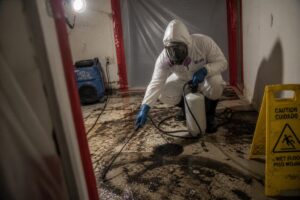 True Day Water Damage Restoration has operated out of 11268 S 2865 W in South Jordan since our founding — which means the 1300 West corridor, the Harvest Village neighborhoods, the lower levels of Daybreak homes, and the utility rooms of the homes along the Jordan River parkway are not abstractions to us. They are places we have worked, in conditions exactly like the ones described on this page, with homeowners who did not expect to need us until the moment they did. We are the restoration company that answers its own phones.
There is a particular quality to the moment a homeowner discovers sewage in their basement. It is not the same as finding standing water from a burst pipe — the smell alone communicates something the eyes take a moment longer to process. It is one of the most viscerally distressing property events a family can experience, and the instinct to do something immediately — to grab mops, to open windows, to start throwing towels at the problem — is understandable and almost universally wrong.
Raw sewage is a Category 3 black water hazard. It contains fecal coliform bacteria including E. coli, Salmonella, and Shigella; enteric viruses including norovirus, hepatitis A virus, and rotavirus; and protozoan parasites including Cryptosporidium parvum and Giardia lamblia. These pathogens are transmitted through direct skin contact with contaminated water, inhalation of aerosolized sewage droplets generated by disturbance, and hand-to-face contact with contaminated surfaces. A homeowner who enters a sewage-flooded space without proper respiratory protection and nitrile gloves is not solving a problem — they are creating a health exposure that, in some cases, has required hospitalization.
Close the door. Leave the area. Call True Day Water Damage Restoration at (385) 247-9359.
We are a licensed Utah Contractor (#960332-3505) and IICRC-Certified Firm (ID #927354-5258) based at 11268 S 2865 W in South Jordan. Sewage cleanup is one of the most technically and procedurally demanding situations in property restoration, and it is one we respond to regularly across South Jordan and Salt Lake County — including in the established neighborhoods along the Jordan River corridor where aging sewer infrastructure creates recurring surcharge events, and in the newer communities of Daybreak and Herriman where increased population density has placed growing demands on collection systems designed for a smaller service population.
True Day Water Damage Restoration has operated out of 11268 S 2865 W in South Jordan since our founding — which means the 1300 West corridor, the Harvest Village neighborhoods, the lower levels of Daybreak homes, and the utility rooms of the homes along the Jordan River parkway are not abstractions to us. They are places we have worked, in conditions exactly like the ones described on this page, with homeowners who did not expect to need us until the moment they did. We are the restoration company that answers its own phones.
There is a particular quality to the moment a homeowner discovers sewage in their basement. It is not the same as finding standing water from a burst pipe — the smell alone communicates something the eyes take a moment longer to process. It is one of the most viscerally distressing property events a family can experience, and the instinct to do something immediately — to grab mops, to open windows, to start throwing towels at the problem — is understandable and almost universally wrong.
Raw sewage is a Category 3 black water hazard. It contains fecal coliform bacteria including E. coli, Salmonella, and Shigella; enteric viruses including norovirus, hepatitis A virus, and rotavirus; and protozoan parasites including Cryptosporidium parvum and Giardia lamblia. These pathogens are transmitted through direct skin contact with contaminated water, inhalation of aerosolized sewage droplets generated by disturbance, and hand-to-face contact with contaminated surfaces. A homeowner who enters a sewage-flooded space without proper respiratory protection and nitrile gloves is not solving a problem — they are creating a health exposure that, in some cases, has required hospitalization.
Close the door. Leave the area. Call True Day Water Damage Restoration at (385) 247-9359.
We are a licensed Utah Contractor (#960332-3505) and IICRC-Certified Firm (ID #927354-5258) based at 11268 S 2865 W in South Jordan. Sewage cleanup is one of the most technically and procedurally demanding situations in property restoration, and it is one we respond to regularly across South Jordan and Salt Lake County — including in the established neighborhoods along the Jordan River corridor where aging sewer infrastructure creates recurring surcharge events, and in the newer communities of Daybreak and Herriman where increased population density has placed growing demands on collection systems designed for a smaller service population.
Why Sewage Backup Happens in South Jordan — and When
Understanding the cause of a sewage backup changes how it is classified, how the cleanup is conducted, and — critically — how an insurance claim is documented. Not all sewage events have the same origin, and the IICRC water damage classification system applies different protocols depending on the source.Municipal Sewer Hydraulic Surcharge
The North American Monsoon pattern — which generates intense, localized precipitation events across the Salt Lake Valley from early July through mid-September — is the most common trigger for the sewage backflow events we respond to in South Jordan. During these events, surface runoff and stormwater inflow overwhelm the hydraulic capacity of municipal sewer collection lines, causing the hydraulic grade line in the sewer main to rise above the elevation of the lowest connected fixtures. When sewer main pressure exceeds the level of the basement floor drain or basement toilet, sewage flows backward through those fixtures into the basement. South Jordan’s rapid residential development — which has added thousands of housing units over the past two decades in communities like Daybreak, Harvest Village, and the Oquirrh Mountain subdivisions — has increased the volume load on collection infrastructure in ways that make surcharge events more frequent than they were a decade ago.Blocked or Failing Private Sewer Lateral
The private sewer lateral is the underground pipe connecting a home’s internal plumbing to the municipal sewer main at the property line. In South Jordan’s pre-2000 construction stock — homes in established neighborhoods near 11400 South and along the 10200 South corridor — many laterals were originally installed in vitrified clay pipe, which is susceptible to root intrusion from mature landscape trees and to joint displacement from the shrink-swell cycling of the region’s expansive clay soils. A lateral that is partially blocked by root intrusion behaves normally under low-flow conditions and fails catastrophically when a washing machine, dishwasher, and shower are all discharging simultaneously. We have responded to multiple lateral-related backups in the same address in consecutive years because the lateral was cleaned — roots cleared — rather than replaced.Grease and Debris Accumulation
Fat, oil, and grease — fats introduced through kitchen drain discharge — accumulate on the interior walls of residential sewer laterals over years, progressively narrowing the effective pipe diameter. Organic debris including paper products, wipes marketed as flushable but which do not disperse adequately in water, and other non-dispersible materials compound this accumulation and eventually create a complete blockage. This type of backup typically occurs in the lowest fixtures first — a basement floor drain, then a basement toilet, then progressively higher fixtures as the blockage upstream prevents any discharge.Failed Floor Drain Trap Seal
Basement floor drains in South Jordan homes — particularly in older construction with utility rooms and water softener installations — are equipped with a P-trap water seal that prevents sewer gas from entering the living space under normal conditions. If a floor drain is rarely used, the water in the P-trap evaporates over time, breaking the seal. The result is not a sewage backup in the traditional sense but a continuous infiltration of hydrogen sulfide gas and other volatile microbial compounds from the sewer main into the basement — a condition that causes chronic respiratory irritation and musty odor and is frequently misdiagnosed as a mold problem. Pouring water into infrequently used floor drains periodically is one of the simplest and most consistently neglected maintenance steps in residential plumbing.The Pathogen Profile of Category 3 Black Water
The IICRC classifies sewage and sewage-contaminated water as Category 3 — the most hazardous classification in the ANSI/IICRC S500 Standard for Professional Water Damage Restoration — because of the diversity and concentration of pathogenic microorganisms it carries. Understanding the specific pathogens involved is not academic. It directly determines the protective equipment our technicians wear, the disinfectants we select, the dwell times we apply, and which materials must be removed versus which can be retained and treated.Fecal Coliform Bacteria
Fecal coliform bacteria — including Escherichia coli, Salmonella enterica, Shigella dysenteriae, and Campylobacter jejuni — are the primary bacterial pathogens in raw sewage. E. coli O157:H7 in particular is capable of causing hemolytic uremic syndrome in severe cases, particularly in children and elderly individuals. These organisms survive on damp surfaces for hours to days at ambient temperatures, making hand-to-face transmission through contaminated surface contact a realistic exposure pathway even after standing water has been removed.Enteric Viruses
Enteric viruses — including norovirus, hepatitis A virus, rotavirus, and enteroviruses — are shed in fecal matter and present in raw sewage at high concentrations. Norovirus is particularly concerning because of its very low infectious dose — fewer than 20 viral particles are sufficient to cause infection in a susceptible individual — and its resistance to many standard disinfectants at normal application concentrations. Hepatitis A virus can survive on environmental surfaces for weeks under some conditions. Standard household bleach at typical dilutions is not reliably effective against norovirus without specific concentration and contact time protocols that household cleaning does not achieve.Protozoan Parasites
Cryptosporidium parvum and Giardia lamblia are protozoan parasites shed in fecal matter that form environmentally resistant cysts capable of surviving standard chlorine disinfection levels. They cause cryptosporidiosis and giardiasis respectively — gastrointestinal illnesses that can be severe and protracted, particularly in immunocompromised individuals, infants, and the elderly. Standard household disinfectants are largely ineffective against Cryptosporidium oocysts. This is one of the reasons EPA-registered products specifically formulated for Category 3 remediation — applied at manufacturer-specified concentrations with required contact times — are required rather than consumer cleaning products.Hydrogen Sulfide and Ammonia
Beyond the biological hazards, raw sewage generates significant concentrations of toxic gases through the anaerobic decomposition of organic matter. Hydrogen sulfide — the compound responsible for the characteristic sewage odor — is acutely toxic at elevated concentrations, with the Occupational Safety and Health Administration setting a ceiling limit of 20 parts per million for general industry work. Ammonia, generated from the bacterial decomposition of urea in sewage, causes respiratory irritation and can be hazardous at elevated concentrations in enclosed spaces. Our technicians enter sewage-affected enclosed spaces with appropriate respiratory protection — half-face respirators with organic vapor and P100 combination cartridges at minimum — not paper dust masks.What Sewage Contamination Does to Building Materials
The material science of sewage contamination determines what can be saved and what cannot. This is not a judgment call — it is a function of porosity, the saturation depth of contamination, and the practical limitations of disinfection chemistry on porous substrates.Materials That Must Be Removed
Any porous material that has come into contact with Category 3 black water must be removed and disposed of in accordance with applicable waste regulations. This is not a conservative recommendation — it is what the ANSI/IICRC S500 standard requires, and it is grounded in the physical reality that porous materials harbor pathogenic organisms in pore spaces that topical disinfectant application cannot penetrate effectively. Materials that must be removed include:- Carpet and carpet padding — the fibrous matrix retains sewage at a concentration that cannot be reduced to safe levels through any cleaning or disinfection protocol
- Drywall gypsum board — the paper facing and gypsum core absorb sewage by capillary action and cannot be disinfected in place; the paper facing also provides a nutrient substrate for rapid mold amplification
- Fiberglass batt and cellulose insulation — both retain liquid and cannot be dried or disinfected in place
- OSB and plywood subfloor panels saturated beyond their surface layer
- Upholstered furniture, mattresses, and soft furnishings
- Cardboard, paper, and organic stored materials
Materials That Can Be Disinfected and Retained
Non-porous and semi-porous hard surfaces can be thoroughly cleaned, disinfected, and retained:- Sealed concrete and concrete block — cleaned with physical removal of all organic matter, then disinfected with appropriate EPA-registered agents
- Ceramic and porcelain tile with intact grout — thoroughly cleaned and disinfected; damaged grout creates porosity that may require regrouting before the surface can be considered adequately treated
- Metal framing, pipes, and hardware
- Glass surfaces
- Solid wood framing — when not saturated beyond the surface layer, structural framing can be cleaned, treated with EPA-registered antimicrobials, and retained; severely contaminated or saturated framing sections may require replacement
Our Sewage Cleanup Process
Step 1 — Emergency Response and Full PPE Establishment
We respond to sewage events at South Jordan addresses under our written response-time guarantee, and within 45–75 minutes elsewhere in the Salt Lake Valley depending on time of day and traffic. Our technicians arrive in full personal protective equipment — nitrile gloves, chemical-resistant boots, disposable Tyvek coveralls, safety goggles, and half-face respirators with combination organic vapor and P100 cartridges. PPE is donned before any entry into the affected space and doffed in a designated clean area to prevent cross-contamination. Equipment that enters a Category 3 environment is decontaminated before leaving.Step 2 — Scope Assessment and Containment
Before extraction begins, we establish the full extent of sewage contamination using visual inspection and FLIR thermal imaging cameras — which reveal the temperature differential of wet contaminated surfaces even beneath flooring and behind baseboards. We establish physical containment barriers at the perimeter of the affected area, and where the space geometry allows, we set HEPA air scrubbers to negative air pressure mode — exhausting filtered air from the containment zone to the building exterior to prevent aerosolized sewage particles from migrating to unaffected areas of the home.Step 3 — Sewage Extraction
All sewage and contaminated water is extracted using equipment dedicated exclusively to Category 3 use — not the same units used for clean water restoration. Extracted material is contained and disposed of in compliance with applicable Salt Lake County health regulations. We do not discharge extracted sewage into municipal storm drains or on-site soil — it is managed as contaminated waste.Step 4 — Contaminated Materials Removal and Disposal
All porous materials that contacted sewage are carefully removed within the containment zone, double-bagged in heavy-duty polyethylene bags, and transported for disposal in compliance with applicable waste handling requirements. Materials are not carried loose through uncontaminated areas of the home at any point in the removal process.Step 5 — Physical Cleaning
All remaining hard surfaces undergo thorough physical cleaning to remove all visible sewage matter before any disinfectant is applied. This step is not optional — disinfectant chemistry cannot penetrate organic biofilm to reach pathogens on the substrate surface beneath. Physical cleaning removes the protective organic layer and exposes the surface to effective disinfectant contact. We use dedicated scrubbing tools, appropriate surfactant cleaning agents, and high-pressure rinsing to achieve a physically clean surface before moving to disinfection.Step 6 — Multi-Stage EPA-Registered Disinfection
Cleaned surfaces are treated with EPA-registered broad-spectrum disinfectants formulated for the pathogen profile of Category 3 black water — including agents with label claims against fecal coliform bacteria, norovirus, and hepatitis A virus. Because protozoan cysts like Cryptosporidium resist most disinfectants, removing porous materials and thorough physical cleaning carry most of that load. Products are applied at manufacturer-specified concentrations with the contact time required to achieve the rated log reduction of target organisms. A single spray-and-wipe application is not a disinfection protocol — it is a cosmetic treatment. We apply multiple treatment passes with appropriate dwell time between applications.Step 7 — Structural Drying
After cleanup and disinfection, we deploy industrial low-grain refrigerant dehumidifiers and high-velocity air movers to bring the structural assembly back to dry standard. Residual moisture following sewage cleanup creates two compounding problems: it sustains conditions for mold amplification even on disinfected surfaces, and it maintains the humid environment in which hydrogen sulfide and other volatile sewage gases continue to off-gas from the structure. Complete structural drying — verified by calibrated moisture meter readings at all monitoring points — is required before the space is safe for reconstruction. Learn more about our structural drying and dehumidification services.Step 8 — Odor Elimination
Sewage odor is caused by hydrogen sulfide, ammonia, and a complex mixture of volatile microbial metabolites — collectively called microbial volatile organic compounds — that penetrate into porous structural materials and continue to off-gas after cleaning is complete. Surface deodorizer sprays mask these compounds temporarily. Eliminating them requires treatment technologies that penetrate into the same pore spaces where the odor compounds reside. We use thermal fogging — converting a professional deodorizing solution into a microscopic fog that penetrates wall cavities, wood grain, and subfloor assemblies — and hydroxyl generation, which produces hydroxyl radicals that oxidize and break down volatile organic odor compounds at the molecular level. Learn more about our odor removal services.Step 9 — Verification and Documentation
Following cleanup and drying, we perform a final assessment — moisture readings at all monitored points, visual inspection of all treated surfaces, and odor evaluation — to confirm the space meets the criteria for reconstruction. All phases of the cleanup are documented with timestamped photographs and a written project log provided to you and your insurance carrier.Step 10 — Full Reconstruction
With the space verified clean and dry, our licensed general contractor team (Utah License #960332-3505) performs all reconstruction — replacing drywall, insulation, flooring, baseboards, and any other materials removed during cleanup, and completing all finish work to return the space as close to pre-loss condition as the loss and your policy allow. Learn more about our reconstruction and repair services.A Sewage Event We Responded To in South Jordan
In August 2023, during an intense monsoon afternoon storm, we received a call from a homeowner on the east side of South Jordan near the 1300 West corridor and the Jordan River — an area we know well for its elevated water table and its proximity to a sewer main that has historically experienced surcharge during high-intensity precipitation. The homeowner had arrived home to find four inches of sewage standing across the entire floor plate of their finished basement. The backup had entered through the floor drain and the basement toilet simultaneously — a pattern consistent with hydraulic surcharge rather than a localized lateral blockage, because both fixtures failed at the same moment rather than sequentially. The basement was finished: LVP flooring over a wood subfloor, framed and drywalled walls, a drop ceiling, a sectional sofa and entertainment center, and a laundry area with the washer and dryer sitting in the sewage. The homeowner’s first question was whether the couch could be saved. It could not — it was upholstered, had been sitting in Category 3 black water, and could not be disinfected to any defensible standard. We established containment, entered in full PPE, and began extraction with our Category 3-rated equipment. The LVP flooring came up — it is a non-porous surface technically, but the sewage had penetrated the click-lock seams and saturated the wood subfloor beneath, which was reading 62% moisture content on our penetrating meters. The drywall came out above the flood line to the height the moisture readings called for. The drop ceiling tiles came down. The insulation came out of every framed wall cavity. Thermal imaging showed the sewage had wicked up behind the drywall on three walls to heights above the visible water line — a phenomenon we see consistently because drywall paper facing acts as a capillary wick, drawing liquid upward beyond the flood elevation. Those three walls would have been missed entirely if we had cut drywall only to the water line rather than using the thermal camera to define the actual saturation boundary. The homeowner carried a sewer backup endorsement. The full remediation and reconstruction was covered. They were back in their basement six weeks later. The thing that stayed with me from that project was the homeowner standing in the empty stripped-out space on day two, looking at bare concrete and exposed framing, and saying — quietly, not to anyone in particular — “I can’t believe this is my house.” That moment is not something you rehearse a response for. You acknowledge it. You tell them what the space is going to look like when it is done. And then you get back to work. The documentation package we provided at project close included: 47 timestamped photographs organized by phase — pre-extraction, post-extraction, post-demolition, mid-drying, and post-reconstruction; the full thermal imaging report with annotated infrared images of all three walls where capillary wicking was detected above the visible flood line; moisture meter logs showing readings at 18 monitoring points from day one through day six, with the day-six readings confirming all framing had dropped to 11–14%, under our 16% completion target; the Xactimate-format scope of work and cost estimate that was submitted to the carrier; and a written project narrative explaining the hydraulic surcharge cause, the contamination classification, the material removal rationale, and the disinfection protocol applied. The homeowner’s adjuster approved the supplemental scope — which included the three additional wall cavities identified by thermal imaging — without a physical reinspection, citing the documentation as sufficient to support the additional scope. Total approved claim: $18,340. Deductible paid by homeowner: $1,000.What to Do Before We Arrive
While our team is en route, the most important thing you can do is limit your exposure and prevent contamination from spreading:- Keep all household members and pets out of the affected area — sewage contamination on shoes and paws tracks pathogens to unaffected areas of the home
- Do not use any plumbing fixtures that discharge into the same sewer lateral as the affected area — every flush and drain discharge during an active backup adds more sewage volume to the flooded space
- Do not run the HVAC system — forced air circulation distributes aerosolized sewage particles and hydrogen sulfide gas to other parts of the house through the duct network
- Do not run exhaust fans that draw air from the affected area toward occupied areas of the home
- If the affected area has a window that can be opened safely from the exterior, opening it reduces the concentration of hydrogen sulfide in the space — but do not enter the space to open it
- Call your insurance carrier and inform them you have dispatched a professional mitigation company — most policies with sewer backup endorsements require prompt notification
- Do not attempt cleanup with household mops, sponges, or consumer disinfectants — these cannot adequately address the pathogen load in Category 3 water and will spread contamination
Sewage Cleanup Sub-Services
- Sewage Backup Cleanup — Emergency response to municipal sewer surcharge, lateral blockage, and sewer system backflows into residential and commercial properties throughout Salt Lake County.
- Toilet Overflow Cleanup — Professional assessment, sanitation, and restoration following toilet overflow events — including determination of contamination category and appropriate protocol selection based on the overflow source.
Frequently Asked Questions — Sewage Cleanup
Is sewage backup dangerous to my health?
Yes. Raw sewage is Category 3 black water containing fecal coliform bacteria, enteric viruses including norovirus and hepatitis A, and protozoan parasites including Cryptosporidium and Giardia. Exposure through skin contact, inhalation of aerosolized particles, or contact with contaminated surfaces can cause serious illness. Do not enter without proper protective equipment. Call (385) 247-9359 immediately.Why does sewage back up into South Jordan basements during summer storms?
The North American Monsoon pattern generates intense precipitation events in the Salt Lake Valley from July through September that can overwhelm the hydraulic capacity of municipal sewer collection mains — causing sewage to backflow through basement floor drains and toilets. South Jordan’s population growth has increased the load on collection infrastructure, making surcharge events more frequent in some neighborhoods, particularly those near older collection lines along the 1300 West and 11400 South corridors.Does homeowner’s insurance cover sewage backup?
Standard homeowner’s policies typically exclude sewage backup unless a sewer backup endorsement has been added. This endorsement is available from most major carriers. If you are uncertain whether your policy carries it, check your declarations page or call your agent before filing. We document all damage professionally regardless of coverage status.Can carpet and drywall be saved after sewage backup?
No. Porous materials contaminated by Category 3 black water — carpet, padding, drywall, insulation — must be removed and disposed of. The ANSI/IICRC S500 Standard requires this, and the physical reality of pathogen penetration into porous substrates makes it necessary. Non-porous hard surfaces can be disinfected and retained.Related Services
- Sewage Backup Cleanup
- Toilet Overflow Cleanup
- Water Damage Restoration
- Basement Flooding Cleanup
- Mold Remediation
- Biohazard Cleanup
- Odor Removal Services
- Air Scrubbing & HEPA Filtration
- Structural Drying
- Dehumidification
- Reconstruction & Repairs
- Sewage Cleanup — South Jordan, UT
- Category 3 — Black Water Damage
Call True Day for Emergency Sewage Cleanup in South Jordan, UT
Sewage backup is a health emergency. The time between discovery and professional response directly determines what is salvageable, what pathogen exposure has occurred, and how extensively the contamination has spread through the structure. True Day Water Damage Restoration responds within 45 minutes to South Jordan addresses under our written guarantee, and serves Daybreak, Herriman, Bluffdale, Riverton, Draper, West Jordan, and the Salt Lake Valley — in full protective equipment, with Category 3-rated equipment, and with the documentation process running from the moment we arrive. True Day Water Damage Restoration 11268 S 2865 W, South Jordan, UT 84095 Phone: (385) 247-9359 Email: info@truedaywaterdamagerestoration.xyz Utah Contractor License: #960332-3505 IICRC Certified Firm ID: #927354-5258Certified
Firm
Pay Over Time Through Wisetack — No Hit to Your Credit to Check
Insurance covers most restoration jobs. For the deductible, non-covered scope, or jobs filed out-of-pocket, True Day offers financing through Wisetack — a homeowner-friendly lender with soft-credit prequalification (checking your rate does not affect your credit score).
Your True Day project manager can prequalify you in a few minutes during the written-scope visit. Nothing to sign on the spot.
About Wisetack: loans are issued through independent lending partners. Rates and approval depend on your credit profile. Prequalification is a soft inquiry; final approval may involve a hard inquiry. True Day does not profit from or receive referral fees for financing.
What True Day guarantees on every job
Sewage cleanup FAQ
What makes Category 3 water different, what has to go, and how insurance really handles it.
What makes sewage cleanup different from regular water damage?
Is sewage water actually a health risk?
What has to be thrown away?
Will my homeowners insurance cover a sewage backup?
How much does sewage cleanup cost?
Can I stay in the house during sewage cleanup?
Keeping pets and kids safe while we’re on site
Honest guidance for what children, elderly, and pets should do (or avoid) during each phase of a restoration job.
Normal supervision — just mind the cords
No microbial risk from the water itself. Kids and pets can be in adjacent rooms while equipment runs. Trip hazards and 85 dB noise are the real risks — route air-mover cords along baseboards, close the affected room’s door when equipment is on, keep pets from chewing containment plastic.
Keep out of the affected area until decontaminated
Pathogen content is low but present. Children and immunocompromised occupants should stay out of the affected rooms until antimicrobial treatment is complete — usually day 2 or 3. Pets especially: dogs will drink from the sump pit, cats will walk through drip zones.
Strict occupant relocation from the affected zone
Full containment with HEPA scrubbers running under negative pressure. The affected area is sealed with 6-mil poly. Children, pregnant occupants, immunocompromised, and all pets should stay outside the containment until post-remediation verification clears the space.
Sensitive occupants relocate during containment-breakdown phase
Containment prevents cross-contamination during the work, but when we take the containment down at closeout, disturbed spores can briefly go airborne. Asthmatic, pregnant, immunocompromised, or very young occupants should be out of the house during the containment-breakdown day — usually 2–4 hours.
Common pet hazards during a drying job
Cats will unplug air movers (we tape cables to the floor). Dogs will drink from the sump pit or chew containment plastic. Both are attracted to the warm exhaust air from LGR dehumidifiers — trip risk if they curl up behind one. If you can confine pets to a non-affected room during drying, do it.
If anyone in your home has a respiratory condition, immune compromise, or is pregnant, tell us at the inspection. We adjust containment and scheduling to minimize their exposure. (385) 247-9359.
Sewage cleanup is not a cleaning job — it’s a containment job
Category 3 water — sewage, toilet overflow with waste, rising groundwater, flood water from outside, standing stagnant water with microbial growth — is the IICRC S500 classification that triggers specific handling because of the bioburden involved. The protocol is written for safety and non-contamination of unaffected areas, not for cleaning efficiency. Here is what the real protocol looks like.
Why "just clean it" doesn’t apply
Category 3 water contains bacteria (E. coli, Enterococcus, Pseudomonas), viruses (hepatitis A, rotavirus, enteric adenovirus), parasites (giardia, cryptosporidium), and in storm/flood scenarios can also contain fuel residues, agricultural chemicals, and industrial contaminants. Standard surface cleaning sanitizes the top layer but does not remediate materials that absorbed the water. S500 therefore requires that porous and semi-porous materials affected by Category 3 water be removed, not cleaned in place.
What has to be removed vs. what can be cleaned
| Material | Category 3 Handling |
|---|---|
| Drywall (affected to any height above waterline + 24") | Remove. Replace during rebuild. No exception. |
| Insulation (any type that got wet) | Remove. Replace during rebuild. Fiberglass, cellulose, open-cell spray foam — all removed. |
| Carpet, pad, baseboard | Remove. Standard protocol under S500 Chapter 12. |
| Subfloor OSB (if wet) | Can sometimes be saved with aggressive drying + antimicrobial if dry-standard is reached quickly. Default is removal; drying is the exception that requires documented justification. |
| Framing lumber (studs, joists) | Clean on all sides, antimicrobial, dry to S500 standard. Framing is almost never replaced for Category 3 unless it is visibly compromised. |
| Concrete slab | Clean and disinfect. Non-porous; never removed for Category 3 alone. |
| Tile and grout | Clean and disinfect. Grout may need deeper cleaning or sealing. |
| Hardwood flooring | Replace. Hardwood absorbs Category 3 contamination into end grain and under-floor assembly; drying-in-place is not S500 compliant for Category 3. |
PPE and containment required on every Category 3 scope
- P100 respirators for all technicians in the affected space (not N95 — the step up).
- Tyvek body suits with hoods and taped seams at wrists and ankles.
- Nitrile gloves double-layered.
- Boot covers or dedicated boots that stay in the work zone and are decontaminated before removal.
- Eye protection — splash-rated goggles, not standard safety glasses.
- Full containment around the work zone with poly, zippered entry, HEPA-filtered negative pressure air scrubber. Separate decontamination area at the entry for suit removal and glove changes.
- HVAC isolation — supply and return registers covered with poly before any work begins.
When we require you to leave the home
For most Category 3 jobs, we recommend temporary relocation during the active cleaning and demo phase (typically 3-5 days). For jobs with large affected areas, children or elderly in the household, immunocompromised family members, or Category 3 in a central area of the home (not an isolated basement bathroom), we require relocation. Your Coverage D (Additional Living Expense) typically pays for this; we help document the ALE justification.
Third-party clearance before reconstruction
On any Category 3 scope above about 100 sq ft affected area, we recommend third-party Indoor Environmental Professional (IEP) air sampling before reconstruction. The IEP samples air from the previously affected space with containment still up; if sample results pass, containment comes down and rebuild begins. If sample results fail, we re-clean and re-sample. The IEP relationship means the clearance is independent — you don’t have to trust us on the result; the lab reports go directly to you.
Sewage cleanup — frequently asked questions
Category 3 water is a different job. We take it.
A lot of restoration companies in Salt Lake County will show up for a Category 1 clean-water burst pipe and quietly decline a sewage backup. We don’t — we handle Category 3 water with the training, equipment, and insurance to do it correctly.
If someone else told you they “don’t do sewage” — call us. (385) 247-9359. We’ll be dispatched before you’ve finished the explanation.
Reviewed by True Day’s IICRC-certified crew
Each page covering specialty work is signed off by the technicians who hold the matching IICRC credentials. Numbers below are IICRC Registrant IDs, verifiable on the public registry.
- Marcus Rivera — Lead Restoration Technician
IICRC WRT · ASD · AMRT — Registrant #246893 - Sofia Mendoza — Mitigation & Remediation Specialist
IICRC WRT · AMRT — Registrant #305127 - Daniel — Water Mitigation Technician
IICRC WRT · ASD — Registrant #274615 - Alex — Restoration Technician
IICRC WRT · ASD — Registrant #318742
Signed off: Michael Bass, Owner, True Day Water Damage Restoration · reviewed October 2026 · WRT = Water Damage Restoration Technician · ASD = Applied Structural Drying · AMRT = Applied Microbial Remediation Technician.
The sewer-backup rider — what it actually covers
Standard Utah homeowner policies exclude sewer backup by default. Coverage requires an endorsement (rider) added to the policy, usually at an annual cost in the $40-$80 range. Here is what varies between carriers — the rider isn’t one standard product.
What the rider typically covers
| Element | Usually included | Often excluded |
|---|---|---|
| Water from sewer or drain backup | Yes, up to coverage limit | Sewage from exterior sources (floods, surface) |
| Sump pump failure water | Yes, usually bundled | Mold caused by failure past a few days |
| Damaged flooring + drywall | Yes, up to limit | Permanent landscaping, outdoor property |
| Contents damage | Yes, usually sub-limited | Jewelry, cash, collectibles over sub-limit |
| Mitigation + reconstruction cost | Yes | Upgrades beyond pre-loss condition |
Common coverage limits
Rider limits typically run $5,000, $10,000, $25,000, or policy-limit-match. The $10,000 band is most common on Utah policies. If you have a finished basement, $10,000 may not cover a full Cat 3 scope on a bad backup — $25,000 limit is often worth the extra premium if your basement has significant finish.
What to check on your policy
- Do you have the rider at all? (Declarations page lists endorsements)
- What’s the coverage limit?
- Is sump pump failure included or separate?
- What’s the deductible on this coverage? (Sometimes separate from main deductible)
- Does it cover both your line (lateral) and the city line (mainline)?
What our job is during the claim
Document the source precisely — mainline vs. lateral vs. storm-driven decides whether city or your own carrier owns the claim. Our documentation often decides a borderline claim’s outcome.
Plumber or restoration first? The sequence that matters
On an active sewage backup, the common mistake is calling the plumber first, waiting hours while they clear the line, and only then calling for cleanup. By then the Cat 3 water has sat long enough that the scope doubled. Here’s the right sequence.
The right call order
- Call both of us in parallel. You can call restoration first; we dispatch while you’re calling the plumber. The two trades work independently on different problems.
- Plumber’s job: stop the source. Clear the line, repair the break, run a camera to find the cause. Plumbing-trade work, we don’t do it.
- Our job: cleanup. Containment, extraction, discard of porous materials, antimicrobial, structural drying, reconstruction. We work on the water + damage; plumber works on the plumbing.
- Parallel timing is faster than serial. Plumber clearing the line while we extract water and set containment means both finish sooner than if we each waited for the other.
Why the mistake happens
Homeowners default to “call the plumber” because the sewage backup feels like a plumbing problem. It is — but it’s also a Cat 3 water contamination problem. Those two problems have different trades and different urgency curves. The water contamination gets worse by the hour; the plumbing is fixed when it’s fixed.
Who’s responsible for what cost
- Plumber bill: You pay, usually billed to you directly. Insurance may reimburse if source is a covered loss.
- Our bill: Billed to insurance if you have the sewer-backup rider + authorize direct billing. You cover deductible only.
- If the source is a city mainline failure: The city may be liable for your deductible and the plumber bill. We help document the source.
What if you already called just the plumber
Call us as soon as you realize cleanup is needed. The gap between plumber-arrives and we-arrive adds to the scope but doesn’t prevent cleanup. We’ll scope what’s current and get started.
When sewage reaches HVAC ductwork — what has to happen
Finished basements in Salt Lake County often have the HVAC return ducts cut right into the subfloor — grates in the floor pull air back to the furnace. When a sewer line backs up in that basement, Category 3 water pours straight into those returns and into the ductwork plenum. This is a specific scenario that changes the whole scope of the job.
How we assess HVAC contamination
- Scope of contamination: we open the plenum, pull the furnace blower cover, and check the inside of the first 10 feet of each duct run — residue, standing liquid, odor
- Return side vs. supply side: contamination usually starts on the return side (that’s where the floor grate was) and may or may not have reached the supply side depending on how long the system ran
- Material: flex duct that got wet is almost always replaced — the mylar inner lining and the fiberglass insulation hold contamination you can’t clean out; sheet-metal duct can usually be cleaned and sanitized in place
What a full HVAC decontamination involves
- Remove and discard all contaminated flex duct, boots, and air filters
- Mechanical cleaning (brush-and-vacuum with HEPA negative pressure) of sheet-metal runs
- Antimicrobial fogging of the entire system per IICRC guidelines
- New filter installed; blower wheel cleaned or replaced depending on condition
- Written confirmation of what was cleaned, what was replaced, and visual before/after photos
Our GC license 960332-3505 covers ductwork replacement scope under general contracting; we work with HVAC-licensed partners for anything that affects the furnace itself (gas lines, blower motor, control board). The homeowner is told clearly what we handle in-house and what gets referred out.
Septic-system homes: what changes on a sewer backup
Most Salt Lake County homes are on municipal sewer, but older properties in the valley foothills and some larger-lot areas are on septic systems. The sewage-backup response is the same inside the house — but outside, the diagnosis and clearance process is very different.
- Verify the home is on septic (if the owner isn’t sure, we check for a riser or inspection port in the yard)
- Call a septic contractor to inspect the tank level and the drain field — our scope doesn’t include tank pumping
- Common cause patterns: full tank needing pumping, drain-field saturation (post-storm, over-use), damaged or crushed inlet/outlet baffle, roots in the lateral
- Tank gets pumped and system assessed before any attempt to clear the house line — otherwise clearing the house line just backs up again
Access coordination issues specific to septic
- Tank inspection ports and lids can be buried under landscaping, pavers, or decking that’s gone in since the system was installed — locating them can take time
- Drain-field saturation after a wet spring is common — the field needs time to dry before the system can handle normal flow
- In older homes, the exact tank location may not be in county records — probing or hand-digging to find it may be required
What we tell septic-home owners up front
- House-side cleanup (what we do) can be completed, but the system issue has to be resolved by the septic contractor before plumbing can be used normally again
- If drain field is the issue, use of the home’s plumbing may be restricted for days after our interior work is complete
- Septic contractor’s work is a separate scope that may or may not be covered under your homeowner’s policy — it depends on cause (sudden failure, root damage, physical damage usually covered; wear-and-tear usually not)
Well-water complications
- Homes on septic are often also on well water — and a backing-up septic field can contaminate a well if they’re close enough
- If your home is on both septic and well, we recommend a well water test after the backup is resolved and the system is cleared
- Water testing is referred to a Utah DEQ-certified lab — we don’t do the lab work ourselves
If you’re on septic and you suspect a backup, mention it on the first call. Our dispatch changes slightly — we come with the containment and PPE a Cat 3 needs, and we coordinate with your septic contractor rather than assuming the city has a line crew on the way.
Who owns which part of the sewer line (and who pays for what)
When a sewer backup happens, the question of “whose line failed” matters because it decides whose insurance and whose repair budget covers the damage downstream. The split between homeowner responsibility and city responsibility isn’t the same in every Salt Lake Valley city — but there’s a general pattern.
Homeowner responsible: everything from inside the house to the connection at the city main. This includes the house’s internal plumbing, the sewer line running under your yard (the “lateral”), and the cleanout at the property line.
City/municipal responsible: the main sewer line in the street, lift stations, pump stations, and treatment plant infrastructure.
Shared / sometimes-ambiguous: the saddle or wye connection where your lateral ties into the city main; cleanouts in the public right-of-way.
What this means for a specific backup scenario
- Blockage in the house: homeowner’s problem; standard plumber fix; homeowner’s insurance (with a backup rider) may cover resulting water damage
- Blockage in the lateral (your yard): homeowner’s problem; plumber scopes with a camera; sometimes root removal, sometimes lateral replacement. Can be expensive if excavation is needed
- Blockage in the city main downstream of your connection: city’s problem; municipality’s responsibility for the clear-up; your homeowner’s insurance (with a backup rider) typically covers the water damage inside your home even though the cause was municipal
- Clay or crushed older lateral: homeowner’s responsibility to replace, even if roots or settling caused the damage; some cities have grant or loan programs for lateral replacement
How we figure out which it is on your job
- Multi-fixture test on arrival to confirm it’s not just one toilet or one branch line
- Plumber camera-scope through the lateral — shows the blockage location, root intrusion, or structural failure
- Call to the city if the camera shows the blockage is downstream of your cleanout — city crew comes out and verifies on their side
- Documentation of the camera footage and the determination — part of your insurance claim file
When the city is responsible, what to expect
- City doesn’t pay for the damage inside your home — your homeowner’s insurance does (if you have the backup rider)
- City typically pays for the clean-up and repair of its own line, not your yard or inside
- Some cities have a sewer-backup claim process for damage caused by city-line failure — worth asking your city’s public works office if you have a confirmed municipal failure
- Documentation of city responsibility matters for your insurance subrogation (your carrier may try to recover from the city)
Backflow preventer connection
- A backflow preventer on your lateral protects your home from backups originating in the city main
- Doesn’t help with blockages that are inside your house or your lateral
- Discussed in detail on the sewage-backup page in the earlier “Backflow preventer” block
Utah city sewer systems in our service area (characteristics affecting backups)
Different cities have different sewer system characteristics that affect how sewage backups happen and how municipal response works. Here’s a honest overview of the cities we serve:
Primarily newer infrastructure (last 25-30 years). Low-pressure sewer in some newer developments; gravity-fed in most. Peak-flow handling generally good; occasional backups during heavy rain + runoff events. Service dispatch via city public works typically same-day for emergencies.
Mostly newer infrastructure (last 20 years as the city has grown). Some older sections in central Riverton with aging clay or cast-iron laterals. Backups typically from private-lateral issues more than main-line failures. Public works response reasonable.
Mix of older and newer sections. 1980s-90s subdivisions have aging infrastructure; recent subdivisions newer. Significant growth area; occasional capacity issues during storm events. Standard municipal response.
Newer city, newer infrastructure. Peak-flow handling has been expanded as the city has grown. Occasional issues at pump stations serving the elevation differences.
Mix of older east-bench sections and newer west-side development. East-bench has older infrastructure; aging clay laterals common on 1970s-80s properties. Suncrest + newer sections have modern infrastructure.
Mostly newer. Some older rural-adjacent properties are on septic rather than municipal sewer — always confirm before assuming municipal.
Older infrastructure in east Sandy (1970s-80s originals); newer in west Sandy. Clay sewer laterals aging on older properties. Occasional capacity events during peak runoff.
Significant portion is pre-1970 infrastructure. Clay + cast-iron laterals common. Main-line failures in some older areas. SLC Public Utilities operates separately from Salt Lake County; different response patterns.
Davis County infrastructure; primarily newer. Mostly good peak-flow handling.
Mix of ages. Foothill drainage affects both storm + sewer during peak events.
Common patterns across cities
- Private lateral (homeowner-owned portion) is more often the backup source than city main
- Clay laterals (older homes) are more failure-prone than PVC
- Root intrusion in older laterals is a recurring issue
- City mains fail from infiltration during heavy rain, pump station issues, or specific blockages
- Backflow preventers on private lateral prevent city-main backups from entering homes
What municipal sewer response typically looks like
- Call to city public works line; dispatched usually within an hour for active backup
- Camera + jetting for private laterals usually requires private plumber if the lateral is yours
- City-main investigation typically involves camera inspection + possible repair work
- Cost of city-side work covered by city; private-lateral cost covered by homeowner (unless specific city subsidy program)
What our scope is vs city’s scope
- We: cleanup inside the home after the backup
- City: clearing + repairing the main sewer line in the street
- Plumber: clearing + repairing your private lateral
- You coordinate all three for a complete response
Insurance patterns by city
- Water-backup rider recommended regardless of city — because standard homeowner policies exclude sewer backup across all carriers
- Some cities have specific disaster programs for repeat-event areas — worth asking your city public works
- FEMA flood policy may apply if backup is from flood water (vs plumbing failure)
Public utility contacts (as of writing — verify current)
- South Jordan Public Works: contact via SJ city website
- Riverton Public Works: contact via Riverton city website
- West Jordan Public Works: contact via WJ city website
- SLC Public Utilities: separate agency; distinct contact
- Davis County cities: county-level infrastructure info available
Call (385) 247-9359 for the house-side cleanup when a sewer backup happens. We coordinate with the city for main-line issues + plumber for private-lateral issues on your specific job.
Septic system vs city sewer — scope and sequence differ
Most of our service area is on city sewer, but some outlying homes run septic systems. The restoration scope for a backup from each is different enough that it changes dispatch:
| Phase | City sewer backup | Septic backup |
|---|---|---|
| First call | True Day for cleanup; city line crew only if the issue is in the city main | Septic pumping company FIRST to clear the tank/field; True Day after the system is pumped |
| Why the order | Backup usually resolves when the trap or lateral is cleared; cleanup can start immediately | Cleanup over a full septic tank just re-fills the lower drains; the tank must be pumped first |
| Classification | Cat 3 (grossly contaminated) | Cat 3 (grossly contaminated) |
| Remediation protocol | IICRC S500 Cat 3 — remove and dispose of porous materials, decontaminate hard surfaces, verify dryness | Same S500 Cat 3 protocol — but tank-pumping records go in the file alongside our scope |
| Permit implications | Rare; permit usually only for rebuild phase | If drain field is compromised, septic repair triggers Utah county health department involvement |
| Final verification | Dry readings + visual + optional spore sample | Dry readings + visual + spore sample + septic company sign-off that system is functioning |
If you don’t know whether your home is on city sewer or septic: check your water bill. City sewer appears as a line item; septic doesn’t. Older rural lots in the dispatch area are the most common septic homes.
When sewage becomes mold — the crossover timeline
Sewage (Category 3 water) carries active microbial content from the first minute. Unlike a Cat 1 water loss, mold is not a 48-hour risk — it is often an immediate scope component. Here is the honest timing:
Sewage in your home right now? Stop using sinks, toilets, and appliances, keep everyone out of the area, and call (385) 247-9359 — live-answered 24/7. Michael Bass is paged on every sewage call.
In South Jordan? Inside city limits we’re on site within 45 minutes, 24/7, or your emergency inspection is free. Michael Bass is paged on every sewage call.
Sewage cleanup by city
| City | Arrival |
|---|---|
| South Jordan | 45-minute guarantee |
| Riverton | 45–75 min target |
| West Jordan | 45–75 min target |
| Herriman | 45–75 min target |
| Bluffdale | 45–75 min target |
| Draper | 45–75 min target |
| Sandy | Call for an arrival estimate |
| Salt Lake City | Call for an arrival estimate |
| Cottonwood Heights | Call for an arrival estimate |
| Syracuse | Call for an arrival estimate |
One number for every city: (385) 247-9359, live-answered 24/7.
Sewage cleanup — quick answers
What should I do first when sewage backs up?
Stop using all water in the house, keep everyone away from the area, and call (385) 247-9359. Don’t try to clean it with household products.
Which areas do you serve for sewage cleanup?
South Jordan, Riverton, West Jordan, Herriman, Bluffdale, Draper, Sandy, Salt Lake City, Cottonwood Heights, Syracuse and Daybreak, from our office in South Jordan.
How fast can you get here?
Inside South Jordan city limits, within 45 minutes or your emergency inspection is free. Riverton, West Jordan and Herriman are a 45–75 minute target; elsewhere the dispatcher gives you an estimate on the call.
Can anything be saved after a sewage backup?
Hard, non-porous items can usually be cleaned and disinfected. Carpet, pad, drywall and insulation that sewage soaked into are removed.
Is the inspection free?
Yes. The inspection is free, with no obligation, and you get a written estimate before work starts.
How to choose a sewage cleanup company
- Check the license: Utah DOPL contractor lookup. Ours is #960332-3505.
- Check IICRC firm certification. Ours is IICRC Certified Firm #927354-5258.
- Ask who will do the work — employees or subcontractors? Ours are four W-2 technicians.
- Expect PPE and containment on arrival, not just a wet-vac.
- Get a written, itemized estimate before work starts.
- Ask about insurance billing. We bill carriers directly in Xactimate.
Sewage under the house: crawlspace leaks
A cracked or disconnected drain line under the house can leak sewage into a crawlspace for weeks before anyone notices — usually first as a smell in the rooms above.
- Don’t crawl into a space with sewage in it.
- Call a plumber to repair the line.
- We remove contaminated soil covering and insulation, clean and treat the framing, and dry the space.
Renters and landlords: who calls, who decides
If you rent
Tell your landlord or property manager right away, in writing (a text or email with photos is fine). Keep out of the affected area. Your landlord’s policy usually covers the building; your renters policy may cover your belongings — check it, and keep receipts if you have to stay somewhere else.
If you own the rental
You can call us directly at (385) 247-9359. We work with your tenant on access, document the damage for your insurer, and bill your carrier directly in Xactimate. The inspection is free.
Who pays for what depends on your lease and policies. We can explain what we see on site, but we’re not attorneys — for lease questions, check with your property manager or a Utah landlord-tenant resource.
Sewage backups in businesses and multi-unit buildings
The Category 3 protocol is the same in a shop, office or apartment building as in a basement: containment, removal of contaminated porous materials, antimicrobial treatment and structural drying. What changes is the coordination.
- We section off the affected area so the rest of the building can stay open where it’s safe to do so.
- We document every unit or suite separately for the property manager and each insurer.
- Owner Michael Bass is paged on every sewage call.
Live-answered 24/7 at (385) 247-9359. More on commercial water damage and multi-family restoration.
Is it sewage or storm water?
| What you see | Likely source | How we treat it |
|---|---|---|
| Water coming up through a floor drain, toilet or tub, often dark, with a sewage smell | Sewer line backup | Category 3 (black water): containment, PPE, removal of porous materials |
| Water coming in through window wells, a foundation crack or under a door after heavy rain | Surface or ground water | Treated as Category 3 once it has crossed soil and outside surfaces |
| Clear water from a burst supply line or water heater | Clean water (Category 1) | Can usually be dried in place if caught early |
Floodwater from outside and sewage are both handled as contaminated water under the IICRC S500 standard. Clean water left standing can also degrade into a higher category over a day or two.
Not sure? Call (385) 247-9359 — live-answered 24/7, and the inspection is free.
What happens to your belongings after a sewage backup
- Porous items that soaked up sewage — carpet and pad, upholstered furniture, mattresses, cardboard boxes, paper and most clothing that can’t be laundered hot — are usually discarded. They can’t be reliably disinfected.
- Hard, non-porous items — metal, glass, sealed plastic, many hard furniture pieces — can usually be cleaned and disinfected.
- Everything is documented first. We photograph and list what is removed so you have an inventory for your insurer.
- Keepsakes and documents: tell us what matters most before work starts so we can set it aside and talk through options.
More on contents cleaning and pack-out.
City sewer main or your own line? Quick clues
| Clue | Points toward |
|---|---|
| Neighbors are backing up too, or a street manhole is overflowing | The public sewer main |
| Only your home, and the lowest drains back up when you run water upstairs | Your private sewer lateral |
| Backup started during or right after a heavy storm | Either — storms can overload the main or expose a weak lateral |
These are clues, not a ruling. A plumber with a sewer camera can confirm where the blockage is, and the city decides responsibility for the public main. Whatever the cause, the cleanup protocol is the same and it shouldn’t wait — document everything with photos.
Not sure? Call (385) 247-9359 — live-answered 24/7, and the inspection is free.
Sewage cleanup in every South Jordan neighborhood
All of these are inside South Jordan city limits, so our 45-minute arrival guarantee applies: if we miss it, your emergency inspection is free.
What South Jordan homeowners say
“Called for emergency water damage services and was surprised how fast they responded. Crew showed up ready and started extracting water immediately.”
— James Scott, Santorini Village · Google review
“I was impressed with how quickly they arrived. They worked efficiently and left everything clean and dry.”
— Serene Langley, Wheadon Acres · Google review
“The crew arrived on time and immediately began restoring the damaged areas with care.”
— Maya Chandler, Wheadon Acres · Google review
“True Day Water Damage Restoration did an amazing job drying out my home after a leak. They were thorough, respectful, and kept me informed every step of the way.”
— Blakely Glass, Lampton Farms · Google review
“Great customer service and high-quality restoration. I would definitely use them again if needed.”
— Katherine Tremblay, Daybreak · Google review
5.0 stars from 41 Google reviews. See all reviews →