
Flooring removal and replacement from True Day Water Damage Restoration: carpet, pad, hardwood, and laminate, scheduled after drying. Based in South Jordan, UT and serving the Salt Lake Valley — live-answered 24/7 at (385) 247-9359. IICRC Certified Firm #927354-5258, Utah license #960332-3505.
Flooring Removal & Replacement After Water Damage in South Jordan, UT
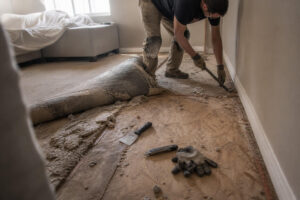
Flooring is one of the first casualties of water damage and one of the most important to address correctly. Water-saturated flooring traps moisture against the subfloor, prevents structural drying, harbors mold, and in many cases cannot be effectively dried without removal. At the same time, not all flooring must be replaced — experienced assessment can save materials that a less thorough approach would write off unnecessarily.
True Day Water Damage Restoration is a licensed Utah Contractor (#960332-3505) and IICRC-Certified Firm (ID #927354-5258), based at 11268 S 2865 W in South Jordan. We handle complete flooring removal and replacement throughout Salt Lake County. Call us at (385) 247-9359.
Why Flooring Removal Is Often Necessary
Flooring traps moisture against the subfloor in a sealed assembly that industrial drying equipment placed above cannot effectively reach. Water that penetrates beneath flooring — through click-lock seams in luxury vinyl plank, through grout joints in tile, through the fiber matrix of carpet — is effectively sealed from evaporation in both directions. The only way to dry the subfloor is to remove the flooring and direct airflow across the exposed subfloor surface.
Carpet padding retains water like a sponge even after professional extraction — holding moisture in the foam or fiber matrix at concentrations that cannot be reduced to safe levels without physical removal. Padding that feels relatively dry at the surface may be retaining moisture sufficient for mold amplification in the sealed space between pad and subfloor. Padding must be removed and replaced in virtually every water damage situation regardless of how quickly the event was discovered.
Oriented strand board subfloor panels — the engineered wood panel product used as structural subfloor in the majority of South Jordan’s post-1990 residential construction — absorb moisture readily through the resin-bonded wood fiber composite. OSB at elevated moisture content swells, potentially delaminates at the face layers, and creates an ideal substrate for mold germination in the dark, low-ventilation environment beneath flooring. When flooring is removed, we always assess and test the OSB subfloor before installing new flooring — an OSB subfloor reading above its dry standard of 10% to 14% will damage new flooring installed over it as moisture transfers upward.
Flooring Types — Behavior and Salvageability
Carpet and Carpet Padding
Carpet padding: always removed. Carpet surface: may be salvageable from Category 1 clean water if extracted quickly — Category 2 or 3 contamination requires replacement. The fibrous matrix of carpet retains contaminants at concentrations that cannot be reduced to safe levels by any cleaning or disinfection protocol applied to carpet that remains in the home.
Hardwood Flooring
Solid hardwood absorbs water and expands unevenly — causing cupping (edges higher than center), crowning (center higher than edges), and buckling (boards lifting from the subfloor) as moisture content changes. The equilibrium moisture content of Douglas fir and other species used in South Jordan residential construction is 12% to 19% in this climate zone; flooring reading above this range after water exposure has undergone dimensional change. Hardwood exposed briefly to clean water and dried quickly may be salvageable after sanding and refinishing. Hardwood that has buckled significantly or been wet for extended periods typically requires replacement.
Laminate Flooring
Laminate’s high-density fiberboard core absorbs water rapidly and swells — separating click-lock joints, bowing panels, and in most cases requiring complete replacement. The photographic surface layer may remain visually intact while the structural core has failed. Laminate flooring almost never survives significant water damage.
Luxury Vinyl Plank (LVP)
The vinyl surface layer is waterproof, but water seeps through click-lock seams and penetrates the subfloor beneath — which may be thoroughly saturated while the vinyl surface appears undisturbed. LVP removal to access and dry the subfloor is frequently necessary even when the vinyl itself could technically be retained. New adhesive or underlayment requirements make reuse impractical in most cases.
Ceramic and Porcelain Tile
Tile is waterproof but grout is porous. Water enters through grout joints and saturates the mortar bed and substrate beneath the tile, where it is sealed in by the tile surface above. Tile removal to access the subfloor is often necessary despite the tile itself being undamaged.
Subfloor Assessment and Replacement
Following flooring removal, we inspect and calibrated-meter test the subfloor at multiple points. Swollen, delaminated, or structurally compromised OSB panels are replaced. Structural framing is assessed for moisture and integrity. New flooring is never installed until moisture meter readings confirm the subfloor has reached the dry standard appropriate for the flooring type — preventing the new flooring from absorbing subfloor moisture and developing the same problems as the original. In Daybreak’s post-2006 I-joist floor system construction — where the floor-ceiling assembly between levels includes I-joists with web openings that allow moisture migration between levels — we address the full assembly rather than only the subfloor surface.
- Does carpet need to be removed after water damage?
- Not always, but frequently. Category 2 or 3 water contact always requires removal. Category 1 contact may permit in-place drying if under 24 hours and OSB inner fiber is below ~35%. Carpet backing blocks OSB evaporation from industrial dehumidification when left in place over heavily saturated subfloor.
- Can hardwood flooring be saved?
- Sometimes. Solid hardwood with moderate cupping and no mechanical compression damage at tongue-and-groove joints can be dried and refinished. Engineered hardwood with face veneer separation cannot be restored through drying. Assessment requires penetrating meter readings at the core layer and visual inspection of each plank.
- Is flooring replacement covered by homeowners insurance?
- Yes. Flooring removal, installation, and finish work are included in the reconstruction scope under a covered HO-3 water damage event.
Learn more about our structural drying, moisture detection, and reconstruction services.
True Day Water Damage Restoration | 11268 S 2865 W, South Jordan, UT 84095 | (385) 247-9359 | Utah Contractor License: #960332-3505 | IICRC Firm ID: #927354-5258
What True Day guarantees on every job
How we save a hardwood floor that got wet (and when we can’t)
Hardwood is the most expensive flooring material in most Utah homes, which means saving it on a water loss has disproportionate value — a 500 sq ft hardwood floor replaced costs $10,000-$18,000, while specialty drying typically runs $2,500-$5,000. The decision whether hardwood can be saved comes down to specific readings and technique. Here is how it actually works and when it doesn’t.
Why hardwood is hard to dry
Solid hardwood floors absorb water from the top down. The surface finish seals most moisture out, but once water finds a seam or an unfinished edge, it penetrates into the wood below. From underneath, water enters through the plank joints as it travels across the subfloor. Air-mover drying from above has limited effect — the surface finish prevents moisture from escaping upward. Standard carpet-and-pad drying technique doesn’t apply.
The specialty drying technique
Floor drying mats + vacuum pull. A hardwood-specific drying mat (looks like a stiff plastic grid) seals against the floor surface with a vacuum pump pulling continuously. The mat creates negative pressure under the gasket seal, pulling moisture out of the floor through the plank seams and finish pores — upside-down drying rather than top-down evaporation.
Combined with LGR dehumidification running in the room to control ambient humidity. Mat count scales with affected area: typically 2-4 mats per 100 sq ft of wet hardwood.
What the readings have to show
- Day 1 initial reading: penetrating pin meter through the plank at measured depth. Starting MC often 25-40%+ on fully wet boards.
- Day 2 check: readings should drop at least 3-5 percentage points. If they haven’t, the mat seal is leaking or the moisture source hasn’t been fully addressed.
- Days 3-5: steady decline toward dry standard. Dry standard for hardwood is typically ≤12% MC per IICRC S500.
- Days 5-7: dry standard reached; mats removed; final readings documented.
When specialty drying works
- Category 1 clean water (supply-line leak, water-heater failure caught early).
- Discovery within 48 hours — before significant cupping or crowning has set in.
- Finish is intact (polyurethane or similar). Older waxed finishes don’t take vacuum well.
- Subfloor beneath is dry or minimally wet (we may still need to dry the subfloor separately from below).
- No water trapped under finished basement areas below.
When specialty drying doesn’t work (and the floor must be replaced)
- Category 2 or 3 water. Contamination into the wood grain cannot be remediated through drying alone.
- Severe cupping (edges raised more than ~2 mm above the plank center) — the wood has already deformed past the point where drying restores flatness.
- Crowning (plank center raised above the edges, after extended wet period) — permanent deformation.
- Buckling or separation — the planks have lifted off the subfloor completely.
- Water that entered from below (basement finish, slab-on-grade with wet subgrade). Vacuum-mat drying works top-side but not when water keeps coming from below.
- Engineered hardwood with a wet HDF/plywood core — the engineered layer absorbs water and doesn’t release it fast enough for mat drying. Many engineered hardwoods are replaced rather than specialty-dried.
- Wax finish or old-type polyurethane finish — mat gasket can’t achieve seal.
Flooring replacement after a water loss — what each material actually involves
Flooring is almost always the largest single line item on a water-damage reconstruction scope. The timeline, the cost, and the match-to-existing-floor question all vary significantly by material. Here is what the install actually looks like for each common Utah flooring type.
Carpet + pad
Timeline: 1-2 days once scheduled. Materials usually available next-day from Utah flooring suppliers.
Install: New pad stapled to subfloor. Tack strips re-nailed around perimeter. Carpet rolled, stretched with knee-kicker and power stretcher, trimmed at walls, seamed where multiple widths meet, hot-glued at seams. Transitions tacked at doorway thresholds.
Match question: if only one room’s carpet was damaged, matching an older carpet exactly is often impossible — manufacturers change styles yearly, dye-lots vary, and 3+ year-old carpet has faded from the current product. Insurance typically approves replacement to a "like kind and quality" standard; the scope lines up with current retail of a comparable product. If matching across rooms matters, you can usually negotiate replacing the whole continuous carpeted area with a single matching run.
Luxury vinyl plank (LVP)
Timeline: 2-3 days. Materials usually in stock at Utah LVP suppliers for popular styles; special-order can add a week.
Install: Subfloor confirmed flat (any high spots sanded, low spots filled). Underlayment if required for the specific LVP product. Click-lock planks installed starting from a reference wall, staggered seams, cut at obstacles. Floating install (not fastened to subfloor); expansion gap maintained at walls. Transitions and T-moldings at doorways.
Match question: for click-lock floating LVP, we often save and reinstall the undamaged planks from the loss area, replacing only the damaged pieces. This matches perfectly because the planks came from the same original run. For glue-down LVP, planks almost always have to be fully replaced in the affected area, and matching to an older install depends on manufacturer availability.
Hardwood
Timeline: 1-3 weeks depending on acclimation time and finish method. Solid hardwood needs to acclimate in the home for 3-7 days before install.
Install: Subfloor flat. Vapor barrier or moisture-cure barrier if required. Planks nailed into subfloor through the tongue. Random-length layout with staggered seams. Transition pieces at thresholds. Pre-finished vs. site-finished: pre-finished is faster (install, done); site-finished requires sanding, staining, and 3 coats of polyurethane with cure time between coats.
Match question: matching replacement hardwood to existing is the hardest match in flooring. Species, cut, finish, and age all matter — a brand new oak plank next to a 10-year-old oak plank reads different in color even if the species and cut are identical. Options: (a) weave new boards into the existing floor in a feathered pattern (works for small-area replacement, requires skilled installer); (b) replace the full room (looks correct, costs more); (c) dye-match the new boards to the aged color (works for some species, requires specialty finisher). Carrier usually approves (a) or (c) for small areas, (b) for larger areas or where the loss affects multiple visible areas.
Tile
Timeline: 3-5 days including grout and sealant cure. Tile install itself is 1-2 days; grout and cure add the rest.
Install: Subfloor prepared with cement backer board or decoupling membrane. Thin-set mortar applied, tile set, spacers for grout line. Cure 24 hours before grout. Grout applied, cleaned up, cure 24 hours. Sealant on grout for showers and heavy-moisture areas.
Match question: if the original tile is still in production, direct match is usually possible. If it’s discontinued, we match the closest current option or you can choose to replace the whole continuous tile area (bathroom floor, backsplash) with a current product.
Laminate
Timeline: 2 days. Materials usually in stock.
Install: Similar to LVP floating install. Click-lock planks over foam underlayment. Expansion gap at walls. Transitions at doorways.
Match question: laminate styles change frequently; matching older product is often impossible. Carrier usually approves replacement of the full room area so there’s no visible seam.
How we save carpet after a water loss — and when we don’t
Carpet is the most common affected finish on a Utah water-damage call, and the decision whether to save the face carpet is a specific one with real stakes — replacement is a substantial scope line, and most carpet has sentimental or specific-style value beyond cost alone. Here is how we actually make the save/replace call on carpet.
The two separate decisions
Carpet is technically two components: the carpet face (the visible layer you walk on) and the pad underneath. Each gets its own decision. In most Utah water losses the pad is always replaced; the face carpet is sometimes saved.
Carpet pad — almost always replaced
Pad holds water that LGR dehumidifiers cannot recover through the carpet surface. Attempted dry-in-place of a wet pad produces a pad that remains partially saturated for weeks, which drives mold growth in the pad itself and pulls moisture back into the carpet above it. IICRC S500 standard treats pad replacement as the default on any absorbed-water loss. The exception is a tiny Category 1 contained drip caught within hours and limited to a few square feet.
New pad is a routine scope line and material cost is small compared to carpet face. The decision to replace pad is almost automatic.
Carpet face — the real decision
| Condition | Face carpet decision |
|---|---|
| Category 1, under 48 hours | Save face carpet. Lift, dry on the pole, replace pad underneath, reinstall carpet with new seams if needed. |
| Category 1, 48+ hours dwell | Case by case. Dwell past 48 hours moves toward Category 2. Carpet with visible delamination or jute-backing degradation is not savable. |
| Category 2 (grey water) | Usually replace. S500 allows cleaning if dwell was very short and specific decontamination is performed, but replacement is more common. |
| Category 3 (black water) | Always replace. No exception under S500. |
The save-the-carpet technique
- Lift the carpet off tack strips. Starting at one corner, pull the carpet back carefully to expose the pad and subfloor underneath. Fold carpet back on itself in sections rather than removing it from the room entirely.
- Remove and discard pad. Cut into manageable sections, bag, dispose.
- Clean and treat the subfloor. Extract any residual water, apply antimicrobial on Category 2+, dry subfloor to standard.
- Clean the back of the carpet. Carpet backing (jute, synthetic) collected debris and water. We vacuum and treat the back before the carpet goes back down.
- Lay new pad. Standard 6-pound or 8-pound rebond pad, stapled to subfloor. New tack strips installed if existing are degraded.
- Reinstall carpet. Stretch with knee-kicker and power stretcher. Re-seam any locations where the lift required a cut. Re-trim at walls.
The whole technique takes about 1-2 days for a standard room, done after the drying phase is complete. The carpet face is cleaned (dry extraction + hot-water extraction depending on soiling) before reinstallation.
When saved carpet still looks or feels different afterward
Saved carpet is sometimes slightly different afterward — minor color shift from drying, texture change on wool or specialty synthetics, visible seam lines where re-seaming was needed. Our save-rate target is "unchanged to the naked eye after cleaning," and we achieve that on most Category 1 jobs. If the saved carpet looks worse than the surrounding unaffected area after cleaning and reinstall, we document it at walkthrough and discuss replacement options as a supplement. "Saved" doesn’t mean the homeowner has to accept a visibly inferior result.
Flooring removal and replacement — frequently asked questions
Dry it in place, or tear it out? The IICRC S500 decision.
Every wet material in your home gets one of two verdicts. The difference between a right call and a wrong call is thousands of dollars of avoidable rebuild cost — in either direction. These are the standard-of-care rules we work from.
| Material | Dry in place when… | Tear out when… |
|---|---|---|
| Carpet | Dry in place if the water is Category 1 (clean), caught in the first 24 hours, and extraction + air mover + dehumidifier can reach a dry benchmark within 72 hours. | Tear out if water is Category 2 or 3, if the pad is saturated and compressed, or if drying stalls above the dry benchmark after 72 hours. |
| Carpet pad | Almost never. Pad holds water, cannot be sanitized reliably, and is cheap to replace relative to the mold risk of keeping it. | Tear out in nearly every real loss. Pulling and replacing pad while keeping the carpet is standard IICRC practice for Category 1 jobs. |
| Drywall | Dry in place if the wet height is under 24 inches, Category 1 water, no visible sagging, and in-wall moisture clears to benchmark within the drying window. | Flood cut (remove the bottom 24 inches) if the water is Category 2/3, insulation behind is wet, drywall is sagging, or benchmark isn’t reached. |
| Wall insulation | Fiberglass batt almost never dries acceptably in a wall cavity. | Tear out wet batt insulation as a matter of course when drywall is opened. |
| Hardwood floor | Dry in place is possible for engineered hardwood or solid hardwood with specialized drying mats, if caught in the first few hours and water is Category 1. | Replace if water sat more than ~24 hours, if cupping/crowning is visible beyond cosmetic, or if subfloor delamination has started. |
| Cabinets & vanities | Dry in place if only the toe-kick is wet and MDF structure is intact. | Replace if MDF has swelled or delaminated, or if sewage/Category 3 water contacted food-prep surfaces. |
A restoration crew that tears everything out, every time, is maximizing their invoice. A crew that dries everything in place, every time, is risking a mold callback. The right answer is material-by-material, measured on day one and re-measured daily — which is why our moisture logs are a daily deliverable, not a closing-day report.
What dries in place vs. what has to come out
The IICRC S500 Standard — and your water category (1/2/3) and class (1-4) — decides what flooring is salvageable, not what the contractor prefers. Here is how it actually breaks down by flooring type.
| Flooring type | Cat 1 (clean water) | Cat 2 (gray water) | Cat 3 (black water) |
|---|---|---|---|
| Carpet + pad | Carpet may dry in place; pad must be replaced (holds water, degrades) | Carpet can often be cleaned + dried; pad discarded | Both discarded per S500 |
| Laminate | Rarely salvageable — swells irreversibly even in Cat 1 | Discarded | Discarded |
| LVP / LVT (click-lock) | Often salvageable; pulled up to dry subfloor, re-laid | Pulled up, cleaned, re-laid if planks intact | Discarded (porous backing contaminated) |
| Engineered hardwood | Depends on cupping/crowning — may dry with mats | Usually discarded (adhesive breakdown) | Discarded |
| Solid hardwood | Specialty drying (floor mats, injection) often works | Case-by-case; may discard | Discarded |
| Tile (ceramic/porcelain) | Dries in place; grout may need sealing | Dries in place with sanitization | Tile stays, grout evaluated case-by-case; subfloor beneath often discarded |
What always comes out, regardless of flooring
The subfloor if it’s particleboard or OSB that got wet past 24 hours (swells irreversibly). Plywood subfloor may dry in place if caught early. Any underlayment foam or cork that absorbed Cat 2 or Cat 3 water. We moisture-test subfloor with a GE Protimeter penetrating-pin meter before signing off — the dry standard is EMC equilibrium with unaffected areas, not a visual “looks dry.”
Choosing replacement flooring + what to expect
If flooring has to come out and be replaced, the decision isn’t just “same thing again.” This is the moment you can upgrade or downgrade. Here’s what each path involves.
Replacement decision framework
| Choice | What it means for your claim |
|---|---|
| Like-kind, like-quality (same material + grade as what was there) | Fully covered by insurance (minus deductible) |
| Upgrade (nicer material or higher grade) | Insurance pays the equivalent of like-kind; you pay the upgrade delta |
| Downgrade (cheaper material) | Insurance pays the like-kind rate; you don’t receive the price difference back — carrier benefits |
Timeline by material
| Material | Install time (typical room) | Walk-on time |
|---|---|---|
| Carpet + pad | Half-day | Immediate |
| LVP / LVT (click-lock) | Half-day to full day | Immediate |
| Laminate | Full day | Immediate |
| Engineered hardwood | 1-2 days | 24 hours (acclimation) |
| Solid hardwood | 2-3 days | 48 hours (sanded + finished on-site) |
| Tile | 2-3 days | 24-48 hours after grout cure |
What usually gets upgraded on water-damage reconstruction
- Laminate replaced with LVP (better water resistance for ~$1-2/sf more)
- Carpet pad upgraded from 6# to 8# density (longer life)
- Hardwood replaced with engineered hardwood in moisture-prone areas (kitchen, basement) — same look, better water tolerance
Choosing color + style when the old flooring is gone
If flooring was removed before you saw it, we photograph the removed material + save samples when possible. Local suppliers have most popular Utah-market flooring in stock; special-order materials (specialty hardwood species, imported tile) can add 2-4 weeks to the overall timeline.
Transitions between rooms
If only one room is being replaced, we handle transition strips between new and existing flooring. Mismatched colors between adjacent rooms are a cosmetic consideration; often homeowners choose to replace adjacent-room flooring at their own cost for a continuous look.
Subfloor: dry it in place, or cut it out?
When flooring comes up because of water damage, the subfloor underneath has to be assessed too. Some subfloors can be dried in place with air movers and dehumidifiers. Some have to be cut out and replaced. The call depends on three things: subfloor material, how long it was wet, and whether contamination was involved. Here’s how we decide.
| Subfloor type | Dry in place if… | Must be removed if… |
|---|---|---|
| Plywood (3/4" CDX typical) | Clean-water loss, less than 72 hours wet, no delamination, no visible warping, MC drops to <16% within 5 days of drying | Any Category 3 water; delamination (plies separating); permanent warping or cupping; MC won’t come down in 5 days |
| OSB (oriented strand board) | Clean-water loss, less than 48 hours wet, no visible swelling at edges, MC drops to <16% within 5 days | Any swelling at the seams (OSB rarely recovers once swollen); any Category 3 water; MC won’t drop |
| Particleboard | Rarely — particleboard absorbs water, swells, and generally doesn’t recover | Almost always — particleboard underlayment that got wet usually gets replaced |
| Concrete slab | Clean-water loss on a slab — dry in place with surface air movement and dehumidification; moisture testing by calcium chloride or RH probe before new flooring installed | Deep cracks that passed Category 3 water underneath; slab moisture won’t come down to flooring-manufacturer spec |
Why we test moisture at the end, not just the beginning
- Manufacturers of new flooring (LVP, engineered wood, carpet, tile) all have maximum subfloor MC and RH specs for warranty — usually ≤12% MC for wood subfloor, ≤75% RH on concrete
- If we don’t verify we’re under those numbers, the new flooring may fail (cupping, buckling, adhesive failure) within months and the warranty won’t honor it
- We give you the moisture-test readings in writing before the new floor goes down — so the flooring contractor and the manufacturer have what they need
If we cut out and replace subfloor, we match the original material and thickness. Different subfloor thicknesses create height differences at transitions that are hard to hide; using the original thickness avoids that.
Specific flooring types + how we respond to each when wet
Flooring material changes everything about the response: what can be dried in place, what has to come out, how long the dry takes, and what the replacement scope looks like. Here’s the honest matrix per common flooring type:
| Flooring type | Can it be dried in place? | What determines salvage |
|---|---|---|
| Solid hardwood (3/4" nail-down) | Often yes, if caught within 48 hours and if minimal cupping has started | Age; moisture content under boards; whether species is prone to crowning (oak crowns slowly; maple fails faster); whether finish is sealed or oil-based |
| Engineered hardwood (floating) | Case by case; the plywood core delaminates when wet, so often replaced | How long wet; whether seams swelled; whether planks separated at tongue-and-groove |
| Carpet (wall-to-wall, Cat 1 loss) | Yes, after thorough extraction — pad usually replaced | Age of carpet; whether backing swelled; whether Cat 1 degraded to Cat 2 before extraction |
| Carpet (Cat 2 or Cat 3 loss) | Pad always removed; carpet usually removed on Cat 3 | IICRC S500 standard: Cat 3 carpet is removed, period; Cat 2 is case-by-case |
| LVP (Luxury Vinyl Plank, click) | Yes — usually pulled up, dried, re-laid | Mostly straightforward; subfloor underneath needs checking |
| LVT (Luxury Vinyl Tile, glue-down) | Usually not — adhesive bond fails when wet underneath | Usually replaced; subfloor needs full drying and new adhesive |
| Laminate (click-together with HDF core) | Rarely — the HDF core swells permanently when wet | Almost always replaced; even light moisture can swell planks beyond recovery |
| Porcelain or ceramic tile | Yes — the tile itself is waterproof; grout is porous but dries | Subfloor and backer-board underneath; crack-free tiles that stay bonded are fine |
| Natural stone (marble, slate, travertine) | Yes — stone itself is minimally affected | Grout and sealing condition; underlayment; whether porous stone absorbed Cat 2+ water |
| Sheet vinyl | Case by case — often lifted up, dried underneath, re-laid | Adhesion to subfloor after drying; sheet-vinyl age |
| Cork or bamboo | Rarely — both expand with moisture and don’t recover | Usually replaced |
What we tell you honestly on inspection
- If your hardwood is 15+ years old with original finish and gets wet, cupping may be permanent regardless of our response speed
- If your laminate got wet, don’t expect it to recover — replacement scope is almost certain
- If your carpet is 10+ years old and gets a Cat 2 loss, replacement is often more cost-effective than cleaning + re-pad
- If your tile stays bonded and the grout isn’t cracked, you can usually keep it — even though the subfloor beneath may need replacement
We photograph flooring at the start of the job so there’s no “was this damage pre-loss” question. If flooring must be replaced, we offer same-type replacement options; manufacturer warranty on the new flooring requires us to verify subfloor moisture is below spec before installation.
Flooring reinstall and manufacturer warranty — what we have to document
New flooring installed after a water-damage job comes with the manufacturer’s warranty on the product itself — usually 20-50 years on the finish and the plank integrity. But that warranty has specific installation and subfloor-condition requirements. If we don’t meet them, the warranty can be voided — and you’d find out when a problem shows up years later. Here’s what each major flooring type requires:
| Flooring type | Subfloor moisture spec | Documentation needed |
|---|---|---|
| Solid hardwood | Wood subfloor ≤12% MC; concrete slab ≤3 lbs/1000 sq ft/24hr by calcium chloride or ≤75% RH probe | Moisture-meter log; final subfloor reading photo; manufacturer’s acclimation period met |
| Engineered hardwood | Same as solid; usually some tolerance for slightly higher concrete RH | Same; floating-floor install specs vary by brand |
| LVP / LVT | Subfloor flatness within 1/8" over 10 ft (3.1mm over 3m); moisture content varies by brand (often 3-5 lbs or RH 85%) | Flatness documentation; subfloor moisture reading; manufacturer requires specific underlayment often |
| Laminate | Subfloor ≤12% MC on wood; ≤3 lbs/1000 sq ft/24hr on concrete | Moisture-meter log; vapor-barrier underlayment required on concrete; acclimation period met |
| Carpet | Pad manufacturer: subfloor <75% RH on concrete; wood subfloor ≤16% MC | Moisture reading documentation; pad warranty often requires specific pad type matched to flooring |
| Tile / stone | Backer board or concrete slab; MC less critical but needs structural flatness | Backer-board specification; thinset manufacturer requirements; grout cure time |
What we do to meet the specs
- Final moisture-meter readings on subfloor BEFORE flooring contractor arrives for install — photographed with meter in place
- Documentation of the drying log showing readings over the drying period
- Written confirmation to the flooring contractor that subfloor is at manufacturer spec
- Acclimation period observed per manufacturer specs for solid/engineered hardwood (typically 2-5 days of flooring sitting in the room before install)
What voids a flooring manufacturer warranty
- Install on wet subfloor — most common cause of warranty denial
- Install without manufacturer-specified underlayment on concrete
- Install over subfloor that isn’t flat to spec
- Install in a space with ambient humidity outside spec during install (usually 35-55% RH)
- Install before adhesive or substrate preparation cure time
Our documentation becomes your warranty-defense file
- If a flooring issue arises in years 2-20 and the manufacturer questions whether the subfloor was properly prepared, your file shows exactly what the readings were
- Photos, dates, and specific meter numbers — not just “subfloor was dry”
- Shared with you at job completion as part of the final documentation package
If you have a specific flooring product in mind for the replacement, tell us at the start — we can look up the specific manufacturer specs and make sure our drying targets match what the flooring warranty requires.
Flooring documentation we deliver (ties to manufacturer warranty)
Flooring replacement comes with specific documentation requirements, especially if you want to preserve the manufacturer’s warranty on the new flooring. Here’s what you receive at job completion for the flooring portion:
- Photos of subfloor condition before installation
- Moisture-meter readings of subfloor at specific points (with meter model + date)
- Flatness assessment with reference measurements
- Ambient humidity in the installation space during install
- Acclimation period (for hardwood): dates the material was on-site before install
- Manufacturer, product line, specific model, color/style number
- Lot number of the installed material
- Vendor invoice or receipt for the material
- Manufacturer’s installation guide reference (which version applied)
- Any transition pieces, trim, underlayment, or accessories noted
- Who installed (lead tech or installer name)
- Date range of installation
- Specific adhesive or fastening system used (manufacturer, product)
- Any specific manufacturer requirements followed (dry-time between coats, specific primer, etc.)
- Final-install photos
- Cure or set time observed before furniture reinstall or heavy use
- Any specific instructions for the homeowner about maintenance in the first 90 days
- Manufacturer warranty registration (we initiate on your behalf when the manufacturer offers it)
- Our 2-year workmanship warranty applied to the installation
Why this specific documentation
- Flooring manufacturer warranties typically require proof of installation per their specifications
- If flooring fails in years 2-20, the manufacturer may ask: “was the subfloor dry at install?” — your documentation answers it
- Separate our workmanship warranty from the manufacturer warranty — you have both, each applies to different issues
- Insurance claim closure if the flooring was part of a covered loss
What voids a manufacturer warranty without proper documentation
- Installation on subfloor above manufacturer MC spec — without reading, no defense
- Installation during ambient conditions outside manufacturer spec — same
- Installation without specified underlayment or vapor barrier — documentation shows what was used
- Non-approved adhesive or fastener — same
Our workmanship warranty on flooring installation
- 2-year coverage for workmanship issues (seam failure, improper transitions, installation defects)
- Does NOT cover manufacturer defects in the material itself (that’s the manufacturer’s warranty)
- Does NOT cover damage from use (scratches, dents from furniture, etc.)
- Does NOT cover a new water loss that affects the flooring (that’s your next homeowner’s claim)
What we recommend keeping with your flooring documentation
- Extra material (manufacturer-matched planks or pieces for future repairs)
- Lot number record (critical for future matching if material is discontinued)
- Vendor receipt (sometimes needed for warranty claims)
- Specific installation manual the manufacturer provided
If you want to request a copy of your flooring documentation after the job, email us or call (385) 247-9359. Retrieval typically same business day.
Subfloor: when to save, when to replace
Removing the surface flooring is a small decision. The expensive decision underneath is the subfloor — plywood, OSB, or in older South Jordan homes, dimensional board. Here is how we evaluate whether it stays:
| Subfloor type | Save if… | Replace if… |
|---|---|---|
| Plywood | Moisture dries below 16%, no delamination at edges, no sag between joists. | Visible delamination, warping, swelling that won’t flatten, Cat 2 or 3 exposure longer than 48 hours. |
| OSB | Dries below 16% quickly, edges remain tight, no mushroom-shape swelling. | Edge-swelling that reads as raised ridges, long Cat 1 exposure, any Cat 2 or 3 contact. |
| Dimensional board (older homes) | Boards remain tight, no cupping between joists, moisture dries to equilibrium with surrounding structure. | Cupping that lifts the finished floor, visible staining through the surface, any Cat 3 exposure. |
The subfloor evaluation happens before the surface flooring goes back down — not after. New flooring over a compromised subfloor telegraphs the problem within a season and voids most manufacturer warranties. True Day documents subfloor moisture at the time of removal and again before replacement goes in.
Replacing flooring: pick by room function, not by trend
Once removal is done, the next decision is what replaces it. The homeowner usually asks “what do you recommend?” Here is the honest answer, framed by what the room is actually used for:
The flooring that caused the loss is often the one being replaced. Replacing it with the same material in the same location without addressing why it failed — missing moisture barrier, poor substrate prep, wrong product for the room — sets up the next loss. We flag the “why” in the mitigation report so the replacement choice can address it, not just repeat it.