
Grey water (Category 2) damage: water with some contamination, such as a washing machine, dishwasher or toilet overflow without waste. It needs antimicrobial treatment, and pad and some porous materials are usually removed. Live-answered 24/7 from South Jordan, UT.
Category 2 — Grey Water Damage in South Jordan, UT
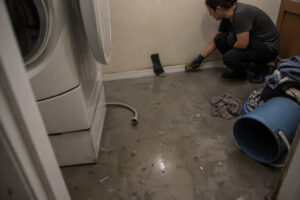 Category 2 water damage sits in the middle of the IICRC contamination spectrum — not the clean-source events that most homeowners are comfortable attempting to address, and not the sewage biohazard that everyone understands requires professional response. Grey water occupies the space in between: contaminated enough to pose a genuine health risk, but not always obviously hazardous in the way that sewage is. The risk of underprepared cleanup — without appropriate personal protective equipment, antimicrobial treatment, and proper material removal — is real, and the gap between “it was just the washing machine” and understanding what Category 2 actually requires is where inadequate restoration and failed insurance claims frequently originate.
Grey water calls have a specific emotional texture that clean water calls do not. With a burst pipe, the homeowner is dealing with a problem. With a washing machine overflow that contaminated the finished basement where the kids play, or a dishwasher failure that soaked the kitchen subfloor and the cabinets storing the family’s dishes, the homeowner is dealing with a problem and a question they do not want to ask out loud: is this safe? The answer depends on what category the water actually is, how long it has been there, and whether the cleanup addresses the contamination — not just the moisture. We will tell you honestly what we found and what it requires.
True Day Water Damage Restoration is a licensed Utah Contractor (#960332-3505) and IICRC-Certified Firm (ID #927354-5258). Call us at (385) 247-9359.
Category 2 water damage sits in the middle of the IICRC contamination spectrum — not the clean-source events that most homeowners are comfortable attempting to address, and not the sewage biohazard that everyone understands requires professional response. Grey water occupies the space in between: contaminated enough to pose a genuine health risk, but not always obviously hazardous in the way that sewage is. The risk of underprepared cleanup — without appropriate personal protective equipment, antimicrobial treatment, and proper material removal — is real, and the gap between “it was just the washing machine” and understanding what Category 2 actually requires is where inadequate restoration and failed insurance claims frequently originate.
Grey water calls have a specific emotional texture that clean water calls do not. With a burst pipe, the homeowner is dealing with a problem. With a washing machine overflow that contaminated the finished basement where the kids play, or a dishwasher failure that soaked the kitchen subfloor and the cabinets storing the family’s dishes, the homeowner is dealing with a problem and a question they do not want to ask out loud: is this safe? The answer depends on what category the water actually is, how long it has been there, and whether the cleanup addresses the contamination — not just the moisture. We will tell you honestly what we found and what it requires.
True Day Water Damage Restoration is a licensed Utah Contractor (#960332-3505) and IICRC-Certified Firm (ID #927354-5258). Call us at (385) 247-9359.
Category 2 Sources in South Jordan Properties
Washing machine overflow and supply line failure: Washing machine events are the most common Category 2 source in South Jordan residential properties. The wash cycle introduces biological matter from clothing — including fecal bacteria from soiled garments — and cleaning chemicals into the water, elevating it to Category 2. The hard water scale failures of washing machine supply line fittings from the Jordan Valley Water Conservancy District’s 7-to-10-grain-per-gallon supply add a Category 1-at-source supply line failure to a Category 2 overflow scenario — producing the combined damage profile we respond to most frequently in South Jordan’s established neighborhoods and Daybreak’s townhome stock. Secondary irrigation system intrusion: South Jordan has one of the highest secondary water connection rates in Salt Lake County — approximately one in four homes has access to the city’s non-potable secondary water irrigation system. The secondary system draws from untreated surface water sources and carries coliform bacteria, soil-borne pathogens, and seasonal agricultural runoff that may include pesticide residue. Secondary water system failures that introduce water into a structure classify as Category 2 or higher — a South Jordan-specific risk factor that contractors unfamiliar with this community do not automatically account for in their assessment. South Jordan’s secondary water system also carries the broader water quality context of the Jordan River corridor. The Jordan River — which flows northward through the Salt Lake Valley carrying agricultural runoff, stormwater, and treated wastewater effluent from upstream municipalities — contributes to surface water sources that eventually recharge portions of the valley aquifer and supply components of the secondary irrigation network. Local stormwater management programs administered through Salt Lake County and the Jordan Valley Water Conservancy District address runoff quality, but the secondary system is explicitly non-potable and untreated. In secondary water system failure events, we treat the intruding water as Category 2 at minimum and assess the specific contamination profile before determining whether the specific event warrants Category 3 protocols based on what the water has been in contact with before entering the structure. Dishwasher supply line and drain failures: Food debris, biological matter, and cleaning agents in dishwasher discharge water elevate it to Category 2. Kitchen subfloor saturation from a dishwasher failure that runs undetected — in the cabinet cavity below the appliance — typically involves Category 2 water in contact with the subfloor for many hours before detection. Bathroom sink and shower drain backflows: Drain backflows from blockages in the shared drain stack introduce water that has been in the drain system — carrying biological matter, soap residue, and hair — as Category 2 contamination onto bathroom flooring and into adjacent wall assemblies. Category 1 events after 24 to 48 hours: Clean water sitting in contact with cellulose-based building materials at ambient temperature develops bacterial colonization of the organic substrate within 24 to 48 hours, reclassifying the event to Category 2. A supply line failure discovered on Monday morning after a weekend absence — 48 to 72 hours after the event — is almost certainly Category 2 at the time of response regardless of its clean-water origin.A Category 2 Project in Daybreak
In July 2022, we responded to a washing machine overflow in a 2013-era Daybreak contemporary craftsman home — one of the Energy Star-rated homes that characterize Daybreak’s later construction phases, with a tight building envelope, engineered lumber I-joist floor system, and a finished lower level family room directly below the second-floor laundry room. The front-load washing machine’s door seal had failed during a cycle, discharging the full wash load — roughly 14 gallons of Category 2 water containing detergent and biological matter from a mixed clothing load — through the door gap onto the laundry room floor. The tight building envelope that makes Daybreak’s Energy Star homes more energy-efficient than older South Jordan construction also slows moisture dissipation from enclosed assemblies — the vapor-retarder wall construction that reduces air infiltration also reduces natural drying rates after a water event. By the time the homeowner discovered the event and called us, the water had been standing for approximately four hours. FLIR thermal imaging showed the Category 2 water had migrated through the I-joist web openings in the floor-ceiling assembly and was present across a 6-by-8-foot cold zone in the lower level ceiling below the laundry room. Moisture meter readings at nine points showed the I-joist lower flanges reading 24% to 31% and the lower level ceiling drywall reading 22% at four points. Because the water source was Category 2, we applied EPA-registered antimicrobial treatment to all contacted framing surfaces after drying — not an optional step even though the water had not been standing long. The lower level ceiling drywall was removed at the affected section to allow direct antimicrobial treatment of the I-joist framing and to confirm the category boundary. Drying equipment ran for three days. The homeowners policy covered the event as a sudden and accidental appliance failure. Total approved claim: $4,870. The homeowner’s question at the end of the project — “why did it go through the floor so fast?” — is one we answer regularly in Daybreak’s I-joist construction. The web openings that make I-joists structurally efficient also make them effective conduits for water migration between levels.What Category 2 Requires That Category 1 Does Not
Appropriate personal protective equipment for technicians; antimicrobial treatment of all hard surfaces that contacted grey water at appropriate EPA-registered product concentration and contact time; removal of porous materials — carpet, padding, insulation, drywall that has absorbed significant grey water contamination — rather than drying in place; documentation of contamination category for the insurance claim; and more conservative assessment of material salvageability than Category 1 events permit. Category 2 can degrade to Category 3 if it contacts sewage-contaminated materials, if it contains sufficient biological load for significant microbial amplification, or if it remains standing for more than 72 hours. A washing machine overflow that spreads to a basement floor drain with residual sewage contamination becomes Category 3 at the point of contact.- Why is toilet bowl overflow Category 2 rather than Category 3?
- Bowl water has been in contact with drain plumbing and bowl surfaces colonized with enteric bacteria — significantly contaminated, but not at the gross sewage level of Category 3. If visible sewage material is present, or if the overflow is from a blocked drain rather than the bowl itself, treat as Category 3.
- Can carpet be dried in place after Category 2 water damage?
- No. Carpet and pad in contact with Category 2 water must be removed and disposed of as regulated waste. ANSI/IICRC S500 specifies material removal minimums for Category 2 that require removal of porous materials that cannot be adequately disinfected in place.
What Category 2 (grey water) damage actually means
The IICRC S500 Standard defines Category 2 as water that contains significant contamination and can cause discomfort or sickness if ingested or exposed. It carries microbiological, chemical, or physical contaminants but is not grossly contaminated (that would be Cat 3).
Typical Category 2 sources
- Dishwasher or washing-machine discharge (soap + food/body residue)
- Aquarium or waterbed rupture
- Toilet bowl water that contains urine but no feces
- Sump pump failure with discharge water contaminants
- Water from a punctured waterbed
- Shower or tub overflow with soap and biological residue
- Category 1 water that sat 24-48 hours and picked up contaminants
What gets saved on Cat 2 (if caught early)
Hard surfaces (tile, sealed concrete, glass, stainless) can be cleaned and sanitized with EPA-registered thymol or accelerated hydrogen peroxide. Carpet can sometimes be cleaned and dried if cleaned within the first 24 hours; pad discarded. Framing dries in place after sanitization if moisture content returns to EMC baseline.
What’s discarded regardless
Carpet pad, insulation that absorbed water, drywall below the water line (usually bottom 2 ft minimum, cut and replaced), particleboard subfloor that swelled, and any porous material that cannot be cleaned to the standard the S500 sets for Category 2.
Common Cat 2 (greywater) sources — and the 48-hour clock
Greywater is water that contains significant contamination that could cause illness or discomfort if ingested or if it contacts skin, but it isn’t sewage. It’s a middle category — and it’s the category most people guess wrong about. Here’s what counts:
| Source | Why it’s Cat 2 |
|---|---|
| Washing machine overflow or discharge | Detergents, dirt, body-oils, bleach residue, plus any pre-existing bacteria in the hoses |
| Dishwasher overflow | Detergents + food particles + grease; often warm, accelerating bacterial growth |
| Aquarium leak or rupture | Fish waste, algae, bacteria from biofilm — often more contaminated than people expect |
| Waterbed leak | Stagnant water sitting warm against mattress for months; usually heavy microbial content |
| Shower overflow or tub overflow (soapy water) | Soaps, body-oils, hair, skin cells — mild Cat 2 but Cat 2 nonetheless |
| Toilet bowl overflow (clean bowl water only, no sewage) | Standing water above the trap seal is Cat 2; past the trap seal is Cat 3 |
| Punctured or leaking water bed, humidifier reservoir, drip-tray overflow | Stagnant source water; biological activity assumed |
| Sprinkler-system discharge (fire suppression wet-pipe) | Water sat in iron pipe for years; mineral + bacterial content |
What this means for insurance
- Most policies pay for Cat 2 cleanup the same as Cat 1 under water-damage coverage
- Age-degraded Cat 3 (originally Cat 1 or 2 that sat too long) is sometimes contested — carriers may argue the homeowner’s delay caused the degradation
- Documentation (date of loss, when you noticed, when you called) matters here — call as soon as you discover the loss
The three most common Cat 2 scenarios — and what differs between them
Cat 2 water is a specific category with specific response requirements, but the three most common sources all behave slightly differently once they’re on your floor. Here’s each one in detail:
- Water signature: contains detergent residue, body-oils, bleach traces, lint, and whatever was pre-rinsed off the current load; often warm
- Materials affected: laundry room floor, adjacent room (usually garage or kitchen) depending on floor plan; basement below if upstairs laundry
- Scope specifics: standard Cat 2 extraction + flood cut if drywall was involved; carpet pad usually removed; carpet case-by-case based on age
- Timeline: 5-7 days typical
- What’s often missed: water tracked under washer and under adjacent appliances (dryer, utility sink); need to pull appliances to inspect
- Water signature: detergent residue, food particles, grease; warm; often tracks forward out of the kitchen into adjacent rooms
- Materials affected: kitchen floor (hardwood or LVP typically); cabinet bases around dishwasher; sometimes basement ceiling below
- Scope specifics: extraction + cabinet base assessment (often MDF, often needs replacement); hardwood dry-in-place attempt; subfloor assessment
- Timeline: 4-6 days typical
- What’s often missed: water that migrated behind the dishwasher into the subfloor area; need to pull the dishwasher to inspect
- Water signature: clean city water from the toilet tank fill; some bowl film residue; typically cool
- Materials affected: bathroom floor; wax ring and flange area; occasionally adjacent room if water flowed under the door
- Scope specifics: standard Cat 2 (not Cat 3, since source is clean supply water); tile floor usually survives; wax ring replacement common
- Timeline: 3-5 days typical (bathrooms are small)
- What’s often missed: moisture wicked up walls behind baseboards; thermal imaging catches it before visible staining
Why these three dominate Cat 2 call volume
- Household appliance mechanical failures are the most common water-loss category we respond to
- Each has a specific pattern we recognize on the first call
- Catching any of these fast means lower overall scope — Cat 2 at 24 hours is a different job than Cat 2 at 72 hours
Prevention for each
- Washing machine: braided stainless steel supply hoses (not rubber); replace every 5-7 years; smart water leak sensor behind the washer
- Dishwasher: check the fill valve + supply line annually; smart leak sensor under the sink
- Toilet: check flapper annually; replace shut-off valve if it ever seized; quarter-turn ball valves preferred for new installs
Cat 2 degradation timing — what actually happens hour by hour
The S500 standard says Cat 2 becomes Cat 3 at approximately 48 hours in warm humid conditions. Here’s a more granular look at what’s happening biologically and how specific conditions change the clock:
- Temperature (warm = faster biological growth)
- Humidity (warm humid conditions favor microbes)
- Nutrients in the water or materials (organic matter feeds growth)
- Surface area (wet carpet + pad has large surface area for colonization)
- Time elapsed since the loss started
Hour-by-hour biological timeline (typical warm-humid conditions)
- 0-12 hours: Water as it arrived (Cat 2 by source). Microbial content as the source introduced. Clean-up at this stage preserves most materials.
- 12-24 hours: Water + surface biology beginning to interact. Minor microbial activity may be detectable but not visible. Clean-up still preserves most materials with Cat 2 protocol.
- 24-48 hours: Visible or detectable biological activity may begin. Odor may start to appear. Material clean-up boundary approaches: pad usually comes out, carpet becomes borderline-salvage. Still Cat 2.
- 48-72 hours: Transition zone. Some assessors call this Cat 3; others still Cat 2 depending on specific conditions. We treat as Cat 3 by default to be safe.
- 72+ hours: Definitively Cat 3 by S500. Full material-removal scope applies. Containment required. PPE required. Biohazard waste disposal applies.
What makes degradation faster
- Warmer house (above 72°F) — biological growth accelerates ~2x for every 10°F warmer
- Higher humidity — relative humidity above 65% supports colonization
- Organic contamination in the water (food particles in dishwasher discharge, body-oils in bath water) — provides nutrients
- Carpet + pad + organic debris on floor already — large colonizable surface
- HVAC spreading moist air through the house — introduces spores from elsewhere
What makes degradation slower
- Cooler house (below 65°F) — biological activity slows significantly
- Lower humidity — less water available for microbes
- Clean source + minimal organic matter in affected materials
- Hard-surface flooring (no fiber for colonization) — much slower biological activity than carpet
- HVAC off or isolated — limits spore distribution
How we document the time elapsed
- Date-of-loss (when water started) in the scope narrative
- Date-of-discovery (when homeowner noticed) — often different from DOL
- Date-of-call (when we were contacted)
- Date-of-arrival (when we started)
- Time elapsed is the sum from DOL to arrival; drives the category decision
Why the honest category matters
- Scoping Cat 2 as Cat 1 to save money (ours or carrier’s) results in incomplete remediation and future mold claim
- Scoping Cat 3 as Cat 2 to seem cheaper is incomplete and leaves contamination
- Right-category is right-sized; the material-condition and water-biology drive the decision, not what seems easiest
What we tell callers whose Cat 2 is approaching the degradation threshold
- “Your loss started about X hours ago. We’re on the clock. Here’s our ETA.”
- Specific instructions on preserving materials in the gap (keep room cool, don’t open to warmer air, don’t disturb the water or materials)
- Honest assessment of whether we think your materials are still salvageable or whether degradation has started
- The call is more useful than any guide at this specific moment — we triage your specific timing
Cat 2 occupant safety + displacement decisions
Most Cat 2 losses don’t require vacating the home, but some situations warrant it. Here’s how we think about occupant safety during Cat 2 mitigation:
- Affected area is isolated and can be closed off
- HVAC can be isolated from the drying zone
- No one in the household has respiratory sensitivity or immune concerns
- Pets can be kept away from the affected area
- Loss area isn’t a critical-use room (bedroom, kitchen, only bathroom)
- Affected area is the only kitchen or primary bathroom
- Loss area is a bedroom with occupants requiring sleep
- Occupant has respiratory sensitivity (asthma, COPD, allergies)
- Immune-compromised occupant present
- Pregnant occupant (precaution)
- Multiple affected rooms making circulation of unaffected spaces impractical
- Equipment noise would prevent sleep for 5+ days
Insurance ALE (Additional Living Expenses) coverage
- Most homeowner policies include ALE if your home isn’t habitable during a covered loss
- ALE typically covers hotel costs + reasonable meal costs beyond your normal expenses
- Documentation: keep receipts for all displacement-related expenses
- Written documentation of why the home isn’t habitable (from us as the restoration contractor) supports the ALE claim
What makes a home “not habitable” for insurance purposes
- Only kitchen is affected; no cooking facility
- Only bathroom is affected; no toilet or shower
- Only bedroom(s) affected; no sleeping accommodation
- HVAC unusable; home temperature can’t be maintained
- Specific health concerns (contamination, air quality) that make occupancy risky
What doesn’t automatically trigger displacement
- Noise from equipment (uncomfortable but not uninhabitable)
- Disruption of a specific room (if alternatives exist)
- Equipment taking up floor space
- Visual disruption of a space
How to decide if your situation warrants displacement
- Ask us at the initial scope visit; we’ll give you a specific assessment
- Call your insurance adjuster if you’re borderline — they can authorize ALE and document the decision
- Health considerations always warrant extra caution; when in doubt, displace
Alternatives to full displacement
- Stay-at-home with isolation: close doors to affected area; use alternative rooms for daily activities
- Night-only displacement: stay elsewhere for sleep only
- Partial displacement: specific family members (immune-compromised, elderly) displace while others stay
- Weekend displacement: stay elsewhere during peak noisy work days
If you’re a renter
- Your renters insurance (HO-4) usually includes ALE similar to homeowner’s
- Landlord may be required to provide alternative accommodations if home is uninhabitable (depends on Utah landlord-tenant law + specific lease terms)
- Document the uninhabitability in writing from both us and the landlord
What we do to minimize displacement need
- Containment of the affected area to allow unaffected spaces to be used normally
- Quieter equipment where feasible (quiet-run air movers, decibel-rated dehumidifiers)
- Scheduling noisy work for daytime when occupants are typically out
- Flexible scheduling if specific family events require accommodation
If you’re considering displacement during a Cat 2 job, let us know on the first visit. We adjust scope + scheduling to minimize impact; we also help you document the ALE case to your insurance.
Happening right now? Grey water from a washer or dishwasher needs extraction and antimicrobial treatment, and it gets worse the longer it sits. Call (385) 247-9359 — live-answered 24/7.
Grey water or black water?
| Grey water (Category 2) | Black water (Category 3) | |
|---|---|---|
| Typical source | Washer, dishwasher, sink | Sewage, toilet waste, floodwater |
| Response | Extraction, antimicrobial, some porous materials replaced | PPE, containment, soaked porous materials removed |
| If it sits | Can become black water | — |