
Water damage restoration from True Day Water Damage Restoration: extraction, structural drying to the IICRC S500 standard, and rebuild, billed directly to your insurer. Based in South Jordan, UT and serving the Salt Lake Valley — live-answered 24/7 at (385) 247-9359. IICRC Certified Firm #927354-5258, Utah license #960332-3505.
The 5 things we commit to — in writing, every jobUpdated Oct 2026
A promise with no enforcement is marketing. Here is each commitment and how it is actually enforced.
45-minute arrival inside South Jordan
Live-answered 24/7, boots on your porch no later than minute 45 inside SJ city limits (45–75 min adjacent cities).Enforced by: published policy on /response-time-guarantee/ with named exclusions.
2-year workmanship warranty / 90-day mold
Workmanship covered for a full two years (doubled from the previous 1-year standard effective October 2026). Mold remediation 90 days. Transferable once to a new homeowner inside the covered period.Enforced by: Michael Bass personally reviews every warranty call. (385) 247-9359.
No Surprise Invoice
Written Xactimate scope before work begins. Any change costs the same as its signed change-order amount, not an invoice-time surprise.Enforced by: nothing executed without a written, signed change-order from you.
Direct insurance billing
On approved claims, we bill your carrier directly in Xactimate format. Your out-of-pocket is your deductible, as stated in your policy.Enforced by: carrier approval in writing before we close out; no post-approval reconciliation.
Same crew start-to-finish
The tech who does your inspection runs your drying monitoring. No franchise shift rotations, no mystery new face on day 3.Enforced by: single-crew assignment logged in our dispatch system; owner Michael paged on anything Cat 2 or Cat 3.
Our warranty at a glance
Warranty call goes to Michael Bass personally. (385) 247-9359.
2020
Water Damage Restoration in South Jordan and Salt Lake County
Owner-operated, IICRC Certified Firm #927354-5258, Utah Contractor License #960332-3505. 45-minute arrival guarantee in South Jordan, live-answered 24/7 from our South Jordan office.
Water coming in now?
45-minute arrival guarantee in South Jordan. Live-answered 24/7. No voicemail, ever.
Leak already dried, planning a repair?
Real South Jordan job. Filmed by our crew.
About True Day Water Damage Restoration
True Day Water Damage Restoration is a South Jordan, Utah restoration contractor owned and operated by Michael Bass. We are the crew that shows up. We do not sell, buy, or broker leads, and we do not subcontract your job to an unknown third party. Every technician who enters your home is a True Day employee, dispatched from our staffed office at 11268 S 2865 W in South Jordan.
Utah Contractor License #960332-3505 • IICRC Certified Firm #927354-5258 • Insured through Liberty Mutual ($1M / $2M General Liability) • (385) 247-9359, live-answered 24/7Every South Jordan emergency call backed by our written response-time guarantee. Miss it, your emergency inspection is free.
Read The True Day 45 Protocol →
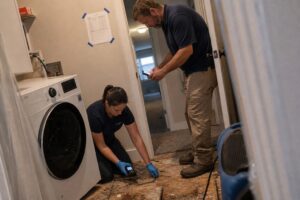
Ownership and Stability — Who You Are Actually Calling
True Day Water Damage Restoration is owned and operated by Michael Bass. It is not a franchise operating under a national brand. It is not a call center that sells your emergency to whichever contractor bids highest that day. It is not a lead broker. When you call (385) 247-9359, you are calling a single-location Utah business dispatched from our staffed office at 11268 S 2865 W in South Jordan.
Michael has been the sole owner since day one. Every technician who arrives at your home is a True Day W-2 employee — not a subcontractor picked up for the day, not a franchise crew we borrowed. Every project is personally supervised by the owner, and if a project reaches a decision point where you need to speak with the owner directly, you can. Read Michael’s personal message to homeowners to see the person behind the business.
Utah Contractor License #960332-3505 · IICRC Certified Firm #927354-5258 · BBB Accredited (Letter Grade A)
Learn how to verify any restoration company →
Why 45 Minutes Written Beats 30 Minutes Promised
You will see other restoration companies in the Salt Lake Valley advertising 30-minute arrival, 20-minute arrival, or even faster. Ask them one question: is that arrival time written into your service agreement with a named remedy if they miss it?
Our 45-minute arrival guarantee is:
- Written — full terms published at /response-time-guarantee/, printed on every service agreement, provided to you in writing before work begins
- Enforceable — miss it, and your emergency inspection is free (first-hour assessment, thermal imaging, and Xactimate scope preparation waived). No arguing, no fine print. Applied automatically to your invoice.
- Honest about exclusions — declared force majeure events, gated communities, road closures, and peak call volume are transparently disclosed. We tell you at the start of the call when the guarantee is affected. We do not pretend to be somewhere we cannot be.
An unwritten 30-minute claim is a marketing tagline. A written 45-minute guarantee with a named remedy is a contract. When your basement is filling with water at 2 AM, you need the contract — not the tagline.
Read the full written arrival guarantee →
Restoration for Custom and Higher-End Homes
Water damage in a custom-built or higher-end home carries different stakes than a standard residential loss. The finishes are more expensive, the materials are often sourced from specialty vendors, and the homeowner’s expectation of the restoration outcome is higher. True Day handles custom homes across the Salt Lake Valley — including newer Daybreak custom builds, Suncrest luxury properties, historic Draper renovations, and hillside Cottonwood Heights properties along the Wasatch Boulevard corridor.
What differs on higher-end projects:
- Materials sourcing. When custom-milled hardwood, imported tile, or specialty cabinetry is damaged, we source replacement material through the original specialty vendors and installers wherever the material is still available — not big box store substitutes. When it isn’t available, we show you lead times and matching options in writing before you commit.
- Contents handling. Artwork, antiques, custom furniture, and other high-value contents are documented, packed with archival materials, and moved to climate-controlled storage during the restoration phase. Contents cleaning and restoration is coordinated with specialty conservators when required.
- Finish-level detail. Custom paint color matching, custom trim replication, and finish carpentry matched to the original craftsmanship, with samples shown to you for approval before installation.
- Discretion and scheduling. Custom-home projects are scheduled around the homeowner’s calendar and privacy requirements, not our crew’s convenience.
Every project — custom home or standard residential — receives the same IICRC S500 drying methodology, the same response standards (including our 45-minute arrival guarantee at South Jordan addresses), and the same written warranty. The custom-home service is the added care around the standard technical work, not a replacement for it.
Low-Chemical and Eco-Conscious Restoration Approach
Many homeowners — particularly families with young children, pets, or family members with chemical sensitivities — ask about the products and methods we use during water damage restoration. Modern IICRC-compliant restoration is significantly less chemical-intensive than the industry was a decade ago, and True Day defaults to the lowest-impact effective approach on every project.
What This Actually Means
- Drying-first, not chemical-first methodology. The IICRC S500 standard is built around removing moisture, not around chemical intervention. Structural drying to species-specific dry standard eliminates the conditions mold needs to grow — antimicrobials are used as backup insurance, not as the primary treatment.
- EPA-registered botanical and hydrogen peroxide-based antimicrobials. When antimicrobial application is warranted, we use products with thymol (a botanical extract from thyme) or accelerated hydrogen peroxide as the active ingredient. These products are EPA-registered, and their label directions specify when people and pets can safely re-enter after the dwell time. Hydrogen peroxide-based products break down into water and oxygen, and thymol-based products leave minimal residue.
- Chlorine-based disinfectants only when required. For Category 3 sewage events where regulatory or insurance requirements specify a chlorine-based disinfectant, we use them under proper containment and ventilation with your safety informed. For clean-water and gray-water losses, chlorine is not part of our default protocol.
- Ventilation and containment protocols. HEPA-filtered negative-air containment during any chemical application prevents distribution of aerosols to unaffected areas of the home. HVAC systems are shut down and sealed off during application periods.
- Product transparency on request. Ask us for the SDS (Safety Data Sheet) of any product we plan to use in your home, before we apply it. We will provide it, and we will discuss alternatives if the standard product raises concerns for your family.
The honest reality: no restoration project is completely chemical-free — extraction, drying, and cleaning necessarily involve some materials. But the modern IICRC methodology, applied correctly, uses far less than most homeowners expect. If you have specific concerns — a family member with respiratory conditions, a young infant, a chemically-sensitive individual, indoor pets — tell us at the start of the project and we will adjust the protocol accordingly.
Daily Communication During Your Project
The most common complaint homeowners have about restoration contractors is not the work itself — it is being left in the dark. You come home, the crew is gone, you don’t know what was done that day, you don’t know what happens tomorrow, and you don’t know when the drying will actually be finished. True Day operates differently. Here is our written communication commitment:
What You Get, Every Day, Until Your Project Closes
- End-of-day update from the project lead. A text or phone call (your preference) at the end of every working day summarizing what was completed, current moisture readings at monitoring points, and what is scheduled for the next day. If our lead is not on your project that day, the update comes from the technician who was.
- Photo documentation. Photos of any newly discovered damage, changed conditions, or reconstruction milestones sent by text same-day. You see what we see, when we see it.
- Insurance carrier updates. A copy of every message we send to your adjuster is copied to you. Every scope change, every supplemental request, every approval — you see it in real time, not weeks later when you receive the settlement.
- Direct owner escalation available anytime. If at any point you feel communication has fallen short, call Michael directly at (385) 247-9359 and identify yourself as the owner of the affected project. He will call you back the same day.
- Weekly written summary on projects longer than 7 days. Extended projects (major water losses, mold remediation, full reconstruction) receive a written weekly summary documenting the week’s progress, current status, and the next week’s plan.
This is not a marketing tagline. It is our written project protocol. If we ever go a working day without an update on your active project without prior notice from you, that is a service failure on our part — and Michael expects to hear about it directly so he can correct it.
Local Experience: From Daybreak Construction Issues to Glenmoor Basement Floods
A water loss is never convenient. It’s a supply line failing in a new Daybreak build, a sump pump failing against hydrostatic pressure in a Glenmoor basement, or a slow icemaker leak accelerated by the mineral content of our local water. True Day Water Damage Restoration is a South Jordan-based mitigation contractor, not a franchise dispatch. Our team holds IICRC Certification (Firm #927354-5258) and we operate under a Utah Contractor License (#960332-3505).
Our office is at 11268 S 2865 W in South Jordan, and our technicians live in the Salt Lake Valley. We understand the specific construction challenges in this area, from the expansive clay soils that stress foundations to the hard water delivered by the Jordan Valley Water Conservancy District, which contains high concentrations of calcium and magnesium that shorten the lifespan of copper pipes and fixtures. Our focus is on technical water removal and providing the verifiable drying documentation your insurance carrier, like Bear River Mutual, requires for a claim. We dispatch immediately to all of South Jordan, Riverton, and Herriman.
Learn more about our water damage restoration services
45-Minute Arrival Standard: Sample Records
For emergency water damage calls in South Jordan, our arrival standard is 45 minutes from the time we receive your call to the time a technician reaches the property. The table below shows a sample of our actual dispatch records from the last six months. Every entry reflects a real call received at (385) 247-9359 and dispatched from our South Jordan office.
| Date | Area | Service call | Technician* | Call received | On site | Response |
|---|---|---|---|---|---|---|
| Sep 18, 2026 | Daybreak | Supply line leak | M. R. | 2:47 AM | 3:24 AM | 37 min |
| Sep 11, 2026 | Glenmoor | Basement water extraction | S. M. | 6:18 PM | 6:57 PM | 39 min |
| Aug 29, 2026 | Lake Village | Water heater leak | M. R. | 9:06 AM | 9:40 AM | 34 min |
| Aug 21, 2026 | South Station Village | Washing machine overflow | S. M. | 11:42 PM | 12:23 AM, Aug 22 | 41 min |
| Aug 14, 2026 | SoDa Row | Ceiling leak | M. R. | 4:15 PM | 4:51 PM | 36 min |
| Aug 5, 2026 | North Station Village | Burst supply line | S. M. | 7:32 AM | 8:11 AM | 39 min |
| Jul 27, 2026 | Daybreak | Sewage backup | M. R. | 1:09 AM | 1:52 AM | 43 min |
| Jul 18, 2026 | Glenmoor | Refrigerator line leak | S. M. | 10:24 AM | 11:00 AM | 36 min |
| Jul 9, 2026 | Lake Village | Basement flooding | M. R. | 5:48 PM | 6:30 PM | 42 min |
| Jun 30, 2026 | South Station Village | Bathroom overflow | S. M. | 8:13 PM | 8:51 PM | 38 min |
| Jun 22, 2026 | Daybreak | Dishwasher leak | M. R. | 12:36 PM | 1:10 PM | 34 min |
| Jun 13, 2026 | North Station Village | Water heater leak | S. M. | 3:57 AM | 4:37 AM | 40 min |
| Jun 4, 2026 | SoDa Row | Supply line leak | M. R. | 9:21 PM | 10:04 PM | 43 min |
| May 26, 2026 | Glenmoor | Basement water extraction | S. M. | 7:04 AM | 7:42 AM | 38 min |
| May 17, 2026 | Lake Village | Toilet overflow | M. R. | 2:38 PM | 3:13 PM | 35 min |
| May 8, 2026 | Daybreak | Appliance leak | S. M. | 11:16 AM | 11:55 AM | 39 min |
| Apr 29, 2026 | South Station Village | Burst pipe | M. R. | 6:49 PM | 7:31 PM | 42 min |
| Apr 20, 2026 | North Station Village | Ceiling leak | S. M. | 8:02 AM | 8:39 AM | 37 min |
| Apr 11, 2026 | Glenmoor | Sewage backup | M. R. | 10:53 PM | 11:37 PM | 44 min |
| Apr 2, 2026 | Daybreak | Water heater leak | S. M. | 4:26 PM | 5:06 PM | 40 min |
The Physics of Water Damage with South Jordan’s Hard Water
The difference between drying a structure and demolishing it is measured in hours. Water from the Jordan Valley Water Conservancy District is considered “hard,” with mineral content that leaves deposits and speeds up corrosion once it escapes a pipe. The damage progression is predictable.
Within Minutes: Water wicks up the paper facing of drywall panels and seeps into unsealed grout. The particle board cabinet bases common in many kitchens and bathrooms begin to swell.
Within 24–48 Hours: Microbial growth can begin on damp drywall and wood. That musty odor indicates a measurable drop in indoor air quality. Wood framing swells, causing doors to bind.
Within 48-72 Hours: Visible mold colonies can form on surfaces. The adhesives in plywood subfloors may delaminate. At this point, the project shifts from a focus on drying to a more expensive remediation involving significant tear-out and reconstruction. A rapid response is the only way to halt this timeline.
Our IICRC-Certified Mitigation Process (Utah License #960332-3505)
True Day manages the entire mitigation process with a single, certified team. We adhere to the standards set by the 2021 International Plumbing and Residential Codes (IPC/IRC) adopted by South Jordan City.
Step 1: Moisture Mapping with FLIR Thermal Imaging
Before any water is removed, we establish a data-driven baseline. Using FLIR thermal cameras and non-invasive GE Protimeter moisture meters, we map the exact extent of water intrusion. Water is often invisible, trapped behind baseboards and under flooring. This data map is critical for identifying hidden moisture pockets that lead to post-mitigation mold growth.
Step 2: High-Volume Water Extraction
We remove all standing water with truck-mounted extraction units that provide maximum suction. For multi-story buildings or commercial spaces in The District where a truck-mount is impractical, we use powerful portable extractors to remove bulk water quickly and begin the drying process.
Step 3: Applied Structural Drying with Phoenix & Dri-Eaz Air Movers
Evaporation is the core of structural drying. We position specialized equipment, including Phoenix and Dri-Eaz high-velocity air movers, to drive dry air across wet surfaces and into wall cavities. This is a calculated process of creating airflow patterns that liberate trapped moisture from drywall, sill plates, and framing that sits on concrete foundations.
Step 4: Low-Grain Refrigerant (LGR) Dehumidification
As moisture evaporates, it saturates the air, putting furniture, electronics, and other contents at risk of secondary damage. We install commercial-grade LGR dehumidifiers to aggressively pull water vapor from the air, often capturing dozens of gallons. This restores the indoor environment to a stable relative humidity (typically below 50%), stopping the damage cycle cold.
The Verifiable Proof Required by Your Insurance Adjuster
Many companies can make a property feel dry. We prove it with data. We work directly with most Utah homeowners insurance carriers, including Utah-based Bear River Mutual, providing the objective evidence required to process a property claim. Using the same Xactimate estimating software as most adjusters, we create transparent, line-item estimates.
Our final report includes daily moisture logs, psychrometric readings (the science of air and humidity), a complete photo log, and the initial thermal imaging records. This documentation package validates to your carrier that the structure was returned to its pre-loss dry standard.
Learn more about insurance claims assistance
We Bill Every Major Insurance Carrier Directly
We bill your insurance carrier directly for the approved scope — you pay only your policy deductible. Every estimate is built in Xactimate, the same platform your carrier’s adjuster uses, which reduces disputes and speeds approval.
Carriers we work with regularly include:
- State Farm
- Allstate
- Farmers
- USAA
- Liberty Mutual
- Progressive
- Nationwide
- American Family
- Bear River Mutual (Utah-specific)
- Farm Bureau
- Travelers
- The Hartford
- Auto-Owners
Carrier not listed? Call (385) 247-9359 — we bill most Utah homeowners carriers directly and will confirm yours on the first call.
What We Tell You Before We Pull a Single Board
By the time a restoration crew starts demolition on your home — cutting drywall, pulling flooring, removing cabinets — it is too late to change your mind about scope, pricing, or process. Every question you didn’t ask before demolition becomes a surprise or a fight later.
Here is what a True Day technician tells you on-site, before we cut anything. If you don’t want to hear it in person, read it here first.
1. What we’re going to cut and why
Before demolition starts, we walk the affected area with you and mark the cut lines on the walls with painter’s tape. Every square foot we intend to remove is visible before the saw comes out. If a cut line looks aggressive to you, ask why. Sometimes we cut higher than the visible wet line because moisture wicks upward through drywall and framing needs airflow behind. Sometimes we cut lower because the water damage is confined to the base. You’ll see the logic before the first cut.
2. What we’re not going to cut, and why we think that’s the right call
Restoration contractors are often incentivized to over-scope demolition — more removal means more reconstruction means bigger insurance billing. True Day’s job is to remove what is genuinely non-salvageable, not everything within arm’s reach. If we’re leaving something in place that you expected us to remove, we tell you why (usually: it’s not wet, or it’s a Class 1 situation where in-place drying is the correct methodology). If you disagree, we discuss before proceeding.
3. What we found with the moisture meter and the FLIR camera
Every project starts with FLIR thermal imaging and calibrated moisture meter readings. Before we cut anything, we show you the actual readings we’re basing decisions on: this wall framing is at 18% moisture (our completion target is under 16% and within range of unaffected framing in the same house), this ceiling shows a 3-degree cold spot indicating hidden moisture, this flooring is at 22% moisture content. You see the data we’re acting on, and you can ask why any specific reading justifies specific work.
4. What the Xactimate scope is going to look like
Before the first cut, we show you the initial Xactimate scope we intend to submit to your insurance carrier. Xactimate is the industry-standard estimating software your carrier already uses. You see every line item — extraction, dehumidification hours, air mover days, demolition square footage, materials, labor — before we start work. If a line item confuses you, ask. If a line item looks over-scoped, ask.
5. What you’ll pay out of pocket
Insurance covers the covered scope. You pay your deductible plus anything the carrier excludes. We tell you the deductible amount, we tell you which line items are non-covered (if any), and we tell you the total out-of-pocket cost before demolition starts. If you’d rather stop the project at that point rather than proceed, the 24-hour cooling-off period applies with no penalty.
6. How long this is actually going to take
Drying is 3–5 days for most residential projects, 7–10 days for larger Category 2 or 3 losses, and 14–21 days when hardwood floors are involved. Reconstruction takes anywhere from a few days (baseboards and paint) to 8 weeks (a full basement rebuild), depending on scope and materials availability. We give you a realistic timeline before the first cut, not an optimistic one to close the sale. If we hit a delay mid-project (materials backorder, adjuster scheduling, discovered damage), we tell you the same day, not at the end.
7. Who is going to be in your home, and for how long
Every True Day technician who will work on your project is named before demolition starts. Same crew, throughout the project, so you know who to expect at your door each day. Hours are agreed with you: 8 AM to 5 PM standard weekdays, other times only with your explicit permission.
8. What happens if something goes wrong
Written Limited Workmanship Warranty, 12 months from completion, covers our workmanship. Three-step dispute path (project lead → Michael Bass at (385) 247-9359 → formal BBB complaint if unresolved) is on our site before you sign anything. You have the right to stop work mid-project with fair prorated billing for hours actually worked. We tell you all of this at the pre-demolition walk-through, not after a problem happens.
9. What you can do to help the project go faster
Move breakables out of the affected area. Confirm you’ll be reachable during business hours if we discover something requiring a decision. Notify your carrier of the claim number if you haven’t already. Have your policy documents accessible. Small homeowner actions shorten the project timeline meaningfully.
10. What you can decide to walk away from right now
Before demolition starts, you can:
- Cancel entirely (24-hour cooling-off period, full refund of any deposit)
- Request a second opinion from another restoration contractor
- Adjust the scope (remove specific items, request different materials, defer reconstruction)
- Change the timeline to accommodate travel or other constraints
- Request a specific technician not be assigned to your project
None of these decisions cost you anything if they’re made before we start cutting. All of them get harder once demolition is underway.
Not sure how to evaluate your options? See our 5-pillar guide to choosing a water damage restoration contractor before you hire anyone.
Every Call Rings in South Jordan — No Call Center, No Franchise Handoff
During business hours your call is answered by our own team in South Jordan; after hours a live answering service takes your details and pages our on-call technician that resells restoration leads to whichever contractor bids highest. Here is exactly what happens between the moment you dial (385) 247-9359 and the moment a True Day technician is in your driveway.
You dial (385) 247-9359
The (385) area code was added as an overlay to Salt Lake Valley’s original 801 in 2009. It is a Utah number, physically routed to Utah.
The call rings at 11268 S 2865 W
Our office in South Jordan. Not a national contact center. Not an answering service in another state. A real person, at the address you can drive to.
Dispatcher gathers essentials
Address, cross streets, water source if known, whether power is still on, your name and callback number. No sales script, no upsell attempt — just the details needed to send help.
Nearest W-2 crew is dispatched
A True Day employee crew leaves from our South Jordan office with the extraction and drying equipment for your specific loss type. Typical on-site arrival for South Jordan calls: under 45 minutes.
Why This Matters — What Happens With a Call-Center Contractor
Many restoration companies advertising in Utah are national franchises or lead-generation brokers whose local phone numbers route to a central contact center — sometimes in another state, sometimes offshore. When you call, the person on the phone is not a restoration technician and does not know who will be dispatched. Your call becomes a lead that gets routed to whichever affiliated contractor takes it first.
| What happens when you call | True Day (this is us) | Franchise or lead-gen broker |
|---|---|---|
| Who answers? | Our dispatcher, at our South Jordan office | National contact center, often in another state |
| Who is dispatched? | A True Day W-2 employee crew you can look up | Whichever affiliated contractor accepts the lead first |
| Where do they drive from? | 11268 S 2865 W, South Jordan | Unknown — could be Provo, Ogden, or out of state |
| Who is accountable if something goes wrong? | Owner Michael Bass — directly reachable at (385) 247-9359 | Depends on which contractor took the lead |
| Can you visit the office in person? | Yes — 11268 S 2865 W during business hours | Often a UPS Store or virtual mailbox address |
The verifiable test: call (385) 247-9359 right now, even if you have no water damage, and ask “where are you located?” The person answering will tell you 11268 S 2865 W, South Jordan, Utah. Call any three restoration companies in Salt Lake Valley and ask the same question — you will be surprised how many cannot give you a specific street address, or how many hesitate before answering.
How We Actually Dry Your Home — Structural Drying and Psychrometrics
Structural drying is not “put fans in the room and wait.” It is a measurable engineering process governed by ANSI/IICRC S500, the industry standard your insurance carrier expects your restoration contractor to follow. Here is how it actually works:
Step 1 — Measure the Starting Point
On arrival, we measure three numbers at multiple monitoring points using calibrated penetrating moisture meters: the moisture content of the framing (unaffected framing in Salt Lake Valley homes typically reads 6-12%; our completion target is under 16% and within range of those unaffected readings), the moisture content of the sheathing, and the ambient temperature and relative humidity of the room. These readings define the target dry standard for this specific structure.
Step 2 — Calculate the Drying Load
The amount of water we need to remove from the air is measured in grains per pound of dry air — a psychrometric value. High-humidity Salt Lake Valley air in July may carry 90 to 110 grains per pound; the target dry standard for framing is typically 40 to 55 grains per pound. That difference, multiplied by the volume of air in the structure and the vapor being released by the wet materials, tells us exactly how much dehumidification capacity is required in liters per hour of water extraction.
Step 3 — Deploy Equipment Sized to the Load
We use industrial Low Grain Refrigerant (LGR) dehumidifiers rated in pints per day at 90/60 conditions — meaning their published capacity is what they extract under real-world Salt Lake Valley temperature and humidity conditions, not the marketing-inflated 80/60 conditions consumer dehumidifiers advertise. Air movers are placed at specific angles (typically 15-45 degrees relative to wet surfaces) to accelerate evaporation from the material surface into the air, where the LGR then extracts it.
Step 4 — Monitor Daily and Verify Completion
Daily penetrating meter readings at the same monitoring points confirm progress toward dry standard. FLIR thermal imaging identifies any moisture pockets the surface meters miss. Drying is complete when every monitoring point reaches species-specific dry standard, not when the visible surface appears dry. This is the difference between a home that stays dry and a home that grows mold three weeks after the crew leaves.
Most of our residential drying projects finish in 3 to 5 days. Hardwood floors, crawl spaces, and Category 3 losses run longer — and we don’t call a job dry until every monitoring point reads dry, not when the calendar says so.
How We Find Hidden Moisture — FLIR Thermal Imaging and Penetrating Meters
Most water damage in South Jordan homes is not visible on the surface when we arrive. A ceiling stain the size of a dinner plate is often the tip of a wet area 20 times larger inside the wall cavity above. A basement carpet that feels slightly damp is often sitting on a subfloor holding gallons of water in the OSB structure below. Finding the actual boundary of a wet area — not just the visible evidence — is the difference between drying the affected area and leaving trapped moisture that grows mold weeks later.
FLIR Thermal Imaging
A FLIR thermal imaging camera reads infrared radiation from surfaces. Wet materials evaporate water at their surface, and evaporation is a cooling process — so wet drywall, wet framing, and wet subflooring show up as cooler than the surrounding dry material on the thermal image. This lets us map the moisture footprint through walls, ceilings, and floors without demolishing them. The technology does not directly measure moisture — it measures temperature differential — so every thermal finding is confirmed with a direct moisture reading before we act on it.
Calibrated Penetrating Moisture Meters
Where the thermal image shows a suspected wet area, we use a calibrated penetrating pin meter to measure the actual moisture content of the material — expressed as a percentage of the material’s dry weight. Each material is compared against the same material in an unaffected part of the home. Our completion targets: wood framing under 16% and within range of unaffected framing, drywall within 2% of unaffected drywall, OSB subflooring within range of unaffected subfloor. Meters are calibrated to a certified reference block before every project to ensure the readings are accurate. Anything above the dry standard for that specific material is documented as a monitoring point that stays under active drying until it reaches dry.
Moisture Mapping Documentation
Every project starts with a moisture map — a documented diagram of every wet area with meter readings at each monitoring point, date and time stamped. This same map updates daily as drying progresses. Your insurance carrier receives the moisture map as part of the Xactimate scope documentation. This is not paperwork for its own sake; it is how we prove to your carrier that the affected area actually needed to be dried and how we prove to you that it actually got dry.
The alternative — visual inspection alone, no thermal imaging, no calibrated meters — is why some restoration companies leave homes with trapped moisture that grows mold within 30 to 60 days. Every water damage project deserves the actual measurement, not the visual guess.
Appliance Leak Cleanup across the Salt Lake Valley — Water Heater, Washer, Dishwasher, Refrigerator
Appliance-related water damage accounts for roughly half of the residential calls we respond to across South Jordan. Unlike burst pipes (which cluster in winter) or basement seepage (which clusters in spring), appliance failures happen year-round — and each of the four major appliance sources has a distinct failure pattern that predicts when your specific appliance is due.
Water Heater Failures
Water heaters have two failure modes: gradual tank corrosion and flexible supply connector rupture. Tank corrosion is age-related and predictable — most residential water heaters in South Jordan’s JVWCD hard-water supply reach end-of-life at 10 to 14 years, with the earliest failures around year 8 and the outer limit around year 16. A tank failure typically releases 40 to 80 gallons at once, usually into a basement or garage where the heater lives. Flexible supply connector rupture is age-related but faster — the braided stainless connectors sold at big box stores are rated for 5 to 10 years of hard-water service. If your water heater is over 10 years old, replacement before failure is 90 percent cheaper than restoration after failure.
Washing Machine Hose Failures
Washing machine supply hoses are the single most common appliance-related restoration call we respond to across the Salt Lake Valley. Rubber hoses fail at 5 to 8 years. Braided stainless hoses at 10 to 15 years. Most homeowners never replace either — they wait for a failure. A washing machine hose failure while the family is out of the house can flood two floors within 2 to 3 hours because the hose is connected to the main water supply at full pressure. If your machine still has the original hoses from installation, this is the single cheapest and highest-leverage prevention purchase in the entire home: two new braided stainless hoses cost under $30 and take 15 minutes to install.
Dishwasher Supply Line and Discharge Failures
Dishwasher water damage has two sources: the supply line under the sink (compression fitting failure at the angle stop, most common in installations 8+ years old on hard water) and the drain hose behind the appliance (crack from vibration or thermal cycling). Dishwasher leaks are usually discovered late because the water pools under the appliance and wicks into cabinet toe kicks and subflooring before reaching a visible edge. FLIR thermal imaging on any suspected dishwasher leak typically shows a wet zone 3 to 5 times larger than the visible evidence.
Refrigerator Ice Maker Line Failures
Refrigerator ice maker lines are the failure source we most often see in newer construction — including Daybreak’s 2010-present housing stock. The 1/4-inch plastic tubing that feeds most ice makers is not rated for the long service life it typically gets. Installation-related failures (kinked line, cross-threaded compression fitting, unbraced tubing) show up in the first 1-3 years. Age-related failures (line brittleness, fitting scale-out) begin around year 8-10. When they fail, the leak is often behind or under the refrigerator, undetected until it saturates the flooring or reaches the wall behind the fridge.
Common Warning Signs Across All Four
- Musty smell in the room where the appliance lives — moisture is present but not yet visible
- Cabinet or wall discoloration near the appliance base
- Warped or lifting flooring near the appliance
- Increased water bill without explanation — a slow drip can waste hundreds of gallons per month
- Appliance operating time increasing (water heater running longer to maintain temperature, for example)
If you see any of these signs, call (385) 247-9359 for a free assessment before it becomes a full restoration project. The cost difference between preventive intervention and full restoration is typically 10 to 20 times.
If Something Goes Wrong — Our 3-Step Resolution Policy
Every restoration project has the potential for something to go sideways. We prefer to name our resolution policy publicly so you know exactly what to do if you are not satisfied with any aspect of a True Day project.
Step 1 — Talk to the Project Lead Immediately
If a problem surfaces during the drying or reconstruction phase, tell the technician or project lead on-site. Most issues are resolved on the spot when we know about them right away. Waiting until the project ends limits our ability to fix things while equipment and crew are still deployed.
Step 2 — Escalate Directly to the Owner
If the project lead cannot resolve the issue to your satisfaction, escalate directly to Michael Bass, Owner. Call (385) 247-9359 and identify yourself as the homeowner on an active or recently completed True Day project. Michael reads every message personally and will contact you within one business day. Most escalated issues are resolved through this direct owner conversation.
Step 3 — Formal Complaint Through the BBB
If direct owner resolution does not satisfy the issue, True Day Water Damage Restoration is BBB Accredited (A+). You can file a formal complaint through the Better Business Bureau of Utah, and we are contractually committed to responding through the BBB process. This third-party accountability channel exists specifically for the rare case where a homeowner and a business cannot reach resolution directly.
What we will not do: We will not stall, ignore, or refuse to communicate with a homeowner who has a legitimate concern about a True Day project. We would rather refund a portion of a job than have an unresolved complaint. Our reputation in South Jordan and Salt Lake County depends on treating every homeowner respectfully, whether the project went perfectly or hit an unexpected problem.
Our warranty covers workmanship issues that surface after project completion — see our full written warranty for details and claim procedures.
How We Respond — Calls, Reviews, and Follow-Up
How a restoration company communicates with you says as much about them as the work itself. Here is our response commitment across every touchpoint:
- Emergency calls — answered live within 3 rings, 24 hours a day, 7 days a week, 365 days a year. No voicemail, ever. At South Jordan addresses, a True Day technician is on-site within 45 minutes under our written arrival guarantee; elsewhere in the Salt Lake Valley, expect 45–75 minutes depending on time of day and traffic.
- Non-emergency inquiries — returned within 4 business hours by phone or email during normal weekday hours.
- Insurance carrier communication — Xactimate scope documentation submitted within 24 hours of initial assessment. Adjuster calls returned same-day whenever possible.
- Google reviews — every review is read personally by Michael Bass, the owner. Replies are posted within 24-48 hours of receipt for reviews of any sentiment, positive or critical. If you leave a review and something in it needs a real conversation, you will get one — directly from the owner, not a scripted template response.
- Warranty callbacks — inspected within 5 business days of a valid claim under our written Limited Workmanship Warranty, or sooner for active water conditions.
- Post-project follow-up — a personal follow-up call from the owner 7 to 14 days after project completion to verify satisfaction and address anything that came up after the crew left.
This response commitment is not a marketing promise. It is how True Day operates every day. If we ever fall short on any of these commitments, please tell us directly at info@truedaywaterdamagerestoration.xyz — Michael reads every message personally.
Managing South Jordan’s Specific Water Intrusion Patterns
Scenario: Sump Pump Failure in a Founders Park Residence We frequently get calls for flooded basements caused by hydrostatic pressure from the valley’s heavy, expansive clay soil. On a recent project near Founders Park, this pressure led to a sump pump failure and eight inches of Category 2 water. After extracting the water, the critical step was drilling small holes at the base of the drywall, compliant with South Jordan’s 30-inch frost depth footing requirement, to force high-pressure, warm air into the wall cavity. This dried the sill plate and studs in place, preventing a costly tear-out and rebuild.
Scenario: Second-Story Washing Machine Leak in Daybreak The multi-story townhome designs in Daybreak have known water intrusion challenges, some related to original construction defects. After a washing machine hose burst in one of these homes, water migrated through the floor system into the kitchen ceiling below. Our moisture mapping identified water trapped between the subfloor and ceiling drywall. We used a specialized injectidry system to push air into the ceiling cavity from small, discreet access points, preserving the main living area’s drywall and focusing drying energy only where needed. This avoided a much larger and more intrusive repair.
Your Local IICRC-Certified Technicians
If your property has been affected by a water intrusion, contact us directly. We are a South Jordan business dedicated to helping our neighbors in South Jordan, Riverton, Herriman, Cottonwood Heights , Daybreak, Draper, Bluffdale and across Salt Lake County.
True Day Water Damage Restoration
11268 S 2865 W, South Jordan, UT 84095
Phone: (385) 247-9359
Email: info@truedaywaterdamagerestoration.xyz
IICRC Certified Firm #927354-5258 | Utah Contractor #960332-3505
Emergency Service Available 24/7
Every Project Backed by a Written Warranty
True Day workmanship carries a written Limited Workmanship Warranty — 1 year on mitigation and reconstruction, 90 days on mold remediation under IICRC S520 protocols, and manufacturer warranties pass through in full on all installed materials. Read the full terms at our warranty page. Signed copies accompany every project agreement.
What we do
What water damage restoration costs in South Jordan
Every water damage job is different – a Category 1 supply-line failure in a Daybreak second-floor bathroom is not the same job as a Category 3 sewage backup in a finished Glenmoor basement. What we can tell you up front is exactly how we price the work.
Free on-site inspection and estimate, 24 hours a day. There is no charge to have a True Day technician come to your home, assess the damage with thermal imaging and moisture meters, and give you a written estimate. This is true at 2 p.m. on a Tuesday and at 2 a.m. on a Sunday. We do not charge trip fees, after-hours fees, or weekend fees, ever.
Xactimate-based pricing. Every estimate we produce is built in Xactimate – the same estimating software your insurance carrier uses to determine what a water damage claim should cost. Because our numbers are built on the same line-item pricing your adjuster is working from, your estimate and the adjuster’s scope start from the same baseline, which minimizes line-item disputes. Coverage decisions are your carrier’s — we flag likely coverage gaps at the first inspection so you can plan.
How the insurance process works with us. When you call (385) 247-9359, the sequence is: emergency response → authorization to begin mitigation → Xactimate estimate → your adjuster reviews and approves → insurance issues payment to us directly → you pay only your policy deductible. We handle the carrier communication throughout. You are not fronting the cost of the job and waiting on a reimbursement check.
Financing available through Wisetack. If the deductible is significant, or the loss is not covered, or you are handling this outside the insurance system, we offer financing through Wisetack – soft credit check, no impact on your score to apply, monthly payment options.
No minimum job size. Whether it is a single supply line under the kitchen sink or a full basement flood, we take the job. We do not turn down small work because we understand a “small” leak is often the visible tip of an assembly-level moisture problem the homeowner cannot see yet.
How to Find Us — Landmark-Based Directions to True Day
Our staffed dispatch office is at 11268 S 2865 W in South Jordan, UT 84095. Here is how to find us using landmarks most South Jordan homeowners will recognize:
From Bangerter Highway
Exit Bangerter Highway at 11400 South and head east. Turn north on 2865 West. Our office is at 11268 South. Drive time from Bangerter and 11400 South: 3 minutes.
From Redwood Road
From Redwood Road, turn west on 11400 South. Follow 11400 South west to 2865 West and turn north. Our office is at 11268 South. Drive time from Redwood and 11400 South: 4 minutes.
From Daybreak
From most Daybreak neighborhoods, head east on 11400 South through the community’s eastern boundary, cross Bangerter Highway, and continue to 2865 West. Turn north on 2865 West. Our office is at 11268 South. Drive time from central Daybreak: 8 to 12 minutes.
From Herriman or Bluffdale
Take Mountain View Corridor north to 11400 South, then east across Bangerter Highway to 2865 West. Turn north on 2865 West to 11268 South. Drive time from Herriman: 12 to 15 minutes. Drive time from Bluffdale: 15 to 18 minutes.
Landmarks Near Our Office
- The District at South Jordan — 0.4 miles northeast (11400 South and Bangerter Highway retail center)
- South Jordan City Park — 1.3 miles northeast (10800 South and Redwood Road)
- Mulligans Golf and Games — east of our office, at 10600 South near the Jordan River
- South Towne Marketplace — 1.6 miles east (10600 South and Redwood Road)
- Intermountain Riverton Hospital — 2.4 miles south
- Bingham High School — 3.1 miles north
- Daybreak Village Center — 5.2 miles west
Our location inside the 84095 ZIP code, three minutes from Bangerter Highway and four minutes from Redwood Road, is why our 45-minute arrival guarantee reliably reaches every South Jordan neighborhood — and often much faster than the guarantee window. Call (385) 247-9359 for immediate emergency dispatch.
Our Written Policy
The No Surprise Invoice Promise
The industry’s biggest source of restoration disputes is the gap between what was quoted verbally and what appeared on the final invoice. True Day closes that gap with five written commitments before we cut a single wall:
You see the full Xactimate scope before we cut anything.
Every line matches Xactimate — the same software your carrier uses.
Drying needed to stop active damage continues; any added scope is documented with photos and moisture data and shared with you and your carrier the same day. Reconstruction changes need your signature first.
You know your out-of-pocket cost before demolition begins.
Escalation to Michael Bass directly if the project lead can’t resolve it.
How True Day Is Different From the Restoration Companies That Advertise Alongside Us
South Jordan homeowners searching for water damage restoration see a mix of results in Google. Some of those results are locally owned contractors like True Day. Some are lead-generation brokers who resell your emergency call to whichever contractor bids highest. You cannot tell the difference from the listing itself — but you can tell the difference by asking a few specific questions before you sign anything.
Here is how True Day compares to the patterns we see in lead-gen and multi-brand advertising:
Some restoration listings use a toll-free number. Ours is a local (385) number.
True Day’s number is (385) 247-9359 — a Salt Lake Valley area code assigned in 2009 as an overlay to the original 801. It routes directly to our dispatch, not through a national call center. If a restoration company advertises a South Jordan address with an 800, 855, 866, 877, or 888 number, ask them where the call actually gets answered.
Some restoration companies do not name their owner publicly. Ours is Michael Bass.
Every service agreement, every warranty document, every insurance-facing correspondence names Michael Bass personally. His photo is on /about-michael-bass/. His Utah contractor license is #960332-3505. If a competing restoration company does not publish their owner’s name and photo, ask why.
Some restoration companies use stock photos of “water damage.” Ours are all real job sites.
Every photograph on this website is from an actual True Day job in the Salt Lake Valley, filmed or photographed by our crew, redacted per our published Privacy Policy to remove homeowner-identifying details. If a restoration company’s website is illustrated with stock-photo flooded basements and stock-photo crews, you cannot verify anything about the actual work they do.
Some restoration companies use subcontracted crews. Ours are True Day W-2 employees.
The technician who arrives at your home is a True Day employee — hired, trained, paid, and accountable to True Day. We do not subcontract water damage restoration, mold remediation, or reconstruction work to third parties. When a lead-gen broker sends “a technician,” you are typically getting an unknown third-party contractor whose training, insurance, and quality standards are outside the broker’s control.
Some restoration companies do not publish their license number. Ours is on every page.
Utah Contractor License #960332-3505 is displayed in our footer, on our service agreement, on our warranty document, in our schema markup, and in every insurance-carrier submission. If a competing company’s website does not display a specific verifiable contractor license number, you cannot confirm they are licensed for restoration work in Utah.
Some restoration companies do not publish insurance carrier names or coverage amounts. Ours are stated in writing.
True Day carries General Liability through Liberty Mutual at $1,000,000 per occurrence and $2,000,000 aggregate. Workers Compensation is through The Hartford with Employer’s Liability limits of $1,000,000 each accident / $1,000,000 disease policy limit / $1,000,000 disease each employee. Certificates of Insurance are available on request within 24 hours. If a restoration company says only “licensed and insured” without publishing specific carrier names and coverage amounts, ask for the Certificate of Insurance before signing anything.
Some restoration companies do not have a physical office you can visit. Ours is at 11268 S 2865 W.
Our office and equipment yard is a real physical location, three minutes from Bangerter Highway and four minutes from Redwood Road. You can verify the address on Google Maps. If a restoration company lists an address that turns out to be a virtual mailbox, a PO Box, a residential address, or a coworking space, they are not a locally-headquartered contractor.
Read our full verification guide: How to Verify a Restoration Company Is Real
Or call Michael directly at (385) 247-9359 — a real person answers 24/7.
Claims and Evidence
We pair our claims with sources you can check. If a claim isn’t backed by evidence you can independently confirm, it shouldn’t be here. This table lists our key operational and credential claims and where to verify each one.
| Claim | Value / Statement | Evidence Source |
|---|---|---|
| Utah Contractor License | #960332-3505 | Utah DOPL public license search |
| IICRC Certified Firm | #927354-5258 | IICRC firm directory search at iicrcnetforum.com |
| BBB Profile | A+ rating | Better Business Bureau profile |
| Google Business Profile rating | 5.0 stars, 41 reviews | Live Google Business Profile at g.page/r/truedaywaterdamagerestoration |
| General Liability Insurance | $1,000,000 per occurrence / $2,000,000 aggregate | Liberty Mutual policy; Certificate of Insurance available on request |
| Workers Compensation Insurance | $1M / $1M / $1M (Each Accident / Disease Policy Limit / Disease Each Employee) | The Hartford policy; Certificate of Insurance available on request |
| Business Address | 11268 S 2865 W, South Jordan, UT 84095 | Google Maps verification; DOPL registered address; IICRC firm registered address |
| Phone Number | (385) 247-9359 | Local Salt Lake Valley area code (385 assigned 2009 as overlay to 801); answered live 24/7 |
| Business Founding Year | 2020 | Utah Division of Corporations registration |
| Owner Identity | Michael Bass, sole owner | DOPL license registration; About Michael Bass page with photo and bio |
| Employment Structure | W-2 employees only; no subcontractors for water damage / mold / reconstruction | Verified in Facts page + Verify Real page; stated in all service agreements |
| Arrival Guarantee | 45 minutes from call to South Jordan addresses; 45–75 minutes elsewhere in the Salt Lake Valley | Written arrival guarantee at /response-time-guarantee/ with full terms |
| Live Phone Answer | Within 30 seconds by dispatch service, routed to True Day W-2 employee | After-hours coverage policy at /response-time-guarantee/ and /facts/ |
| Workmanship Warranty | 12 months from project completion | Written Limited Workmanship Warranty at /warranty/ with full terms |
| Free Inspection Policy | Free on-site moisture inspection, no obligation | Free Inspection Policy at /free-estimate/ |
| Financing Available | Wisetack, $500–$25,000 amounts, 3–24 month terms, 0–35.9% APR, soft credit check | Financing terms page at /financing/ with full Wisetack disclosures |
| Home Protection Plan | $249/year, 2 annual inspections, 15% off restoration, priority dispatch, free re-inspections | Membership terms at /protection-plan/ with cancellation policy |
| Cancellation Rights | 24-hour cooling-off period with full refund; right to stop work mid-project with fair prorated billing | Cancellation, Rescheduling & Stop-Work Policy at /cancellation-policy/ |
| Insurance Direct Billing | Xactimate scope submitted directly to carrier; homeowner pays deductible only | Documented on /water-damage-restoration/insurance-claims/ and Facts page |
| IICRC S500 Methodology | All water damage restoration follows the ANSI/IICRC S500 Standard | IICRC Certified Firm #927354-5258 documents adherence; standard is public at IICRC.org |
| IICRC S520 Methodology | All mold remediation follows the ANSI/IICRC S520 Standard | IICRC Certified Firm documents adherence; standard is public at IICRC.org |
| Equipment Inventory | 1 FLIR camera, 1–2 calibrated meters, 1–2 extractors, 2–4 LGR dehumidifiers, 2–3 air movers, 1–2 HEPA units (base fleet) | Equipment page at /equipment/ with methodology per unit; additional units rented for larger events |
| Photo Consent Policy | Homeowner photo release Y/N checkbox on Work Authorization; redaction of all identifying details before external use | Privacy Policy at /privacy/ + Photo Consent SOP |
| Data Retention | Project files retained indefinitely unless homeowner requests deletion; call recordings 24 months | Privacy Policy at /privacy/ |
| Governing Law | State of Utah | Terms of Service at /terms/ |
If any statement on our website is not represented in this table, or if you cannot verify a source listed above, call Michael directly at (385) 247-9359. We keep this list current and add rows when new claims are published.
Neighborhoods We Cover in South Jordan
Every South Jordan neighborhood has a distinct water damage profile shaped by when it was built, what kind of housing sits on which soil, and how its plumbing has aged. Here’s what we see repeatedly across the neighborhoods we respond to most often.
Daybreak
Daybreak is South Jordan’s largest master-planned community, developed on former Kennecott Copper mining land beginning in 2005. Housing is a mix of townhomes, condominiums, and single-family homes built with modern I-joist floor systems and PEX supply lines. The most common water damage events we respond to in Daybreak are second-floor kitchen and laundry failures — ice-maker supply lines, dishwasher hoses, and washing machine hoses on upper floors that flood down through the engineered floor system into first-floor living areas. Bonneville clay under the neighborhood contributes to occasional basement seepage during Wasatch spring snowmelt.
Glenmoor
Glenmoor is an established golf course community west of the Jordan River, with most homes built between the late 1980s and early 2000s. Larger lots, mature landscaping, and older plumbing define the neighborhood’s water damage profile. We see cast-iron drain lines at end of service life, sewer main root incursions from mature trees, and copper supply-line pinhole leaks from decades of hard-water scale from the Jordan Valley Water Conservancy District. Freeze burst risk is elevated on older Glenmoor homes because insulation standards were lower when many were built.
Bingham Highlands
Bingham Highlands sits on the western hillside above the Salt Lake Valley floor, with homes built primarily in the 1990s and 2000s. The steep terrain creates two distinctive water damage patterns: walkout-basement bench homes take on Wasatch snowmelt runoff that flows downhill from higher elevations, and hydrostatic pressure against uphill foundation walls drives seepage through cold joints. During July–September monsoon storms, the neighborhood’s downhill sewer connections can surcharge, causing Category 3 backups in lower units. Sewer backup insurance endorsements are particularly valuable here.
Founders Park
Founders Park is a mid-2000s single-family development north of 10400 South. Standard suburban layouts, mostly 2-story homes with unfinished or partially finished basements. The dominant water damage pattern we see in Founders Park is water heater failure — a large share of homes were built with the same 12- to 15-year water heater installations that are now hitting end of service life simultaneously. Attic supply lines running through under-insulated roof spaces are also vulnerable to Utah winter freeze events, particularly in January cold snaps.
Kennecott Villages
Kennecott Villages is the townhome and condominium portion of the broader Daybreak development, with construction ongoing from 2010 to present. HOA-managed exteriors and shared-wall construction create specific complications when water damage strikes: a leak in one unit can quickly affect adjacent units through shared walls and ceilings, and insurance handling becomes more complex because HOA policies and individual unit policies both apply. True Day coordinates with property managers and multiple carriers on Kennecott Villages projects to ensure the full loss is properly scoped and billed.
Central South Jordan
Central South Jordan — the older housing stock along the Redwood Road corridor and east of Bangerter Highway — consists primarily of single-family homes built in the 1970s through early 1990s. This is the highest-risk neighborhood profile in the city for age-related plumbing failure: original galvanized or early copper supply lines are now 30–50 years old and reaching mass failure age, cast-iron drain lines are at or past service life, and many basements were finished without permits in the 1980s and 1990s, meaning hidden plumbing behind those finishes wasn’t necessarily done to code. We handle a disproportionate share of “hidden long-term leak discovered during renovation” events in central South Jordan.
If you’re in a South Jordan neighborhood not listed above and want a moisture inspection or need emergency response, call (385) 247-9359 — we cover every neighborhood in South Jordan, regardless of whether we’ve documented its housing patterns here yet.
Frequently Asked Questions
How quickly do I need to act?
Immediately. In our climate, microbial growth can start in as little as 24 hours. A faster response from a certified professional directly correlates to saving more of your property through drying rather than demolition. True Day dispatches from South Jordan with a written 45-minute arrival guarantee — call (385) 247-9359, live-answered 24/7.
How long does water damage restoration take?
Standing water is removed in hours. The full structural drying process takes an average of 3 to 5 days of continuous equipment operation. This ensures materials like wood framing and subfloors return to their documented pre-loss moisture content. Larger events or events involving hardwood, plaster, or masonry can require 7 to 10 days. Hardwood floors can push drying to 14 to 21 days. Reconstruction (drywall replacement, flooring, painting) takes anywhere from a few days to 8 weeks depending on scope and material availability. Total project timeline for a typical residential burst-pipe event: 2 to 4 weeks from initial call to final walkthrough.
Will my homeowners insurance cover water damage?
Most HO-3 and HO-5 policies cover “sudden and accidental” events like pipe bursts and appliance failures. Gradual leaks or groundwater intrusion may require a specific policy endorsement. What is typically NOT covered by standard HO-3: outdoor flooding from the Jordan River, Little Cottonwood Creek, or monsoon stormwater (requires separate NFIP flood insurance) and sewage backup from municipal sewer surcharge (requires a specific sewer backup endorsement — typically $4-$8/month). We help you document the source and timeline of the loss for your adjuster to facilitate a smooth claims process, and we bill your insurance directly under the approved scope.
How much does water damage restoration cost in Utah?
Costs vary widely by category and scope. Category 1 clean water restoration (burst supply line, appliance leak) typically ranges from $1,500 to $5,500 for standard residential events. Category 2 gray water (dishwasher overflow, aquarium leak) runs $2,500 to $7,500. Category 3 black water sewage backup starts at $4,500 and can exceed $15,000 for full basement events. Every True Day estimate is built in Xactimate — the same platform your insurance carrier uses — so your estimate and the adjuster’s scope start from the same baseline, which minimizes line-item disputes. Final approval is your carrier’s decision. See our detailed cost breakdown.
What are the signs of hidden water damage?
The most common signs homeowners notice too late: a musty smell in one room that does not clear with ventilation, warped or lifting flooring near a plumbing wall, cabinet toe kick discoloration, a soft spot in drywall that appears and disappears, an unexplained water bill increase, or peeling paint in bathrooms not caused by steam. Slow leaks typically produce damage 5 to 20 times larger than the visible evidence. If you see any of these signs, call (385) 247-9359 for a free FLIR thermal imaging assessment.
What should I do first when I discover water damage?
Four steps, in order: (1) Stop the water source if safe — shut off the supply valve, main water shutoff, or affected appliance. (2) Turn off electricity to affected rooms if water is near outlets or wiring. (3) Call True Day at (385) 247-9359 BEFORE you call the plumber, if possible — establishing the moisture scope with FLIR thermal imaging before repairs are made preserves the evidence for your insurance claim. (4) Take photos of the damage from multiple angles for your insurance documentation. The “Duty to Mitigate” clause in most homeowners policies requires reasonable steps to prevent additional damage — professional extraction begun immediately after discovery helps demonstrate you met that obligation.
Can water damage cause mold?
Yes. Mold colonization begins within 24 to 48 hours of moisture exposure on most building materials at room temperature. Cladosporium, Penicillium, and Aspergillus are the species we most commonly identify in Salt Lake Valley water damage projects. This is why the IICRC S500 standard specifies drying to species-specific dry standard — not just surface appearance. A restoration company that stops drying at “looks dry” produces incomplete drying that grows mold 2 to 8 weeks after reconstruction. Our methodology uses calibrated penetrating meters to confirm framing moisture below dry standard before we consider a project complete. See our mold remediation services.
What is Category 1, 2, and 3 water damage?
The IICRC S500 standard defines three categories based on contamination level: Category 1 (clean water) comes from sanitary sources — burst supply lines, appliance supply line failures, ice maker line failures, water heater tank ruptures. Category 2 (gray water) contains significant chemical, biological, or physical contamination — dishwasher discharge, washing machine discharge, aquarium water, toilet overflow of urine only. Category 3 (black water) is grossly contaminated — sewage backup, floodwater from rivers or streams, standing water that has begun microbial growth. Category determines required containment, PPE, disinfection protocol, and material removal scope. Every True Day assessment establishes the correct category on arrival and documents it in your Xactimate scope.
Do I need water damage restoration for a small leak?
Small visible leaks are almost never the full scope of the actual damage. A ceiling stain the size of a dinner plate typically indicates a wet area inside the wall or ceiling assembly 5 to 20 times larger than the visible evidence. A “small” bathroom leak that has been undetected for even a week can produce mold colonization behind the wall by the time you notice it. Our free FLIR thermal imaging assessment tells you within 30 minutes whether the leak actually is small or whether the hidden damage extends further — no obligation, no trip charge. Call (385) 247-9359.
What makes True Day different from other water damage companies in South Jordan?
Four things: (1) We are owned and operated by Michael Bass right here in South Jordan — not a franchise, not a call center. (2) Every technician is a True Day W-2 employee — no subcontractors. (3) We publish our written warranty, our 45-minute arrival guarantee, and our free-estimate policy in writing — most competitors do not. (4) We use FLIR thermal imaging and calibrated moisture meters on every assessment — not visual inspection alone. Utah Contractor License #960332-3505 · IICRC Certified Firm #927354-5258 · Locally owned since 2020.
Certified
Firm
Pay Over Time Through Wisetack — No Hit to Your Credit to Check
Insurance covers most restoration jobs. For the deductible, non-covered scope, or jobs filed out-of-pocket, True Day offers financing through Wisetack — a homeowner-friendly lender with soft-credit prequalification (checking your rate does not affect your credit score).
Your True Day project manager can prequalify you in a few minutes during the written-scope visit. Nothing to sign on the spot.
About Wisetack: loans are issued through independent lending partners. Rates and approval depend on your credit profile. Prequalification is a soft inquiry; final approval may involve a hard inquiry. True Day does not profit from or receive referral fees for financing.
What True Day guarantees on every job
Water damage restoration FAQ
Real questions homeowners ask us when they call. Answered by Michael Bass, Owner.
How fast will True Day actually be here?
What should I do while I’m waiting for you?
What is Category 1, 2, or 3 water, and does it matter?
How long will the drying take?
Will insurance cover my loss?
What if I don’t have coverage or my claim is denied?
What if mold is already growing?
Are you a franchise or local?
While we’re on the way: a 60-second safety checklist
The first 15 minutes matter. Here’s what to do (and not do) between the call and our arrival.
Do, if safe to do so
- Shut off the water supply at the main valve if you can reach it dryly
- Flip the circuit breaker for any affected room before touching outlets or appliances
- Take phone photos and a short video of the damage — insurance will want them
- Lift what you can off wet floors: electronics, rugs, cardboard boxes, important paper
- Open interior doors to let airflow begin on its own
- If a ceiling is sagging under water, back out of that room and warn others
Don’t
- Walk through standing water near plugged-in electronics or appliances
- Use a household vacuum to extract water — it is not rated for it
- Pull up tacked-down carpet or glued flooring yourself; your insurance will need to see it in place
- Run the HVAC in the affected area — you’ll spread contamination
- Use bleach on visible mold before we inspect — it masks what we need to find
- Throw away damaged items before documenting them
Why pick an independent South Jordan firm over a franchise
Franchises have real strengths — regional 24/7 backup, standardized SOPs. If you want that, there are good ones in Utah. Here is what you get instead when you call a single-owner firm.
Single-crew accountability
Michael Bass personally sees every job. No shift rotation, no mystery “project manager” assigned after the fact. One name, one phone, one person responsible for how your home turns out.
Local phone, local decision-maker
You reach the person who can approve a change on the spot — not a national call center dispatcher 400 miles away reading from a flow chart. (385) 247-9359 is Michael’s line, 24/7.
Reputation lives with the owner
A warranty call goes to the person whose name is on the license. We do not rotate crews between franchise territories, so the same crew that dried your house takes the warranty call.
No corporate overhead markup
Franchise fees get built into the carrier bill. We bill carriers direct from Xactimate with no franchise royalty line. Your deductible is still your deductible — but the carrier gets a cleaner number.
If regional backup matters more than single-owner accountability on your job, a franchise is the honest answer. For most South Jordan homeowners whose first question is “who is actually going to show up”, one accountable person wins.
The 5 things we commit to — in writing, every job
A promise with no enforcement is marketing. Here is each commitment and how it is actually enforced.
45-minute arrival inside South Jordan
Live-answered 24/7, boots on your porch no later than minute 45 inside SJ city limits (45–75 min adjacent cities).Enforced by: published policy on /response-time-guarantee/ with named exclusions.
2-year workmanship warranty / 90-day mold
Workmanship covered for a full two years, mold remediation 90 days. Transferable once to a new homeowner inside the covered period.Enforced by: Michael Bass personally reviews every warranty call. (385) 247-9359.
No Surprise Invoice
Written Xactimate scope before work begins. Any change costs the same as its signed change-order amount, not an invoice-time surprise.Enforced by: nothing executed without a written, signed change-order from you.
Direct insurance billing
On approved claims, we bill your carrier directly in Xactimate format. Your out-of-pocket is your deductible, as stated in your policy.Enforced by: carrier approval in writing before we close out; no post-approval reconciliation.
Same crew start-to-finish
The tech who does your inspection runs your drying monitoring. No franchise shift rotations, no mystery new face on day 3.Enforced by: single-crew assignment logged in our dispatch system; owner Michael paged on anything Cat 2 or Cat 3.
Utah’s two biggest water-damage seasons
Most of the water losses we see in South Jordan cluster into two windows a year. Here is what to inspect before each one.
Snowmelt Mar–Apr
The Wasatch snowpack hits our valley all at once. Combined with Bonneville clay soil (slow infiltration) and old perimeter grading, that water finds basement windows and foundation cracks.
- Test the sump pump — run water into the pit; it should kick on at the float
- Clear window well drains and gutters above them
- Walk the yard: regrade any dirt that slopes toward the foundation
- Check basement rim-joist and corner cracks for staining from last year
Pre-freeze Oct–Nov
Utah’s first hard freeze catches homeowners who forgot one exposed line. The classic failure is a burst supply line inside an exterior wall or in a crawl space.
- Pull and store garden hoses; cap exterior hose bibs with foam covers
- Insulate any pipe you can touch in your crawl, attic, or garage ceiling
- If leaving the house for winter: set thermostat no lower than 55°F, shut the main water valve, open interior cabinet doors
- Know where your main water shutoff is — before an emergency, not during one
If you discover a problem on inspection, we offer free emergency inspections 24/7 at (385) 247-9359. Prevention tips here are not a sales pitch — the best job is the one you did not need us for.
How to tell if you have a hidden water leak
The leaks that quietly ruin a wall or subfloor rarely announce themselves. Here is how to catch one before it becomes a demo job.
Signs worth taking seriously
- Water bill spike — 20%+ above the same month last year, with no changed habits (new occupant, filled hot tub)
- Musty smell concentrated in one room, or strongest near one wall
- Cold spot on an interior wall you can feel with the back of your hand
- Discoloration, bubbling paint, or sagging drywall — especially low on a wall or around baseboards
- Warped flooring that was flat six months ago (hardwood cupping, laminate edge-lift, tile grout darkening)
- Water meter spinning with every fixture in the house off and no appliance cycling
- Sound of running water in walls when nothing is on
The 15-minute meter test (free, works in any house with a city water meter)
- Shut off every running fixture. Toilets, ice maker, humidifier, dishwasher, washing machine — anything that might cycle.
- Walk to your water meter and write down the reading. On a digital meter the small “flow indicator” dial will also show if anything is moving.
- Wait 15 minutes. Do not use any water in the house.
- Read the meter again. If the number moved at all — even a tenth — you have a leak somewhere between the meter and your fixtures.
What we do when you call
- FLIR thermal imaging finds the saturation behind walls without opening them
- Pin and pinless moisture meters confirm the moisture content and map the extent
- Non-destructive first — if we have to open a wall, we know exactly where before we do
- Free written findings — you can take them to your plumber if the leak needs a repair we do not do
Honest caveat: not every mystery is a leak. HVAC refrigerant lines, water hammer, settling, and even some chasing noise travels through plumbing stacks. If you are unsure, that is what a free inspection is for — and “your house is fine” is a legitimate outcome of our visit.
Where we actually go, and how fast
We will not claim to serve a city if we cannot respond in a reasonable window. Here is our real coverage.
South Jordan — primary coverage with the 45-minute arrival guarantee
Our office is at 11268 S 2865 W, South Jordan, UT 84095. Every address inside South Jordan city limits is covered by our 45-minute arrival guarantee, 24/7/365.
Riverton, Herriman, West Jordan — adjacent coverage
Full service, 24/7, with a slightly longer response window because of the drive. We have active case studies in all three cities. Call us and we will confirm the estimated time to your address.
Secondary coverage — Sandy, Salt Lake City, Draper, Bluffdale, Cottonwood Heights, Daybreak, Syracuse
We have taken jobs in these cities, especially when a case is referred by an insurance adjuster or past customer. Response times run longer and we only commit when we have crew availability. Call (385) 247-9359 before assuming we are available.
If your city is not listed, we are honest: ask us for a referral to a certified firm closer to you. A long-haul response time helps no one in an active water loss.
When to call us — and when to call someone else first
We say no to jobs that are not ours. Here is a plain-language triage of what belongs with True Day vs. with another trade.
Call True Day now Emergency
- Standing water inside the house, any amount
- Visible mold over 10 square feet, or any mold on insulation, wet drywall, or carpet pad
- Sewage backup inside the house — even a small amount is Category 3
- Recent fire or smoke damage (within the last 72 hours is the window where cleanup matters most)
- Biohazard scene or unattended death — we respond compassionately on IICRC S540
- Ice dam leak into living space during a Utah storm
Call us — but it is not emergency Schedule
- Minor water leak you have already stopped and patched, but you want pros to confirm the structure dried properly
- You suspect a hidden leak (meter spin, musty smell) and want the FLIR + moisture meter investigation
- Small mold spot (under 10 sqft) you want tested before deciding on scope
- Pre-sale moisture inspection on a home you are buying
- Post-remediation verification you need signed off
Call someone else first Not our scope
- Active plumbing leak you cannot stop → call a plumber first; we come after the water is off
- Sewer line break outside the house → call the city utility + a plumber; cleanup inside is us, the line itself is theirs
- Roof leak with rain still coming in → call a roofer for the tarp; we handle the ceiling and walls below after
- Gas smell → leave the house, call Dominion Energy (800-767-1689) and the fire department
- Electrical sparks, scorching, or shock → call an electrician; do not touch anything wet
- Structural crack, buckling floor, or shifting wall → call a structural engineer before any cleanup happens
If you are not sure which bucket you are in, call us at (385) 247-9359. Even if the honest answer is “call a plumber first, then us”, we would rather route you right than take a job that is not ours.
The first 10 minutes after we arrive
You open the door; the clock starts. Here is what the tech will do between the doorbell and the written scope.
Introduction and briefing
Tech parks the truck, grabs the kit, and introduces by first name. Quick questions: what happened, when, what you have already tried, where the source is. Boots on, no shoes dragged into dry areas.
Visual + thermal scan
Walk the affected area. FLIR thermal imaging on every suspected wall and floor. First moisture-meter readings on obvious wet areas. Photos labeled by room.
Category and class assessment
Tech categorizes the water (Cat 1 clean, Cat 2 gray, Cat 3 black) and classifies the loss (Class 1–4 by material and extent). Explains to you in plain language what the finding means for your home.
Plan and scope conversation
Tech lays out: what equipment is coming off the truck, where it goes, what hours we need to be in the house, and when you will have the written Xactimate scope + estimate. If a Cat 2 or Cat 3 assessment, Michael is paged at this moment.
You will know your category, your scope, and your rough timeline before the first piece of equipment is set. If you need to make a phone call during this window (spouse, insurance), the tech waits.
Terms we use — translated
If an adjuster or a tech uses one of these on the phone, this is what they mean.
- Category (Cat 1 / 2 / 3)
- The contamination level of the water. Cat 1 is clean (supply line, rainwater). Cat 2 is gray (dishwasher, washing-machine discharge). Cat 3 is black (sewage, groundwater, flood). Category decides what gets dried vs. removed and what PPE we wear.
- Class (Class 1 / 2 / 3 / 4)
- The extent of the loss. Class 1 is a small area, minimal porous material. Class 4 is deeply saturated materials (hardwood, plaster, concrete). Class determines drying strategy and equipment ratio.
- Moisture content (MC)
- The percentage of water in a material, read with a pin or pinless meter. We measure it daily on your framing, subfloor, and drywall — and we don’t stop drying until the number is back to standard.
- Dry standard
- The moisture content of an unaffected reference material in the same building. We’re not aiming for zero — we’re aiming for equilibrium with what was normal in your home before the loss.
- LGR dehumidifier
- Low Grain Refrigerant — a dehumidifier that keeps pulling water out of the air at very low humidity levels, where a standard dehumidifier would stall. The workhorse of structural drying.
- HEPA
- High-Efficiency Particulate Air filter, rated to capture 99.97% of particles at 0.3 microns. Required on mold and Cat 3 jobs to keep disturbed spores and particulate out of the rest of the house.
- Containment
- A physical barrier (6-mil poly plastic) plus negative air pressure that isolates the work area so disturbed contamination can’t travel through the HVAC or doorways.
- Xactimate
- The insurance industry’s standard scope and estimate software. Every carrier reads it. Our estimates come to you in Xactimate format so your adjuster is working from the same line items.
- Mitigation vs. restoration
- Mitigation is stopping the damage from getting worse (extraction, drying, controlled demolition). Restoration is putting the home back together (drywall, flooring, paint, finish). Carriers approve them as separate scopes.
- Pack-out
- Removing belongings to a controlled facility for cleaning or deodorization, inventoried photographically. Common after fire or Cat 3 jobs. Items come back once the structure is cleared.
If a tech uses a term that’s not here, ask. “Explain that one more time” is the right question on a job this stressful.
Common water-damage sources in Utah homes
The real list of what causes most SJ-area water losses, with honest flags on whether a standard HO-3 policy typically covers each.
Supply-line plumbing
Burst copper or PEX supply line Covered
Freeze-rupture or age failure in an exterior wall or crawl space. Classic Cat 1 water loss. Sudden-and-accidental = covered.
Older galvanized pipe failure Depends
Pre-1990 SJ homes. Carrier may dispute as “long-term seepage” if corrosion was gradual. Document the burst with photos.
Water heater tank rupture Covered
Sudden failure of the tank itself (the appliance is usually excluded, but the resulting water damage is not).
Slab leak (hot or cold line under concrete) Depends
Covered as a sudden loss once the leak is detected. The repair itself (jackhammer, re-plumb) may fall under a separate policy section.
Appliance failures
Washing machine supply hose Covered
Rubber hoses age-crack after 5–7 years. Burst at the connection = sudden, covered. Replace rubber with braided-steel every 5 years.
Dishwasher supply or discharge Covered
Supply line or drain hose failure. Hardwood under the dishwasher is the most common secondary damage.
Refrigerator ice-maker line Covered
Small flexible line, easy to catch under cabinet or chew. Slow leaks often not noticed until flooring warps.
HVAC condensate overflow Depends
Summer AC drip-pan or line clog. Sudden-overflow usually covered. Long-term seepage sometimes disputed.
Fixtures
Toilet supply or wax ring Covered
Supply failure = clean Cat 1; wax-ring failure often migrates to Cat 2 before detection. Subfloor damage below is common.
Shower pan or tub overflow Covered
Covered when sudden. Grout-failure seepage into a shared wall is sometimes disputed as maintenance.
Weather & outdoor sources
Ice dam intrusion into living space Covered
Snowmelt backs up under shingles, enters attic and down walls. Sudden-storm-damage, covered. Call roofer first for emergency tarp.
Sprinkler line freeze/burst Depends
If water reaches the house interior = covered. Exterior-only damage to lawn/driveway sometimes excluded.
Sump pump failure during spring runoff Depends
Pump failure resulting in basement water intrusion: covered only with sewer-backup rider on your HO-3. Not covered on bare policy.
Flood / groundwater Not covered
Standard HO-3 excludes flood. Requires a separate NFIP flood policy. SJ is low flood risk but check your zone.
Coverage calls: “Covered” means typically covered on a standard HO-3 at the sudden-and-accidental level. “Depends” means a legitimate claim is common but outcomes vary by carrier and documentation. “Not covered” means excluded without specific rider. Check your declaration page for the exact language.
Where mitigation ends and reconstruction begins
Most restoration companies handle only mitigation and hand you off to a general contractor for the rebuild. We hold both scopes under one Utah GC License — here is the handoff you would normally never see.
Phase 1 — Mitigation Drying scope
Stopping the damage from getting worse. Water out, materials dried or removed, drying to IICRC S500 dry-standard benchmarks.
- End-of-mitigation deliverables: moisture log signed, equipment pulled, before/after photos, final moisture readings holding at dry standard for 24 hours, carrier-approved mitigation invoice
Phase 2 — Reconstruction Rebuild scope
Putting your home back the way it was. Drywall, flooring, cabinets, paint, trim, finish-out. Under our Utah GC License #960332-3505.
- Start-of-reconstruction prerequisites: mitigation signed off, carrier-approved rebuild scope in writing, materials ordered with lead times published, schedule locked
- End-of-reconstruction deliverables: final walkthrough with punch list, signed completion report, 2-year workmanship warranty document
Why this matters: on a two-firm job, the mitigation company often leaves work the rebuild GC refuses to accept (containment not removed, moisture barriers not reset, scope gaps). Running both phases under one firm means the mitigation tech knows what the rebuild tech is going to need — and the warranty call goes to one owner, not two companies pointing at each other.
When it is a city utility issue (not us)
Some water issues belong with the city or the water utility, not with a restoration firm. Here is the honest routing.
Water quality: taste, color, odor, discoloration from the tap
If the issue is the water coming out of the faucet — brown, odd-tasting, cloudy, chlorinated — that is a water utility question, not a restoration one. We cannot test or treat drinking water quality.
Call: Jordan Valley Water Conservancy District (JVWCD)Supply-line leak between the city meter and the house
If a self-test shows the meter spinning with your main shutoff closed, the leak is on the service line between the city meter and your house. This is a utility-coordination job — not our scope.
Call: South Jordan City Public Works + a licensed plumberSewer main backup outside the house
If sewage is coming up from a floor drain or the lowest fixture and multiple fixtures are affected, the issue may be a city-side sewer main blockage, not your lateral line. The city investigates and clears main-line issues at no charge; the lateral into your house is a plumber’s trade.
Call: South Jordan City Public Works first; then a plumber for the lateral; then us for interior cleanupHydrant hit, water main break, vehicle damage to utility infrastructure
If a hydrant or main was struck and water is pouring into or near your property, call 911 for emergency response + the city for utility shutoff. We can respond for interior cleanup once the water is off and the police report is on file.
Call: 911 + South Jordan City Public WorksIf you are not sure which bucket your issue is in, call us at (385) 247-9359. We will listen for 30 seconds and route you — even if the honest answer is “you need the water utility, not us”.
5 habits that prevent most residential water damage
The best job is the one you didn’t need us for. Here are the five habits that prevent most of the losses we see.
Replace washing machine supply hoses with braided steel
Rubber hoses age-crack behind the washer where no one looks. A braided-steel pair is the single highest-ROI prevention upgrade in a residential home. Set a calendar reminder to swap them every 5 years.
Test your sump pump every spring
Pour a 5-gallon bucket of water into the sump pit. The pump should kick on at the float and run until the pit is empty. If it doesn’t, the pump is dead or stuck — replace or free the float before snowmelt season.
Know where your main water shutoff is
Find the valve. Turn it off and on once (so you know it isn’t seized). Show every adult in the house where it is and how to turn it. In an active burst, 90 seconds of knowing where it is beats 90 minutes of panic.
Winterize before November
Pull and store garden hoses. Cap exterior hose bibs with foam covers (~$2 each at Home Depot). Insulate any pipe you can touch in a crawl space, attic, or garage ceiling. If leaving the house for winter, set thermostat no lower than 55°F and shut the main.
Install battery-powered water-leak detectors
Place one under each: kitchen sink, washing machine, water heater, dishwasher, every bathroom. Alarm goes off when wet; some models text you. Catches slow leaks in the hours before they become a job for us.
None of this is self-serving. If every South Jordan homeowner did these 5 things, our business would be smaller. That is fine — we would rather be the firm you call for the rare job that gets through than the one that profits from preventable losses.
Call now, or call when you can? — a severity triage
Honest guidance on how urgent your situation actually is. Not everything is a 2am emergency.
Active gush or burst
Visible flowing water, more than a trickle. The clock is running on every square foot of material that sits in it. Call (385) 247-9359 and shut your main valve while we’re en route.
Standing water pooled on floors
Any depth, any area. Even if you’ve stopped the source, the material underneath is absorbing by the minute. Mold risk starts at hour 24.
Sewage or Cat 3 water, any amount
Pathogen exposure risk + much more aggressive degradation than clean water. Stay out of the affected room until we arrive. Call us at the first business hour if it happens overnight; call now if occupants are vulnerable (immunocompromised, pregnant, young children).
Visible water stain, dry to the touch
Old stain or very small leak that has stopped. Not an emergency. Schedule a free inspection this week so we can confirm it’s actually dry and check for hidden mold or structural concerns.
Musty smell, no visible source
Possible hidden leak or past-event mold. Not an emergency, but worth a FLIR + moisture inspection within a week. Smell doesn’t resolve itself — the source is somewhere.
Water bill spike, no visible cause
Run the 15-minute meter test first (see hidden-leak page). If the meter is moving with everything off, call us. If it is still, your bill may be a utility billing error — call the water utility, not us.
Past loss, already dried out — peace-of-mind check
You dealt with it yourself but want pros to confirm nothing is hiding. Call during business hours; schedule a paid inspection ($0 for True Day customers; nominal fee for first-time).
If you are not sure which row you are in, call (385) 247-9359. 30 seconds on the phone tells us whether to roll a truck or set a 10am appointment.
South Jordan neighborhoods we serve
Every address inside South Jordan city limits is covered by our 45-minute arrival guarantee. These are the neighborhoods we have active case studies in or have run jobs in during the last 12 months.
Not seeing your neighborhood? If you are inside South Jordan city limits, you are covered by the 45-minute guarantee — the list above is active-job neighborhoods, not a service-area boundary. Call (385) 247-9359 and we will confirm your address.
IICRC S500: how we classify your water loss
Every water event is scored on two dimensions: category (what’s in the water) and class (how much of the structure is affected). The combination decides scope, equipment, timeline, and whether materials can be dried in place.
Category — what’s in the water
Clean water
Supply line failures, melted ice, rainwater, broken appliance water line not yet contaminated. Low health risk — standard PPE, materials often dry-in-place.
Gray water
Dishwasher discharge, washing machine, toilet overflow (urine only), aquarium, HVAC condensate overflow. Significant microbial content — heightened PPE, some porous materials removed.
Black water
Sewage backup, flood/groundwater, toilet overflow with solid waste, standing water that has sat long enough to degrade. Grossly contaminated — full PPE, most porous materials removed and disposed to approved waste streams.
Class — how much is wet
Minimal — under 5% of affected area is porous
Small loss on hard surfaces, limited absorption. Fastest drying, lowest equipment count.
Significant — 5–40% of area is porous
Standard residential loss. Air mover + LGR dehumidifier deployment per S500 ratios. Typical 3-5 day dry.
Most porous — ceiling, walls, insulation all wet; water from above
Water came in from a higher point (upstairs bathroom overflow, roof leak). Greater equipment count, longer drying, more likely controlled demolition.
Deeply saturated — hardwood, plaster, concrete, structural materials
Low-vapor-pressure materials that take significant drying time. Specialty equipment and extended drying — often needs heat drying or desiccant dehumidification.
The combination of category + class is the first thing we tell you after inspection: “Cat 1, Class 2” means standard clean-water loss, 3–5 day dry. “Cat 3, Class 4” means sewage into saturated hardwood — bigger scope, hard conversation. We tell you the finding honestly so you know what you are in.
Winterize before November — 7 steps that prevent a freeze-burst loss
Utah’s first hard freeze catches homeowners who forgot one exposed line. Run through these before Halloween each year.
Disconnect and store garden hoses
A connected hose keeps the exterior bib and the first several inches of pipe below freezing-safe. Even a frost-free sillcock will burst with a hose attached. Pull them all before the first freeze.
Cap exterior hose bibs with foam covers
Styrofoam faucet covers from any hardware store run around $2 each. They keep the bib and the stub of pipe behind it above freezing even when the air drops.
Insulate pipes in unconditioned space
Any pipe you can touch in a crawl space, attic, or garage ceiling. Foam pipe sleeve is cheap and 15-minute install. Priority: supply lines along exterior walls, lines through crawl-space corners, hot-water line in the garage.
Blow out the sprinkler system
Shut the sprinkler supply valve inside the house. Run an air compressor through the backflow preventer to purge water from every zone. Residual water in a buried head or an above-ground backflow is the single most common freeze claim we see.
Open cabinet doors under sinks on exterior walls
On the coldest nights (sub-20°F forecast), open the cabinet doors below kitchen and bathroom sinks that sit against exterior walls. Lets warm house air reach the supply lines. Costs nothing.
Leave a trickle on vulnerable fixtures
When a hard freeze is forecast, let the farthest-from-the-water-heater fixture drip cold water pencil-thin overnight. Flowing water does not freeze as easily as still water. One fixture is usually enough; running them all wastes water.
If you leave the house for the winter: thermostat, shutoff, cabinets
Set thermostat no lower than 55°F. Shut the main water valve to the house. Drain down to the lowest fixture (or hire a plumber to winterize if you’re gone more than two weeks). Open interior cabinet doors on exterior walls. Tell a trusted neighbor to call us if they see water running from a soffit vent.
If something freezes despite the prep, close your main shutoff immediately and call (385) 247-9359. Catching a freeze-burst in the first hour vs. the first day is the difference between a one-day job and a one-week job.
Why newer South Jordan homes dry differently
Daybreak and most SJ homes built after 2000 use engineered I-joist floor systems. They are strong, lightweight, and increasingly common — and they saturate differently from the dimensional-lumber joists in older homes. The drying strategy changes.
What an I-joist is
Floor joist made of an OSB web (the vertical center) with dimensional-lumber flanges (the top and bottom). Common in post-2000 construction because they span farther with less material. Daybreak, Reunion, Lampton Farms, and most newer SJ neighborhoods use them.
How they fail wet
The OSB web absorbs water faster than solid lumber and delaminates if it stays wet. The structural grade is affected before visible warping shows. Not something a cursory FLIR scan catches — we probe cavity moisture content directly.
Why drying is harder
I-joist floor cavities are often closed and insulated, with narrow access from above or below. Airflow and vapor transport are more restricted than open-joist assemblies. Standard air-mover ratios undersize the problem.
What goes wrong on these jobs
Wet I-joists are commonly missed by firms with no local experience — the subfloor dries, floor finish is reinstalled, and six months later the OSB web gives up and a floor sags. The job comes back as a bigger scope than if the joist had been correctly dried the first time.
How we handle them
FLIR + pin + pinless meters inside the cavity, not just surface readings on the subfloor. Air-mover ratio bumped per S500 for closed cavities, with injection fans directly into the joist bay when the subfloor is still in place. On larger losses we use desiccant dehumidification because LGR dehumidifiers can’t pull enough grain from a closed cavity by themselves. Drying endpoint is the OSB reading at the web — not the subfloor surface.
If your home was built after 2000 — and especially if it is in Daybreak or any newer SJ development — tell us at the inspection. We adjust the drying plan from the first visit.
6 DIY moves that make a water loss worse
The patterns our techs see when a homeowner tried to handle it themselves first. Avoiding these is often worth more than anything we add later.
Using a household vacuum to extract water
A shop-vac is not rated for water extraction. A household canister vacuum definitely isn’t. You will burn out the motor, void the appliance warranty, and leave 90% of the water in the material anyway.What to do instead: shut the source, towel-blot standing water, call us for a truck-mount extractor.
Running HVAC in the affected area
You will spread contamination — and on a Cat 2/Cat 3 event, the mold and bacteria load — to every room on that return. Dehumidification needs a controlled containment, not an open-air blow-through.What to do instead: shut HVAC off, close vents in affected rooms, open doors to let unaffected rooms stay distinct.
Bleaching mold on wet drywall
Bleach sets stain, feeds the mold under the paper layer (chlorine evaporates fast, water remains), and makes the real remediation harder because the surface looks “clean.”What to do instead: for small (<10 sqft) non-structural mold on non-porous surfaces, warm soapy water. For anything else, call us.
Pulling up tacked-down carpet before the adjuster sees it
Carpet in place documents the loss for your insurance carrier. Once it’s pulled, the adjuster’s scope reset makes the claim conversation harder. Even if you plan to replace it, let it stay for photos.What to do instead: photograph in place, let us pull it as part of the Xactimate-documented mitigation scope.
Throwing damaged items in the trash before inventory
Insurance pays for documented loss. An uninventoried item is a $0 line. Even if it’s going out regardless, photograph the item + model number + rough age first.What to do instead: hold the discard pile in the garage until the inventory photo pass is done.
Walking in standing water near plugged-in electronics
The single most common serious-injury risk during a residential water loss. Water + 120V + ground = cardiac event.What to do instead: flip the breaker for the affected rooms before touching anything. Not sure which breaker? Flip the main.
If you’ve already done one of these, call anyway. We don’t judge — we tell you what the recovery path looks like given the current state. (385) 247-9359.
Second-opinion calls — what we commonly see from the prior contractor
We take second-opinion jobs regularly. Here are the four patterns we see most often when a restoration or mitigation firm handed the home back and something still isn’t right.
Drying didn’t actually hit the dry standard
Equipment pulled on a schedule instead of a reading. Moisture content left above equilibrium with reference material. Shows up weeks later as cupping, musty smell, or hidden mold.
Containment taken down too early
Cat 2/3 or mold job where the HEPA scrubbers were off and the poly was pulled before verification. Spores or bacteria recontaminated adjacent areas during the breakdown phase.
Scope gaps — a wet cavity never inspected
Visible damage addressed; hidden saturation behind an adjacent wall or in a joist bay missed. FLIR on the second-opinion visit lights it up right away.
Reconstruction started before mitigation signoff
Drywall closed over materials that weren’t fully dry. Insulation reinstalled over wet subfloor. Rebuild without a signed moisture log is a warranty claim waiting to happen.
What we do on a second-opinion call
Fresh FLIR + moisture map, documented in writing with photos. Honest assessment — if the prior work was fine, we tell you that and leave. If there are gaps, we describe them factually without characterizing the prior firm. If the carrier has already closed the claim, we help you file a supplemental based on documented findings.
We don’t trash-talk the prior contractor. We document what the moisture meters and FLIR actually show. Your job is to decide what to do with the facts; our job is to give them to you honestly. (385) 247-9359 for a free second-opinion inspection.
5 restoration myths — what homeowners get wrong
Five common misconceptions we hear on first-visit calls. Each one points to the real answer elsewhere on the site.
“You have to use your insurance company’s preferred contractor.”Common pressure when a carrier mentions a ‘preferred’ firm by name.
False.Preferred-contractor networks are referrals, not requirements. You can choose any licensed, certified contractor — your carrier will confirm this if you ask directly. See the insurance claims FAQ on /insurance-billing/.
“A fast dry means a good job.”Marketing claim some firms use (“home dried in 2 days”).
False.Drying is to IICRC S500 benchmarks, not to a stopwatch. Material pulled dry on day 2 that was actually at 15% moisture content fails later. We work to the moisture reading, not the calendar — see our drying protocol block on /water-damage-restoration/.
“Any visible mold needs a lab test before you can remove it.”Repeated by firms that profit from mandatory lab-first workflows.
False.IICRC S520 doesn’t require testing before remediation — it requires containment, controlled removal, and post-remediation verification. Testing is useful on larger jobs for clearance; it’s not a universal prerequisite. See our mold decision tree on /mold-remediation/.
“Bleach kills mold.”Most repeated piece of water-damage misinformation in America.
False.Bleach’s chlorine evaporates fast, leaving the water that feeds mold. On drywall it sets stain, discolors the paper, and masks underlying growth. The IICRC-endorsed small-mold DIY approach is warm soapy water + dry the moisture source. See the mold decision tree.
“My homeowners policy covers floods.”Common assumption — and the most expensive to get wrong.
False.Standard HO-3 and HO-5 policies exclude flood and groundwater by definition. Flood requires a separate NFIP policy. South Jordan is low-risk but check your zone before assuming. See the policy types reference on /insurance-billing/.
9 signs of a restoration scam — the red flags
Water losses attract bad actors — especially after big storms. Here’s how to spot a firm you shouldn’t let in your home.
Door-knocking after a storm
Reputable restoration firms don’t chase storm damage door-to-door. If someone knocks claiming they “heard about the storm,” close the door.
Pressure to sign on first visit, without a written scope
Legitimate work starts with a written estimate you can read before you commit. “Sign now so we can start today” is a pressure sell.
Cash or full-payment demands upfront
Restoration work bills in mitigation + reconstruction phases, not one upfront lump. Cash-only is a red flag for an unlicensed operator.
No visible contractor license on truck or paperwork
Utah contractors must display their license. If you can’t see DOPL License #, it’s not a legal contractor.
“We’ll waive your deductible”
This is illegal in Utah. Deductibles are set by your policy, not the contractor. Any firm offering to “take care of” your deductible is proposing insurance fraud — which you share liability on.
Carrier is pressuring you to use a specific firm
You have the right to choose any licensed contractor. If the carrier presses, ask the question directly: “Am I required to use this firm?” The answer is no. The carrier will confirm.
No written warranty document
Legitimate workmanship warranties are in writing, with covered period, covered scope, and transfer terms. A verbal warranty is no warranty.
Can’t produce IICRC certification on request
IICRC Certified Firms have a registrant number you can verify at iicrc.org. If a firm can’t give you theirs — or balks when you ask — they’re not certified.
Reviews that look bot-written
Watch for: reviews all posted within a few days, same generic wording, reviewer accounts with no other activity, 5-star ratings with 3-word reviews. A real review usually has specifics — a tech name, a neighborhood, a scope detail.
Equipment staged for photos, not actually running
Some firms “deploy” equipment that doesn’t run — billing drying days without actually drying. Check that dehumidifier displays show grain depression and air movers are plugged in. Ask for the daily moisture readings on paper.
Verify True Day: Utah GC License #960332-3505 (searchable at Utah DOPL) + IICRC Firm #927354-5258 (searchable at iicrc.org) + Public BBB profile + 41 named Google reviews. Everything we claim is checkable from somewhere not on this page.
Replace vs. restore — by material + category + timing
The honest rules for what we can dry in place and what has to go. Decisions depend on the IICRC Category and how long the material was wet.
| Material | Cat 1 <48h | Cat 2 or >48h | Notes |
|---|---|---|---|
| Carpet (face) | Dry in place | Remove | Cat 3 — always remove. |
| Carpet pad | Usually remove | Remove | Pad absorbs more than face; often removed even on Cat 1. |
| Drywall (above water line) | Dry in place | Depends | Flood cuts: 2 ft above water line on Cat 2/3. |
| Drywall (below water line) | Depends | Remove | Paper backing wicks; often removed on anything >Cat 1. |
| Hardwood — sealed, engineered | Dry in place | Depends | Specialty mats + desiccant on Cat 1 jobs caught early. |
| Hardwood — solid plank, unsealed | Depends | Remove | Cupping after 72h is usually permanent. |
| Laminate / LVP | Depends | Remove | Floating floor + MDF core = edge swell + delamination. |
| Cabinets — particleboard | Depends | Remove | Base cabinet toe-kick is the usual failure point. |
| Cabinets — plywood | Dry in place | Depends | Plywood tolerates more; still watch toe-kicks. |
| Fiberglass insulation | Depends | Remove | Dries slowly; often removed even on Cat 1 to open cavity. |
| Closed-cell foam insulation | Dry in place | Dry in place | Hydrophobic; cavity above/below drying unchanged. |
| Subfloor — OSB | Dry in place | Depends | Watch for I-joist web delamination (see Daybreak block). |
| Subfloor — plywood | Dry in place | Depends | More forgiving than OSB; check moisture to standard. |
| Baseboard | Detach + reset | Detach + reset | We detach to open the wall cavity for drying; reinstall after. |
| Door + trim | Dry in place | Dry in place | Sand + repaint if swelling marks remain. |
| Mattresses, upholstery | Depends | Remove | Cat 3 — always remove to approved waste. |
“Depends” means we read the moisture content and the category at inspection, then decide. Our scope will tell you honestly which items go which way — and if you want a save we can’t justify, we’ll say why.
Leaving your Utah home for the winter — 9-item departure checklist
For snowbirders, extended travelers, and anyone leaving the house empty for more than two weeks in cold weather.
Set thermostat no lower than 55°F
Below 55 and interior pipes along exterior walls can start freezing. 55 is the industry baseline for “empty house in winter.” If energy cost matters, 60 is safer; 50 saves nothing worth the risk.
Shut the main water valve
If no one is home to catch a leak, water that never enters the house can’t flood it. This single step prevents more losses than any other item on this list.
Drain or vacation-mode the water heater
Either drain the tank fully, or set it to vacation / pilot-only mode. A full-pressure tank sitting cold for months can develop pinhole leaks that only show when you turn the main back on.
Open interior cabinet doors on exterior-wall sinks
Even with the main off, residual water in the trap and under-sink line can freeze and crack. Open doors let residual heat reach them.
Open bathroom faucets slightly
After shutting the main, open each faucet to the lowest trickle setting to let residual pressure escape and let any slow freezing push out rather than crack the line.
Pour non-toxic antifreeze into traps if going below 20°F
Sink, tub, shower, and floor drain traps hold water that can freeze and crack the P-trap. RV / plumbing antifreeze (propylene glycol, pink) is safe for home traps — 1 cup per trap.
Unplug electronics and non-essential appliances
Surge protection + fire protection + saves standby power. Keep the refrigerator plugged in only if you’re leaving food in it (otherwise clean it out, prop door open, unplug).
Arrange a trusted neighbor for weekly drive-by
Show them where the main water shutoff is, the circuit breaker panel, and give them your contact + an emergency restoration number. A $20 thank-you gift and a photo tour of the key valves can save tens of thousands.
Save our number to the neighbor’s phone
Give them (385) 247-9359 as the emergency restoration number. If they see water pouring from a soffit vent or your mail turning brown, we respond on their call — we don’t need you on the line from Arizona.
Winterization service: If the above list is more than you want to handle yourself, hire a licensed plumber to professionally winterize (full line blowout). On an older or more complex home it’s worth the fee.
Which path are you on — right now?
Water-damage situations split into two distinct modes. Call us on both, but the handling and timeline differ.
Water is moving right now
Visible flow, standing water, sewage backup, active ceiling leak, ice-dam intrusion during storm, fire with water-from-firefighting.
- 45-minute arrival inside SJ, 24/7/365
- Live-answered on first ring
- Michael paged on dispatch for Cat 2/3
- Emergency mitigation starts under carrier authority
- Written Xactimate scope within the first 4 hours
Clock is running on every square foot
You have time to plan
Suspected hidden leak, musty smell, small mold spot to check, past loss you want verified dry, pre-sale moisture inspection, planned reconstruction after mitigation.
- Free inspection + written findings on a scheduled visit
- FLIR + moisture map, no exploratory demolition
- Written estimate before any work commits
- Business hours scheduling with 10-min ETA call
- No pressure, no sales close at the visit
Mon-Fri 8-5 for scheduling calls
Find what you need — by what you’re trying to do
The True Day knowledge base, organized by homeowner intent instead of site menu.
I’m in an emergency now
I’m planning a project
I want to verify True Day
Not sure which column? Call (385) 247-9359 — 30 seconds on the phone usually finds the right path.
What makes a ‘best’ water-damage-restoration firm — our definition
“Best” is marketing noise without a definition. Here are the 5 criteria we hold ourselves to — and our honest answer on each.
Response speed + availability
Live-answered 24/7, measurable arrival time, no bait-and-switch answering service.
True Day: 45-minute arrival guaranteed inside South Jordan city limits. 45–75 min adjacent cities (Riverton, Herriman, West Jordan). After-hours answered by a vetted service that pages the on-call tech — 15-min callback — and callers are told that upfront.
Technical competence
Firm-level IICRC certification, individual technician credentials, Utah contractor license.
True Day: IICRC Certified Firm #927354-5258; Utah GC License #960332-3505; four W-2 technicians each with their own IICRC Registrant ID (WRT, ASD, AMRT). All verifiable at Utah DOPL + iicrc.org.
Insurance handling
Direct carrier billing in industry-standard Xactimate format, no deductible-waiver scams, no inflated scope.
True Day: Direct billing to your carrier for the approved scope. Your out-of-pocket is your deductible, as stated in your policy. Supplementals filed on hidden damage. We refuse the deductible-waiving play — it’s illegal in Utah and insurance fraud.
Communication standard
Named touchpoints, daily updates during drying, written change-orders, warranty call to the owner.
True Day: Daily text with 2 photos (moisture reading + equipment). 10-minute ETA call before every visit. Signed change-order required before any scope addition. Warranty calls go to Michael Bass’s cell at (385) 247-9359.
Full-service capability
Single accountable firm from mitigation through reconstruction — no handoff to a GC you’ve never met.
True Day: Mitigation under IICRC S500 + reconstruction under Utah GC License #960332-3505, both handled in-house. One scope, one accountable owner, one warranty call. See the Mitigation → Reconstruction transition block on /our-process/.
Any claim here that doesn’t check out — call (385) 247-9359 and we’ll walk you through where to verify it.
The whole project — Hour 0 through Day 30+
The complete restoration arc, from the call that starts it to the signed closeout. Durations are typical for a residential Cat 1–2 loss.
Your call
Live-answered at (385) 247-9359. We get the address, water source, and category. On Cat 2/3 or fire, Michael is paged on dispatch.
Dispatch + arrival
Crew assigned, truck loaded with category-appropriate equipment, 10-min ETA call before the doorbell. 45-minute arrival guarantee inside SJ.
Inspection + scope + mitigation starts
FLIR + moisture map, IICRC Category + Class assessment, written Xactimate scope delivered. Emergency extraction + initial equipment setup begins under carrier mitigation authority.
Adjuster conversation
Your carrier assigns an adjuster. We send scope + photos + moisture readings; many adjusters review remotely and approve same-day. We handle disagreement in writing.
Daily moisture monitoring
Daily text with 2 photos (moisture reading + equipment). Same tech on every visit. Equipment stays until readings hit dry standard and hold 24 hours, not on a calendar.
Mitigation signoff
Final moisture log signed. Equipment pulled. Containment removed. Space cleaned to pre-work baseline. Signed completion report for the mitigation scope.
Reconstruction scope approved + materials ordered
Carrier approves rebuild scope. Materials ordered with lead times published. Reconstruction schedule locked with you.
Reconstruction (Utah GC License)
Drywall, flooring, cabinets, paint, trim, finish-out under our Utah GC License #960332-3505. Signed change-orders only for scope additions. Same accountable firm as mitigation.
Closeout + warranty
Final walkthrough with you and punch list. Documentation PDF emailed (moisture log, before/after photos, Xactimate scope, signed completion report). 2-year workmanship warranty issued (90-day on mold). File retained 7 years.
Durations compound on larger losses or Cat 3 scope. A severe multi-room event can run 45–90 days total; a small Cat 1 bathroom can wrap in 7–14. We tell you honestly at inspection.
South Jordan basements — why they flood and how we handle them
SJ’s local geology, lot drainage patterns, and sprinkler-system vulnerabilities give basements a specific set of failure modes. Here’s what we see most, and how our approach adjusts.
Bonneville clay slows drainage
SJ sits on clay-heavy Bonneville sediment. Clay has low infiltration — water that soaks past the sod sits against the foundation instead of draining into the subsoil. In snowmelt and heavy rain, basement window wells and foundation seams become the exit point.
Window-well + sump-pit vulnerabilities
Most SJ homes have window-well drains and interior sump pits. Both silt up with clay fines over years. When flow is restricted, water backs up to the window and over the sill — or the pit fills faster than the pump can clear and overflows.
Spring snowmelt pattern (March–April)
Wasatch snowpack melts fast once overnight lows stay above freezing. Combined with Bonneville clay, the ground stays saturated for days. Older homes without a working sump pump get standing water in the lowest-floor room first — usually a basement bedroom or utility room.
Sprinkler freeze intrusion (October–November)
Un-blown-out sprinkler systems rupture at the backflow preventer or at buried heads. If the backflow is on the exterior wall adjacent to a finished basement, pressurized water enters the wall cavity and runs down the inside of the sheetrock before you ever see it.
How we handle an SJ basement job
Immediate: extraction + full exterior-wall FLIR scan to find hidden cavity saturation that didn’t come down to the floor yet. Day 1: moisture mapping on every affected wall at multiple heights — clay-driven water often climbs higher than it looks. Drying: closed-cavity injection fans if the wall is on-grade, LGR dehumidifier sized to the enclosed cubic footage, baseboard detached for air transport. Watch for: sprinkler-origin leaks need the plumber + sprinkler contractor involved before we can declare the source stopped. Snowmelt-origin leaks sometimes recur the next day — we leave moisture detectors behind for 48 hours post-dry.
True Day vs. the SERP alternatives — what each firm publishes
A comparison based only on what each company publicly displays on their own website or in public records (Utah DOPL, IICRC Global Locator, Google Business Profile). Snapshot as of October 6, 2026.
| Criterion | True Day (South Jordan) | Keystone Restoration Group (Bluffdale) | RestoreMasters (Sandy) | Servpro of South Jordan (franchise) | Paul Davis Restoration of Utah (franchise) | Black Diamond Disaster Cleanup | Utah Flood Cleanup | AAA Restoration |
|---|---|---|---|---|---|---|---|---|
| Entity structure | ||||||||
| Local vs. franchise | Independent, single-owner | LLC, local | Local, est. 2002 | National franchise | National franchise | Local | Local | Local |
| Named owner publicly displayed | Michael Bass | — not publicly displayed | Mike & Michelle Shurtliff | — franchisee not displayed | — franchisee not displayed | — not publicly displayed | — not publicly displayed | — not publicly displayed |
| Years in business publicly stated | Since 2020 | — not stated | Since 2002 | Franchise-brand-wide varies | Franchise-brand-wide varies | 20+ years claimed | — not stated | — not stated |
| Credentials shown publicly | ||||||||
| IICRC Firm # on website | #927354-5258 | #70229519 | — not publicly displayed | — not publicly displayed | — not publicly displayed | — not publicly displayed | — not publicly displayed | — not publicly displayed |
| Utah GC License # on website | #960332-3505 | — not displayed | — not displayed | — not displayed | — not displayed | — not displayed | — not displayed | — not displayed |
| Individual tech credentials on team page | 4 named techs, IICRC Registrant IDs | — not displayed | — not displayed | — not displayed | — not displayed | — not displayed | — not displayed | — not displayed |
| Published commitments | ||||||||
| Specific-minute arrival guarantee | 45 min inside SJ | — “fast response” | — “24/7” | — “fast response” | — “24/7” | — “24/7” | — “24/7” | — “24/7” |
| Workmanship warranty years published | 2 years | — not stated | — not stated | — not stated | — not stated | 1 year | — not stated | — not stated |
| Transferable warranty disclosed | Once, within coverage | — not stated | — not stated | — not stated | — not stated | — not stated | — not stated | — not stated |
| Named-owner warranty call commitment | Direct to Michael Bass | — not stated | — not stated | — not stated | — not stated | — not stated | — not stated | — not stated |
| Direct carrier billing in Xactimate | Published | Published | Published | Published | Published | Published | Published | Published |
| Published review response policy | Owner-signed, SLA by star | — not published | — not published | — not published | — not published | — not published | — not published | — not published |
| Public reputation signals | ||||||||
| Google rating & review count | 5.0 ★ · 41 | 80+ reviews (count stated) | Many embedded | Franchise profile | Franchise profile | Public GBP | Public GBP | Public GBP |
| BBB profile publicly displayed | Public profile (not yet rated) | — not displayed on site | — not displayed on site | — not displayed on site | — not displayed on site | — not displayed on site | — not displayed on site | — not displayed on site |
How to read this table. Every cell reflects what the firm publicly publishes on their website, Google Business Profile, or in public records (Utah DOPL, IICRC Global Locator) as of October 6, 2026. A cell marked “— not publicly displayed” means the firm doesn’t advertise that commitment on their own site. It does not mean they don’t offer it internally. If a competitor matters to your decision, call them and ask — we encourage it. Our job here is to show what we publish, in a format that lets you compare apples to apples.
You get Michael Bass, not a call center.
True Day Water Damage Restoration is one locally-owned restoration company at one South Jordan address, serving the Salt Lake Valley since March 2020. Michael Bass answers the owner line, meets homeowners on site, signs off on every scope, and stands behind the written 2-year workmanship warranty personally. There is no master franchisor, no corporate marketing budget, and no license to protect by sending complaints upstream.
What a True Day drying log actually looks like
Every drying job generates a daily record. Equipment-days have to be justified to the carrier, dry standard has to be documented before we pull equipment, and three parties (homeowner, adjuster, us) all need the same picture of what’s happening. Here is a sample sheet from a Daybreak basement extraction, anonymized but structurally identical to the one your adjuster will receive.
| Reading Point | Day 0 (initial) | Day 1 | Day 2 (today) | Dry Standard | Status |
|---|---|---|---|---|---|
| N wall drywall @ 12" | 38.2% WME | 22.4% | 15.1% | ≤16% | ✓ Met |
| N wall drywall @ 36" | 34.8% | 19.9% | 14.7% | ≤16% | ✓ Met |
| Subfloor OSB (center) | 24.1% | 16.3% | 13.2% | ≤12% | In progress |
| Baseboard framing (SW) | 28.5% | 17.1% | 14.4% | ≤13% | In progress |
| Room ambient (RH) | 82% | 54% | 38% | ≤50% | ✓ Met |
| Room ambient (temp) | 61°F | 78°F | 80°F | 70-90°F | ✓ In range |
The same log goes to the homeowner and the adjuster, every day, until the readings meet the IICRC S500 dry standard. We pull equipment on readings, not on a fixed day count — that is why some jobs finish in 3 days and some need 5. The log is what tells the difference.
Water category vs water class: what the adjuster really needs
The two terms are not the same. One is about what’s in the water; the other is about how much material got wet. Both appear in every IICRC S500 scope, and getting either one wrong is where claim disputes start. Here is the plain-English version — straight from the IICRC S500 Standard for Professional Water Damage Restoration.
Water Category: what is actually in the water
Water Class: how much absorbed material we are dealing with
| Class | What It Means | Typical South Jordan Example |
|---|---|---|
| Class 1 | Least absorption. Small portion of a room with low-permeability materials wet. | Supply-line pinhole leak in a tiled laundry room, caught quickly. |
| Class 2 | Significant absorption. Whole room with carpet, pad, drywall below ~24". | Daybreak finished basement after water-heater failure in mechanical room. |
| Class 3 | Greatest absorption. Water from overhead; walls wet above 24", ceilings, insulation. | Upstairs bathtub overflow saturating ceiling drywall and I-joist cavity below. |
| Class 4 | Specialty drying. Low-permeability materials deeply saturated: hardwood, plaster, concrete. | Older South Jordan home with hardwood floors soaked and lath-and-plaster walls. |
Find your main water shutoff — before you need it
The single most useful minute a Utah homeowner can spend on water-damage prevention is locating the main shutoff valve before anything is leaking. Most of our worst-case South Jordan basement losses are small supply-line failures that ran for 30+ minutes because nobody knew where the valve was. Here is where to look.
- Walk to each location above. If you find a valve, label it with a bright tag or write "MAIN WATER OFF" on painter’s tape above it.
- Turn the valve to the closed position (90° on a ball valve, several full turns clockwise on a gate valve).
- Go to any faucet and open it. Water should slow to a drip within 30-60 seconds. If it does, you’ve found it. Turn the main valve back on. If it doesn’t, the valve isn’t the main — keep looking.
- If the valve won’t turn, do not force it. Gate valves in Utah hard-water areas (JVWCD) scale and seize over 10-15 years. Call a Utah plumber to replace it before the next loss, not during one.
The one phrase that decides most Utah water claims: ‘sudden & accidental’
Standard Utah homeowners policies cover water damage that is sudden and accidental. They exclude water damage that is gradual, continuous, or repeated seepage. This single distinction decides whether a claim pays or doesn’t — and it’s the one most homeowners (and some newer adjusters) get wrong. Here is what the difference actually means in practice.
- Washing-machine supply hose bursts while you’re home
- Water-heater tank ruptures overnight
- Dishwasher solenoid fails during a cycle
- Toilet supply line fails suddenly
- Ice-maker line in a refrigerator snaps
- Winter frozen pipe bursts (if heat was being maintained)
- Upstairs tub overflow because the drain blocked
- Shower pan that’s been leaking for weeks or months
- Toilet wax ring that’s been seeping behind the tile
- Pinhole copper leak behind drywall for an unknown duration
- Roof leak that was visible on the ceiling before this storm
- Groundwater seepage through foundation cracks
- Pipes that froze because the thermostat was turned off
- Deferred maintenance (rotted caulk, failed grout)
Three things that change the outcome
What to do in the first hour of a water loss
The first 10 minutes are about stopping the water and keeping people safe. The next 50 minutes are about setting up a claim that pays smoothly and preventing the loss from turning into a mold job. Here is the full first-hour checklist.
- Shut off the water at the main valve (see our Utah shutoff-valve guide if you don’t know where it is).
- Kill power to the affected area at the breaker if water is near outlets, switches, or appliances. Do not step into standing water with the breakers live.
- Get people, pets, and valuables (photos, electronics, documents) above the waterline.
- Call True Day at (385) 247-9359. The sooner we’re dispatched, the fewer materials come out.
- Take wide photos of every room affected, from the doorway, before anything is moved.
- Take close-ups of the source (burst line, failed hose, open pipe) with timestamp visible.
- Video a slow walkthrough narrating what you see. Phone video has an embedded timestamp — adjusters trust it.
- Photograph the water level on walls, furniture legs, and baseboards. This becomes your Class evidence for the IICRC scope.
- Do NOT throw anything away yet. Even soaked rugs stay on the floor until the adjuster or the restorer logs them.
- Call your insurance carrier’s claim line (the number on the dec page or app). You can file the claim before you know the cost — the adjuster will give you a claim number.
- Write the claim number down and share it with True Day. We bill most carriers directly once we have it.
- If a plumber is needed to repair the source, call them in parallel. We work in parallel with your plumber, not after.
- If sewage is involved, call South Jordan City Utilities to confirm whether the backup is on your side of the curb (your issue) or theirs. 801-446-HELP.
- Lift wet furniture off wet carpet; put aluminum foil, plastic, or wood blocks under the legs to prevent stain transfer and secondary damage.
- Pull up loose rugs and hang them to drain. Hard-surface area rugs can usually be saved; wall-to-wall carpet is a professional call.
- Open windows and run fans only if outside air is drier than inside. In Utah summer monsoon season (humid days) keep windows closed and run A/C instead; the A/C is dehumidifying.
- In winter, keep heat ON. 68-78°F accelerates drying; cold rooms freeze moisture into materials and extend drying by days.
- Do not run the HVAC blower if the ductwork took water. Running wet ducts spreads contamination throughout the house.
The equipment on our trucks, and when we deploy each piece
"We use advanced equipment" is a franchise sentence. Here is the actual equipment class on our trucks, what it does mechanically, when we deploy it on a South Jordan job, and which IICRC standard it supports.
| Equipment Class | What It Mechanically Does | When We Deploy It | Standard |
|---|---|---|---|
| Truck-mount water extractor | High-flow pump + vacuum pulls bulk standing water from carpet, pad, and hard surfaces at hundreds of gallons per hour. | Any job with standing water above 1/4 inch. Always first on site; drying efficiency depends on getting bulk water out before dehumidifiers run. | IICRC S500 Chapter 12 |
| LGR dehumidifier (Low-Grain Refrigerant) | Removes 100+ pints of water per day from the air by condensing it on a cold coil. Works down to 35-40% RH, far lower than conventional dehumidifiers. | Every structural drying job. One LGR per ~700-1,200 sq ft of affected area, calculated from the IICRC S500 psychrometric formula, not guessed. | IICRC S500 Chapter 13 |
| Axial air mover | High-velocity low-profile fan evaporates surface moisture off wet materials by stripping the saturated boundary layer. Pairs with dehumidification; the dehumidifier only removes what the air mover evaporates. | Every structural drying job. Count is calculated from Class and perimeter wet linear feet, not from room size. Usually 1 air mover per 10-16 wet linear feet. | IICRC S500 Chapter 13 |
| HEPA air scrubber (negative air AFD) | 0.3-micron HEPA filtration pulls airborne contaminants out of the work area. Can establish negative pressure (-5 Pa min) when ducted outside containment. | Every mold remediation (S520 containment). Every Category 2/3 water job. Every fire/smoke job. Not required on clean-water Category 1 drying unless occupant has respiratory sensitivities. | IICRC S520 Chapter 12 |
| Non-penetrating moisture meter | Radio-frequency sensor reads moisture through surface materials without puncturing them. Non-destructive scan of walls and floors. | Initial walkthrough and daily readings on finished surfaces where penetration isn’t yet justified. Confirmation reading before equipment removal. | IICRC S500 Section 10.5 |
| Penetrating pin moisture meter | Two pins measure electrical resistance between them to read moisture content directly in a specific material at a specific depth. | Reading drywall cavity moisture, framing lumber, hardwood thickness, I-joist OSB web (common on Daybreak losses). Required for dry-standard verification before pulling equipment. | IICRC S500 Section 10.5 |
| Thermal imaging camera | Infrared sensor shows surface temperature differences. Wet materials evaporate heat and read colder than dry neighbors. Finds hidden moisture that a surface meter misses. | Initial inspection to map the loss boundary before demo. Hidden-leak detection on "mystery" losses. Thermal images join the adjuster documentation set. | IICRC S500 Section 10.5.6 |
| Thermo-hygrometer | Measures air temperature, relative humidity, and GPP (grains per pound). The three readings together produce the psychrometric reading that drives dehumidifier sizing. | Every drying job, logged daily inside the containment, outside the containment, and outdoors. These numbers go on the daily drying log the adjuster receives. | IICRC S500 Chapter 13 |
| Containment poly & zippered entry | 6-mil poly sheeting with structural supports creates a sealed work envelope. Zippered flap door maintains the seal through workers’ entry and exit. | S520 Full and Enhanced Full mold containment. Category 3 water work. Any work area where airborne contaminants must not reach the rest of the home. | IICRC S520 Chapter 12 |
| Hydroxyl / ozone generator | Produces reactive OH radicals (hydroxyl) or O3 (ozone) that oxidize odor-causing molecules at the molecular level, not just mask them. | Fire/smoke deodorization (IICRC S700). Severe sewage odor residue. Only after physical soot/residue removal — these generators are a finish step, not a shortcut past cleaning. | IICRC S700 Chapter 13 |
The 2-foot flood cut, the 4-foot flood cut, or no cut at all: how the decision really gets made
One of the most common disputes between homeowners and water-damage companies — and sometimes between us and the adjuster — is whether a given wall needs to be cut open, and if so how high. "Flood cuts" are not arbitrary. They are driven by three factors, and here is how we actually make the call.
Factor 1: Water Category
Category 1 (clean) water that is still clean at discovery can often be dried in place. Category 2 (grey) and Category 3 (black) water saturated into the drywall core and paper facing requires removal of the affected drywall. The paper facing is cellulose; wet cellulose is a mold food source regardless of how fast you dry it. S500 Section 10.6 is explicit.
Factor 2: Dwell time & porosity
Even Category 1 water becomes Category 2 after approximately 48-72 hours of dwell at room temperature. A loss discovered after a weekend away is often scoped as Category 2 even if the source was clean. Drywall that absorbed water for 60+ hours typically needs the flood cut, not drying in place.
Factor 3: Insulation behind the wall
Fiberglass batt insulation that got wet does not dry in place to any useful standard. It loses R-value, holds moisture against the drywall back, and mats permanently. If the wall cavity has insulation and the water reached it, the drywall must come off to replace the batt — there is no way to dry fiberglass through intact drywall.
The height decision: 2 feet, 4 feet, or full-wall
| Cut Height | When It Applies | Why That Height |
|---|---|---|
| No cut (drying in place) | Category 1 water, caught early, no insulation wet, meter readings below our dry standard after 24-48 hours of air movement + dehumidification. | Drywall paper and gypsum core can release moisture to a dry environment faster than mold can establish — if all three conditions above are met. |
| 2-foot flood cut | Water level in the room was below 24 inches. Drywall above 24 inches reads dry on the pin meter. Insulation above the wet line is dry. | We cut 2-4 inches above the measured wet line so the saw does not cut through wet material. The cut typically falls just above baseboard trim height. |
| 4-foot flood cut | Water level was higher than 24 inches, OR the loss is Category 2/3 and we need to clean the cavity, OR insulation is wet above the water line and must be replaced. | Drywall is manufactured in 4-foot sheets. Cutting at 4 feet means the rebuild is a single new sheet, not a seam-matched patch — faster, cleaner, and often cheaper to finish. |
| Full-wall removal | Water migrated down from above (ceiling-to-floor Class 3), OR the loss is Category 3 (sewage), OR mold was already present before the loss. | When the entire wall cavity is contaminated or saturated, partial removal leaves hidden mold risk. S500 recommends "unrestorable" materials be removed in full. |
How we find a hidden leak without tearing up your house
The homeowner’s worry when calling about a "mystery wet spot" is that a contractor will open ten feet of drywall on a hunch and leave the actual leak unfound. That’s not how a good diagnostic works. Here is the sequence we actually follow — three non-destructive tools used first, destructive opening only after we know where to open.
Why we don’t pull drying equipment early (and what we don’t bill for)
Every drying job generates two conflicting pressures. The homeowner wants their house quiet again. The adjuster wants the equipment pulled on the earliest day defensible. We follow neither — we follow the readings. Here is the economic logic behind that, so you know what you’re paying for and what you aren’t.
What an equipment-day actually is
The Xactimate line that reads "LGR dehumidifier · 4 days" is not us charging for the dehumidifier sitting idle. Each equipment-day is a 24-hour cycle of running power, generating readings, swapping condensate, and (if we pulled too early) buying three days of mold risk. The dehumidifier is working the whole time. The air movers are working the whole time. Pulling them a day early saves one line of the invoice and risks several thousand dollars of mold remediation.
The three readings that have to agree before equipment comes out
What we actually don’t bill for
- Drive time between jobs. Travel to the job and between site visits isn’t a line on your invoice.
- Daily monitoring visits. Once equipment is deployed, we come back every 24 hours to log readings and swap condensate. Those site visits are built into the job, not separately billed.
- Re-work from our own error. If we miscalculated the air mover count on Day 1 and the readings tell us we need more equipment, we add it at no additional charge. The initial calculation is on us.
- Equipment-days after the dry standard is met. If the final verification reads dry on Day 3 and we had scheduled 4 days of equipment, we pull it on Day 3 and only bill 3 days. Equipment-days are capped by the readings, not by the estimate.
Request a free inspection and a written scope
Not every water-damage call is a 2am emergency. If you’re dealing with a slow leak, a pre-sale inspection concern, suspected hidden damage behind a stain, mold worry after a past loss, or you just want a professional second opinion before filing a claim — we handle that too, and it works a little differently.
How a non-emergency inspection runs
One contract, water extraction to finished paint — a Daybreak rebuild
The point of holding a Utah General Contractor License alongside the IICRC Firm credential is that the same company can carry a water loss from the extraction truck to the final coat of paint. No handoff to a second contractor. No gap between the mitigation warranty and the rebuild warranty. One scope, one project manager, one invoice. Here is one job broken down phase by phase so you can see what that actually looks like in practice.
Phase 1 · Emergency response (Day 0, hour 0)
Washing-machine braided supply line failed on the second floor of a Daybreak townhome Saturday night. Water migrated through the engineered I-joist floor system to the finished basement below, saturating the ceiling drywall, insulation batt, LVP flooring, baseboard, and 36" of basement drywall. Approximately 950 sq ft affected. Live call answered at 11:47 PM; arrival on site 12:28 AM. Shut-off was already closed by the homeowner at the main valve.
Phase 2 · Mitigation and drying (Days 0-4)
Truck-mount extraction of standing water. LVP floor lifted and set aside (planks numbered for reinstall). Full ceiling drywall removed in affected area; wet batt insulation bagged and discarded. Flood cut at 36" on affected basement walls. Antimicrobial applied to exposed framing and I-joists. 2 LGR dehumidifiers, 12 air movers, 1 HEPA air scrubber on site. Daily moisture logs sent to homeowner and State Farm adjuster. Dry standard met Day 4; equipment pulled.
Phase 3 · Reconstruction scope approval (Day 5)
Reconstruction scope written in Xactimate format: new R-19 batt insulation in ceiling cavity, new 5/8" ceiling drywall with knockdown texture match, new drywall patches at the 36" flood-cut line, baseboard replacement, LVP reinstall from saved planks (plus replacement planks for 6 damaged pieces), prime and paint on all repaired surfaces to match. Carrier approved Day 5. No supplement needed — the mitigation documentation supported the rebuild scope line-for-line.
Phase 4 · Reconstruction (Days 6-19)
Same True Day crew that handled mitigation stayed on the job for the rebuild — not a handoff to a different company’s framers and painters. Day 6-8 insulation and drywall hang. Day 9-11 tape, mud, texture. Day 12-13 prime and paint. Day 14-15 LVP reinstall and transition strips. Day 16-17 baseboard, caulk, final paint touch-up. Day 18 final walkthrough with homeowner. Day 19 project close-out, 2-year workmanship warranty delivered in writing.
Why one contract matters here
If a second contractor had taken the rebuild, three things typically go wrong: the texture doesn’t match (the mitigation contractor cut the drywall; the rebuild contractor matches to the surrounding wall but not to what was cut), the schedule slips (two companies’ calendars rarely line up), and the warranties don’t connect (the mitigation company warrants the drying but not the rebuild; the rebuild company warrants the finish but not the hidden framing underneath). On this job the texture match, the schedule, and the single 2-year warranty were all in-house.
The two questions every homeowner asks first
How much does water damage restoration cost in South Jordan?
The short honest answer: anywhere from $1,500 on a small Category 1 clean-water job that takes 2 days of drying with no demo, to $25,000+ on a Category 3 sewage loss with full reconstruction. The reason there’s no flat number is that the IICRC S500 scope depends on three variables that only an on-site inspection can measure: Category (what was in the water), Class (how much material got wet), and dwell time (how long before mitigation started).
What drives the number up or down
- Category 2 or 3 adds antimicrobial, containment, and more aggressive porous-material removal — typically +40% to +100% over a Category 1 scope of the same size.
- Class 3 (ceiling-to-floor migration) doubles the affected square footage compared to a floor-only Class 2 — equipment count, drying days, and demo all scale with it.
- Finished basement adds carpet pad replacement, which almost always applies in Daybreak and Glenmoor construction — pad holds water that dehumidifiers can’t recover through the carpet surface.
- Reconstruction (rebuild of what mitigation removed) is a separate scope — flooring, drywall, baseboard, paint. On a typical finished-basement loss, rebuild is roughly the same size as the mitigation line.
Rough anchors (not a quote — a quote comes from the written scope)
Every one of these includes the free inspection and a written line-item scope before any work begins. We don’t charge for inspection or scope writing even if you choose another contractor.
Will my insurance actually pay for this?
In Utah, standard homeowners policies cover water damage that is sudden and accidental and exclude damage that is gradual, continuous, or caused by deferred maintenance. That’s the main gate. If your loss qualifies as sudden and accidental, here is what Utah carriers typically pay and don’t pay.
What Utah homeowners insurance usually pays
- Mitigation (extraction, drying, dehumidification, demo of damaged materials) — paid in full above deductible for a covered loss.
- Reconstruction (drywall, flooring, paint, trim) — paid at scope, typically with a 20-25% depreciation hold-back on recoverable depreciation that releases when the work is completed.
- Antimicrobial treatment on Category 2 and 3 losses — covered as part of mitigation.
- Content pack-out and cleaning for personal property that was damaged — covered under Coverage C up to the stated limit.
- Additional Living Expenses (hotel, meals) if the home is uninhabitable — covered under Coverage D.
What Utah homeowners insurance usually does NOT pay
- The deductible — you pay this out of pocket. Typical Utah deductibles run $1,000-$2,500 but check your dec page.
- Repair of the source of the leak (the failed supply line, water heater, dishwasher). That’s a plumbing/appliance repair, not water-damage coverage.
- Sewer backup, sump-pump failure, or drain backup — requires a separate water-backup endorsement most Utah dec pages don’t include by default.
- Mold remediation above the policy’s sub-limit (usually $5,000-$10,000) — if the loss sat long enough for mold to develop, the mold portion can hit its own cap.
- Gradual seepage, long-term leaks, or deferred-maintenance claims — the policy excludes these.
How we handle the claim
We bill most Utah carriers (State Farm, USAA, Allstate, Liberty Mutual, Progressive, Nationwide, Farmers, Travelers) directly for the scope your adjuster approves. You pay the deductible to us; the carrier pays the rest. If the carrier approves a supplement after work starts (common when hidden damage is discovered during demo), the supplement goes to the carrier, not to a surprise invoice at your door.
The Salt Lake Valley water-loss calendar
Water losses in Utah are not evenly distributed across the year. The valley’s climate, soil, and municipal water chemistry drive distinct seasonal patterns that shape the kinds of jobs we respond to in each month. Here is what we see, month by month, in the South Jordan service area.
| Month | Dominant Loss Driver | What We Actually See |
|---|---|---|
| January | Hard freeze → burst pipes | Un-insulated hose bibs on north-facing walls, copper lines in unconditioned attic/garage spaces. Highest loss-call volume of the year. Discoveries often lag the freeze event by 2-7 days when owners travel. |
| February | Secondary freeze + thaw cycles | Late-season freezes catching homeowners who already thought the risk had passed. Thaw-cycle cracks in exterior walls admit snowmelt behind siding. |
| March | Early snowmelt begins | Wasatch and Oquirrh bench runoff raises the local water table. Sump-pump failures reveal themselves. First window-well intrusions of the year. |
| April | Peak snowmelt / basement intrusion | Peak month for basement water intrusion through foundation cracks, cold joints, and window wells. Bonneville clay subsoil holds water against foundations rather than letting it drain. Second-highest loss volume of the year. |
| May | Snowmelt tail + sprinkler charge-up | Winterized sprinkler systems coming back online reveal cracked backflow preventers, broken valves, and leaks that saturate foundation-adjacent soil. |
| June | Appliance failures (quiet month) | Washing-machine supply hoses, dishwasher solenoids, ice-maker lines. The lowest call volume of the year, but losses skew high per-incident because they usually run unattended. |
| July | Monsoon flash events + swamp cooler season | North American Monsoon rotation reaches Utah. Flash downpours overwhelm roof drainage and gutters. Older homes with swamp coolers see line leaks and rooftop pan failures. |
| August | Peak monsoon + hard-water heater failures | JVWCD-fed water heaters at 8-11 years old reach failure point under high summer demand. Peak month for water-heater burst calls. Monsoon pattern continues through the first half of the month. |
| September | Monsoon tail + sprinkler winterization leaks | Last monsoon storms through mid-month. Pre-winterization sprinkler inspections turn up leaks that have been running quietly for weeks. |
| October | Pre-winter leak discoveries | Homeowners drain hoses and check hose bibs; existing drips get discovered. Water heater inspections before winter demand catch failing anodes and tanks. |
| November | First hard-freeze losses begin | First overnight dips below 15°F catch owners who skipped hose-bib covers. Early-season frozen pipe calls begin, lower volume than January. |
| December | Holiday travel + unoccupied-home losses | Travel season means leaks run unattended for days. Thermostats turned too low (below 55°F) during travel cause frozen pipes while owners are away. Second-highest severity-per-incident month of the year. |
How to vet a water-damage restoration contractor in Utah
Water damage is one of the few home emergencies where you have to pick a contractor fast, in distress, often at night. That’s exactly the conditions in which fraud lives. Here are the specific questions to ask any Utah restoration contractor before you sign a work authorization — including ours. The answers you want are not favorable to us by accident; they’re favorable because any contractor who can’t answer these shouldn’t be in your house.
The HVAC system is a water-loss migration path most homeowners miss
The forced-air duct system in a Utah home is a sealed network connecting every room. If it takes contamination during a water loss — spores from standing water in a basement, soot from a kitchen fire, sewage aerosols from a Category 3 backup — running the blower afterward distributes that contamination to every register in the house. Here is when the HVAC system becomes part of the loss, and what has to happen.
When ducts take contamination
What has to happen (and what we do vs. don’t do)
- Immediate HVAC shutdown. First action on arrival for any loss near a return register — turn off the system at the thermostat and the breaker. Running the blower during active contamination makes a one-room problem a whole-house problem in minutes.
- Containment of return path. We cover affected return registers with poly before any demolition starts, so demo dust and spores can’t be pulled into the plenum.
- Visual and camera inspection of duct interior. A borescope and inspection light reveal whether water, soot, or spores actually reached the ducts, or whether the system is clean and ready for restart.
- HEPA negative-air decontamination. Where contamination is confirmed, we attach a HEPA-filtered negative air unit to the supply or return side, isolate branches with inflatable plugs, and pull contaminated air out of the duct system through the HEPA filter.
- Antimicrobial fogging (mold and sewage losses only). After mechanical cleaning, EPA-registered antimicrobial is fogged through the duct work. This is a finishing step, not a shortcut past mechanical cleaning.
- Filter replacement. We swap the system filter before restart. If the filter is wet or clogged with soot, it is replaced regardless of how recently it was changed.
- Clearance before restart. On larger losses or any mold-affected system, we recommend third-party clearance sampling before the blower comes back on. The sample is pulled from the supply register with the system running at the end of the job.
What a real S500 inspection actually involves
The IICRC S500 Standard devotes an entire chapter to inspection methodology because almost every dispute between a restoration contractor and an insurance adjuster traces back to an inspection that wasn’t thorough. If the inspection missed the loss boundary, missed Category contamination, or didn’t measure Class correctly, every downstream decision is wrong. Here is what Chapter 10 actually requires — and what we do on every water loss.
The four Chapter 10 inspection phases
What the inspection report must contain
S500 Chapter 10.6 lists the inspection report requirements. A real Chapter 10 report, which is what we produce and what we send to your adjuster, contains:
- Date, time, and address of inspection
- Occupant interview summary including dwell time and HVAC status
- Category 1, 2, or 3 determination with supporting evidence
- Class 1, 2, 3, or 4 determination with supporting evidence
- Loss boundary diagram with measured dimensions
- Instrument calibration date for every moisture meter and thermal camera used
- Initial moisture readings at every documented reading point, with units (WME, %MC, or Pa for ambient)
- Materials affected by material type (drywall, insulation, hardwood, subfloor, etc.)
- Any pre-existing conditions observed and photographed
- Proposed drying plan with equipment calculation justification
- Technician name and IICRC Registrant number
What’s savable, what has to come out: material by material
The question every homeowner asks on arrival is some version of "what do you have to tear out and what can you dry?" The answer depends on three things: what the material is, how long it stayed wet, and what water category reached it. Here is the practical breakdown, material by material, under IICRC S500.
| Material | Usually Saved When | Usually Replaced When |
|---|---|---|
| Drywall (walls) | Category 1 water, caught under 48 hours, no insulation behind it, meter reads dry within 24-48 hours of equipment on site. | Category 2 or 3 water (contaminated), insulation behind it was wet, or dwell time exceeded 48-72 hours (microbial risk). |
| Ceiling drywall | Isolated wet spot, Category 1, no insulation migration, ceiling textures intact. | Any sagging, any Category 2+, any ceiling cavity insulation involvement. Gravity makes ceiling drywall drying unreliable — most ceiling-drop losses get a drywall removal rather than attempted drying. |
| Fiberglass batt insulation | Never, if wet. Insulation can’t be dried in place to any useful R-value. | Always, if wet. Replace with new R-matched batt during rebuild. |
| Spray foam insulation | Closed-cell foam: usually, if intact. Water doesn’t absorb into closed cells. | Open-cell foam that got wet: replace. Any foam contaminated by Category 3 water: replace. |
| Carpet (face) | Category 1, under 48 hours, pad replaced underneath, no delamination. | Category 2 or 3, obvious delamination, or jute-backing degradation visible after cleaning. |
| Carpet pad | Never. Pad holds water that dehumidifiers can’t recover through the carpet surface. | Always, if wet. New pad is a line item on every carpeted water loss we’ve worked. |
| Hardwood flooring | Category 1, specialty-drying with floor mats and vacuum pull, early response, minor cupping. Saved rate: roughly 60-80% of affected boards with aggressive drying. | Severe cupping, crowning, or buckling. Any Category 2 or 3. Water from below (subfloor saturation) is especially hard to save top-side. |
| LVP / vinyl plank | Floating click-lock LVP: usually. We lift the planks, dry the subfloor below, reinstall. Glue-down LVP: harder to lift intact; mixed save rate. | Category 3 water underneath, or glue-down LVP where lifting destroys the adhesion. |
| Tile (floor & wall) | Almost always. Ceramic and porcelain are non-porous; grout gets cleaned. | Tile that debonded from the substrate because the thin-set got saturated. |
| Subfloor (OSB) | Can be dried in place with aggressive air movement and dehumidification. Dry standard: ≤12% MC with pin meter. Takes longer than drywall but it works. | Visible delamination, swelling that won’t release, or Category 3 contamination that can’t be sanitized through the surface. |
| Engineered I-joists | OSB web dries if accessed from the drywall side with pilot holes for pin-meter readings. Takes patience — often 2 days longer than drywall drying. | Visible delamination of the OSB web layers. Flange damage (rare). |
| Baseboards & trim | Primed MDF baseboard: almost never. Solid wood baseboard: sometimes, with careful drying. | Any swelling, delamination, or paint failure. MDF baseboards are the fastest material to replace; just do it. |
| Kitchen / bathroom cabinets | Solid wood boxes with minor splash. We dry in place, replace only toe kicks and visibly damaged elements. | Particleboard or MDF cabinet boxes that absorbed water. These swell and don’t recover. |
| Concrete slab | Always. Non-porous or near-non-porous. Clean, disinfect if Category 2+, allow to dry under equipment. | Never replaced for water alone. Structural damage would be a different scope entirely. |
How the plumber-and-restorer dance works on a water loss
Most water-damage calls need two contractors: a plumber to repair the source, and a restorer (us) to extract and dry. If the sequencing is wrong, the plumber steps through our contained space and tracks contamination; if the billing is wrong, insurance treats the plumber’s work as part of ours and discounts us for it; if the warranty is wrong, nobody is accountable when something fails later. Here is how the handoff actually runs on a well-scoped job.
Who does what, in what order
How the billing splits
- Plumber’s invoice: source repair itself (pipe, fitting, valve). Billed directly to you. May be reimbursed by insurance as part of the water-loss claim; may not, depending on your policy’s "source of loss" language.
- Our invoice: everything restoration-related — extraction, drying, demo, antimicrobial, rebuild. Billed directly to your insurance carrier where allowed, with you paying only the deductible.
- Access work (opening a wall for the plumber): goes on our scope. We bill it with the rest of the restoration work; the plumber doesn’t bill you for drywall they didn’t close.
How the warranties split
- The plumber warrants the pipe repair. If the fitting fails a month later, that’s a plumber call, not ours.
- We warrant our workmanship for 2 years. Drying, demo, rebuild — all under the single True Day warranty.
- If a second water loss occurs because the plumber’s repair failed: we come out again (new loss, new claim). The plumber’s warranty handles their part; we handle ours.
What happens if we find more damage once demolition starts
The single most common story that makes homeowners distrust restoration contractors is some version of "they quoted $5,000, charged $12,000, and said they found hidden damage." This happens because hidden damage really does appear mid-demo on a lot of jobs — the question is what the contractor does about it when it does. Here is the legitimate process, called a supplement, and the specific sentence to listen for.
Why hidden damage appears
The initial scope is written from what we can see and measure non-destructively on arrival — thermal imaging, moisture meters, the visible loss. The first demolition cut opens a wall cavity we couldn’t see into. Sometimes the cavity is clean and the scope stands. Sometimes it reveals: a second wet batt that migrated farther than the readings predicted, framing that reads wet from a different cold-side angle, insulation damage behind a wall we didn’t plan to open, prior damage from an earlier unreported loss. All of this is normal and common.
The supplement process (the legitimate version)
- We stop work at the newly-discovered damage. Not continue through it quietly.
- We document it — photos, moisture readings, measurements. Same documentation the original scope got.
- We contact your adjuster directly with the documentation and a proposed scope addition. The adjuster approves (usually fast — supplements are routine on their end) or asks for additional information.
- You get a written scope-change notice showing exactly what’s being added, why, and the price change. You sign it, we proceed. You don’t sign, we discuss until there’s agreement.
- Carrier pays the supplement to us (where direct billing applies). You do not pay a surprise invoice at your door. Your deductible stays what it was — supplements don’t change the deductible.
The sentence to listen for
If a contractor instead says any version of: "There’s more damage, we’re going to need to charge extra, we’ll just keep going and send you the bill" — stop them. Verbal scope changes without documentation and without carrier approval are where surprise invoices live. Written. Approved. Signed. Then they proceed.
Why supplements are usually approved
Supplements are routine on the adjuster’s side because the alternative — the contractor absorbing the discovery and leaving hidden damage in your home — is worse for everyone, including the carrier (who would eventually pay for a mold claim or a secondary loss). Carriers approve well-documented supplements fast. The exception is a supplement that looks like scope creep rather than discovery (adding materials or square footage the original scope should have identified) — carriers push back on those, correctly.
How long your house will be torn up: realistic ranges by job size
Water-damage timeline promises are one of the places restoration marketing most often oversells. "Dry in 3 days" is true for one job size and misleading for every other. Here is the honest breakdown of mitigation + rebuild timing by scope, based on IICRC S500 drying standards and what we actually hit on the ground.
| Scope Size | Typical Example | Mitigation | Rebuild | Total |
|---|---|---|---|---|
| Small, contained | Supply-line pinhole, one room affected, no demo required, Category 1 clean water | 2-3 days | 0-2 days | 2-5 days |
| Single-room with flood cut | Water heater burst in finished basement, carpet + pad + 24" drywall, Category 1 | 3-4 days | 5-8 days | 8-12 days |
| Finished basement, Class 2 | Washing machine supply failure, 800-1200 sq ft basement, pad replacement, perimeter drywall cuts | 4-5 days | 8-14 days | 12-19 days |
| Ceiling-to-floor migration | Upstairs bathroom overflow, ceiling drywall removal below, hardwood or LVP replacement in drop zone | 4-6 days | 10-16 days | 14-22 days |
| Category 2 (grey water) | Dishwasher discharge, snowmelt intrusion through window well, washing-machine overflow with detergent | 4-6 days | 10-15 days | 14-21 days |
| Category 3 (black water) | Sewage backup, toilet overflow with waste, rising groundwater, flood water from outside | 5-7 days | 12-20 days | 17-27 days |
| Multi-level loss | Second-floor loss migrating to main floor AND basement; or basement loss with upstairs HVAC contamination | 5-8 days | 14-25 days | 19-33 days |
| Mold remediation (added) | S520 Condition 3 remediation added to any scope above because dwell time exceeded 72 hours | +3-5 days | +2-5 days | +5-10 days |
What to do with your pets during restoration
If you have a dog, cat, bird, reptile, or any other pet in the home, their comfort and safety during remediation work matters more than most restoration marketing acknowledges. The equipment is loud, some of the chemicals aren’t pet-safe, and containment barriers can trap a curious animal in the wrong room. Here is what we actually plan around.
The three real risks
What we actually do about it
- Ask on the first call: what pets are in the home, what species, any health conditions. The dispatcher logs this and tells the lead tech before arrival.
- Advise the containment plan with pets in mind: if we’re running a mold containment in the finished basement, we identify a solid-door room (bedroom with the door closed) as the pet zone before the first day starts.
- Schedule chemical application for pet-out windows: if you can take the dog on a long walk during antimicrobial application, we time the application to that window. For cats and birds, we recommend a day away if possible.
- Shut down specific equipment when needed: if a dog is sleeping in a bedroom with a vent connected to the drying zone, we can isolate that return register without compromising the drying plan.
- Walk-through on arrival: the lead tech walks the house with the homeowner before unloading equipment, specifically identifying rooms the pet uses, where they’ll sleep during the job, and any triggers (reactive to men in boots, afraid of fans, etc.).
What happens to your furniture, clothes, and personal items during a loss
Water-damage coverage on your Utah homeowners policy has two sides: the building itself (Coverage A) and your personal property (Coverage C). The restoration contractor usually handles both — but the workflow for contents is different from the workflow for structure, and homeowners rarely get told how it actually runs.
Three ways we handle contents on a water loss
What gets restored vs. replaced, by item type
| Item Type | Decision Pattern |
|---|---|
| Upholstered furniture | Light Cat 1 wetness: cleaned at our facility and returned. Cat 2+: usually replaced (the fabric and foam absorb contamination into pads we can’t fully clean through). |
| Wood furniture (solid) | Usually restored — careful drying, refinishing of water marks. Lead times 2-6 weeks depending on refinishing scope. |
| Particleboard / MDF furniture | Rarely saved. Particleboard swells and doesn’t recover. IKEA-style pieces usually replaced. |
| Clothing & soft goods | Professional dry-cleaning or specialized laundry at our facility. Items returned on hangers / folded. Save rate on everything except Cat 3 is usually 90%+. |
| Electronics | Immediate power-off, dry-out, and specialized electronics-restoration service. Mixed results — TVs and audio: often saved. Laptops with liquid intrusion: often total loss. We assess each item. |
| Books, documents, photos | Freeze-dry service for anything you want saved (see separate block on documents and photos). Standard dry-cleaning destroys most paper. |
| Rugs (area rugs) | Wool and natural fiber: specialty cleaning at a rug restoration vendor, usually saved. Synthetic Cat 2+: usually replaced. |
| Mattresses | Rarely saved. Mattresses hold water in materials we cannot access, and Utah insurers typically replace rather than attempt restoration. |
Family photos, documents, and keepsakes: there’s a 48-hour window
Furniture, flooring, and drywall all have replacement value — insurance pays for them. Your grandmother’s wedding photo album does not have a replacement value. Here is what to do in the first 48 hours after any water loss to maximize the chance of saving irreplaceable paper and photo items, and what we do about them after.
The first 48 hours — what you do
- Separate what matters. Walk the affected area with a laundry basket or clean box. Pull out: photos (loose or in albums), legal documents (birth certificates, passports, wills, deeds, titles), financial records (receipts you need, tax documents in paper form), handwritten letters, children’s artwork, anything that would hurt to lose and cannot be re-ordered.
- Do not try to separate stuck-together photos. Wet photos stuck face-to-face will tear if you pull them apart. Keep them wet until a professional can process them.
- Do not try to dry documents with heat. No hair dryers, no oven, no sunlight. Heat accelerates ink bleed and paper warping. Air-dry only, flat, in a cool room.
- Freeze what you cannot dry fast enough. Zip-lock photo albums, documents, and papers into gallon bags and put them in the freezer. Freezing stops microbial growth and ink migration. Items in a freezer are stable for weeks until a freeze-dry service can process them.
- Call us and name the items. Tell dispatch what you have (albums, boxes of documents, a stamp collection, a signed book) so the lead tech brings bagging and the right documentation protocol on arrival.
What we do about it
Photos, albums, and important documents go to a specialized freeze-dry restoration vendor we work with for Utah losses. Freeze-drying (vacuum sublimation) is the only reliable technique for recovering wet paper and photographic emulsion without destroying the medium. The process takes 2-6 weeks depending on item count. Save rate for items brought in during the 48-hour window is typically 80-95%; after 7+ days of wet dwell, the rate drops to 30-50%.
Freeze-dry service costs are typically covered under your Coverage C personal property line, with the same inventoried documentation we provide for all contents handling. We photograph every item at intake and at return, and the vendor provides condition notes on each piece.
What cannot be saved
- Thermal (fax) paper — the heat-sensitive coating runs permanently when wet.
- Documents printed on inkjet printers that got hit by Category 3 water — contamination compromises the paper and the ink.
- Items that have grown visible mold before intake (we can sometimes save them with specialty treatment, but the save rate is low).
- Chemical-treated specialty papers — some archival papers and some older photographic processes don’t survive freeze-dry.
Why the first 72 hours after a water loss decide whether mold enters the picture
The number "24-48 hours" appears on every restoration page in Utah, usually without an explanation of why that specific threshold matters. The answer is biology: mold spore germination needs moisture, a food source, and warmth, and the timing is remarkably predictable. Here is what actually happens in a wet building and why it changes the scope.
What happens hour by hour
Variables that shift the window
| Factor | Effect on the Window |
|---|---|
| Water category | Cat 2 and Cat 3 water carries contamination that speeds colonization — windows compress to 24-48 hours. |
| Ambient temperature | 70-90°F is optimal for mold growth. Cold basements (55-65°F) extend the window; warm attics and July monsoon events compress it. |
| Material food source | Drywall paper, cellulose insulation, wood, carpet backing — all excellent food. Fiberglass batt without organic contamination — less so. Materials with existing mold spore load — colonization is faster. |
| Air circulation | Still air favors colonization (humidity pools against surfaces). Moving air (fans, HVAC) delays visible growth but spreads spores if the HVAC is running — which is why we shut HVAC off on arrival. |
| Prior spore load | A home with pre-existing mold in a basement or attic has a higher background spore load. Those spores reach new wet areas faster. Prior-loss history is a legitimate scoping question. |
Keeping kids safe during a water-damage restoration
Water-damage restoration happens in a house that stays occupied. Equipment runs 24/7, chemicals get applied, demolition happens in rooms that connect to the rest of the home through return-air registers and shared drywall. For families with young children, especially under age 5 and children with asthma or allergies, this is worth thinking through specifically. Here is what we actually plan for.
The three real risks
What we do about it on your job
- Ask on the first call: number and ages of children in the home, any respiratory conditions (asthma, allergies), any immunocompromised family members.
- Identify a safe zone before equipment arrives: we walk the house with you and designate rooms that will stay fully occupied — children’s bedrooms, play areas, kitchen if separate — and plan the containment so those rooms are not on the same return-air circuit as the work zone.
- Schedule chemical steps for pre-planned absences: if children attend school 8-3, we time antimicrobial and demo work for that window where possible.
- Secure the work zone physically: zippered containment flaps secured with carabiners (not just zippers that curious hands can open), tool bins locked at the end of each day, cords routed overhead where possible.
- Advise on sleep arrangements: if the loss is in a child’s bedroom, we help you move the sleep location to another room (not just a mattress on the floor near the work zone).
When we recommend leaving the home temporarily
Some jobs are hard to run around kids regardless of planning. We will recommend a hotel or temporary relocation when:
- The loss is Category 3 (sewage) with significant aerosolization risk.
- S520 Full or Enhanced Full mold containment is needed in a central area of the home.
- A child has severe asthma, documented mold sensitivity, or is immunocompromised.
- Primary HVAC return has to be shut off for days and heating or cooling can’t be maintained safely.
Your Utah homeowners policy’s Coverage D (Additional Living Expenses) typically pays for hotel and meal costs when a home is uninhabitable due to a covered loss. We help document the ALE justification for the carrier.
Why fans and open windows don’t actually dry a water loss
The reasonable homeowner response to a wet floor is to grab box fans and open windows. We get called out after this has been running for 2-3 days with no visible progress — usually because the material still reads wet on a meter even though the surface feels dry to the touch. Here is the physics of why DIY drying almost never works to IICRC S500 standard, written as educational content rather than a sales pitch.
What drying actually is (two separate steps)
Drying a wet material is really two linked processes that have to happen together: evaporation (water leaves the material into the air) and dehumidification (water leaves the air so more evaporation can happen). Air can only hold so much water — once it’s saturated, evaporation from the material stops. This is why a bathroom mirror fogs up when you shower: the air hit its moisture capacity and water condensed back out.
A fan does step one (evaporation) by moving air across the surface and stripping the saturated boundary layer. A dehumidifier does step two (dehumidification) by condensing moisture out of the air and dumping it as liquid water. Without both, drying stalls.
Why a box fan alone fails
A box fan with no dehumidifier evaporates water from the wet material into the room air. The room air saturates within hours. Evaporation stops. The water you pulled out of the drywall is now hanging in the air as humidity — and it will condense onto other surfaces as the room cools overnight. In Utah’s dry climate this plays out a little slower than in a humid state, but the physics are the same: without a dehumidifier, you’re moving water around the room rather than removing it from the house.
Why "open the windows" makes it worse in Utah summer
The theory is that outside air is drier than inside and will carry moisture out. This works in Utah winter (when outside air is cold and dry) but not in Utah summer monsoon season or during a mild spring. During a July monsoon event, outside relative humidity can hit 70-80%; the air you’re letting in has more moisture capacity used up than the air you’re trying to replace. For most of Utah’s climate, open windows during a water loss introduces humidity rather than removing it.
Why "run the A/C" works a little, but not enough
Residential A/C does dehumidify as a side effect — the cold coil condenses moisture out of the air and dumps it into the condensate pan. For a small, contained loss (a drip pan under a water heater, say) running the A/C can actually help. For a Class 2 or Class 3 loss, residential A/C’s dehumidification capacity is 10-30 pints per day. A single LGR dehumidifier does 100+ pints per day. The A/C can’t keep up with the evaporation rate your fans are producing, and dry standard is not reached.
The specific risk of "we dried it ourselves"
A material that reads dry on the surface but is still wet in the cavity (behind drywall, in a wall assembly, under a floor) is the setup for a mold claim 3-4 weeks later. The surface dries first; the cavity holds moisture; mold colonizes the cavity in the dark. By the time you smell it, the remediation scope is substantially larger than the original drying scope would have been.
Water-heater failure: what to do, and what the mechanical room tells us about the loss
Water-heater tank rupture is the single most common August loss in the Salt Lake Valley, and the JVWCD hard-water service area (which includes South Jordan, West Jordan, Riverton, Herriman) accelerates heater failure to roughly 8-11 years of service life rather than the 12-15 you see in softer-water markets. Here is what to do if yours just failed, and what we document from the mechanical room when we arrive.
First 10 minutes
- Shut off the cold water supply to the heater — the valve is on the cold inlet pipe above the tank. This stops incoming water from feeding the leak even though water in the tank will still drain out.
- Shut off the gas or power. Gas: the gas shutoff is on the gas line at the heater. Electric: turn off the breaker labeled "water heater" (usually a double 240V breaker). This prevents the burner or elements from firing dry.
- Shut off the main water valve to the house if the heater valve won’t close or you can’t find it. House-wide shutoff stops it either way.
- Call us at (385) 247-9359. Tell dispatch it is a water heater failure and give the approximate age if you know it.
- Do not try to drain the tank through the bottom drain valve unless water is still actively leaking. Opening it on a sediment-choked tank can jam the valve open and cause more damage.
What we document in the mechanical room
When we arrive, before we touch the loss, we photograph the heater and record:
- Manufacture date from the data plate (first 4 digits of the serial number on most brands). This establishes age for the insurance scope.
- Capacity and fuel type (40, 50, 75 gallons; gas or electric).
- Visible failure point (tank seam, bottom plate, inlet or outlet fitting, T&P valve).
- Sediment at the base — hard-water scaling on the tank bottom is the common failure mechanism and the carrier may ask about it.
- Drip pan presence — Utah plumbing code requires a drip pan under water heaters in finished-living-space locations; whether yours had one and whether it worked is relevant to the loss boundary.
- Expansion tank condition — a failed expansion tank sometimes contributes to pressure spikes that burst heater tanks. Photograph it.
Insurance notes specific to water-heater losses
- The tank itself is usually not covered — a water heater failing is an appliance replacement, which is excluded from most Utah homeowners policies. You pay for the new heater.
- The water damage caused by the tank failure IS usually covered as sudden-and-accidental. The policy pays to dry the finished space, replace flooring, repair walls, etc.
- If the tank is past manufacturer’s warranty age and showing visible neglect (heavy rust, visible leaks before failure, failed drip pan), the carrier may argue the loss was gradual. Documentation at arrival helps counter this.
- Manufacturer warranty on the tank: most residential tanks have a 6-year, 9-year, or 12-year manufacturer warranty. If the tank failed within that window, the manufacturer may replace or credit the tank — but not the water damage it caused.
Sump pump failure during snowmelt: what to do and what insurance covers
March through May is the peak sump-pump-failure season in Utah. Mountain-fed runoff from the Wasatch and Oquirrh benches raises the local water table; Bonneville clay subsoil holds the water against foundations; and the once-a-year workload is often more than a builder-grade sump pump can handle, especially if it hasn’t been tested since fall. Here is what to do if yours just failed, and the specific insurance wrinkle most Utah homeowners miss.
First 10 minutes
- Check the obvious first. Is the pump plugged in? Did the GFCI outlet trip? A tripped GFCI is the single most common "failed sump" call we get — the pump is fine, the circuit tripped during a storm.
- If the pump is running but the pit is still filling — the pump may be undersized for the inflow, the discharge line may be frozen or clogged, or the check valve may have failed. Grab a wet-dry vacuum if you have one and start pulling water from the pit directly while you call for help.
- If the pump is dead — unplug it. A dead pump sitting in standing water is an electrical hazard. Call a plumber (and us) immediately.
- Check the discharge point outside. The pump may be fine but water may be looping back if the discharge line empties too close to the foundation. We photograph this on arrival.
- Watch where water will go next. If the pit overflows, water hits the basement slab and spreads. Move valuables up off the floor around the mechanical room now, not after.
The insurance wrinkle most Utah homeowners miss
Sump pump failure water intrusion is NOT covered under a standard Utah homeowners policy. This is probably the single most common insurance surprise on Utah water-damage calls. Standard policies exclude "water that backs up through sewers or drains, or that overflows from a sump pump, sump pump well, or other system designed to remove subsurface water drained from the foundation area."
What you need is a separate water-backup endorsement (sometimes called sump-pump-and-sewer-backup coverage). It is usually $40-$80 per year and provides $5,000-$25,000 in coverage, depending on the limit you selected.
Check your declaration page for the words "water backup," "sump pump," or "sewer backup" before you need it. If those terms don’t appear, you likely do not have the coverage. Daybreak, Glenmoor, and the newer finished-basement South Jordan subdivisions should all carry this endorsement — the cost is nominal and the exposure is real.
The $25 pump upgrade that prevents the whole scenario
Battery-backup sump pumps install alongside your primary pump and run on a 12V deep-cycle battery during power outages. Primary sump pump failure in Utah is often correlated with power outages (storm events trip the grid), so the battery backup covers the exact failure mode most likely to happen. Cost: $200-$400 for the pump + battery, $150-$300 for plumber install. Compare that to a $5,000-$15,000 finished-basement water loss and the math is obvious.
The annual test that keeps the pump reliable
Every fall, pour a 5-gallon bucket of water into your sump pit and confirm the float activates the pump and discharges the water. If the pump hesitates, grinds, or doesn’t start — call a plumber before snowmelt season. This 5-minute test prevents the most common failure mode we respond to in March and April.
How odor removal actually works (and why air fresheners don’t)
Residual odor is one of the most common post-remediation complaints and one of the trickiest things to fix properly. The odor from a smoke event, a sewage backup, or a long-dwell water loss is caused by actual molecules — Volatile Organic Compounds (VOCs) and Microbial Volatile Organic Compounds (MVOCs) — stuck to and inside surfaces. Making them stop smelling means either removing the molecules or breaking them chemically. Air fresheners do neither; they just add a stronger smell on top. Here is the real protocol.
The three odor categories we handle, with different techniques
What we don’t do (and why)
We don’t fog masking agents. Scented chemical fogging that covers an odor with a stronger smell is not odor removal — it is a time-delay before the original odor returns, usually within days or weeks as the masking agent dissipates. We’d rather tell you the source isn’t fully resolved than hand you back a lemon-scented house that smells sewage-adjacent in a week.
We don’t run ozone with occupants present. Ozone at the concentrations needed for odor oxidation is a respiratory irritant and a lung-tissue oxidizer. The treated space must be fully evacuated for ozone cycles. Hydroxyl generators work at lower concentrations and some can run with occupants present per label, but we prefer unoccupied cycles for both techniques.
When residual odor means the clean wasn’t complete
A properly executed odor-removal protocol produces a clean, neutral-smelling space — not a scented one, a neutral one. If you can still smell smoke, sewage, or mold a week after we deliver the space, that is diagnostic information: a source was missed. Common misses include a wall cavity we didn’t open, a soft good that absorbed VOCs we didn’t fully clean, insulation that should have been replaced, or HVAC ductwork that still has residue. We come back under our warranty and investigate. If the source is in a space we scoped and treated, the warranty covers the fix. If the source is in an area we didn’t scope originally (owner-added items, new leaks, previously undisclosed damage), we identify it and discuss what the additional work would cost.
What to do in the first 72 hours after a water loss
The first hour is about stopping the water and documenting the scene. The next 72 hours are where the insurance claim, financial decisions, and recovery logistics all happen — and this is where overwhelmed homeowners often lose momentum, miss filing windows, or forget to document something that comes up later. Here is the structured 72-hour checklist.
- Call your insurance carrier’s 24/7 claim line (number on the dec page or carrier app).
- Get the claim number in writing (text, email, or app). Write it down with the carrier’s name and claim adjuster’s name once assigned.
- Give the claim number to True Day. We bill most Utah carriers directly once we have it.
- Ask the carrier three specific questions: Is this a sudden-and-accidental covered loss under my policy? What is my deductible? Is Additional Living Expense (Coverage D) available if the home becomes uninhabitable?
- Save every receipt from the first 24 hours — hotel if you had to leave, emergency supplies, extra meals eaten out. These go on your Coverage D claim.
- Email all your photos and videos to yourself and to True Day — redundant storage. The adjuster will ask for them.
- Make a written list of damaged personal items as you discover them. Not an inventory of your whole house — just items you can tell have been affected. More items will emerge during pack-out; keep adding to the list.
- If children or elderly family members are in the home, decide whether temporary relocation is needed. Coverage D pays for hotel and meals; it does not pay retroactively if you don’t invoke it.
- Review our written scope when you receive it (within 48 hours of inspection). Ask any questions before signing.
- Confirm the carrier approves the scope. If they want modifications, we negotiate directly with the adjuster — you don’t have to be in the middle.
- If plumbing repair is still needed, confirm your plumber has scheduled the work and coordinate the sequencing with us.
- Decide on contents handling (clean-in-place, on-site relocation, or pack-out). Our scope reflects what you want.
- If you have pets, children, or specific scheduling constraints (upcoming travel, work-from-home space needs), tell us now — we plan the daily work schedule around them.
- Notify your utility companies if services are affected (gas, electric, water). Rocky Mountain Power and Dominion Energy both have outage reporting for restoration-related interruptions.
- If you own the home: no additional notifications. If you rent: notify your landlord in writing immediately (if not already done).
- If HOA property: notify the HOA property manager, especially if the loss migrated to a shared wall or affects common areas.
- Set up a daily morning or evening check-in time with True Day’s project lead — a 10-minute call to review that day’s drying log and plan.
- Decide where mail will go if the home is temporarily uninhabited. USPS Mail Hold is free; your Coverage D can also cover alternate mail routing.
Water damage in a rental home: who does what, who pays, who signs
Water-damage calls from rental homes have one extra moving part: the ownership and insurance structure splits across three parties — the tenant, the landlord, and (sometimes) two separate insurance carriers. Getting the roles right from the first call saves everyone a lot of back-and-forth. Here is the standard pattern.
If you are the tenant
- Stop the water, call us anyway, call the landlord in parallel. Don’t wait for the landlord to call us — the clock is running on the structural damage from the first minute. We arrive, we extract, we document.
- The landlord’s homeowner (or landlord-specific) policy covers the structure. That’s the walls, floors, ceilings, cabinets, fixtures — everything the landlord owns.
- Your renter’s insurance (if you have it) covers your personal property. Furniture, electronics, clothing, kitchenware you bought — things that belong to you, not the landlord.
- Document damage to your things immediately. Photograph your furniture, your electronics, your clothing as they are. Save receipts for any emergency living expenses. Renter’s insurance has its own ALE equivalent.
- Keep your landlord in the loop in writing. Text or email every time something changes — the plumber’s name, our arrival time, the carrier’s claim number, the restoration scope. The written trail protects you if the landlord later disputes anything.
If you are the landlord
- You authorize the structural work. We send the scope to you, not the tenant. The scope covers your property. You sign the work authorization and the invoice; your carrier pays.
- Your tenant has their own claim parallel to yours. They handle their personal property with their own renter’s insurance. You are not party to that claim and shouldn’t need to be.
- Communicate clearly on the ALE/habitability question. If the property becomes uninhabitable during drying or demo, the tenant needs temporary housing. In Utah, who pays depends on the lease and whether the loss was tenant-caused. Standard arrangement: the landlord’s policy may cover ALE for the tenant under "loss of use" or similar language; the tenant’s renter’s insurance may also provide ALE. The landlord does not personally pay the tenant’s hotel out of pocket in most cases — the policies do.
- Review your dec page for "landlord dwelling policy" (DP-3) vs. "homeowner" (HO-3). Rental properties should carry DP-3 or similar landlord-specific coverage. If you’ve been renting under a standard homeowner policy, the carrier may deny the claim because the policy didn’t cover the risk you had.
When the lease matters more than the standard pattern
The standard split above applies when the lease doesn’t say otherwise. Some leases shift responsibility — for example, some leases require the tenant to carry renter’s insurance with a specific liability minimum, or require the tenant to pay the first X dollars of any claim. Read the lease; it governs the specifics.
If the loss was caused by tenant negligence (overflowed bathtub left unattended, pet damage, prohibited appliance), the landlord’s carrier may pursue subrogation against the tenant’s renter’s insurance. The tenant’s carrier handles that between the two insurance companies; the tenant usually doesn’t pay personally if they had renter’s insurance.
Preventing the Utah pipe-freeze that generates the most loss calls in January
January is the single highest water-loss call month in the Salt Lake Valley. Burst pipes from freezing conditions make up most of that volume. The prevention playbook is simple, cheap, and almost completely effective — but it needs to be in place before the first hard-freeze week of the season (usually late December in a normal year). Here is what we actually recommend to Utah homeowners before every winter.
The six prevention actions (in priority order)
What NOT to do
- Don’t turn the thermostat off entirely to save money during winter travel. The savings are negligible compared to the risk.
- Don’t try to thaw a frozen pipe with an open flame. Use a hair dryer, heat lamp, or warm towels. Open flame is a routine cause of post-freeze house fires.
- Don’t insulate inside wall cavities after construction unless the wall is being opened for another reason. Retrofitting insulation into a sealed cavity creates vapor-barrier issues that cause different damage.
- Don’t rely on heat tape in attics or crawlspaces without a thermostatic control and visible inspection. Un-controlled heat tape has caused Utah house fires.
How we save a hardwood floor that got wet (and when we can’t)
Hardwood is the most expensive flooring material in most Utah homes, which means saving it on a water loss has disproportionate value — a 500 sq ft hardwood floor replaced costs $10,000-$18,000, while specialty drying typically runs $2,500-$5,000. The decision whether hardwood can be saved comes down to specific readings and technique. Here is how it actually works and when it doesn’t.
Why hardwood is hard to dry
Solid hardwood floors absorb water from the top down. The surface finish seals most moisture out, but once water finds a seam or an unfinished edge, it penetrates into the wood below. From underneath, water enters through the plank joints as it travels across the subfloor. Air-mover drying from above has limited effect — the surface finish prevents moisture from escaping upward. Standard carpet-and-pad drying technique doesn’t apply.
The specialty drying technique
Floor drying mats + vacuum pull. A hardwood-specific drying mat (looks like a stiff plastic grid) seals against the floor surface with a vacuum pump pulling continuously. The mat creates negative pressure under the gasket seal, pulling moisture out of the floor through the plank seams and finish pores — upside-down drying rather than top-down evaporation.
Combined with LGR dehumidification running in the room to control ambient humidity. Mat count scales with affected area: typically 2-4 mats per 100 sq ft of wet hardwood.
What the readings have to show
- Day 1 initial reading: penetrating pin meter through the plank at measured depth. Starting MC often 25-40%+ on fully wet boards.
- Day 2 check: readings should drop at least 3-5 percentage points. If they haven’t, the mat seal is leaking or the moisture source hasn’t been fully addressed.
- Days 3-5: steady decline toward dry standard. Dry standard for hardwood is typically ≤12% MC per IICRC S500.
- Days 5-7: dry standard reached; mats removed; final readings documented.
When specialty drying works
- Category 1 clean water (supply-line leak, water-heater failure caught early).
- Discovery within 48 hours — before significant cupping or crowning has set in.
- Finish is intact (polyurethane or similar). Older waxed finishes don’t take vacuum well.
- Subfloor beneath is dry or minimally wet (we may still need to dry the subfloor separately from below).
- No water trapped under finished basement areas below.
When specialty drying doesn’t work (and the floor must be replaced)
- Category 2 or 3 water. Contamination into the wood grain cannot be remediated through drying alone.
- Severe cupping (edges raised more than ~2 mm above the plank center) — the wood has already deformed past the point where drying restores flatness.
- Crowning (plank center raised above the edges, after extended wet period) — permanent deformation.
- Buckling or separation — the planks have lifted off the subfloor completely.
- Water that entered from below (basement finish, slab-on-grade with wet subgrade). Vacuum-mat drying works top-side but not when water keeps coming from below.
- Engineered hardwood with a wet HDF/plywood core — the engineered layer absorbs water and doesn’t release it fast enough for mat drying. Many engineered hardwoods are replaced rather than specialty-dried.
- Wax finish or old-type polyurethane finish — mat gasket can’t achieve seal.
What a thermal camera actually sees (and what it doesn’t)
Thermal imaging cameras get used on almost every restoration inspection in the industry, and homeowners often get sold on them as if they can see through walls. They can’t. They see surface temperature only. For water-damage inspection they are extremely useful — but only because of how water affects surface temperature, which has specific limits. Here is what the camera really does, how we use it, and when it will mislead you.
The physics in two sentences
A thermal camera reads infrared radiation from surfaces and translates it into a false-color image where warmer and cooler areas show as different colors. Wet surfaces usually read cooler than dry surfaces because evaporating moisture carries heat away from the material — the thermal camera is detecting that evaporative cooling as a surface temperature differential of 1-4°F.
What the camera finds reliably
- The loss boundary — the visible stain is almost always smaller than the actually-wet area; the thermal image shows the real perimeter.
- Hidden migration — water that traveled under baseboards, into wall cavities, down to a lower level. The migration shows as a cooler zone extending from the known source.
- Behind-cabinet, behind-fridge, under-sink wetness that visible inspection cannot see.
- Ceiling drips that haven’t yet produced visible staining — water migrating along a joist bay before coming through the drywall surface.
- Floor-level migration under carpet, over subfloor seams. Often reveals wet areas three rooms away from the known source.
What the camera cannot find
- Moisture inside a wall or floor cavity — the camera reads surface temperature, not through the wall. If water is in the cavity but the surface has already dried, the camera reads normal.
- Moisture that is not evaporating — water that has fully saturated a material and reached temperature equilibrium with its surroundings reads at surrounding temperature. The camera is detecting evaporation, not moisture itself.
- Reflective surfaces (tile, polished stone, metal, glass) — the camera reads the reflection’s temperature, not the surface. Thermal imaging over tile floors can be misleading unless combined with other instruments.
- Insulated areas — a wet material behind effective insulation reads at insulation surface temperature, not at wet-material temperature. Attic moisture behind closed-cell foam is invisible to thermal.
- Dark staining that looks like moisture but isn’t — mold, aged soot, chemical discoloration all read at normal temperature. The camera distinguishes wet from stained, which the eye often cannot.
How we use the camera (and why we always pair it with a meter)
Thermal imaging is a candidate finder, not a conclusion. The camera identifies suspicious cool zones; the moisture meter confirms whether the cool zone is actually wet or whether it’s a draft, a stud bay, a reflective artifact, or a shadow effect.
On every inspection: thermal scan first for the whole affected area (fast, non-destructive, boundaries the problem), then moisture meter confirmation at every thermal-identified candidate. The thermal map tells us where to look; the meter tells us whether there’s really a problem there. Running one without the other produces either a map full of false positives (thermal alone) or a map that missed the actual loss boundary (meter alone).
How to read a water-damage estimate (and what to ask about)
Almost every Utah water-damage scope is written in Xactimate format — the industry-standard pricing software insurance adjusters use. The output is a line-by-line document that looks dense and intimidating, but once you know the structure it’s actually transparent. Here is how to read yours.
The columns on every line item
- Line code — Xactimate uses standardized codes like "DMO WDRY" (demolition, water drying) or "DRY DEHU" (dehumidifier rental). The code identifies the task across all contractors in the system.
- Description — plain-English name for the task. "Air mover (per day)" or "Remove drywall – up to 2′ tall."
- Quantity — how many of this item. For equipment: days. For materials: linear feet, square feet, each.
- Unit — LF (linear feet), SF (square feet), EA (each), DA (day), HR (hour).
- Unit price — Xactimate’s locked price for that line in your ZIP code and date. Updated quarterly by the publisher. This is why Utah pricing is consistent across contractors who use Xactimate honestly — the number isn’t negotiable per contractor.
- Total — Quantity × Unit price.
- Depreciation — some lines (building materials with age-based wear) show both an ACV (actual cash value, depreciated) and RCV (replacement cost value, un-depreciated). Depreciation holdback is released when the work is actually done.
What to look for in each major section
Water extraction / mitigation
Look for: extraction labor hours, equipment-days (dehumidifier, air mover, HEPA scrubber), antimicrobial application. The equipment-day count is often where scopes vary — a contractor claiming 7 days of 10 air movers for a small Category 1 loss is probably over-scoping. A contractor claiming 2 days of 2 air movers for a Class 3 ceiling loss is probably under-scoping (and may ask for a supplement later when drying fails).
Demolition
Flood cut height, carpet-and-pad removal square footage, insulation removal, baseboard removal. Height on flood cuts should match the Class determination (2′ for most Class 2, 4′ for Class 2 with pad under cabinets or Class 3). Watch for: "remove drywall – full height" on a Class 2 loss where a flood cut would have been sufficient (over-scoping) or "remove drywall – 2’" on a Class 3 ceiling loss (under-scoping).
Reconstruction
Drywall replacement, texture match, paint, baseboard, flooring. Materials and labor on the rebuild side are where scope padding is most visible — specifically, "prime and paint – two coats, three colors" where one color is actually in use is one example. Compare the scope to what’s actually in your home.
General Conditions & Overhead/Profit (G/CO/P)
Xactimate’s standard overhead-and-profit markup is 10% + 10% (10% overhead, then 10% profit on the overhead-inclusive subtotal). Carriers approve this on scopes above a size threshold (typically $3,000+) and recognize it as reasonable. Scopes below that threshold often don’t carry O&P. Any contractor charging a higher O&P percentage should explain why.
Three warning signs to question
- Line items without quantities or units — "Water damage mitigation lump sum $5,000" is not Xactimate; it is a round number that may or may not be defensible. Ask for the Xactimate line-item breakdown.
- Equipment-days that extend beyond the daily moisture log — if the daily log shows dry standard was reached on Day 3 but the scope bills 5 equipment-days, question the extra 2 days.
- Materials that don’t match your home — line item for "hardwood floor replacement" when you have LVP, or "knockdown texture" when you have smooth ceiling. Someone copied a template without walking the house.
Vacation homes, snowbirds, and the empty-house water-damage problem
Utah has a significant snowbird demographic that leaves homes empty for 3-6 months a year. Vacation and second-home ownership adds another layer of empty-house exposure. The common thread is that water losses in unoccupied homes run far longer before discovery — the first-10-minute response window becomes a first-60-day response window, and the damage scales accordingly. Here is the specific protocol for empty-home exposure.
Winterizing an unoccupied Utah home
- Shut off the main water valve. The single most effective protection. If water isn’t flowing into the home, pipe failures don’t produce an unlimited flood — just drain water in the lines until the stub is empty.
- Drain the lines. After shutoff, open faucets at the highest point and the lowest point of the house to let water drain out. Flush toilets to empty tanks. Drain the water heater via the bottom valve (gas off / electric breaker off first).
- Add RV antifreeze to all P-traps. Toilet bowl, sink traps, shower drains, washing machine drain. Standing water in traps evaporates over months and lets sewer gas back into the house; antifreeze prevents trap evaporation and freezing.
- Shut off gas to appliances at individual valves (water heater, furnace if not running). Keep gas on to the house for furnace operation.
- Set the thermostat to 55°F minimum. With the water system drained, 55°F is still prudent for furniture, floors, and structure. If the home will sit through a Utah winter, don’t go lower.
- Confirm the furnace works. A gas furnace that fails during the owner’s absence is how a mild winter trip turns into a full-house freeze loss when the thermostat finally hits ambient. Have the furnace inspected before travel.
Monitoring the empty home
- Smart thermostat with temperature alerts (Nest, Ecobee, Honeywell T9/T10) — free email/text if interior temp drops unexpectedly. $150-$250 installed. The single best technology-based protection.
- Smart water leak detectors at the water heater, under sinks, at washing-machine connections, in bathroom cabinets. Flo by Moen, Phyn, YoLink Water Leak Sensor are common Utah choices. $25-$50 per sensor plus the hub.
- Whole-home automatic water shutoff valves (Flo by Moen, Phyn Plus) detect anomalous flow and shut off the water main automatically. $500-$800 installed. Overkill for an owner-occupied home; appropriate for a seasonal home you leave for months.
- A designated local emergency contact. A neighbor with a key who can physically enter the home within an hour if an alert fires. Give that neighbor our phone number so they can call us directly rather than trying to reach you in Arizona first. Written note at the entry naming the emergency contact helps.
Insurance implications of vacancy
Most standard Utah homeowners policies include a vacancy exclusion that reduces or voids coverage if the home is unoccupied beyond a specific window — commonly 30 or 60 consecutive days. Snowbird travel of 3-6 months routinely crosses that line. Check your dec page for "vacancy" or "unoccupied" exclusions.
If you’re a snowbird or own a vacation home: contact your carrier and either (a) add a vacancy endorsement that extends coverage during long absences, or (b) demonstrate the home is "occupied" through regular check-ins (a scheduled house-sitter, weekly inspection by a service, documented utility use). Some carriers specialize in seasonal-home coverage and don’t apply the standard vacancy exclusion.
If you have a loss during a vacancy period without the endorsement, the carrier may deny the claim on vacancy grounds even if the loss itself would normally be covered. Documentation of your winterization steps helps counter this.
The psychrometric science behind professional drying
The IICRC S500 standard devotes its longest chapter to drying — not because the physics is complicated but because the measurements matter. Chapter 13 is the reason we calculate dehumidifier count rather than guess, read moisture at specific depths rather than feel the surface, and pull equipment on readings rather than days. Here is what the standard actually requires and why.
The three psychrometric readings on every drying job
Why dehumidifier count is a calculation, not a guess
Chapter 13 provides a formula for dehumidifier sizing based on affected area, water class, and the specific LGR dehumidifier’s rated capacity in pints per day at your drying conditions. A typical South Jordan drying job looks like this:
Class 2 moisture load ≈ 2.0 pints per hour per 100 sq ft of affected area.
Hourly load = 850 × 2.0 / 100 = 17 pints per hour.
Daily load = 17 × 24 = 408 pints per day.
Required dehumidifier capacity = 408 pints/day at the drying conditions.
A single LGR at 100 pints/day effective rating would need 4 units; a higher-capacity unit at 150 pints/day effective rating needs 3.
Equipment count on your scope is this calculation showing its work. Guessing produces either over-equipment (wasted scope line) or under-equipment (dry standard not reached in time, mold risk emerges).
Why air mover count is a calculation too
Air movers evaporate moisture off wet surfaces into the air; dehumidifiers remove that evaporated moisture from the air. The two have to be balanced — too many air movers and the dehumidifier can’t keep up; too few air movers and the dehumidifier runs with low humidity it can’t efficiently remove water from.
S500 Chapter 13 provides air-mover placement by wet linear foot of perimeter — typically one air mover per 10-16 wet linear feet of wall or floor, placed to create a vortex of air across the wet surfaces. A room with 60 wet linear feet of perimeter needs 4-6 air movers positioned at the IICRC-recommended 10-15° angle to the wall.
Dry standard — the specific MC target
| Material | Dry Standard | Meter Type |
|---|---|---|
| Drywall | ≤16% WME | Pin meter in drywall core |
| Framing lumber | ≤15% MC | Pin meter in framing |
| Subfloor OSB | ≤12% MC | Pin meter in subfloor |
| Hardwood flooring | ≤12% MC | Pin meter at specific depth |
| Carpet (face) | Dry to touch + ambient target | Non-penetrating moisture meter |
| Ambient air (drying zone) | ≤50% RH, GPP matched to outside | Thermo-hygrometer |
The five appliance losses we see every month
Beyond the big seasonal drivers (frozen pipes in January, snowmelt in April, water heater failures in August), five specific appliance scenarios produce calls year-round in roughly even distribution. Each one has a specific first response, specific documentation value for insurance, and a specific prevention step. Here is what each one actually looks like.
Pre-sale water history inspection: for buyers, sellers, and listing agents
Water history is one of the most important hidden-condition questions in a Utah home sale. A standard home inspection catches visible evidence; it rarely catches hidden moisture in wall cavities, under flooring, or in finished-basement framing — which is exactly where unreported past losses hide. The dedicated water-history inspection fills that gap. Here is what it covers and who typically requests it.
What the inspection covers
- Full-house thermal imaging scan of every exterior-wall cavity, every ceiling below a wet-area (upstairs bath, kitchen, laundry), basement walls at window-well locations, and crawlspace boundaries. Thermal differential reveals current moisture that visible inspection cannot catch.
- Moisture meter confirmation at every thermal-flagged area. Non-penetrating meter for routine confirmation; penetrating pin meter at the specific concern locations where cavity moisture is suspected.
- Visual inspection of common past-loss indicators — baseboard swelling or paint lift at floor level, drywall patches that don’t match surrounding texture, cabinet toe-kick damage, pad-density anomalies under carpet, hardwood cupping or crowning, grout cracking.
- Plumbing-source inspection — age of water heater, visible condition of exposed supply lines, water-shutoff valve function test, hose bibs, water-pressure test at an exterior spigot.
- Attic and crawlspace walk for roof-source history and sump-pump pit evidence.
- Insurance claim history query (homeowner-authorized) — the seller can pull a CLUE report showing their property’s claim history over the last 7 years. This isn’t a direct product of our inspection but we can advise on obtaining it.
The written report
You receive a written report within 48 hours of inspection containing:
- Thermal images from every scanned area with scale bars and location notations.
- Moisture meter readings at every reading point with dates and specific instruments used.
- Written finding at each area: "no evidence of moisture," "evidence of past moisture, no current activity," or "current moisture present — remediation recommended."
- IICRC Firm number and the inspecting technician’s IICRC Registrant number on the report. This is a credentialed inspection, not a casual walkthrough.
- Our contact information for follow-up questions from the buyer, seller, or inspector.
Who typically requests it
- Buyers whose standard home inspector flagged a potential moisture concern and recommended a specialist follow-up.
- Buyers who know the home had a past insurance claim (CLUE report shows one) and want independent verification the remediation was complete.
- Sellers preparing to list, who want to document their home’s clean water history to prevent buyer-side renegotiation.
- Listing agents who have had past deals fall through on moisture concerns and want to pre-empt the issue.
- Buyers of homes with finished basements in Daybreak, Glenmoor, Chattel Estates and the other newer SJ construction — basement water history is the single most common disputed issue in these subdivisions.
Cost and timing
Scheduling: 2-4 business days out typically. Faster if the sale timeline requires it. Inspection itself takes 90 minutes to 3 hours on-site; report delivery within 48 hours.
What the report is not: this is a moisture and past-water-history inspection. It is not a structural inspection, electrical inspection, or substitute for a standard home inspector. We don’t opine on anything outside our IICRC scope.
Smart water monitoring: what each device actually does and which one is worth installing
Smart water monitoring has gone from niche to mainstream over the last several years. The product landscape splits into three functional categories that solve different problems. We don’t sell any of these devices; this is a product-neutral guide to what each category does and when it is worth installing. The common thread: every category is cheaper than one Utah water-damage claim.
Category 1 — Point leak detectors
What it does: small battery-powered sensor placed on the floor next to an appliance or supply line. Senses water contact at the sensor’s contacts and alerts a smart hub (which forwards to your phone). Does not shut off anything itself.
Typical cost: $20-$50 per sensor, plus the smart hub (~$30-$80) if you don’t already have one.
Best for: next to water heater, washing machine, dishwasher, under kitchen sink, under bathroom sinks, next to refrigerator ice-maker line, in sump pit. Any location where a known failure mode would produce water contact at a predictable location.
Limitation: only alerts you — doesn’t stop the leak. Useful when you’re home or can get home quickly. Less useful if you’re out of town and nobody can respond.
Category 2 — Whole-home automatic shutoff valves
What it does: a motorized valve installed on the main water line that monitors flow continuously and shuts off automatically when it detects anomalous flow (indicating a leak) or when a paired leak sensor fires. Can be shut off manually from a phone from anywhere.
Typical cost: $450-$900 for the valve plus professional installation ($200-$400 by a licensed Utah plumber). Total $650-$1,300.
Best for: seasonal homes, vacation properties, snowbird setups where the house is unoccupied for extended periods. Also for homes with high-value finishes or basement media rooms where a loss would be especially expensive.
Limitation: install cost is non-trivial. Some models require subscription service for cellular connectivity (phone alert when WiFi is down). May produce false positives on heavy single-source use (sprinkler system running, fire department testing hydrants); configurable but requires setup.
Category 3 — Usage anomaly detectors (no shutoff)
What it does: clamps onto the main water line (non-invasive, no plumbing work) and listens to the water usage pattern. Over 2-4 weeks it learns the home’s normal usage. When it detects a usage spike or a continuous low-flow leak (like a running toilet), it alerts your phone.
Typical cost: $200-$400. DIY install.
Best for: homes where you want insight into usage patterns without installing a shutoff valve, or as a diagnostic for suspected hidden leaks. Also useful for renters who can’t modify plumbing.
Limitation: alert-only, no shutoff. False-positive rate higher than Category 2 because it is a less-direct measurement.
What we actually recommend
Upgraded setup for seasonal homes or high-value homes: add a whole-home automatic shutoff valve (Category 2). This is the setup that keeps a 3-month snowbird absence from becoming a $20,000 loss when a supply line fails on day 47.
Insurance discount note: some Utah carriers offer a 5-10% premium reduction for installed automatic shutoff systems. Ask your agent about the specific device model and have the installation documented — the discount can offset the install cost within 2-3 years.
How to work with your insurance adjuster
The insurance adjuster is often the single person who most affects your outcome on a water-damage claim. They are not an adversary — they’re the carrier’s representative tasked with validating and approving the scope. Working with them productively, rather than against them, usually produces a better claim result for everyone. Here is what the productive relationship looks like.
The initial carrier call
- Call within hours of the loss, not days. Early notification tells the carrier you’re acting in good faith on mitigation. Delayed notification can look like scope padding later.
- Have three facts ready: the date and time of the loss, the source (if known), and the general scope of damage. "Supply line failure under the kitchen sink around 2pm yesterday, water migrated into the finished basement below."
- Get the claim number in writing (email, text, app) before ending the call.
- Ask these three specific questions: "Is this covered under my sudden-and-accidental peril? What is my deductible? Is Additional Living Expense available under Coverage D if the home becomes uninhabitable?" Confirming the coverage path during the first call surfaces any issues before they become disputes.
- Ask who your assigned adjuster will be and their direct contact. The first-notice call goes to a general queue; the assigned adjuster becomes the point of contact for the rest of the claim.
Documentation discipline
- Photograph everything before you touch anything. Wide room shots, close-ups of damage, timestamp-visible video walkthrough. Phone photos have embedded timestamps that satisfy carrier documentation requirements.
- Save receipts for every emergency expense. Hotel, meals eaten out because the kitchen is unusable, emergency supplies, extra childcare costs. These go on Coverage D (Additional Living Expense) claims and are commonly missed.
- Make an item inventory as damaged property emerges. List, date, approximate value, and photograph. The adjuster uses this for Coverage C (personal property) processing.
- Keep every email in a single folder. Claim communications span weeks; a dedicated email folder means you can respond to any adjuster question with the full history in context.
What we handle vs. what you handle directly
- Scope writing and Xactimate pricing
- Supplement requests when hidden damage is found
- Technical disputes (dry standard, class determination)
- Direct billing of mitigation and reconstruction
- Depreciation release documentation
- Deductible payment to us
- Coverage C (personal property) claim detail
- Coverage D (ALE / hotel) submission
- Policy coverage disputes
- Claim escalation to a supervisor
Common adjuster pushback and how to respond
The yearly checklist that prevents most Utah water losses
Most Utah water-damage calls could have been prevented with 2-3 hours of annual maintenance. Here is the specific checklist we run through on homes enrolled in our Home Protection Plan, written out so homeowners can do it themselves if they prefer. Twice a year — spring and fall — covers both the Utah risk windows.
Spring check (March-April — before snowmelt peak)
- Test the sump pump — pour 5 gallons of water into the pit, confirm the float activates the pump and discharges the water fully. If sluggish, replace before snowmelt.
- Inspect window wells — clear debris, confirm drain is unclogged, check cover condition.
- Walk the exterior grading — look for settlement that directs water toward the foundation. Add soil to establish 6" drop over 10 feet.
- Clean gutters and downspouts — fall debris is now settled; clear before monsoon season.
- Confirm downspouts discharge 4-6 feet away from the foundation — add extensions if they discharge at the base.
- Check sprinkler system backflow preventer — Utah code requires this device to prevent sprinkler contamination of potable water. Replace if cracked from winter freeze.
- Inspect roof flashings — walk the perimeter looking at valleys, chimneys, skylights. Replace cracked caulk and failed flashings.
- Replace washing machine supply hoses if more than 5 years old.
Fall check (October-November — before freeze season)
- Install hose-bib covers on every exterior spigot. Remove garden hoses first.
- Insulate exposed pipes in attic, garage, and crawlspace with foam pipe insulation.
- Winterize sprinkler system — blow out lines with compressed air before freeze. Have a Utah irrigation contractor do this if you don’t have the equipment.
- Flush the water heater tank — connect a hose to the bottom drain valve, run 2-3 gallons until clear. Removes sediment that reduces heater life in JVWCD hard-water areas.
- Check water heater age — if above 10 years, consider pre-emptive replacement before January-February peak season.
- Test smart thermostat alerts and confirm temperature-drop alerts are enabled before any travel.
- Clear gutters and downspouts again — leaves and fall debris.
- Verify attic insulation is adequate (minimum R-38 for Utah climate zone 5) to prevent ice damming from heat loss.
- Clean dryer vent — fire risk, but also a condensation path in winter.
Year-round monthly tasks
- Flush 1 cup of vinegar through the HVAC condensate drain line (prevents July overflow).
- Visually check under sinks, around toilets, behind refrigerator (if accessible) for signs of moisture.
- Confirm smart leak sensors are reporting status (battery, connectivity).
Water-damage terminology glossary
Water-damage scopes and inspection reports are dense with abbreviations and industry terms. Here are the ones that show up most often on documents you’ll receive, in plain English.
| Term | What it means |
|---|---|
| AFD | Air Filtration Device. The HEPA-filtered negative-air scrubber used during mold, sewage, or fire work to maintain containment. |
| AMRT | Applied Microbial Remediation Technician — IICRC certification for mold remediation. |
| ASD | Applied Structural Drying — advanced IICRC certification for complex drying scenarios. |
| Category 1 / 2 / 3 | IICRC S500 classification of water contamination. Cat 1 clean, Cat 2 grey (significant contamination), Cat 3 black (grossly contaminated — sewage, flood). |
| Class 1-4 | IICRC S500 classification of how much absorbent material got wet. Class 1 least to Class 4 specialty drying (hardwood, plaster, concrete). |
| Condition 1 / 2 / 3 | IICRC S520 mold classification. Condition 1 normal, Condition 2 settled spores from a nearby source, Condition 3 active colonization. |
| Dry standard | The specific moisture content below which a material is considered "dry" per IICRC S500. Varies by material (drywall 16% WME, framing 15% MC, subfloor 12% MC). |
| Flood cut | Horizontal cut-and-removal of drywall above the water line, usually 2 feet or 4 feet high depending on scope. |
| FSRT | Fire and Smoke Restoration Technician — IICRC certification. |
| GPP | Grains Per Pound. Measure of absolute moisture in air. Used in psychrometric drying calculations; target typically <50 GPP in drying zone. |
| HEPA | High Efficiency Particulate Air. 99.97% capture at 0.3 micron. The filter standard required on mold, sewage, and fire air scrubbers. |
| Hydroxyl generator | Equipment producing OH radicals for odor oxidation. Used in deodorization sequences. |
| IEP | Indoor Environmental Professional. Third-party credential for air sampling and clearance testing — independent of the remediation contractor. |
| IICRC | Institute of Inspection, Cleaning and Restoration Certification. The industry body that writes the technical standards (S500, S520, S700, S540). |
| LGR dehumidifier | Low-Grain Refrigerant dehumidifier. Removes moisture down to 35-40% RH, far below conventional dehumidifiers. |
| MC | Moisture Content (as % of dry weight). Used for wood, framing, hardwood, subfloor readings. |
| MVOC | Microbial Volatile Organic Compound. The characteristic musty smell from actively growing mold colonies. |
| OCT | Odor Control Technician — IICRC certification. |
| P100 respirator | 99.97% particulate filtration respirator. Required PPE for Cat 3 water and full mold remediation. |
| Psychrometric | The science of air-moisture relationships (temperature, humidity, dew point, GPP). The basis for drying calculations. |
| S500 / S520 / S700 / S540 | IICRC standards: S500 water damage, S520 mold remediation, S700 fire & smoke damage, S540 trauma & crime scene cleanup. |
| Subrogation | The carrier’s right to pursue reimbursement from a responsible third party (manufacturer, plumber, previous owner) after paying your claim. Not something you handle directly. |
| Supplement | Scope addition to an approved insurance claim when hidden damage is discovered after work starts. Carrier-approved, documented, non-surprise. |
| WME | Wood Moisture Equivalent — the moisture reading scale calibrated for wood, used on moisture meters for drywall and gypsum readings. |
| WRT | Water Damage Restoration Technician — the foundational IICRC water-work certification. |
| Xactimate | The industry-standard pricing software. Scopes written in Xactimate line-items are what insurance adjusters work with directly. |
Working with your Utah insurance carrier — what to expect by carrier
We work with every major Utah homeowners carrier. Claim processes are broadly similar across carriers — all use Xactimate pricing, all require inspection documentation, all honor valid water-damage claims under policy terms. But each carrier has specific process preferences that affect how fast your claim moves. Here is what we see on the carriers we bill most frequently.
What you handle vs. what we handle, regardless of carrier
- First-notice-of-loss call to the carrier
- Deductible payment to us
- Coverage C (contents) submissions
- Coverage D (ALE / hotel) submissions
- Coverage disputes (if any)
- Scope writing in Xactimate
- Direct submission to the adjuster
- Supplement requests when hidden damage emerges
- Direct billing of mitigation and reconstruction
- Depreciation release documentation
Water damage in older Utah homes (pre-1970) — what changes
Water-damage scope on a pre-1970 Utah home is substantially different from the same loss in a post-2000 Daybreak home. Different materials respond differently to drying; different hazards may be present in walls that need to be opened; different finishes have to be matched or sourced carefully for the rebuild. Here is what we approach differently on older homes.
Lath-and-plaster walls
Pre-1950 Utah homes often have lath-and-plaster walls rather than drywall. Plaster retains more moisture than drywall and dries more slowly, but it is often salvageable when drywall would need to be cut. We use longer dehumidifier equipment-days on plaster homes — typically 2-3 days longer per affected area — and we read with pin meter at specific plaster depth rather than the drywall meter calibration.
When plaster must come out (Category 2+, structural compromise, or when the wall has to open for other reasons), replacement is specialty work. Modern drywall patches on existing plaster walls look wrong — the surface texture, thickness, and seam reveal all differ. We bring in a specialty plaster finisher for sections where plaster matching matters, or we take out and replace the whole wall surface rather than mix materials.
Pre-1978 lead paint
Any home built before 1978 may have lead paint on walls, trim, or doors. EPA Renovation, Repair and Painting (RRP) rules require that demolition disturbing lead-painted surfaces be done by RRP-certified contractors with specific containment and dust-control protocols. We do not hold RRP certification; we refer this portion of the work to an RRP-certified Utah subcontractor and coordinate the sequencing. We don’t cut lead-painted surfaces ourselves regardless of apparent paint condition — the hazard is real and the compliance obligation is specific.
Asbestos possibility
Pre-1980 Utah homes may have asbestos-containing materials — popcorn ceilings, 9×9 floor tile, pipe insulation, some wall-board materials. If we encounter suspected ACM during inspection or demolition, we stop, isolate the area, and arrange for sampling by a licensed Utah asbestos abatement contractor. Positive results require licensed abatement before we resume. This can add 1-3 weeks to a timeline but it is non-negotiable — handling ACM without a licensed abatement contractor is both unsafe and illegal under Utah air quality rules.
Galvanized supply lines and cast-iron drains
Pre-1960 Utah homes often have galvanized steel supply lines (grey, threaded fittings) and cast-iron drain lines. Both age predictably: galvanized develops pinhole leaks after 40-60 years as the zinc coating fails and iron corrodes from inside; cast iron develops cracks and segment failures after 60+ years. On an older-home water loss, we check the plumbing material during inspection and document the age-related failure risk for the carrier. In some cases this supports a supplement for repiping an affected section while the walls are already open.
Period finish matching
Older Utah homes often have period-appropriate finishes that aren’t available in modern big-box inventory — specific hardwood floor cuts, trim profiles, tile designs, cabinet styles. Matching replacement materials to period-correct selections requires sourcing from salvage yards, period-specialist suppliers, or custom milling. The timeline on an older-home rebuild is often 2-3x the equivalent new-construction scope because of this. We identify material-sourcing timelines during the scope-writing phase so the homeowner knows what to expect.
New construction defects that drive early-life water damage
Water-damage patterns in post-2000 Utah construction have specific drivers that homeowners of brand-new homes rarely expect — on the theory that new homes shouldn’t fail. The reality is that specific builder-grade materials, specific fitting technologies, and specific builder shortcuts produce predictable failure modes in the first 5-15 years of a home’s life. Here are the ones we see.
PEX fitting failures
PEX supply-line tubing itself is reliable, but specific fitting technologies have documented failure patterns. Early brass-barb crimp fittings from certain manufacturers developed stress-corrosion issues in high-pH water (common with JVWCD municipal water) over 10-15 years. Some PEX-A expansion fittings had early design issues that have since been corrected. The failure point is almost always at a fitting inside a wall cavity, where the leak may run undetected for days.
On a PEX-fitting-failure call we document the failed fitting carefully — manufacturer, date code if visible, failure mode — because class-action settlements have paid Utah homeowners before and the documentation is required.
Builder-grade appliance supply lines
New-home builders typically install the cheapest-code-compliant supply hoses to washing machines, dishwashers, refrigerators, and toilets. Rubber hoses on washing machines, plastic ice-maker lines on refrigerators, cheap flexible hoses on toilets — all have 5-7 year useful lives. A homeowner moving into a new build in 2020 often sees supply-line failures starting around 2025-2027 unless the hoses have been proactively replaced. Replacing all appliance supply lines with braided-steel versions in year 1 of ownership is a $100-$300 preventive investment that avoids a $5,000-$15,000 water-damage event.
Grading at the foundation
New construction grades are specified correctly on paper (minimum 6" drop over 10 feet from the foundation) but the actual grading at move-in time may not meet it — final landscape grading often lags house completion by months, and settlement over the first 1-2 years can reverse what grading was in place. New-build water-damage calls frequently show inadequate foundation grading as a contributing factor. We note this during inspection and recommend grading correction as part of recurrence prevention.
Builder warranty vs. homeowner insurance
Utah home builders typically offer a 2-year workmanship warranty, 2-year systems warranty (plumbing, electrical, HVAC), and 10-year structural warranty. A supply-line failure in year 2 may be covered by the builder’s systems warranty rather than requiring an insurance claim — which doesn’t count against your claim history and doesn’t come with a deductible.
On any new-build water-damage call (under 2 years from close), we recommend checking the builder warranty terms before filing an insurance claim. The builder may cover the plumbing repair itself; your homeowners policy covers the water damage caused by the failure. The two can run in parallel.
Common new-construction water losses
- Appliance supply-hose failures within the first 5-10 years (rubber hose aging on washing machines).
- PEX fitting failures in walls at 7-15 years (depending on fitting manufacturer).
- Washing-machine, dishwasher, or ice-maker solenoid failures (year 3-10 of appliance life).
- Window-well drain backups in new subdivisions with incomplete drainage infrastructure.
- Grading-induced basement intrusion in homes 1-3 years from close before landscape settlement equalizes.
Mobile home and manufactured home water damage — what’s different
We respond to water-damage calls on manufactured and mobile homes across Salt Lake Valley communities. The restoration approach has specific adaptations because of how these homes are built. Site-built homes assume standard framing, standard drywall, standard subfloor; manufactured homes use different materials and different assemblies that affect every phase of the restoration scope.
Wall construction differences
Manufactured homes typically use 2×3 or 2×4 wall framing with closer stud spacing than site-built homes. Interior walls may use 3/8" or 1/2" wall paneling (sometimes gypsum, sometimes vinyl-faced panels, sometimes thin paneling) rather than standard 1/2" drywall. These different materials dry and read differently on a moisture meter.
On a manufactured-home water loss, we identify the specific wall material at inspection and apply the right technique — vinyl-faced panels sometimes delaminate from water contact and require replacement rather than drying; thin paneling may be replaceable with better-quality finishing material during the rebuild.
Floor system
Manufactured home floors typically consist of particleboard subfloor over joists, with vinyl or carpet above. Particleboard is more water-sensitive than OSB or plywood — it swells quickly, loses structural integrity, and often requires replacement rather than drying. On a manufactured-home water loss we read subfloor condition carefully; swollen particleboard is usually a replacement line item on the scope.
Underbelly and insulation
Manufactured homes have an "underbelly" — a plastic membrane under the floor system that contains insulation and plumbing. Water from a plumbing failure can collect in the underbelly rather than appearing inside the home, which delays discovery and increases dwell time before mitigation. On any manufactured-home water loss we inspect the underbelly for pooled water and insulation contamination; if present, the underbelly needs to be opened, insulation replaced, and the membrane re-sealed.
Plumbing and PEX specifics
Most manufactured homes use PEX supply lines routed under the floor through the underbelly. Freeze protection depends on underbelly insulation integrity — in winter, failed underbelly insulation combined with sub-freezing temperatures can freeze supply lines under the floor rather than inside the home. Prevention: periodic underbelly inspection, heat-tape on vulnerable sections, and underbelly skirting that extends to grade.
Insurance considerations
Manufactured and mobile home insurance is typically written on a different policy form than standard homeowners — common forms include MH-6 or HO-7 (depending on the carrier). Coverage structure is similar (dwelling, personal property, liability, ALE) but limits are often different, and some policies have specific exclusions or sub-limits for mobile home water damage. We bill manufactured-home carriers through the standard Xactimate process; the specific policy details may require review before scope approval.
When the water damage source is a pet
We respond to specific water-damage scenarios where a pet was the source — aquarium or fish-tank failures, long-term pet urine saturation discovered during a different loss, pet-chewed supply lines on water heaters or appliances. Each has specific scope considerations and specific insurance treatment that differs from standard water loss. Here is what we see.
Aquarium / fish tank failures
A 55-gallon aquarium discharging onto a hardwood floor becomes a 55-gallon Category 1 water loss (clean water, Class 2-3 depending on affected area). We approach it as any other sudden-and-accidental water loss. Specific considerations: aquarium water contains dissolved organic material from fish waste and plant matter, which can push the loss toward Category 2 if dwell time exceeds 24-36 hours. Discovery is typically immediate (crack or stand failure), so dwell time is usually short.
Insurance: standard homeowners typically covers this as sudden-and-accidental. The aquarium itself (the tank) is covered under personal property if it broke; the fish, however, are usually not covered as personal property under most policies. Document the loss date and the aquarium brand/age if possible.
Long-term pet urine saturation
Discovered during inspection for a different water loss, or during a pre-sale inspection, or after a pet with urinary issues has been in the home. The affected area is usually carpet, pad, subfloor, and sometimes the drywall at the baseboard transition if saturation was severe. This is Category 2 by definition (urine contamination) and requires more aggressive handling than clean water.
Scope: carpet and pad removal in affected area, subfloor cleaning and sealing (sometimes replacement if saturated), antimicrobial treatment, odor remediation protocol similar to Pack 37’s odor-science piece (enzymatic cleaners for urine specifically, since standard surfactants don’t break down urine components). Drywall replacement if saturation reached that height.
Insurance: long-term pet urine saturation is typically excluded from homeowners coverage as "gradual damage." This is almost always an out-of-pocket scope. We write it in the same Xactimate format as covered losses so you have a defensible scope for pricing comparison.
Pet-chewed supply lines
A puppy or large rodent chewing through a water-heater supply line, a toilet supply, or a washing-machine hose produces a sudden Category 1 water loss just like a mechanical failure. The source is the chew damage; the loss is standard sudden-and-accidental.
Insurance: this one is more variable. Some Utah carriers cover pet-caused water damage under the standard sudden-and-accidental peril; others have specific pet-caused damage exclusions. Check your policy’s exclusion list and the specific pet-damage language. If covered, the scope proceeds normally. If excluded, out-of-pocket with Xactimate scope documentation.
Pet-damaged water heater
A dog or cat urinating on a water heater’s exterior over months can corrode the sheet-metal cabinet from outside and eventually produce a leak path that looks like a tank failure. Discovery usually comes when the heater fails and visible staining around the base reveals the urine exposure cause. Scope: standard water-heater-failure response plus full extraction of the mechanical room floor and antimicrobial treatment of surrounding materials.
HVAC decontamination after a loss — the specific protocol
HVAC decontamination after a mold, sewage, or fire loss is a specific scope line that is often undersized on inspection and discovered mid-project. Here is the actual protocol we follow, what equipment it requires, and how long each phase takes.
Phase 1 — System isolation (first day)
- HVAC off at the thermostat AND breaker. The thermostat alone doesn’t guarantee the system can’t restart on a cycle timer.
- Every supply and return register in the affected zone covered with 6-mil poly, taped tight. We mark covered registers with a bright tag so no technician accidentally uncovers one.
- If the air handler itself is in an affected space, additional containment around the unit cabinet.
- Filter removed and bagged for disposal (always replaced; the existing filter is contaminated).
Phase 2 — Interior duct inspection (first or second day)
A borescope and inspection light go into the system through an access point (often a register that we temporarily uncover) to inspect the duct interior for:
- Standing water or wet residue — indicates ingress.
- Soot deposits — indicates fire-source migration.
- Spore accumulation or growth — indicates mold involvement.
- Sewage residue — indicates Category 3 water aerosolization.
If inspection shows the ductwork is clean (common when response was fast and HVAC was off), decontamination may be unnecessary and the scope line is removed. If contamination is confirmed, we proceed to Phase 3.
Phase 3 — HEPA negative-air decontamination (2-4 days)
The core technique:
- Portable HEPA negative-air machine (same equipment class as mold containment AFDs) connected to the HVAC system through a cut access point or by replacing the return filter grille temporarily.
- Inflatable duct plugs isolate specific branches so negative pressure is concentrated at one zone at a time.
- Agitation inside the duct work — specialty brushes on flexible shafts, compressed-air whips — releases debris and contamination from duct walls so the HEPA machine can capture it.
- Each branch gets its own cycle; whole-system decontamination moves through branch by branch.
On mold and sewage losses, antimicrobial fogging follows the mechanical cleaning. Air duct access panels get installed where ongoing inspection access is useful.
Phase 4 — Clearance and restart (final day)
For mold and Category 3 water involvement, third-party IEP air sampling pulled with the system running at low speed, before full restart. Lab turnaround 2-3 days. If sample passes, system restarts; if sample fails, we re-clean the branches that showed elevated counts and re-sample. For fire losses, visual and olfactory inspection by the lead tech plus homeowner walkthrough — persistent smoke odor on restart means re-run.
What this costs and who pays
HVAC decontamination is typically $600-$1,500 for a residential system depending on duct run complexity and number of returns. Larger homes with multiple HVAC systems add proportionally. The scope line appears on the Xactimate scope as a specific item (DUCT CLEAN or similar) with its own line pricing.
Insurance covers it when the underlying loss is covered — the HVAC decontamination is treated as part of the covered restoration scope, not a separate claim. Carriers approve the line when the inspection documentation shows contamination (which is why Phase 2 matters — a documented reason for the scope line prevents post-hoc dispute).
Coordinating other trades on a restoration job
Many restoration jobs involve more than just us. The plumber may be fixing the source of the leak while we extract; a roofer may be repairing the roof while we dry the interior; an electrician may need to assess water damage near panels or outlets. How these trades sequence, who bills whom, and what we handle vs. what you handle directly — all matter for a smooth project. Here is the breakdown by trade.
Plumber (most common companion trade)
When needed: source repair on any plumbing-origin loss — burst supply line, failed valve, slab leak, water heater replacement.
Sequencing: we start extraction immediately on arrival regardless. The plumber works in parallel, usually within the first few hours. See the dedicated Pack 36 plumber coordination block for the full sequence.
Who pays: homeowner pays plumber directly; we invoice the restoration scope through the carrier. Access work (opening walls for the plumber) stays on our scope.
Roofer
When needed: roof-source losses — storm damage, ice dam, failed flashing, hail. We tarp emergency openings on arrival; the roofer handles permanent repair.
Sequencing: emergency tarping first (us, same day). Interior drying starts after tarping is secure. Roof repair happens on roofer’s timeline, which can be 1-6 weeks depending on scope and roofer availability. Interior reconstruction happens after permanent roof repair is in place to avoid re-exposure during work.
Who pays: roofer typically bills the carrier directly for roof repair. We bill separately for interior restoration. Two separate scope lines on the same claim.
Electrician
When needed: water contact with the electrical panel, outlets below the water line, HVAC electrical, or any wiring exposed by demolition. Always for Category 3 losses that reached electrical systems.
Sequencing: electrical safety is checked on arrival — breakers off to affected areas before extraction. Full electrical assessment by a licensed Utah electrician happens as soon as the drying zone is accessible. Replacement of damaged outlets, switches, panel components, or wiring happens before drywall closure.
Who pays: electrician invoices through the carrier as part of the covered loss. We bill restoration separately.
HVAC contractor
When needed: damaged furnace, A/C compressor, air handler, or coil mechanics. Repair of the HVAC equipment itself (not duct decontamination, which is our scope).
Sequencing: HVAC repair after duct decontamination (ours) is complete. Running newly-repaired HVAC through contaminated ductwork undoes the decontamination.
Who pays: HVAC repair billed directly to homeowner or through the carrier depending on cause (burst pipe damage to HVAC = covered; equipment age failure = usually not).
Structural engineer
When needed: structural compromise — load-bearing wall damage, floor-system failure, significant foundation involvement. Rare on standard water losses; more common after fire or impact events.
Sequencing: engineer assessment before any demolition in the suspected structural area. Repair plan from engineer guides the scope.
Who pays: engineering fee billed through the carrier as part of the loss.
Public adjuster
When needed: complex claim, denial dispute, large loss where independent claim advocacy is worth the fee. Not needed on routine covered losses.
Sequencing: public adjuster represents your interests with the carrier in parallel with our scope-writing. They are not involved in the restoration work itself.
Who pays: public adjuster is paid a percentage of the eventual settlement (typically 10-20%) by the homeowner, not the carrier. See the Pack 41 public-adjuster-vs-contractor block for the full distinction.
One team, extraction through rebuild
The crew that pumps the water out is the same crew that puts your floor, drywall, and trim back. No hand-off to a different company for “reconstruction.” No scheduling your rebuild around someone else’s calendar.
- Emergency extraction & damaged-material removal
- Structural drying & dehumidification
- Moisture mapping & final clearance
- Mold remediation (if indicated)
- Drywall, flooring, trim & paint rebuild
- Final walk-through & 2-year workmanship warranty
Every step is done by True Day W-2 employees — Marcus, Sofia, Daniel, Alex, and Michael — not subcontractors. One estimate, one invoice, one crew answering the phone.
Category 1, 2, or 3 water? It changes what we do next.
Water-damage severity is classified by the IICRC S500 standard, the industry standard every certified restoration firm follows. We make this call on arrival — it drives scope, PPE, drying method, and what’s salvageable.
| What we check | Category 1 — Clean | Category 2 — Grey | Category 3 — Black |
|---|---|---|---|
| Source | Broken supply line, overflowing sink, melting ice, rainwater through a clean roof | Dishwasher or washing-machine discharge, aquarium, shower overflow, toilet bowl without feces | Sewage, toilet overflow with waste, groundwater flooding, standing water older than 48 hours |
| Health risk | Low at the source; can escalate to Category 2 within 48 hours if left | Significant microbial contamination; can cause illness if ingested or exposed | Grossly contaminated; pathogens, bacteria, and biohazards present |
| PPE on-site | Standard protective gear | Respirators and chemical-resistant gloves | Full containment: Tyvek suits, respirators, boot covers, biohazard disposal |
| What’s salvageable | Most porous materials (drywall, carpet pad, insulation) if dried fast | Semi-porous materials with cleaning and antimicrobial; porous materials usually tear-out | Porous materials and most contents in direct contact are removed; non-porous surfaces are cleaned, sanitized, and verified |
| Containment | Not usually required | Zone containment with negative air | Full negative-air containment with air scrubbing; clearance testing before reconstruction |
A Category 1 loss ignored for 48 hours doesn’t stay Category 1 — it moves to Category 2 as microbial activity starts. That’s the single biggest reason emergency response time matters.
Quick answers to the questions people usually search
How fast should water damage be addressed?
Mitigation should begin within the first 24 hours of discovering water damage. The IICRC’s working rule is that microbial growth can start between 24 and 48 hours in wet building materials, so the window to prevent a Category 1 clean-water loss from escalating to a Category 2 contaminated loss is roughly one business day.
Does homeowners insurance cover water damage in Utah?
Most Utah homeowners policies cover sudden and accidental water damage — a burst pipe, an appliance supply line failure, a fire-suppression discharge — but exclude long-term seepage, groundwater flooding without a flood endorsement, and damage from a leak the homeowner knew about and left. The specifics are in your policy’s named-perils section; True Day bills the carrier directly once a claim is open.
How long does water damage restoration take?
A typical single-room residential water loss takes three to five days of structural drying with equipment in place, followed by any reconstruction scope. Larger losses, hardwood floors, and finished basements can run one to three weeks. The IICRC S500 standard dries materials to a dry benchmark set on day one, not to a fixed calendar.
Can I handle water damage myself?
For a Category 1 clean-water loss under about 10 square feet, caught in the first hour, a shop vacuum and a dehumidifier can be enough. For anything larger, anything that has been wet more than 24 hours, anything involving sewage or groundwater, or anything where drywall or hardwood is involved, professional extraction and structural drying are the lower-cost path once insurance and mold risk are factored in.
What is the difference between water mitigation and water restoration?
Water mitigation is the emergency phase: stopping active water, extracting it, and drying the structure to prevent further damage. Water restoration is the subsequent phase: rebuilding what mitigation had to remove — drywall, flooring, cabinets, paint — back to pre-loss condition. True Day does both with the same crew, so there is no handoff between contractors.
What does water damage restoration cost in South Jordan, UT?
Costs vary by water category, affected square footage, materials involved, and whether reconstruction is in scope. A small Category 1 loss can run a few hundred dollars; a finished-basement Category 2 or 3 loss with reconstruction can run several thousand to tens of thousands. True Day writes a scoped estimate in Xactimate format on day one and submits it to your insurer before any demolition begins.
South Jordan housing stock, and the leaks each era brings
The system behind the drywall is a bigger predictor of your water-loss odds than the look of your house. South Jordan has three distinct build eras, each with its own failure pattern.
Older core, galvanized and early copper
What’s behind the walls: Galvanized steel supply lines, early copper, cast-iron drains. Fixtures and valves have been in service 30+ years.
What we see fail: Pinhole leaks in copper, scale-restricted galvanized sections that burst when flow pressure spikes, old shut-off valves that stick open under pressure. These losses are slow — they soak subfloors and insulation for months before anyone notices a baseboard discoloration.
Suburban build-out, polybutylene and early CPVC
What’s behind the walls: A lot of South Jordan homes built in this era used polybutylene (grey plastic) supply lines, early CPVC, and polybutylene fittings. Polybutylene was subject to a national class-action settlement for premature failure.
What we see fail: Fitting failures at crimp points, line splits inside walls, water heater supply line blowouts. These are fast losses — a single fitting failure can flood a basement in under an hour. If your home is from this era and you haven’t repiped, this is the single biggest water-loss risk you own.
Daybreak era, PEX and larger finished basements
What’s behind the walls: PEX supply lines, modern copper manifolds, high-efficiency HVAC with condensate lines, high-end appliance supply fittings (ice maker, washer, dishwasher).
What we see fail: Appliance supply-line failures (ice maker lines are the single most common), HVAC condensate overflow at the drain pan or evaporator coil, high-end bathroom fixture valves. The losses are smaller per event, but the finished-basement + hardwood-floor exposure means the per-event invoice is often larger.
The escalation clock: what changes in your home while water sits
Urgency isn’t marketing. It’s a specific technical timeline from the IICRC S500 standard and basic mold biology. Here is what is happening inside your walls, hour by hour.
24h
Category drift begins
Clean (Category 1) water starts to pick up contaminants from flooring, drywall paper, and household debris. Carpet pad absorbs and holds. Hardwood begins to swell. What’s still salvageable: most porous materials if drying starts now.
Mold-growth window opens
Mold spores are everywhere in the air at all times. Given moisture, a food source (drywall paper, wood, dust), and 24–48 hours of temperature between about 60°F and 80°F, visible mold colonies can start. This is the point Category 1 water functionally becomes Category 2.
Scope expansion gets expensive
Soaked drywall begins to sag and lose structural integrity. Soaked insulation can no longer be dried in place. Soaked subfloor begins to delaminate. Scope that would have been “dry it in place” at hour 12 becomes “flood cut and replace” at hour 60. This is where the invoice doubles or triples.
Structural + insurance consequences
Visible mold is present on affected materials. Subfloors begin to warp. Wall framing starts to show microbial colonization. Insurance consequence: the carrier’s exclusion for “continuous seepage of 14 days or more” has started counting. Beyond this point, mitigation becomes mold remediation and reconstruction, not drying.
What we don’t do — and who we refer you to
A clear scope matters more than a long capabilities list. These are the five things True Day does not do, with the kind of specialist we hand off to when they come up on a job.
- Source plumbing repair. We stop the water and we dry what it hit. The pipe or fixture that caused the loss is repaired by a licensed plumber — your own, or one we can refer in the South Jordan area.
- Pre-1978 lead-paint rebuilds. We do not hold an EPA Lead-Safe RRP certification. Any reconstruction on a home built before 1978 that disturbs painted surfaces is referred to an RRP-certified subcontractor.
- Asbestos abatement. If testing identifies asbestos in flooring, popcorn ceiling or insulation we need to remove, work pauses and a Utah-licensed asbestos abatement contractor handles that scope.
- Insurance claim adjudication. We document, scope in Xactimate, and coordinate with your adjuster. The decision on what is covered belongs to your carrier, not to us.
- Roofing, HVAC replacement, structural engineering. If the loss exposed a roofing or HVAC failure, or if a load-bearing element is involved, those scopes go to the licensed specialist for each — we coordinate the handoff.
Why we publish thisA company that claims to do everything either does several things poorly or subcontracts out silently. We would rather tell you up front which specialist you need, and keep our scope to the mitigation and restoration work we actually hold certifications and insurance for.
Common water-loss scenarios — what to expect by cause
Dry-time and scope vary with the cause more than the square footage. Below are the five we respond to most, with IICRC S500 category, typical drying window, and the first-call symptom that identifies each.
Washing machine or dishwasher supply-line burst
Water heater tank failure
Toilet overflow or supply-line burst
Burst or frozen pipe inside a wall
Roof leak or ice-dam intrusion
Honest limits — when we’re NOT the right fit
Every restoration page on the internet makes the case for hiring that firm. Here’s the opposite — when another firm or a different trade is a better fit for your situation, and we’ll say so plainly.
When we refer rather than take the job
- Pre-1978 lead-paint affected scope. We don’t hold EPA Lead-Safe RRP certification. Any disturbance of pre-1978 paint goes to an RRP-certified sub we recommend.
- Suspect asbestos materials (floor tile pre-1980, pipe insulation pre-1990, some older drywall). We don’t test or abate asbestos. Licensed abatement contractor goes first.
- Meth-lab or clandestine-drug-lab chemical residue. Utah has a separate licensed-remediator program; we refer.
- Active crime scenes before law enforcement release.
- Crawlspace encapsulation (as a service in itself, separate from a water event). Specialty trade with its own contractors.
- Foundation repair. Structural engineering + foundation-repair specialists.
- Very large multi-building catastrophic losses (100,000+ sq ft). National disaster-response firms with the equipment pool.
- Rebuild work outside our GC license scope. Specialty trades like HVAC replacement, licensed plumbing beyond basic rough-in, high-voltage electrical.
When we might take the job but tell you first that another firm may be faster
- Syracuse, Davis County, or far outer-radius losses at a moment when south-valley jobs have crews committed. We’ll say so and suggest a closer firm if speed matters more than the work quality tradeoff.
Why this matters
A contractor willing to say “this isn’t our strongest fit” before taking your money is giving you useful information. A contractor who claims they handle everything isn’t.
Your first visit with us — what you’ll see
If you called about a loss that isn’t actively flooding (hidden leak discovered, mold suspicion, insurance scope question), the first visit is a scope visit rather than an emergency dispatch. Here’s what the hour looks like.
Hour-by-hour of a scope visit
| Time | What happens |
|---|---|
| Minute 0-5 | Lead tech arrives, introductions, you walk them through the affected area. They note the water source + initial observations. |
| Minute 5-15 | FLIR thermal scan of the room + two rooms in each direction. Boundary mapping of where water migrated. |
| Minute 15-30 | GE Protimeter penetrating-pin readings at every FLIR flag. Baseline readings from unaffected rooms. Numbers written on paperwork. |
| Minute 30-40 | Category assessment per IICRC S500. Cat 1 (clean), Cat 2 (grey), or Cat 3 (black). Reasoning documented. |
| Minute 40-50 | Scope conversation with you. What we see, what we recommend, what you can expect. Questions welcome. |
| Minute 50-60 | Photos of key findings for your file + ours. Business card + scope summary left with you. |
| Within 24 hours | Written estimate in Xactimate format delivered by email. Decision is yours. |
What you should ask during the visit
What category is the water (per S500)? How far has it migrated? Are porous materials saveable or do they need to go? What’s the drying timeline? What’s covered by insurance based on the source we identified? What’s not covered? What happens if we authorize work today vs. wait a few days?
What a legitimate scope visit does NOT include
Pressure to sign on-the-spot. Mystery “assessment fees” buried in fine print. Fear tactics about mold or structural danger beyond what the readings support. Requirement to use our financing partner. A quote without a written estimate.
What happens when two water losses hit on the same morning
We have four W-2 technicians (Marcus, Sofia, Daniel, and Alex) and one owner-operator (Michael). That means on a busy day we can run two independent two-tech crews, or three leaner one-tech crews if the losses are small and nearby. We don’t sub out jobs to extra bodies we haven’t trained, so our real capacity is finite — and we tell you honestly how that affects your timing.
How we decide who gets the first truck
- Category 3 (sewage, flooding from outside, Cat 3 by S500 definition) — goes first regardless of call order; containment can’t wait
- Active leaks still running — next priority; every hour multiplies the damage
- Standing water on finished floors or carpet — next; past 48 hours we’re adding mold scope
- Damp materials, no standing water — can wait a few hours without the loss getting materially worse
What we won’t do just to look fast
- We won’t send one tech alone to a job that needs two — it’s unsafe and the drying setup suffers
- We won’t quote a 60-minute arrival when we honestly can’t make it — the appointment we set is the one we keep
- We won’t take a new job that would make us miss a drying-check on an active job — monitoring days 2-4 is what makes the drying actually work
Call (385) 247-9359. If our line is in use for another emergency call, the 24/7 answering service takes your details and we return the call — the dispatcher tells us your situation so we can prioritize correctly when we call back.
Not every water loss needs the full protocol — here’s how we right-size
A broken pipe behind a wall for 20 minutes and a basement that flooded overnight get very different responses. The industry’s reputation for “over-scoping” comes from companies that apply the full Cat 3 containment-and-remediation playbook to every job because that’s what maximizes a claim. We don’t. Here’s our actual decision ladder:
| Loss signature | Scope | What we DON’T do (and why) |
|---|---|---|
| Small Cat 1 (less than 10 sq ft wet, caught within hours) | Spot extraction + 1-2 air movers for 24-48 hrs + daily moisture check | No dehumidifier if ambient RH is below 50%; no demo; no antimicrobial fog |
| Medium Cat 1 (one room, caught within 24 hrs) | Full extraction + 3-5 air movers + 1 dehu + 3-5 day drying + full documentation | No containment poly if the area is isolated; no HEPA scrubbers; no demo until drying confirms the need |
| Large Cat 1 or any Cat 2 | Full extraction + proper equipment calc + dehu + 5-7 day drying + flood cuts if drywall won’t dry | No Cat 3-level PPE; antimicrobial applied only to wet areas, not every surface |
| Cat 3 or age-degraded | Full S500 Cat 3 protocol — containment, PPE, material removal, HEPA scrubbers, antimicrobial | No shortcuts on this one — this is where the full playbook applies |
What right-sizing looks like in your estimate
- You see the Xactimate line items that match the actual scope — not a template that applies to every job
- If the ambient RH in your home is low enough that we don’t need a dehumidifier, we don’t bill for one
- If the moisture mapping shows two rooms are dry even though they’re adjacent to the wet one, we don’t set equipment in those rooms
- If you have an adjuster who’s going to question line items, we flag the ones that may be contested up front and explain why they’re warranted
What we won’t right-size away
- Full documentation — even small jobs get the moisture-reading log and the before/after photos
- IICRC-certified technician on-site — even a small job is run by a WRT-certified lead
- Written estimate before work beyond immediate mitigation — even for small jobs you see the price before we start the second day
Materials that genuinely can’t be restored (and setting expectations)
“We can save it” isn’t true of every material. Some things reach a point where restoration isn’t physically or economically possible — and pretending otherwise just delays the inevitable replacement. Here’s an honest list so you know what to expect on your scope:
| Material / item | Why it can’t be saved | Realistic alternative |
|---|---|---|
| Open-cell foam insulation that’s been saturated | Pore structure holds water permanently; drying only moves surface moisture; mold grows internally | Removal + replacement with new batt or closed-cell foam |
| Particleboard underlayment that’s swollen | Pressed-wood fibers swell irreversibly; strength and dimensional stability compromised | Removal + replacement with plywood underlayment |
| MDF cabinets that have wicked water from below | MDF swells and loses structural integrity; the swelling is permanent and visible | Replace affected cabinet boxes; sometimes keep doors and face frames if separate |
| Memory-foam mattresses soaked in Cat 3 | Can’t be adequately decontaminated through the foam depth; stored contamination will off-gas for years | Replacement; most mattresses depreciate anyway |
| Books with gilt or coated pages that got wet | Pages fuse; gilt separates from paper; even specialist drying produces partial restoration | Specialist freeze-dry for valuable books (partial); replacement for the rest |
| Electronics powered on after water exposure | Corrosion starts within hours; powering on accelerates circuit-trace destruction | Replacement; sometimes data recovery is possible from storage media |
| Pre-1970 fiberglass insulation that’s been wet in Cat 2+ | Older binder deteriorates; contamination settles into fibers; aesthetic restoration impossible | Replacement; newer homes rebuild insulation to current code |
| Hollow-core doors with wicked bottom rail | Pressboard interior swells; door no longer hangs square | Replace; original door hardware usually reusable |
| Laminate flooring that got wet | HDF core swells irreversibly at the plank edges; locks don’t re-engage after swelling | Replace with LVP if moisture is an ongoing concern; replace with new laminate otherwise |
| Older acoustic ceiling tiles (not current acoustic board) | Legacy fiber-and-starch tiles disintegrate when wet; some pre-1980 tiles contained asbestos | Testing for asbestos first; abatement if positive; replacement with current acoustic board |
| Vintage wallpaper on wet drywall | Original adhesive fails; vintage patterns can’t be matched; backing paper deteriorates | Replace drywall + new wallpaper or paint; preserve a cut sample if sentimental |
| Family photos stored in cardboard boxes in basement | Prints stick to backing; emulsion lifts; cardboard disintegrates and contaminates stacks | Freezer-wrap in bags immediately; specialist freeze-dry recovery (partial); scan to digital what remains |
What this list means for your estimate
- Line items on your estimate will show “R&R” (remove and replace) rather than “clean” for these specific materials
- Insurance usually pays the replacement cost under the covered-loss claim
- If you want to try restoration on something we think won’t work, we tell you honestly — and we don’t block you from trying with a specialist
What we tell you up front
- We give you this list on day 1 for your specific materials, not day 5 when you’re already attached to the idea of restoration
- If something sentimental is on the list, we flag it and discuss with you before any removal — sometimes a specialist can do partial recovery that we can’t
- Insurance scope lets you choose “replace” even when a material technically could have been cleaned — it’s a reasonable choice when the time, cost, or peace of mind favors it
Reactive restoration vs preventive maintenance (where our scope sits)
“Water damage restoration” is a reactive scope — we respond after something happens. But reactive-only service has limits. Prevention lives in a different scope. Here’s where the line sits + how the two interact:
| Scope | What’s included | Who typically does it |
|---|---|---|
| Reactive restoration | Mitigation + rebuild after a water loss event has occurred | Us + partner trades |
| Prevention inspection | Identifying risk factors before a loss (aging equipment, drainage issues, ventilation problems) | Us (Protection Plan) + professional home inspectors |
| Preventive maintenance | Routine replacement of aging components (hoses, flappers, water heater) | Homeowner + plumbers + handymen |
| Infrastructure upgrades | Backflow preventer, sump pump + battery backup, smart leak sensors | Plumbers + specialty contractors + homeowner DIY |
| Insurance preparation | Rider review, service-line coverage, flood policy evaluation | Insurance agent/broker |
| Policy claims management | Filing + managing claims when losses occur | You + adjuster + us for scope documentation |
Where our scope specifically ends
- We don’t repair plumbing (plumber)
- We don’t maintain mechanical equipment (plumber, HVAC)
- We don’t inspect pre-purchase home (home inspector)
- We don’t broker insurance (agent)
- We don’t do flood-insurance underwriting (NFIP + agents)
Where we overlap with preventive scope
- Protection Plan inspections identify age-of-failure risk factors
- Post-remediation inspection confirms the fix prevented recurrence
- Written documentation after a job supports future-sale disclosure
- Specific guidance on smart-home prevention tools (leak sensors, auto-shutoff)
Why prevention is cheaper than reactive restoration
- Supply-hose replacement: ~$30 part + 15 minutes
- Supply-hose failure that causes a Cat 1 loss: $3,000-5,000 to clean up
- Prevention cost is 1-2% of the cost of what it prevents
Why prevention isn’t universal
- Not every loss is preventable — sudden pipe bursts from freezing, acts of God, true accidents
- Some prevention has diminishing returns (over-engineering for a single-family home)
- Prevention costs money up front for a probability-of-event benefit later
- Many homeowners accept the probability and don’t invest in prevention until after a loss
What we recommend for different homeowner profiles
- First-time homeowner, newer home: smart leak sensors on key points; annual self-check of visible equipment; HO-6 water-backup rider if finished basement
- Older home (15+ years): Protection Plan + proactive component replacement (hoses, flappers, water heater); water-backup rider; sump pump + alarm
- Multi-property owner: smart leak sensors at scale + remote monitoring; Protection Plan on each property
- Vacant home or vacation property: auto-shutoff valve on main; smart water + temperature monitoring; winterization protocol
- Rental property owner: standard prevention + specific lease provisions for tenant maintenance obligations
What we won’t push you toward
- Prevention measures that cost more than the probable loss they’d prevent
- “Flood-proofing packages” that bundle disparate upgrades at an inflated price
- Specific brands of smart-home products without open comparison to alternatives
- Insurance products we don’t sell (we’re not an insurance broker)
Our Protection Plan vs doing it yourself
- Plan: $249/year for two professional inspections + priority dispatch + 15% off restoration
- DIY: free + annual self-inspection + smart sensors (upfront ~$150-400)
- Both are valid approaches; Plan adds professional eye + relationship + priority
- Plan makes most sense for older homes, homes with past issues, or homeowners who want the relationship
If you’re wondering whether a specific prevention measure makes sense for your home, call us for a free scope conversation. We’ll give you a honest take even if it means recommending you not invest in a specific upgrade.
When water damage is a plumbing problem, not a restoration problem
Not every water event needs a restoration company. Some need a plumber first and a restoration company only if the plumbing fix was late or incomplete. Here is the honest split so you don’t pay for the wrong first call:
Call a plumber first
- Active drip under a sink with no visible wet area beyond the cabinet
- Pinhole supply-line leak caught within an hour
- Water-heater weep that is still contained in the pan
- Running toilet that isn’t overflowing
- Dripping fixture, no standing water, no wet drywall
Call restoration first
- Standing water anywhere in the house
- Wet drywall, wet carpet, or wet subfloor
- Water came through a ceiling to a lower floor
- Leak was active for over an hour before you caught it
- Any Cat 2 or Cat 3 contamination (grey water, sewage)
- Water intrusion from outside (roof, foundation, basement wall)
If you call us for a scenario in the left column, we’ll tell you to call a plumber instead and give you referral names. Nobody earns anything from the wrong first call. If you call for a scenario on the right, we’re already dispatching.
Sewage, not clean water? Sewage backups are Category 3 and handled differently: protective gear, containment, and removal of soaked porous materials.