
Emergency board-up from True Day Water Damage Restoration: openings secured and firefighting water extracted after a fire. Based in South Jordan, UT and serving the Salt Lake Valley — live-answered 24/7 at (385) 247-9359. IICRC Certified Firm #927354-5258, Utah license #960332-3505.
Fire Damage Board-Up Services in South Jordan, UT
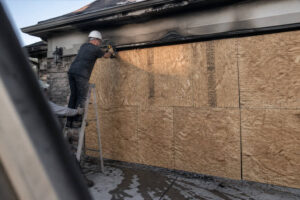
When the fire department leaves and the smoke clears, the damaged structure immediately faces a new set of threats that have nothing to do with the fire itself. Rain through broken windows. Snow through a compromised roofline. Unauthorized entry through a door that no longer closes. Theft of whatever remains. And in South Jordan’s climate — where January temperatures drop below 15°F overnight while daytime highs recover above freezing — a fire-damaged structure with open exterior penetrations can accumulate freeze-thaw water damage in wall cavities and subfloor assemblies within 24 hours of the fire being extinguished.
Emergency board-up is the first step that stops additional damage from compounding the fire damage. True Day Water Damage Restoration is a licensed Utah Contractor (#960332-3505) and IICRC-Certified Firm (ID #927354-5258), based at 11268 S 2865 W in South Jordan. We deploy board-up as quickly as possible after the fire department releases the property — the same day in virtually every case. Call us at (385) 247-9359.
Why Board-Up Cannot Wait
Every hour a fire-damaged structure sits open to weather, unauthorized entry, and environmental exposure converts potential restoration savings into reconstruction costs. The reasons are specific:
Weather intrusion in Utah’s climate: South Jordan’s Wasatch Front location creates a specific post-fire weather risk. The same freeze-thaw cycling that produces ice dam conditions on residential roofs throughout the valley — overnight lows well below freezing, daytime temperatures above 32°F — can drive meltwater into open structural penetrations and then freeze it in place within wall cavities and subfloor assemblies. Water damage from weather intrusion through an unsecured fire-damaged structure is not always separately covered by insurance — most policies expect the homeowner to take reasonable steps to prevent it, which means board-up.
Unauthorized entry and theft: A fire-damaged property with visible open windows and unsecured doors is visibly accessible. Remaining contents, appliances, copper plumbing, and salvageable materials become accessible targets. Fire investigators and restoration crews need a secured, undisturbed site to conduct their work accurately — a site that has been accessed by unauthorized parties compromises that chain of custody.
Liability exposure: An unsecured fire-damaged property creates liability risk for the owner. If anyone — including a child exploring — enters through an unsecured opening and is injured, the property owner may face tort liability consequences. Board-up addresses this risk.
Insurance Duty to Mitigate: Most homeowner’s insurance policies require the policyholder to take reasonable steps to prevent additional damage after a covered loss. Failing to board up promptly may give the carrier grounds to dispute coverage for weather damage or vandalism that occurs after the fire in an unsecured structure. Emergency board-up is typically covered as a mitigation expense — we document all work for inclusion in the claim.
What We Board Up and Tarp
Windows: All windows broken by heat, by firefighting ventilation operations, or by structural damage are covered with plywood panels secured to the surrounding framing. Panels are cut to fit, weather-sealed at the edges, and fastened securely enough to resist wind loading and unauthorized removal.
Exterior doors: Doors damaged during firefighting entry, destroyed by heat, or left otherwise compromised are covered with plywood panels secured to the door frame. In cases where the frame is intact, a temporary door panel can be installed to allow controlled access.
Compromised wall sections: Sections of exterior walls burned through, partially collapsed, or otherwise open to the exterior are covered with plywood framing installed to span the opening and provide weather protection and entry deterrence.
Roof tarping and board-up: Roof areas damaged by fire, missing shingles or sheathing, or compromised during firefighting are covered with heavy-duty polyethylene tarping secured with battens and nailing strips, overlapping at ridges and extending well beyond the damaged area. Where roof damage is extensive, plywood decking over the affected area may be installed under tarping for better structural support and weather resistance.
HVAC and utility penetrations: Open pipe penetrations, utility entries, and other structural openings created during firefighting are identified and temporarily sealed — preventing animal entry, debris infiltration, and weather intrusion through secondary openings that are easy to overlook in the larger assessment.
Board-Up as the First Step of Complete Fire Restoration
Because the same company handles board-up and full restoration, there is no gap in documentation, no loss of chain of custody, and no coordination delay between securing the property and beginning the restoration process. The board-up team documents all damage photographically before installing any panels — capturing the pre-board-up condition of every opening for insurance purposes. That documentation becomes part of the complete fire restoration claim file.
- Do I need to board up immediately after a fire?
- Yes, as soon as the fire department clears the structure. The Duty to Mitigate clause in every HO-3 and commercial property policy requires reasonable protective action after a covered loss. Additional damage through unprotected openings may be attributed to failure to mitigate rather than to the original fire event.
- Will insurance cover board-up costs?
- Yes. Board-up and emergency tarping are covered under the fire damage provision as necessary mitigation expenses. We document all work in Xactimate format and submit it as part of the fire damage claim.
- Can I do the board-up myself?
- Basic window and door boarding is feasible temporarily. Roof sections require structural fastening to existing framing at unsafe heights without proper equipment. Pre-mitigation documentation performed simultaneously with professional board-up is critical for the insurance scope — conditions obscured by DIY boarding materials may be missed.
Board-up is the entry point into the full fire restoration sequence. After securing the property, we transition to:
- Smoke Damage Cleanup
- Soot Removal
- Water Extraction from firefighting
- Structural Drying
- Odor Elimination
- Contents Cleaning & Pack-Out
- Full Reconstruction
- Insurance Claims Assistance
Learn more about our full fire damage restoration services.
True Day Water Damage Restoration | 11268 S 2865 W, South Jordan, UT 84095 | (385) 247-9359 | Utah Contractor License: #960332-3505 | IICRC Firm ID: #927354-5258
Emergency board-up: the first job before anything else
A home that just lost a window to firefighter forcible entry, a roof section to a kitchen fire, or wall sheathing to vehicle impact is an open structure. Weather can enter, wildlife can enter, and the home is not legally secure. Emergency board-up is the first scope line on any fire, storm, or impact loss — and it has to be done before extraction, drying, or structural assessment, because the structure can’t be worked on securely until it is closed.
What gets boarded
- Windows broken by heat, smoke release, or firefighter entry. Plywood cut to opening size + 4 inches, fastened to the framing with lag screws, sealed at edges with weather-resistant tape.
- Doors kicked, cut, or burned through. Full-size plywood panel if the frame is intact; frame-and-panel assembly if the frame itself was destroyed.
- Roof holes from fire ventilation. Tarped first (within hours of the fire ending), then plywood decking over the hole once the roof deck is dry enough to work on. Rapid tarping is usually how we respond before full roof board-up can be scheduled.
- Collapsed wall sections. Framing stabilization, then plywood sheet closure, then weather-resistant membrane. If structural engineering is required (load-bearing wall section loss), we coordinate with a Utah structural engineer before closure.
- Vehicle-impact openings. Similar to collapsed wall — stabilization first, closure second, insurance-grade documentation throughout.
Timing — the 24-hour window
Most Utah homeowners policies require "reasonable mitigation to prevent further damage" after a loss. An open structure left unsecured for days accumulates additional damage — weather infiltration, wildlife ingress, security breach — that the carrier may not cover because it was preventable. Board-up within 24 hours is the standard window; our response time is typically same-day or next-day for Salt Lake Valley addresses.
Insurance billing for board-up
Board-up and tarping are standard mitigation line items under Xactimate (BRD BRDUP, BRD TARP) and are billed at Xactimate pricing by linear foot or square foot of opening closed. Carriers approve mitigation board-up without pre-authorization because of the "reasonable mitigation" policy language — you don’t have to wait for an adjuster to call you back to authorize us to close an open structure.
We photograph every opening before and after board-up for the insurance documentation. The before-and-after photo pair is the audit evidence for the specific line item.
What board-up doesn’t cover
Board-up secures the structure; it doesn’t restore it. The plywood stays until permanent repair happens — a licensed Utah window installer, roofer, or framer handles the actual rebuild under our GC license. Typical timeline: plywood goes up on day 1-2, permanent repair happens over the next 1-6 weeks as part of the full reconstruction scope. If you plan to be in the home during that period, we talk through security, weatherproofing, and daylight considerations before completing the board-up — plywood over an entire wall section is secure but it is also dark and claustrophobic.
Emergency board-up — frequently asked questions
What emergency board-up actually does
Post-fire board-up is a mitigation requirement, not a cosmetic step. Utah homeowner policies and most commercial carriers require the property to be secured against further loss within hours of the fire being declared out, or additional damage (weather intrusion, theft, vandalism, animal entry) can be denied as a failure to mitigate.
Scope of a true emergency board-up
- Secure every opening: fire-breached windows, doors, roof penetrations, vented walls. Plywood sheeting minimum 1/2 inch, cut flush, fastened to structure (not just taped to the frame).
- Weather seal: plastic sheeting on roof holes and open walls to keep rain, snow, and wind-driven moisture out until permanent repair.
- Soft-barrier any damaged structural members flagged by the fire marshal.
- Documentation for the carrier: photo of every secured opening, square-footage of boarding, GPS-stamped site photos.
- Lock-change coordination if the structure is uninhabitable but still contains personal property.
Why GC-licensed matters here
Fire-damaged structures often have compromised framing. A board-up crew fastening plywood into charred or weakened structure can make the damage worse. We’re a Utah licensed General Contractor (License #960332-3505) — the same license that lets us do the reconstruction — so structural judgment calls on the board-up happen with the eventual rebuild in mind.
Why emergency board-up matters more than it looks
After a fire, the property has holes — broken windows, holes in the roof from firefighter axe-access, a front door that was forced for entry. Emergency board-up closes those openings before anything else happens. It’s not cosmetic. Here’s what it actually prevents and why insurance usually requires it:
| Risk if left open | What board-up prevents |
|---|---|
| Weather damage | Rain, snow, wind-driven moisture entering through broken openings — adds a water-damage claim on top of the fire claim |
| Animal intrusion | Raccoons, birds, mice entering open roof holes or windows — adds biohazard scope and nesting damage |
| Trespass / theft | Unsecured property is an attractive-nuisance liability; theft of appliances, copper, remaining valuables common on open structures |
| Liability | A trespasser injured on your unsecured property can file a claim against your homeowner’s insurance — even an uninvited one |
| Insurance coverage | Most policies require “reasonable steps to prevent further damage.” If you leave the property open and it rains into the fire-damaged structure, that water damage may be denied as preventable |
What a proper board-up includes
- 3/4" OSB or plywood cut to size, secured with lag screws or structural fasteners — not just plywood propped in place
- All broken windows, door openings, roof holes above 2 feet in area
- Weather sealing where the board meets the structure (so wind-driven rain doesn’t get past the board)
- “Private property, no trespassing” signage per Utah property-posting conventions
- Photos of the board-up for the insurance claim file
Timing
- Ideally within 4-6 hours of the fire department releasing the structure to you
- Our fire-damage board-up service is 24/7 — the time of the fire doesn’t change when we can get there
- We can start board-up the same visit as the initial fire-damage assessment; no need to schedule two separate dispatches
Call (385) 247-9359 after the fire department has cleared you to approach the structure. We handle board-up as a standalone service or as the first step of a larger fire-damage restoration scope — whichever you need.
What we actually install for board-up — and how it comes down later
Emergency board-up looks simple from outside, but there’s actual specification to it. “Plywood propped against the window” isn’t board-up; it’s a hazard. Here’s what proper board-up uses, and how we remove it when permanent repair happens.
Materials specification
| Opening type | What we install |
|---|---|
| Window (standard, up to 4×4 ft) | 3/4" OSB or exterior plywood, cut to size + 4" overlap, secured with 2×4 cleats on inside, through-bolted or 4" lag-screwed through sash and cleat; weatherstripping at edges |
| Window (large or picture window) | Same materials, additional vertical 2×4 bracing to prevent panel sag; may need two panels seamed with batten over the joint |
| Standard door opening | 3/4" OSB panel, hinged to studs or framed into opening; latchable hasp or padlock; weatherstripping |
| Sliding door | Full-size panel, lag-screwed to frame top and sides; vertical reinforcement; floor seal |
| Roof hole (small, <4 sq ft) | Peel-and-stick ice-and-water underlayment OR 3/4" plywood with roofing nails and sealed edges; tarp over top as secondary |
| Roof hole (large or structural) | Framed-in with 2×4 or 2×6 bridging on top of structural members (not just capping); plywood deck replacement; peel-and-stick + tarp; may require engineering sign-off first for structural safety |
| Wall opening or missing section | Framed enclosure with 2×4 studs on 16" centers; OSB sheathing; housewrap; weather seal |
Weather sealing
- Edges of boarded panels sealed with butyl tape or waterproof caulk where they meet the structure
- Vertical panel joints covered with battens and sealed
- Gaps at base of structure sealed to prevent wind-driven rain under
- Vents added if space will stay closed up for weeks — prevents moisture buildup inside
Signage
- “Private Property – No Trespassing” signage per Utah property-posting conventions on every boarded panel visible from public access
- Our company contact info (phone number) on signage so a passerby can report an issue
- Emergency contact for the property owner if applicable
Removal process (when permanent repair happens)
- We remove boards during our rebuild scope if we’re doing the restoration side — included in that scope, no separate charge
- If a different contractor is doing the rebuild, we return and remove boards on their schedule — or they can remove them (standard screws, standard tools)
- Boards are typically recycled or disposed of per standard waste disposal — we remove them from site
- Any mounting hardware that penetrated existing structure is removed carefully; holes patched during rebuild
Duration limits
- Proper board-up with weather seal: effective up to 90 days (longer in dry weather, less in winter wet)
- Thin plastic or thin tarp alone: much shorter — weeks at most before UV degrades it
- If permanent repair gets delayed past 60 days, we check the board-up and refresh seals or replace degraded panels
What to do before we arrive at a fire scene (and what NOT to do)
If you’ve just had a fire and you’re waiting for us to arrive for emergency board-up, there are specific things you can do and specific things you absolutely should not do. Safety is the priority; everything else is secondary.
- Make sure everyone is accounted for and safe
- Call us at (385) 247-9359 if you haven’t already — we triage, we dispatch
- Notify your insurance carrier (FNOL — First Notice of Loss) if you haven’t; we can coordinate once we arrive
- Photograph the exterior from a safe distance — sides of the structure, from the street, including nearby landmarks for context
- Collect important documents you had on you: ID, insurance cards, essential medications, phone chargers
- Arrange temporary accommodations if the home isn’t habitable — hotel, family, friends; your insurance ALE (Additional Living Expenses) usually covers reasonable costs
- Keep receipts for immediate expenses (lodging, meals, essential items purchased)
- Do NOT re-enter the structure to grab items — fire department release first; even then, limited entry with their permission
- Do NOT turn utilities back on if the fire department shut them off — wait for utility company and our assessment
- Do NOT accept help from unknown contractors who show up at the scene — a legitimate contractor won’t solicit at a fire scene; be especially cautious of “we’re already here, we can start right now” approaches
- Do NOT sign any “assignment of benefits” or contract on-scene without reading — some predatory contractors try to lock in work before you’ve thought about it
- Do NOT dispose of anything that might be evidence (fire origin, personal items that may be documented)
- Do NOT clean anything — even soot wipe-down on exterior — before documentation and insurance evaluation
- Do NOT remove the fire department’s “red tag” or do-not-enter signage
Who typically shows up at a fire scene
- Fire department — releases the structure when safe
- Red Cross — sometimes provides immediate assistance (shelter, meals) at residential fires; they’re legitimate
- Your insurance adjuster — usually dispatches quickly on major fires; may call before coming
- Us (and other restoration contractors you called) — emergency board-up and water-mitigation specialists
- Predatory contractors — show up uninvited, pressure for signatures; avoid
How to tell a legitimate restoration contractor at a fire scene
- They were called by you or your insurance, not just showing up
- They have a clearly marked service vehicle (not an unmarked van)
- They have company ID with a license number you can verify
- They don’t pressure you to sign anything immediately
- They coordinate with the fire department rather than treating the scene as their own
- They can give you a specific written estimate before you commit
What we do when we arrive
- Check in with you (and fire department if still on-scene) at a safe location
- Walk the perimeter to assess board-up scope — we don’t enter the structure until the fire department has released it
- Begin board-up on exterior openings while interior assessment waits for structural release
- Discuss insurance situation and immediate scope; signed authorization for emergency board-up specifically (not the full job yet)
- Written estimate for emergency scope; full-restoration estimate follows after we can access the interior
Fire scenes are chaotic; our job in the first hours is to be the calm, specific presence that handles the next step. Call (385) 247-9359.
Board-up when the home is rented — coordinating tenant and owner
Emergency board-up after a fire has a specific coordination problem when the home is rented. The tenant lived there; the owner holds the property; both have decisions to make and insurance interactions to manage. Here’s how we handle it:
- Fire department releases the structure — usually to the tenant if they’re present + listed on lease
- Tenant notifies landlord — standard lease requirement after major damage
- Landlord decides whether to authorize emergency board-up (or tenant does if specific lease terms grant that authority)
- Insurance adjuster(s) involved: landlord’s dwelling policy for the structure; tenant’s renters policy for personal property
Who typically authorizes emergency board-up
- Landlord authorizes as the property owner, usually within hours of fire department release
- Tenant can authorize if the lease specifies emergency-protection authority or if landlord can’t be reached in time
- In practice: emergency board-up is often started on tenant authorization with landlord ratification within 24 hours — it’s reasonable action to protect the property
What differs vs an owner-occupied home
- Tenant’s belongings are at the property; coordination for retrieval needed
- Tenant may need relocation assistance (their renter’s policy may cover ALE)
- Property owner may have different timeline preferences than tenant
- Insurance interactions span two policies with different scopes
Common tension points
- Timing of board-up decision: tenant wants it fast (their property is in there); landlord wants cost control
- Access control: who holds keys / access during board-up and ongoing work
- Decisions about whose contractor: landlord may prefer their own vendor relationships; tenant may want the fastest responder
- Documentation ownership: both tenant and landlord want copies of damage photos + reports
Specific documents we need
- Written authorization from whoever is authorizing the work
- Lease exhibit (if available) showing property responsibility boundaries
- Landlord contact info if we’re starting on tenant authorization
- Tenant contact info if we’re starting on landlord authorization
What we tell tenants calling us
- Call your landlord ASAP; we can also reach out if you have their contact
- Emergency board-up starts on reasonable authority; landlord gets looped in immediately
- Your renter’s insurance covers your contents + ALE; the fire-damage structural work goes through the landlord’s dwelling policy
- Don’t try to retrieve items from the house until the fire department has fully released it
What we tell landlords calling us
- Standard scope: board-up as emergency scope, written estimate for full restoration follows
- Access coordination with tenant for next steps
- Keep tenant informed of the restoration timeline — affects their ALE claim duration
- Written authorization for scope beyond immediate board-up
Insurance claim coordination
- Our Xactimate estimate covers the structural + restoration scope paid by the landlord’s dwelling policy
- Tenant’s claim is separate: contents inventory, additional living expenses, no structural scope on their claim
- We may provide copies of relevant documentation to both carriers with each party’s authorization
What we won’t do in a tenant-landlord scenario
- Scope beyond immediate emergency board-up without written authorization from whoever has authority
- Allow tenant to authorize larger-scope restoration work on behalf of the landlord without the landlord’s agreement
- Allow landlord to deny tenant reasonable access to retrieve personal belongings (not our role to arbitrate, but we don’t facilitate denial)
- Share one party’s documents or communications with the other without authorization
Rented properties with fire damage have more coordination complexity than owner-occupied. Call (385) 247-9359 and we’ll walk through the specifics on your situation.
What makes a board-up actually hold
A board-up is not a sheet of plywood over a window. Insurance expects three things from an emergency board-up and will dispute coverage of secondary losses — theft, vandalism, water intrusion through the opening — if any one of them is missing.
True Day’s board-up scope documents every opening this way. The small loss is the board-up; the big loss is what gets in through a bad one.
How long temporary coverings actually last
Tarps and board-ups are rated for short-term protection, not weather. A board-up installed properly today needs to be checked and often replaced before rebuild starts. Here is the honest service life of each temporary covering:
| Covering | Service life | Replace when |
|---|---|---|
| Standard blue poly tarp (6 mil) | 30-45 days in Utah conditions | UV degradation visible, tears, flapping edges, visible pooling under tarp |
| Heavy-duty green tarp (10 mil) | 60-90 days | Mechanical damage, failed anchor points, water intrusion detected |
| Reinforced construction tarp (14+ mil) | 90-120 days | Any sign of UV cracking at folds; replace proactively past 120 days |
| Shrink-wrap roof covering | 120-180 days | Snow load damage, UV cracking; actively monitored every 30 days |
| Plywood board-up (window/door openings) | 90-120 days | Warping, failed fasteners, moisture damage behind panel |
| OSB board-up | 60-90 days exterior | Edge-swelling visible, warping, moisture damage |
If rebuild starts within the service life, no issue. If rebuild stalls — adjuster back-and-forth, scope revision, contractor availability — the temporary covering often outlasts its service life and needs replacement to keep the structure weatherproof.
True Day flags temporary-covering replacement dates in the mitigation close-out documentation. The rebuild contractor inherits a timeline, not a surprise.