
Odor removal from True Day Water Damage Restoration: finding and removing the source first, then treating what’s left. Based in South Jordan, UT and serving the Salt Lake Valley — live-answered 24/7 at (385) 247-9359. IICRC Certified Firm #927354-5258, Utah license #960332-3505.
Odor Removal Services in South Jordan, UT
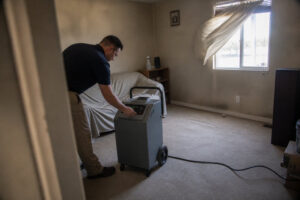 Odor is the last thing to leave a property after a significant damage event — and sometimes the only thing that remains after everything else has been addressed. A house fire where the smoke damage was professionally cleaned and the soot removed from every visible surface may still smell like the fire three months later, because the volatile organic compounds and polycyclic aromatic hydrocarbons that produce smoke odor are embedded in the gypsum core of the drywall, in the wood grain of the framing, in the carpet pile and the padding beneath it — in places that surface cleaning never reached. A sewage backup where the flooring was replaced and the walls were repainted may still carry the chemical signature of hydrogen sulfide in the framing behind the new drywall. A basement where the mold was remediated may still produce the musty character associated with microbial volatile organic compounds from hyphae residue in the oriented strand board subfloor.
These are not failures of the restoration work that preceded the odor. They are failures of understanding what odor actually is and where it actually lives — and therefore what it actually takes to eliminate it.
We get calls about odor after other companies have already been paid to address it. That call is a specific kind of frustration — quieter than the emergency that started the whole sequence, but more corrosive to the homeowner’s confidence in the process. They did everything they were told to do. They hired someone. They paid the invoice. And the house still smells like the thing that happened in it. We understand that frustration, and we want to explain — before any service conversation — exactly why that happens. Because understanding why is the only thing that prevents it from happening again.
True Day Water Damage Restoration is a licensed Utah Contractor (#960332-3505) and IICRC-Certified Firm (ID #927354-5258), based at 11268 S 2865 W in South Jordan. We provide professional odor removal throughout Salt Lake County — using technologies that penetrate where odor compounds are embedded and neutralize them at the molecular level. We do not mask odors. We eliminate them.
Call us at (385) 247-9359.
Odor is the last thing to leave a property after a significant damage event — and sometimes the only thing that remains after everything else has been addressed. A house fire where the smoke damage was professionally cleaned and the soot removed from every visible surface may still smell like the fire three months later, because the volatile organic compounds and polycyclic aromatic hydrocarbons that produce smoke odor are embedded in the gypsum core of the drywall, in the wood grain of the framing, in the carpet pile and the padding beneath it — in places that surface cleaning never reached. A sewage backup where the flooring was replaced and the walls were repainted may still carry the chemical signature of hydrogen sulfide in the framing behind the new drywall. A basement where the mold was remediated may still produce the musty character associated with microbial volatile organic compounds from hyphae residue in the oriented strand board subfloor.
These are not failures of the restoration work that preceded the odor. They are failures of understanding what odor actually is and where it actually lives — and therefore what it actually takes to eliminate it.
We get calls about odor after other companies have already been paid to address it. That call is a specific kind of frustration — quieter than the emergency that started the whole sequence, but more corrosive to the homeowner’s confidence in the process. They did everything they were told to do. They hired someone. They paid the invoice. And the house still smells like the thing that happened in it. We understand that frustration, and we want to explain — before any service conversation — exactly why that happens. Because understanding why is the only thing that prevents it from happening again.
True Day Water Damage Restoration is a licensed Utah Contractor (#960332-3505) and IICRC-Certified Firm (ID #927354-5258), based at 11268 S 2865 W in South Jordan. We provide professional odor removal throughout Salt Lake County — using technologies that penetrate where odor compounds are embedded and neutralize them at the molecular level. We do not mask odors. We eliminate them.
Call us at (385) 247-9359.
The Chemistry of Property Damage Odor — Why It Persists
Understanding why property damage odors persist despite cleaning and ventilation requires understanding what odor actually is at the molecular level — because that understanding determines which elimination technologies are effective and which are temporary. Odor is the olfactory response to volatile organic compounds — molecules that are in gaseous phase at room temperature and pressure and that are detectable by olfactory receptor cells at very low concentrations. A compound does not need to be present at high concentrations to produce a detectable odor: the threshold for human detection of hydrogen sulfide — the primary odor compound in sewage — is approximately 0.5 parts per billion. The human olfactory system is extraordinarily sensitive, which is why property damage odors that analytical instruments might classify as “trace” can be subjectively overwhelming to the occupants of a structure. The persistence of property damage odors after cleaning derives from the fact that odor-producing volatile organic compounds are not confined to the air — they are embedded in the solid and liquid phases of building materials and are continuously released into the air phase by off-gassing at a rate determined by temperature, vapor pressure, and the surface area of the contaminated material. A cubic foot of smoke-contaminated drywall contains far more odor compound mass in its solid phase than in the air column immediately adjacent to it. The air can be cleaned by ventilation or HEPA filtration, but as fast as the compounds are removed from the air, they are replenished by off-gassing from the solid material. The odor perception continues as long as the off-gassing continues — which is as long as the contaminated material remains in the structure. This is the mechanism that explains why consumer odor products fail for property damage applications. An air freshener introduces a competing odorant into the air phase — it does not reach the solid-phase reservoir of odor compounds in the building materials. When the air freshener dissipates, the balance of the competing fragrance versus the underlying odor compounds shifts back toward the damage odor. The solid phase reservoir is unchanged and continues off-gassing indefinitely.The Golden Rule of Odor Elimination — Source Removal First
Every odor elimination technique we use is governed by one foundational principle: no treatment produces lasting results if the physical source of the odor compounds is still present in the structure.- Smoke odor cannot be lastingly eliminated while smoke-contaminated building materials remain in place. The polycyclic aromatic hydrocarbons and volatile organic compounds embedded in contaminated framing, insulation, and drywall will continue off-gassing through any deodorizing treatment applied over them.
- Sewage odor cannot be eliminated while contaminated porous materials — drywall, carpet, padding, insulation — remain in the structure. Hydrogen sulfide and ammonia continue to off-gas from organic matter retained in these materials regardless of surface cleaning.
- Mold odor cannot be eliminated while active mold growth is present. Microbial volatile organic compounds — the musty aldehydes, ketones, and terpenes produced by mold metabolic activity — are generated continuously by living mold colonies. Deodorizing treatment applied while active mold is still growing provides hours of improvement, not lasting elimination.
- Water damage odor cannot be eliminated while structural materials remain at elevated moisture content. The musty odor associated with wet building materials is produced by bacterial decomposition of organic components in those materials — a process that continues as long as the moisture that enables it is present. Complete structural drying is prerequisite to any deodorizing treatment that will last.
Our Odor Elimination Technologies
Thermal Fogging
Thermal fogging uses a heated applicator to convert a professional deodorizing solution into an aerosol fog of extremely fine particles — typically 0.5 to 5 microns in diameter. Particles this small behave similarly to smoke in their ability to penetrate into enclosed spaces: they travel through wall cavities, into carpet fibers, into upholstery stuffing, and into the grain of wood surfaces — following volatile organic odor compounds into the same pore spaces where they are embedded. The deodorizing particles neutralize odor molecules on contact through a chemical pairing mechanism — they do not simply mask odors by overpowering them with a competing fragrance. Thermal fogging is particularly effective for fire and smoke odor because smoke-derived volatile organic compounds penetrate deeply into porous materials — and the thermal fog can follow them. The treatment typically requires the building to be unoccupied during application and for a drying period afterward, during which the fog settles and the chemical reaction proceeds. We conduct thermal fogging after surface cleaning is complete so that the fog can reach the substrate surfaces directly rather than working through a layer of uncleaned residue. Thermal fogging is especially valuable for South Jordan homes where smoke odor compounds have penetrated into the dense spray-applied orange peel and knockdown texture finishes common in this market. These textured surfaces have substantially more total surface area than smooth drywall — and correspondingly more substrate volume for odor compound absorption. The fine fog particle size that thermal fogging produces is what allows penetration into the irregularities of textured surfaces that larger aerosol particles cannot reach.Hydroxyl Generation
Hydroxyl generators produce hydroxyl radicals — a highly reactive oxygen-containing species with the chemical formula OH that is naturally present in outdoor air as a product of the photolysis of ozone by ultraviolet radiation from sunlight. Hydroxyl radicals are the primary mechanism by which the atmosphere self-cleanses volatile organic compounds from outdoor air — they react with and oxidize virtually all organic molecules, breaking them down into carbon dioxide, water, and shorter-chain compounds that are odor-inactive. Industrial hydroxyl generators replicate this process indoors using ultraviolet light and a water vapor spray to produce hydroxyl radicals at concentrations sufficient to oxidize indoor volatile organic compounds and microbial volatile organic compounds. The critical advantage over ozone treatment is safety: hydroxyl radicals at the concentrations produced by industrial generators are not harmful to humans, animals, or plants, and the generators can operate in occupied spaces without evacuation. This makes hydroxyl generation the preferred continuous treatment technology for ongoing odor reduction during restoration projects that span multiple days. Hydroxyl generation is particularly effective for mold-associated odors — the microbial volatile organic compounds produced by mold metabolic activity — because it attacks these gaseous compounds in the air phase continuously, reducing the ambient odor concentration progressively over the treatment period. We use hydroxyl generation during mold remediation projects to manage the musty odor in the work environment and adjacent occupied areas while the physical remediation work proceeds. Learn more about our mold remediation services.Ozone Treatment
Ozone — the triatomic oxygen molecule with the chemical formula O₃ — is one of the most powerful oxidizing agents available for odor elimination. It reacts with volatile organic compounds, bacteria, mold spores, and virtually all organic odor compounds on contact, breaking them down into odor-inactive products. For severe, persistent odors that have not responded adequately to thermal fogging or hydroxyl generation — particularly severe smoke odor in heavily contaminated spaces, or persistent biological odors in unoccupied structures — ozone treatment can achieve a degree of odor elimination that other methods cannot. The constraint is its toxicity at effective treatment concentrations. Ozone at the concentrations required for meaningful odor treatment — typically 1 to 10 parts per million — is hazardous to human respiratory health, harmful to pets and plants, and potentially damaging to certain rubber and latex materials in the treated space. The building must be fully evacuated, including all pets, houseplants, and sensitive materials, before ozone generation begins. After treatment, the space must be ventilated thoroughly — typically for 30 minutes to several hours depending on the treatment concentration and duration — before re-entry is safe. Ozone dissipates through a natural decay process to oxygen; it does not leave a persistent residue. We deploy ozone treatment as a targeted tool for specific situations rather than as a standard ongoing treatment — precisely because the evacuation requirement makes it impractical during active multi-day restoration projects where occupant access to unaffected areas of the building is needed.HEPA Air Scrubbing with Activated Carbon Filtration
Industrial HEPA air scrubbers equipped with activated carbon filter stages capture gaseous volatile organic compounds from the air phase through adsorption — the process by which molecules in gaseous or liquid phase adhere to the surface of a solid material through Van der Waals forces. Activated carbon has an extremely large internal surface area — typically 500 to 1,500 square meters per gram — which provides enormous capacity for adsorbing organic molecules from the airstream. The activated carbon stage captures what the HEPA filter cannot: the gaseous phase odor compounds that pass through particulate filters. Utilizing HEPA air scrubbers equipped with activated carbon filtration during the restoration process consistently diminishes the levels of volatile odor compounds in the air, gradually lowering the off-gassing equilibrium with each cycle and effectively reducing the overall concentration of odor compounds in the area over time. It does not reach the solid-phase reservoir in the building materials — that requires thermal fogging, hydroxyl generation, or ozone — but it meaningfully improves the in-air odor concentration during the restoration period. Learn more about our air scrubbing and HEPA filtration services.Enzymatic and Paired-Ion Deodorizers
For surface application where physical odor compounds are accessible at or near the surface of materials — rather than deeply embedded in the substrate — we use professional-grade deodorizing agents in two categories. Enzymatic deodorizers contain biological enzymes — specifically proteases, lipases, and amylases — that biologically catalyze the breakdown of the organic compounds that produce odors from sewage, urine, food decomposition, and biological sources. These enzymes are highly substrate-specific: a protease that breaks down protein-based odor compounds from sewage has no effect on the hydrocarbon compounds that produce smoke odor. Selecting the correct enzyme formulation for the specific odor source chemistry is essential for effectiveness. Paired-ion deodorizers work through a different mechanism: they release positively and negatively charged ion pairs that are electrically attracted to odor-producing molecules — which typically carry a charge imbalance — and pair with them chemically, neutralizing the molecular charge distribution that enables them to bind to olfactory receptors. The result is an odor compound that is chemically identical in its atomic composition but no longer detectable by olfactory receptors because its charge configuration has changed. Paired-ion deodorizers are effective against a broad range of odor compound types without requiring knowledge of the specific chemical identity of the odor source — which makes them valuable when the odor chemistry is mixed or unknown.Odor Sources We Eliminate — and the Local Context
South Jordan’s water supply context also shapes the biological odor situations we encounter. The Jordan Valley Water Conservancy District draws from both surface water and groundwater sources — including the valley aquifer system that underlies much of the Salt Lake Valley floor. The valley aquifer is a confined and unconfined system that receives recharge from Wasatch Range snowmelt, and in certain areas near the Jordan River floodplain and the historic Lake Bonneville shoreline benches, groundwater is relatively shallow. Properties in these areas experience not only the seasonal hydrostatic pressure basement seepage that creates mold conditions, but also groundwater with elevated total dissolved solids — including sulfate compounds — that, when it enters a basement as seepage or backs up through drain systems during wet periods, carries a faint sulfur odor signature even before any biological decomposition begins. This combination of inorganic sulfate off-gassing and subsequent biological hydrogen sulfide production from microbial activity in the wet organic building materials is a layered odor problem — two distinct chemical sources, both requiring different elimination approaches — that we encounter specifically in the lower-elevation corridors near 1300 West and 11400 South where shallow groundwater and older sewer infrastructure coincide.Fire and Smoke Odor
Smoke odor is caused by polycyclic aromatic hydrocarbons, volatile organic compounds including acrolein and benzaldehyde, and carbon particulate matter that carry adsorbed odor compounds into the pore spaces of every surface the smoke contacted during and after the fire. In South Jordan’s residential construction — particularly in Daybreak’s post-2006 contemporary craftsman homes with their dense engineered lumber structural assemblies and spray-applied textured finishes — smoke odor penetrates more deeply than in earlier, lighter construction. The engineered lumber I-joists and laminated beams that characterize Daybreak’s structural systems have larger exposed surface areas per unit volume than solid-sawn lumber, providing more substrate for smoke compound adsorption during a fire. Complete smoke odor elimination requires: physical removal of all materials that cannot be cleaned of odor compounds; professional surface cleaning with appropriate technique for each residue type; thermal fogging to reach the solid-phase odor compounds in the substrate; and hydroxyl generation run continuously during the post-cleaning period. Learn more about our smoke damage cleanup services.Sewage and Biological Odor
Sewage odor is produced by hydrogen sulfide — which is detectable by the human olfactory system at concentrations as low as 0.5 parts per billion — and by ammonia, generated by bacterial decomposition of urea and proteins in waste material. Both compounds are volatile at ambient temperatures and off-gas from contaminated materials at rates that maintain detectable concentrations in indoor air long after the sewage itself has been extracted. South Jordan sewage backup events — which peak during the North American Monsoon season from July through September when municipal sewer mains experience hydraulic surcharge — frequently occur in enclosed basements where the low air exchange rate allows these gases to accumulate to concentrations well above the detection threshold. Complete sewage odor elimination requires: removal of all porous materials that absorbed sewage contamination; multi-stage EPA-registered disinfection of all remaining surfaces; complete structural drying; and thermal fogging combined with hydroxyl generation for the residual volatile organic compounds embedded in retained structural materials. Learn more about our sewage cleanup services.Mold and Musty Odor
The distinctive musty odor associated with mold growth is caused by microbial volatile organic compounds — a class of small volatile molecules including geosmin, 1-octen-3-ol, and various aldehydes and ketones produced as metabolic byproducts by actively growing mold. These compounds are produced continuously by living mold colonies and are present at detectable concentrations even when visible mold coverage is limited. The human olfactory response to geosmin — the earthy compound produced by many soil and mold organisms — is extraordinarily sensitive, with detection thresholds as low as 5 parts per trillion in some individuals. This extraordinary sensitivity is why South Jordan homeowners sometimes report musty odors from wall assemblies that show no visible mold at the surface — the mold is present and producing microbial volatile organic compounds at detectable concentrations from inside the wall cavity, but has not yet produced sufficient surface coverage to be visible from the room side of the drywall. The odor is the earliest warning signal. Thermal fogging and hydroxyl generation after full mold remediation address the residual microbial volatile organic compounds in the treated structure. Learn more about our mold remediation services.Water Damage and Damp Odor
The musty odor associated with water-damaged building materials is produced by the same class of microbial volatile organic compounds as mold odor — generated by bacterial decomposition activity in wet organic building materials. This odor typically becomes detectable within 24 to 48 hours of water contact on cellulose-based materials and is an early warning that structural drying must be completed before mold amplification begins. The complete structural drying process — monitored daily with calibrated moisture meters until all materials return to equilibrium moisture content — is the prerequisite for any deodorizing treatment that will last. Learn more about our structural drying and dehumidification services.Why South Jordan’s Climate Affects Odor Persistence
South Jordan’s semi-arid high-desert climate creates a specific pattern in odor compound behavior that differs from more humid environments — and that affects both how persistent property damage odors are and which elimination technologies are most effective in this market. In the dry conditions that characterize South Jordan from October through June — with outdoor relative humidity frequently between 15% and 35% — volatile organic compounds off-gas from building materials at rates influenced by the ambient humidity level. Lower ambient humidity increases the vapor pressure differential between the solid-phase odor compounds in building materials and the gas phase in the room air, which tends to increase the rate of off-gassing. In practical terms, this means that smoke odor compounds in South Jordan’s dry winter conditions may be more aggressively released from building materials than the same compounds would be in a more humid climate — producing higher indoor concentrations of airborne odor compounds per unit of contaminated material. The flip side: South Jordan’s dry conditions also mean that the moisture contribution to musty and biological odor is less persistent than in humid climates. A properly dried basement in South Jordan — confirmed by calibrated moisture meter readings — will not re-accumulate the moisture that sustains biological odor production as rapidly as a basement in a coastal climate with chronically elevated outdoor humidity. Complete drying to verified dry standard is more durably effective here than it would be in a more challenging moisture environment. During the North American Monsoon season — July through September — the dynamic reverses. Outdoor relative humidity spikes to levels that slow the evaporation of odor compounds from damp surfaces, reduce the effectiveness of passive ventilation as an odor reduction strategy, and maintain the moisture conditions in basement and crawl space environments that sustain both musty biological odors and the mold colonies that produce microbial volatile organic compounds. Odor elimination during the monsoon season requires more aggressive active dehumidification and mechanical treatment and less reliance on ventilation. There is a particular quality to a South Jordan home in January where smoke odor from an October fire has persisted through two months of attempted ventilation. The house is cold, the windows have been kept closed for weeks, and the odor compounds that were marginally diluted during the brief warm spells have concentrated again as the temperature dropped. The homeowner has adapted to it — the way people adapt to persistent sensory input — and stopped noticing it at rest, but notices it acutely when returning from outside. Their guests notice it immediately. It is not a small thing to live with, and the technical explanation of why it is happening does not make it easier. What makes it easier is knowing it is fixable.A South Jordan Odor Elimination Project
In September 2022, we completed odor elimination treatment for a Riverton homeowner — a neighbor of South Jordan who had contacted us after seeing our work referenced in a Daybreak community discussion — following a sewage backup that had occurred two months earlier in a finished basement. The original cleanup had been performed by a different contractor who had replaced the flooring and repainted the walls but had not removed the framing-level wall assembly or conducted thermal fogging treatment. The odor had returned within three weeks of the original cleanup and had not resolved in the two months since. On arrival, the basement smelled of hydrogen sulfide and ammonia at concentrations our technicians could detect from the staircase before entering the space. The new flooring was in place. The new drywall and paint were in place. And the odor was worse than the homeowner had experienced before the original cleanup — because the new drywall had enclosed the contaminated framing behind it, restricting the natural ventilation that had at least partially diluted the off-gassing from those surfaces before re-enclosure. We removed the baseboards and cut ventilation channels — 4-inch diameter holes at stud-bay intervals — through the lower portion of the new drywall, allowing thermal fog access to the framing cavity without requiring full drywall replacement. FLIR thermal imaging confirmed that the framing and concrete block wall behind the drywall were dry — the structural moisture issue had been resolved by the original contractor. The odor source was the residual hydrogen sulfide and ammonia compounds that had penetrated into the wood framing and concrete block during the original backup event and were off-gassing through the new drywall. We applied enzymatic deodorizer through the ventilation channels directly to the framing surfaces, followed by thermal fogging through the same channels into the stud bays. The framing-level enzymatic treatment was held for the required dwell time before the thermal fog pass. We then ran hydroxyl generators in the basement for 72 hours following the fogging treatment. The ventilation channels were sealed with blocking and the drywall was patched before we conducted the final odor evaluation. The odor was gone. Not reduced — gone. The homeowner, who had been unable to use the basement for two months and who had been sleeping with the basement door sealed to prevent the odor from reaching the main floor, confirmed this at the walkthrough. Total cost of our odor elimination treatment: $2,840. The drywall replacement and flooring in the original cleanup had cost approximately $8,700. The odor elimination should have been part of that original scope — at the framing level, before the new materials were installed. It almost always should be.A Second Project — Mold Odor in a Daybreak Home After a Construction Defect
In April 2024, we were called by a Daybreak homeowner on a corner lot in the Founders Park Village section — a 2011-era contemporary craftsman with a west-facing wall that had experienced chronic moisture intrusion through an improperly flashed window rough opening for an estimated two to three years before the problem was identified during a pre-sale inspection. The wall cavity behind the window had Cladosporium and Aspergillus colonization across the full 8-foot height of the framing — growth that had been producing microbial volatile organic compounds into the living space through the drywall assembly throughout that period. The mold remediation had been completed three weeks earlier by a qualified contractor, and the wall had been rebuilt: new insulation, new drywall, new paint. But the musty odor remained. The homeowner had placed the house back on the market and had received a buyer offer that was now contingent on resolution of the odor — the buyer’s agent had walked through, detected the smell in the corner bedroom, and made it a contractual condition. The closing date was 22 days away. Our assessment confirmed that the framing was dry — the moisture source had been corrected and the structural drying verified before reconstruction. The odor was residual microbial volatile organic compounds from the Cladosporium and Aspergillus colonies that had penetrated the wood framing grain during the two-to-three-year growth period. The compounds were off-gassing through the new drywall at concentrations our technicians could detect at the new paint surface under raking airflow conditions — concentrations that were well within the extraordinary olfactory sensitivity range for geosmin and related mold metabolites, even if they would not register as elevated in a standard spore count air sample. We cut 3-inch access ports into the new drywall at two stud bays on the affected wall — positioned at mid-height and concealed behind the window casing trim — applied enzymatic deodorizer directly to the framing surfaces through the ports, allowed the required dwell time, and then conducted a thermal fogging pass through the same ports into each stud bay cavity. The ports were plugged with foam backer rod and the trim reinstalled. We then ran hydroxyl generators in the bedroom for 48 hours following the fogging treatment. The access port locations were invisible after reinstallation of the casing. The buyer’s agent conducted a re-walk seven days before the scheduled closing. No odor. The sale closed on schedule. The homeowner called us the day after closing to tell us the outcome. She mentioned, in passing, that the remediation contractor who had rebuilt the wall had told her the odor “would go away on its own in a few weeks.” It might have. But the closing was in 22 days and the buyer’s contingency was not. Knowing which treatment to apply, where to apply it, and how to do so without requiring another round of demolition — that is the difference between a service call that resolves the situation and advice that passes the problem down the calendar.Frequently Asked Questions — Odor Removal
Why don’t air fresheners eliminate property damage odors?
Air fresheners introduce a competing odorant into the air phase — they do not reach the solid-phase reservoir of volatile organic odor compounds embedded in building materials. When the air freshener dissipates, the odor returns in full from the unaddressed material source. Property damage odors require treatments that penetrate into the same pore spaces where the odor compounds are embedded and neutralize them chemically — not products that compete with them in the air.What is thermal fogging and how does it work?
A heated applicator converts a professional deodorizing solution into an extremely fine aerosol fog of 0.5-to-5-micron particles that penetrate into wall cavities, carpet fibers, wood grain, and other porous substrates — following volatile organic odor compounds into the same embedded locations. The particles chemically neutralize odor molecules through a paired-ion or binding mechanism. Applied after surface cleaning, thermal fogging reaches the substrate where odor compounds are embedded rather than treating only the surface.What is the difference between hydroxyl generation and ozone treatment?
Both oxidize and break down volatile organic odor compounds. Hydroxyl radicals — naturally occurring in outdoor air from ozone photolysis — are safe in occupied spaces and can run continuously. Ozone at effective treatment concentrations is toxic to humans, pets, and plants and requires full building evacuation during treatment and thorough ventilation before re-entry. We use hydroxyl generation as the continuous treatment and ozone as a targeted intervention for severe persistent odors in unoccupied spaces.Why must the source be removed before treatment?
Because any odor source still present in the structure will continue off-gassing volatile compounds faster than any treatment can neutralize them. Deodorizing treatment over an active source provides temporary improvement — a few hours or days — before the source re-establishes the odor concentration. Source removal and complete structural drying are prerequisites for lasting results. Deodorizing treatment applied after proper remediation produces permanent elimination.Related Services
- Fire Damage Restoration
- Smoke Damage Cleanup
- Air Scrubbing & HEPA Filtration
- Mold Remediation
- Sewage Cleanup
- Biohazard Cleanup
- Water Damage Restoration
- Structural Drying
- Dehumidification
- Reconstruction & Repairs
When the Odor Returned After the Cleanup — That Is the Call We Know How to Answer
A homeowner in Riverton whose odor returned three weeks after an $8,700 cleanup. A Daybreak homeowner whose closing contingency was a smell in a corner bedroom. The pattern is the same in both cases: the physical cleanup was done, but the molecular source was not addressed before the new materials went in. If an odor has returned after a cleanup, it was never eliminated — it was masked or temporarily reduced while the source remained. If an odor persists after restoration, the deodorizing treatment was applied before or without adequate source removal. These are correctable situations. True Day Water Damage Restoration is licensed, IICRC-certified, and locally based in South Jordan — equipped to identify what the source actually is, remove it properly, and apply the appropriate treatment sequence that produces permanent elimination rather than temporary improvement. True Day Water Damage Restoration 11268 S 2865 W, South Jordan, UT 84095 Phone: (385) 247-9359 Email: info@truedaywaterdamagerestoration.xyz Utah Contractor License: #960332-3505 IICRC Certified Firm ID: #927354-5258How odor removal actually works (and why air fresheners don’t)
Residual odor is one of the most common post-remediation complaints and one of the trickiest things to fix properly. The odor from a smoke event, a sewage backup, or a long-dwell water loss is caused by actual molecules — Volatile Organic Compounds (VOCs) and Microbial Volatile Organic Compounds (MVOCs) — stuck to and inside surfaces. Making them stop smelling means either removing the molecules or breaking them chemically. Air fresheners do neither; they just add a stronger smell on top. Here is the real protocol.
The three odor categories we handle, with different techniques
What we don’t do (and why)
We don’t fog masking agents. Scented chemical fogging that covers an odor with a stronger smell is not odor removal — it is a time-delay before the original odor returns, usually within days or weeks as the masking agent dissipates. We’d rather tell you the source isn’t fully resolved than hand you back a lemon-scented house that smells sewage-adjacent in a week.
We don’t run ozone with occupants present. Ozone at the concentrations needed for odor oxidation is a respiratory irritant and a lung-tissue oxidizer. The treated space must be fully evacuated for ozone cycles. Hydroxyl generators work at lower concentrations and some can run with occupants present per label, but we prefer unoccupied cycles for both techniques.
When residual odor means the clean wasn’t complete
A properly executed odor-removal protocol produces a clean, neutral-smelling space — not a scented one, a neutral one. If you can still smell smoke, sewage, or mold a week after we deliver the space, that is diagnostic information: a source was missed. Common misses include a wall cavity we didn’t open, a soft good that absorbed VOCs we didn’t fully clean, insulation that should have been replaced, or HVAC ductwork that still has residue. We come back under our warranty and investigate. If the source is in a space we scoped and treated, the warranty covers the fix. If the source is in an area we didn’t scope originally (owner-added items, new leaks, previously undisclosed damage), we identify it and discuss what the additional work would cost.
Odor removal — frequently asked questions
Different odors need different chemistry — here is which one your situation needs
A single “odor eliminator” product that claims to work on everything is a fragrance mask, not a neutralizer. Here are the four odor sources we see most and the specific chemistry each one requires.
Water-damage mildew and musty basement
Source: microbial VOCs released by actively growing or recently dormant mold. These compounds (geosmin, 1-octen-3-ol) bind to porous materials.
What works: dry the structure to IICRC S500 benchmark first — the mold stops producing new VOCs when moisture drops. Then accelerated hydrogen peroxide fog neutralizes residual molecules in cavities. HEPA air scrubbing captures particulate. Deodorization without drying only resets the clock.
Fire smoke and soot residue
Source: sub-micron combustion particulate and VOCs that penetrate porous materials and HVAC. Rebinds to residual moisture if any remains.
What works: IICRC S700 sequence — HEPA negative-air containment during soot cleaning, surface cleaning matched to residue type (dry/wet/protein, see our fire-damage page), structural dry to S500, then thymol fog as the final step. Order matters: deodorize last.
Pet urine — cat and dog
Source: uric acid crystals that fluoresce under UV. These crystals re-activate every time ambient humidity rises, which is why pet-stained carpet pads smell “clean” one week and sharp again the next.
What works: enzymatic cleaners that break the uric acid chain — a general-purpose cleaner only moves them. Carpet pad removal is often required because the crystal layer sits beneath the carpet in the pad itself.
Protein cooking residue (kitchen fires)
Source: aerosolized fat and protein from food fires — thin yellow-brown film that is almost invisible on first inspection but has a persistent “old grease” odor.
What works: enzymatic surface cleaner on affected surfaces first, degreasing on cabinet interiors and HVAC returns, then thymol fog. General-purpose degreasers mask the smell for a week; the enzyme actually breaks the protein chain.
Odor type → method decision tree
Different odors need different treatments. Using the wrong method either doesn’t work or makes it worse. Here’s the breakdown by source type.
Common residential odor sources
| Odor source | Chemistry | Primary treatment |
|---|---|---|
| Pet urine (dog + cat) | Uric acid crystals bond to surfaces; reactivate with humidity | Enzymatic cleaner specifically for pet urine; sometimes requires carpet-pad or subfloor replacement |
| Cigarette smoke (long-term) | Tar + nicotine deposit on all surfaces; absorbs into porous materials | Surface cleaning + encapsulation sealers on structural wood; HEPA + carbon filtration; sometimes drywall replacement |
| Fire smoke (recent event) | Varies by what burned — dry smoke, wet smoke, or protein smoke | See soot removal for method-by-type breakdown |
| Mildew / musty basement | MVOCs from fungal growth; indicates active moisture | Source removal (fix moisture + remove growth) + HEPA filtration; smell returns if moisture isn’t fixed |
| Cooking odor (fish, curry, grease) | VOCs absorbed into porous surfaces + HVAC filter | HEPA + carbon filtration; HVAC filter change; occasional hydroxyl treatment on severe cases |
| Sewage | Hydrogen sulfide + bacterial VOCs | Full S500 Cat 3 protocol; see sewage cleanup |
| Dead animal | Decomposition compounds (cadaverine, putrescine) | Source removal + enzymatic cleaner + HEPA + possible ozone treatment on severe cases |
| Mold (visible or hidden) | MVOCs from active growth | Full S520 remediation; air scrubbing doesn’t fix without source removal |
What doesn’t work on any of these
- Air fresheners (add competing scent, don’t remove source)
- Candles (same)
- Baking soda on carpet (surface-only, doesn’t penetrate)
- Vinegar + water (works on light cooking residue, not much else)
- Opening windows alone (dilutes but doesn’t remove source)
When ozone treatment is appropriate
Last-resort for residual odor after source removal + surface treatment is complete. Ozone oxidizes molecules in the air during treatment; must be run with no occupants (per S500 safety protocols) and the structure aired before re-entry. Not a substitute for source removal.
Musty, earthy, mildew smell — identifying the source before treating the odor
Odor removal starts with source identification. Masking a smell without finding the source is temporary at best, misleading at worst. Here’s how we distinguish mold-origin odor from other causes:
If you’re calling about an odor, the first call is diagnosis: what does it smell like, where is it strongest, when does it get worse. From there the scope either becomes mold remediation, sewage work, or odor-only. Treating the wrong one is why odor jobs sometimes get redone.
Thermal fogging and encapsulant sealers — the odor finish line
After the odor source is removed and air exchange has done its work, there is sometimes residual odor absorbed into structural surfaces. Two techniques address that last-mile problem:
Both are scoped only when first-pass work hasn’t fully resolved odor. Starting with fogging-plus-sealing on day one is a shortcut around the actual work — and we don’t scope it that way.
Why odor comes back three weeks later — and what the real fix usually is
You call for odor remediation. The air clears. Three weeks later, the smell is back. This is a common pattern and almost always traces to one of the following causes:
If odor returns on a job we did, call us within the warranty window. The return visit is part of the service, not a new one.
HVAC coil and condensate pan — the overlooked odor source
Air passes over the evaporator coil and condensate pan every time the HVAC runs. Both surfaces stay cool and often damp — which is why they’re a common home for biofilm, mold, and bacterial growth that produce persistent odor nobody can find. Here is what cleaning them actually involves:
If an odor job has been to the house twice and nobody has looked at the air handler, that’s where the third visit should start.
“My rebuild smells weird” — new-construction smell vs mold smell
After a reconstruction completes, homeowners sometimes report a smell they’re worried indicates mold is coming back. Usually, it’s not mold — it’s new-material off-gassing. Here’s how to tell:
How we trace a musty smell to its source
A musty smell is a symptom. Deodorizing it without finding the cause just delays the next call. Here is the sequence we follow:
Ozone, hydroxyl, and thermal fogging — what each is for
These tools treat odor that remains after the source is removed. None of them replaces removing the source.
| Method | Best for | Occupancy |
|---|---|---|
| Ozone generator | Strong odors in an empty space, such as heavy smoke | No people, pets, or plants present during treatment; space aired out before re-entry |
| Hydroxyl generator | Ongoing odor and VOC reduction over several days | Generally used with the home occupied |
| Thermal fogging | Smoke odor that has penetrated materials the way smoke did | Space vacated during and after treatment until cleared |
| HEPA air scrubbing | Removing airborne particles that carry odor | Runs with the home occupied |
For musty, mold-related odor, the fix is finding and removing the growth and the moisture behind it. Deodorizing first just hides the clue we need.
Sewage odor that won’t go away
A lingering sewage smell usually means contaminated material is still there — under flooring, inside a wall cavity, or in a dried-out floor drain trap. Pour water into unused floor drains to refill the trap. If the smell persists, the source needs finding before any odor treatment will work.