
Smoke damage cleanup from True Day Water Damage Restoration: residue removal, odor treatment, and contents cleaning after a fire. Based in South Jordan, UT and serving the Salt Lake Valley — live-answered 24/7 at (385) 247-9359. IICRC Certified Firm #927354-5258, Utah license #960332-3505.
Smoke Damage Cleanup in South Jordan, UT
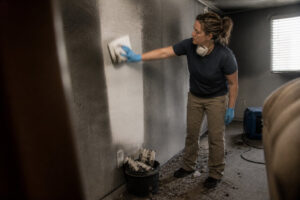
The fire is out. The fire department has left. The remaining sections of the house, untouched by the fire, are coated with a light layer of soot that emits an indescribable odor. Acrid. Chemical. Settled into the carpet and the curtains and the drywall in rooms where there was never a flame. The homeowner’s first instinct is to open windows. To wipe the walls. To put on a mask and start cleaning.
That instinct, in almost every case, is wrong — and acting on it makes the situation worse.
Smoke damage cleanup is a technical discipline with a specific sequence, specific tools, and specific techniques matched to specific residue types. The wrong technique applied to the wrong soot makes the soot permanent. The right technique applied in the wrong sequence produces the same result. And neither addresses the smoke damage that is not visible — the residue inside wall cavities, inside ductwork, on the surfaces of mechanical systems that will redistribute it to every room in the house every time the furnace cycles.
True Day Water Damage Restoration is a licensed Utah Contractor (#960332-3505) and IICRC-Certified Firm (ID #927354-5258), based at 11268 S 2865 W in South Jordan. We provide professional smoke damage cleanup throughout Salt Lake County — with technique matched to residue type, sequence matched to the physics of smoke migration, and documentation matched to what your insurance carrier requires.
Call us at (385) 247-9359.
Why Smoke Damage Is a Time-Critical Emergency
Smoke is not simply dirty air. It is a suspension of fine carbon particles, ash, incompletely combusted organic compounds, and a complex mixture of chemical byproducts that varies with the fuel composition and combustion temperature of the specific fire. When smoke settles on surfaces — which it begins doing within minutes of a fire — it does not merely sit there. The acidic compounds in smoke residue begin attacking the surfaces they contact immediately and continuously.
The specific chemistry matters. Polycyclic aromatic hydrocarbons — a class of organic compounds produced by the incomplete combustion of carbon-containing materials — are among the most persistent and carcinogenic components of smoke residue. Acrolein — a highly reactive aldehyde produced when fats and oils are burned — is responsible for much of the sharp, eye-irritating quality of cooking fire smoke and bonds aggressively to metal surfaces. Sulfur dioxide reaction products from burning materials containing sulfur create sulfuric acid on metal surfaces, beginning the corrosion process within hours of deposition. These volatile organic compounds continue to off-gas from surfaces where they have deposited, reducing indoor air quality and maintaining the smoke odor in the building long after the visible residue is addressed.
The timeline of damage progression after a fire without professional cleanup follows a predictable arc:
- Within minutes to hours: Smoke residue begins discoloring walls and ceilings. Acidic compounds begin etching glass, chrome, and metal fixtures. Porous surfaces begin absorbing residue below the surface layer.
- Within hours: Metal fixtures — door hardware, plumbing fixtures, appliance surfaces — begin to tarnish and corrode visibly. Smoke odor compounds begin to penetrate more deeply into upholstery fibers, carpet pile, and wood grain.
- Within days: Permanent yellowing and discoloration of walls, ceilings, and porous materials. Tannins in wood surfaces react with smoke acidic compounds to produce brown staining that bleeds through paint regardless of how many coats are applied without proper treatment. Fabrics and soft goods that were salvageable become progressively less so.
- After one week: Many surfaces that could have been cleaned become permanent write-offs. Reconstruction cost increases substantially. The odor compounds embedded in structural materials become more difficult to eliminate as they bond more deeply to substrates over time.
Every day of delay is not just an inconvenience — it is a measurable conversion of salvageable materials into materials requiring replacement, and a measurable increase in total restoration cost and scope.
How Smoke Travels — The Whole-Building Problem
The geographic distribution of smoke damage inside a building after a fire consistently surprises homeowners — and consistently determines the scope of cleanup work. Smoke does not stay in the room where the fire occurred. It follows heat and pressure differentials through every available pathway, depositing soot residue on every surface it contacts throughout the structure.
Direct Migration Pathways
Hot smoke rises by convection and moves horizontally through open doorways into adjacent and distant rooms. It enters wall and ceiling cavities through electrical boxes, pipe penetrations, structural gaps in top plates, and anywhere the building envelope has an unsealed opening between the fire space and adjacent spaces. It moves through stairwells, up to upper floors, and into attic assemblies through ceiling penetrations. In South Jordan homes with open floor plan designs — common in Daybreak’s contemporary craftsman construction and increasingly prevalent in renovated older homes throughout the valley — the smoke distribution throughout the main floor is effectively instantaneous, because the kitchen, dining, and living areas share a unified air volume with no interior barriers.
HVAC Distribution — The Invisible Transport System
The HVAC system is the most consequential smoke distribution pathway in most residential fires — and the one that produces the most surprise when the whole-building assessment reveals residue in rooms the homeowner was certain were unaffected. When smoke enters the HVAC return air system — which can happen even in fires several rooms away from the return air grille, because the air handler creates negative pressure at the return that draws smoke toward it — the air handler distributes it through supply ducts to every connected room.
The fine soot particles that travel through ductwork are among the smallest produced by combustion — particles that HEPA filtration captures at 99.97% efficiency at 0.3 microns, but that a standard HVAC filter does not capture. Particles settle onto the surfaces of ducts, register covers, and cooler areas of rooms, particularly at the ends of lengthy duct runs where the airspeed decreases. A homeowner who runs the HVAC system after a fire — for comfort, because the house is cold, because the fire was in only one room — redistributes these particles to every room the system serves, repeatedly, with each operating cycle. By the time they call for professional cleanup days later, the “clean” rooms have received multiple passes of soot-laden air from the contaminated duct system.
HVAC cleaning is not optional in fire restoration. It is a required component of complete smoke damage cleanup — and it must be completed before room surface cleaning to prevent recontamination of cleaned surfaces from ongoing duct distribution. Learn more about our air scrubbing and HEPA filtration services.
Smoke Residue Types — Why One Approach Does Not Fit All
The most consequential technical decision in smoke damage cleanup is identifying the type of residue present in each affected area and selecting the cleaning technique appropriate to that residue type. Different combustion conditions produce fundamentally different residue chemistries — and applying the technique appropriate to one type to another type either fails to clean the surface or actively makes it worse.
Dry Smoke Residue
Produced by fast-burning, high-temperature fires with good oxygen supply — paper, wood, and natural cellulose materials burning at or above their ideal combustion temperature. Dry soot is fine and powdery, ranging from light gray to dark black. It is the most easily airborne of the smoke residue types and the most commonly encountered in South Jordan residential kitchen fires where paper and wood materials ignite quickly.
The critical technical point about dry soot: contact with a cloth, sponge, or damp surface smears the particles horizontally across a wider area and simultaneously drives them vertically deeper into the porous surface below. The smearing converts a surface residue into an embedded residue that requires chemical treatment rather than simple cleaning. Dry soot must first be addressed with a dry chemical sponge — a dense, non-abrasive sponge that lifts particles through adhesion rather than smearing them through contact pressure — using single-direction strokes that deposit lifted material into the sponge rather than spreading it across the surface. HEPA vacuuming of loose surface particles before dry chemical sponging further reduces the smear risk. Only after all dry soot is removed does any wet cleaning begin.
Wet or Oily Smoke Residue
Produced by slow-burning, low-temperature smoldering fires or by fires involving synthetic materials, rubber, foam upholstery, and petroleum-based products that release oily smoke at incomplete combustion temperatures. Wet soot is sticky, highly adherent, and carries a penetrating odor that is chemically more complex and more resistant to elimination than dry soot odor. It penetrates porous surfaces rapidly and aggressively and is significantly more difficult to remove per affected square foot than dry soot — requiring appropriate emulsifying degreasers applied in multiple passes with appropriate agitation and rinse sequences.
Wet soot situations are often the most expensive to remediate per room because the cleaning process is inherently more labor-intensive, and the odor component — produced in part by acrolein and sulfur compounds from the smoldering combustion — is more deeply embedded in porous substrates and more resistant to elimination by thermal fogging or hydroxyl generation alone.
Protein Fire Residue
Produced by kitchen fires involving the burning of food proteins, fats, and cooking oils — the most common fire type in South Jordan residential properties given the frequency of unattended cooking as a fire origin. Protein residue is the most deceptive of the smoke residue types because it is often nearly invisible. Unlike the dark soot that dry or wet fires produce, protein residue leaves only a slight yellowish or greasy film on surfaces — not obviously “soot” to visual inspection — while producing an extremely strong, distinctive odor and bonding tenaciously to surfaces through a different chemical mechanism than soot adhesion.
The chemical specificity of protein residue matters: standard degreasers designed for petroleum-based soot are largely ineffective against protein bonding. Enzymatic cleaning agents — which biologically break down the protein chains that bind the residue to surfaces — are required. Protein residue also discolors painted walls in a yellowish pattern that bleeds through standard latex paint regardless of how many coats are applied, because the residue is not on the paint surface but has been absorbed into the paint matrix. Shellac-based or oil-based primer sealer must be applied after protein residue cleaning before any finish paint is applied.
Fuel Oil Soot from Furnace Puff-Back
A distinct and particularly pervasive smoke residue type produced when a fuel oil furnace malfunction — typically a delayed ignition or a burner assembly failure — causes a combustion backfire that sends extremely fine oily soot through the HVAC system and into every room connected to the duct network. Fuel oil soot is among the finest and most deeply penetrating of smoke residue types. A single furnace puff-back can coat every surface in an entire home with a thin black film through HVAC distribution. The response requires HVAC cleaning as the first priority before any surface cleaning — because continuing to operate the system, or attempting surface cleaning before the duct source is addressed, continuously redeposits residue on cleaned surfaces. Learn more about our soot removal services.
Our Smoke Damage Cleanup Process
Step 1 — Whole-Building Smoke Assessment and Documentation
Before any cleaning begins, we conduct a systematic room-by-room assessment of every space in the building — including rooms that appear visually unaffected. Using FLIR thermal imaging cameras to detect temperature differentials and visual inspection under consistent lighting conditions, we document the presence and density of smoke residue in every area, identify the residue type in each location, and establish the cleaning technique required in each space. All findings are documented with timestamped photographs before any cleaning converts an assessable surface into an assessed-and-treated one.
This initial documentation serves a dual purpose: it establishes the baseline for the insurance claim — capturing the condition of every surface in the building before cleanup — and it informs the cleaning sequence and technique selection that determines how effective the subsequent cleanup will be.
Step 2 — HEPA Air Scrubbing Deployment
Industrial HEPA air scrubbers are deployed throughout the property immediately and run continuously throughout the entire cleanup process. HEPA filtration — which captures 99.97% of airborne particles at 0.3 microns — captures airborne smoke particles before they can settle on cleaned surfaces, protecting the cleaning work already completed from ongoing smoke deposition from the air. This is particularly important in the first hours after our arrival, when the agitation of beginning cleanup work can temporarily increase the concentration of smoke particles in the air of affected rooms. Learn more about our air scrubbing and HEPA filtration services.
Step 3 — HVAC System Decontamination
HVAC cleaning precedes surface cleaning in every fire restoration project where smoke entered the air handling system. Cleaning room surfaces before the HVAC system is decontaminated and before HEPA air scrubbers are reducing the ambient particle concentration means cleaned surfaces are immediately exposed to ongoing soot distribution from the duct system — negating the cleaning work within hours. We coordinate professional HVAC duct cleaning — covering ductwork, registers, air handler components, coil surfaces, and the blower assembly — before proceeding to systematic room surface cleaning. The sequence of smoke cleanup is as important as the technique.
Step 4 — Contents Assessment and Pack-Out
Contents — furniture, clothing, personal items, electronics, documents, and household goods — are inventoried and assessed for salvageability. Items that require off-site professional cleaning are carefully packed out for cleaning and deodorizing at our facility, away from the ongoing smoke environment of the structure. Items that cannot be restored are documented for insurance claim purposes. This documentation provides the personal property component of the insurance claim — and its completeness directly affects the personal property settlement. Learn more about our contents cleaning and pack-out services.
Step 5 — Systematic Surface Cleaning
Beginning with the technique appropriate to the specific residue type in each area, our technicians systematically clean all smoke-affected surfaces throughout the building — working from top to bottom in each room (ceilings, then walls, then trim, then floors) and from the most heavily affected rooms outward, to prevent cross-contamination of less-affected areas. The cleaning sequence within each surface type follows the residue type protocol: dry chemical sponging before wet cleaning for dry soot; emulsifying degreaser in multiple passes for wet soot; enzymatic treatment for protein residue.
Specific surface types require specific considerations:
- Painted drywall: Dry sponging before wet cleaning to avoid smearing; appropriate cleaning solution matched to paint type; care taken with flat paint finishes that mar under abrasive cleaning pressure
- Wood trim and surfaces: Cleaning solution matched to the wood finish type — lacquered, painted, stained, and raw wood require different approaches; stained and raw wood surfaces with smoke residue may develop tannin-reaction brown staining that requires specific treatment before refinishing
- Metal fixtures: Cleaned and treated promptly because soot acidic compounds — including acrolein oxidation products and sulfuric acid precursors — accelerate metal corrosion; tarnished metal may require specific metal restoration treatment beyond cleaning
- Glass: Cleaned with appropriate glass cleaning agents; glass that has been exposed to acidic soot compounds for more than 24 to 48 hours may show permanent surface etching that cleaning cannot reverse
- Brick and masonry: Highly porous substrates that absorb smoke residue deeply; require appropriate masonry cleaning products and technique; masonry that is part of a fireplace surround may require specific treatment for combination fire and smoke deposits
Step 6 — Odor Elimination
Smoke odor is not a surface problem. The volatile organic compounds and polycyclic aromatic hydrocarbons that produce smoke odor penetrate into porous building materials — into the wood grain of framing, into the gypsum core of drywall, into the fiber matrix of carpet and insulation — and continue to off-gas from those embedded locations long after surface cleaning is complete. Eliminating smoke odor requires treatment technologies that penetrate into the same spaces where the odor compounds are embedded.
We use two primary odor elimination technologies after surface cleaning is complete:
- Thermal fogging: A heated applicator converts a professional deodorizing solution into an extremely fine fog of microscopic particles. The fog penetrates into wall cavities, wood grain, carpet fibers, and upholstery — following smoke compounds into the same pore spaces where they are embedded — and chemically pairs with and neutralizes them at the molecular level.
- Hydroxyl generation: Industrial hydroxyl generators produce hydroxyl radicals — highly reactive molecules that oxidize volatile organic odor compounds and break them down at the molecular level. Unlike ozone treatment, hydroxyl generation is safe in occupied spaces. Unlike thermal fogging, it can operate continuously throughout the restoration process rather than requiring a building-vacant treatment period.
Learn more about our odor removal services.
Step 7 — Surface Priming and Preparation for Reconstruction
Cleaned surfaces that will be repainted — even those that appear visually clean after professional smoke cleanup — require application of shellac-based or oil-based stain-blocking primer before any finish paint is applied. This step addresses two residual issues: first, tannin compounds in wood and wood-based materials react with smoke acidic residue to produce brown staining that bleeds through standard latex paint repeatedly regardless of how many coats are applied; second, smoke odor volatile organic compounds embedded in drywall and wood surfaces off-gas through standard latex paint but not through shellac or oil-based primer barriers. Skipping this step produces yellowed, odorous paint within weeks of reconstruction, requiring complete repainting. It is not an optional step — it is a required precondition for a lasting cosmetic result.
Step 8 — Full Reconstruction
Where smoke damage has required material removal — charred or severely smoke-contaminated drywall, damaged structural materials, flooring that cannot be cleaned — our licensed general contractor team (Utah License #960332-3505) performs all reconstruction, returning the space to pre-loss condition. Learn more about our reconstruction and repair services and our full fire damage restoration process.
Smoke Damage in South Jordan Homes — Specific Patterns
Our fire and smoke restoration work in South Jordan concentrates specific patterns by construction era and architectural type — patterns that inform how we approach the initial assessment and what we expect to find before we enter a specific home.
Open Floor Plan Distribution in Daybreak Construction
Daybreak’s post-2006 contemporary craftsman and modern farmhouse homes are characterized by open floor plans that eliminate the interior wall barriers common in older construction. A kitchen fire in an open-concept first floor — which describes the majority of Daybreak’s residential layouts — produces smoke distribution across the kitchen, dining, and living areas simultaneously, as these spaces share a unified air volume without doors or structural barriers to impede smoke movement. By the time the fire department arrives and suppresses the fire, the smoke has already saturated all surfaces in the combined space.
The engineered lumber structural systems common in Daybreak’s construction era also create specific smoke migration pathways: I-joist floor systems have web openings that allow smoke to travel through the floor-ceiling assembly between levels more readily than solid sawn lumber platforms do. A kitchen fire on the first floor of a Daybreak two-story may distribute smoke to the second floor through I-joist web openings in addition to the stairwell pathway — a migration route that visual inspection of the second floor does not always make obvious.
HVAC Distribution in Established Neighborhoods
South Jordan’s pre-2000 construction — the ranch and split-entry homes in established neighborhoods along the 10200 South corridor, near Towne Center Square, and in the communities west of Redwood Road — typically features central forced-air HVAC systems with duct networks that connect multiple levels and wings of the home. In these layouts, a fire in any connected room creates the potential for whole-building smoke distribution through the HVAC system if the system is operating during or after the fire. Older duct systems in these homes may have accumulated layers of dust and debris that smoke residue adheres to — increasing the total soot load in the ductwork and requiring more thorough cleaning than a newer, cleaner system would need.
The South Jordan Winter Fire Pattern
South Jordan’s dry winter climate — with outdoor relative humidity frequently below 15% to 20% from November through March — creates a specific pattern in residential fires during this period. Low humidity not only increases the risk of fire from static electricity and creates dry indoor air but also leads to smoke residue adhering to surfaces faster than it would in a humid environment. Dry smoke residue that has been sitting for even a few hours in South Jordan’s winter interior conditions is more difficult to remove without smearing than the same residue in a more humid environment — because the residue has dehydrated and bonded more tightly to the surface. The urgency of rapid response — already high for any smoke damage event — is compounded by the drying conditions specific to this climate and this season. Learn more about our full fire damage restoration services.
A Smoke Damage Cleanup We Completed in South Jordan
In March 2024, we were called to a 2003-era ranch home near 10400 South in South Jordan following a grease fire that ignited in a cast-iron skillet and extended to the range hood before being extinguished by the homeowner with a fire extinguisher. The visible fire damage was limited to the range hood itself and approximately four square feet of cabinet soffit above it. The homeowner had extinguished the fire before calling the fire department and believed the damage was confined to the kitchen.
The homeowner’s HVAC system had been running on its normal heating cycle during the fire. The return air grille was located eight feet from the range on the kitchen ceiling — well within the smoke plume radius of the grease fire. By the time the fire was extinguished, the air handler had pulled smoke-laden air through the return, through the filter, through the heat exchanger, and distributed it through supply ducts to three other rooms on the main floor and one room on the lower level that was served by the same air handler.
Our whole-building assessment documented protein fire residue — the nearly invisible yellowish-greasy film characteristic of cooking fat combustion — on the ceiling surfaces of the dining room, living room, and the master bedroom hallway. The residue was not visible to the homeowner because protein residue does not present as dark soot. It presented as a slightly tacky, slightly yellowed ceiling surface that the homeowner had not noticed because the change was subtle. On white ceiling paint, protein residue deposition registers as a slightly warm tint against the white baseline — visible to trained inspection under raking light, invisible under normal overhead lighting conditions.
We cleaned the kitchen with enzymatic agents and multiple degreasing passes for the heavy protein residue near the fire origin. We cleaned the three main-floor rooms and the lower-level bedroom with lighter enzymatic treatment appropriate for the reduced residue concentration from HVAC distribution. The HVAC system was professionally cleaned before any room surface cleaning began. Shellac-based primer was applied to all ceiling surfaces before repainting — including in the rooms that had received HVAC-distributed residue, because protein residue bleeds through latex paint regardless of the visual appearance of the surface after cleaning.
The homeowner’s policy covered the event as fire damage with smoke extension. We submitted thermal imaging documentation of the HVAC distribution pathway — showing the temperature differential in ductwork from the warm smoke residue deposited during the fire — and a written explanation of the protein residue chemistry justifying the whole-building scope. Total approved: $8,640. Deductible: $1,000.
The homeowner told us, three days into the project, that she had originally planned to clean the kitchen herself and repaint. She had already purchased paint. She mentioned this not as a complaint but as a realization — that the rooms she would have left untreated were, in fact, already affected. The paint she bought would likely have yellowed within weeks due to the protein residue underneath it continuing to release gases through the top coat. She would have thought the paint was defective. It was not the paint.
Frequently Asked Questions — Smoke Damage Cleanup
How far does smoke damage travel from the fire location?
Throughout the entire building in most cases — smoke travels through doorways, HVAC systems, and structural penetrations to deposit residue in rooms on other floors and in other wings, including rooms that were never exposed to flame. In South Jordan homes with open floor plans and active HVAC during the fire event, whole-building smoke assessment is standard from day one. Learn more about our full fire damage restoration services.
Why does smoke damage need to be cleaned quickly?
Smoke residue contains acidic compounds — polycyclic aromatic hydrocarbons, acrolein, and sulfur dioxide reaction products — that corrode metal, etch glass, and penetrate porous surfaces deeper with every passing hour. Surfaces that are cleanable on day one become permanent write-offs by day seven. Every hour of delay is a measurable increase in restoration scope and cost.
Can I clean smoke damage myself?
Minor surface residue on hard non-porous surfaces may be addressable with appropriate cleaning agents. But using the wrong technique — wiping dry soot with a cloth — spreads it and drives it deeper permanently. HVAC cleaning requires professional equipment. Whole-building assessment requires FLIR thermal imaging. And protein residue requires enzymatic cleaning agents and shellac-based primer that consumer products do not provide.
Why does the HVAC system need to be cleaned after a fire?
Smoke entering the return air system is distributed to every duct-connected room by the air handler. Every time the HVAC operates after a fire without cleaning, it redistributes soot deposits from duct surfaces to all connected rooms — recontaminating cleaned surfaces and spreading residue to rooms the homeowner believed were unaffected.
Related Services
- Fire Damage Restoration
- Soot Removal
- Odor Removal Services
- Air Scrubbing & HEPA Filtration
- Fire Damage Board-Up
- Contents Cleaning & Pack-Out
- Water Damage Restoration
- Structural Drying
- Reconstruction & Repairs
- Drywall Repair
- Insurance Claims Assistance
Call True Day for Smoke Damage Cleanup in South Jordan, UT
Smoke damage cleanup is a sequence-dependent, technique-specific discipline where the wrong first step makes every subsequent step harder. True Day Water Damage Restoration is licensed, IICRC-certified, and locally based in South Jordan — equipped to assess whole-building smoke distribution, match technique to residue type, clean and decontaminate HVAC systems, and eliminate odors at the molecular level rather than masking them at the surface.
True Day Water Damage Restoration
11268 S 2865 W, South Jordan, UT 84095
Phone: (385) 247-9359
Email: info@truedaywaterdamagerestoration.xyz
Utah Contractor License: #960332-3505
IICRC Certified Firm ID: #927354-5258
What True Day guarantees on every job
Smoke damage cleanup FAQ
For small cooking fires, candle smoke, puffback events, and nearby-wildfire infiltration — what smoke-only cleanup involves.
Do I need professional cleanup if there was no visible fire?
How is smoke-only cleanup different from fire damage restoration?
What about smoke from a nearby wildfire?
Will insurance cover smoke-only cleanup?
Do you handle commercial smoke damage — restaurants, offices?
Reading the smoke: how we tell protein from wet from dry residue
Smoke damage in a home is almost never one uniform residue. A single fire event — a kitchen stovetop oil flare-up, a bedroom candle, an electrical panel short — produces soot that behaves differently depending on what burned, how hot, and how much oxygen. The cleaning chemistry has to match the residue chemistry, and reading the residue correctly on arrival is the single technical skill that distinguishes a successful smoke restoration from one that leaves behind permanent discoloration or odor.
The three residue types
Odor: Light smoky, campfire-like. Dissipates relatively quickly in the first few days.
What burned: Wood, paper, natural fiber in good oxygen conditions. A fireplace fire that got out of control, a dropped match on a rug, a brush fire against the exterior.
Cleaning: Dry — chemical sponge (the yellow "soot sponges"), HEPA vacuum, dry-brush techniques. Do not wet dry soot — adding water or liquid cleaner smears it into surfaces permanently.
Odor: Chemical, acrid, plastic-burning. Persists for weeks without deodorization.
What burned: Plastics, synthetic fabrics, foam insulation, electrical wiring, vinyl flooring. A slow smolder before active flame — electrical fires, cushion fires, mattress fires.
Cleaning: Wet — surfactant cleaning agents applied with specific technique. Degreasers for the oily phase, then rinse, then dry. More time-intensive than dry soot. Severely-wet-soot surfaces often need primer-sealer coat before paint even after cleaning, because the oily residue penetrates porous drywall paper.
Odor: Intense, putrid, bacterial-rotting. The smell is often worse than the visible damage and travels far from the fire origin — the whole house may smell even if only the kitchen burned.
What burned: Cooking oil, grease, meat, poultry on a stovetop. A pan fire, a forgotten burner, a grease fire. Also any protein-based material in a slow smolder.
Cleaning: Enzymatic cleaners specifically designed for protein break-down. Standard surfactants and solvents spread it rather than remove it. Protein film requires HEPA vacuuming, enzymatic cleaner application, dwell time, physical agitation, rinse, and often repeated passes. Deodorization has to follow — hydroxyl generation or ozone, because enzymatic cleaning removes the film but not the embedded odor molecules.
Why misidentification destroys the restoration
- Wetting dry soot → smears it permanently into drywall paper and carpet fibers. The job becomes a drywall-replacement scope that should have been a cleaning scope.
- Dry-cleaning wet soot → the oily residue stays. Surfaces look clean but smell chemical for months, and the smell comes back on humid days.
- Standard-cleaning protein → the enzymatic reaction doesn’t happen. The invisible film stays and the smell gets worse (because standard cleaning agitates it without breaking it down).
- Running ozone or hydroxyl before mechanical cleaning → the oxidizers react with the soot molecules on the surface and bake them permanently into drywall and ceiling paint. One of the most expensive mistakes in fire restoration.
Smoke damage — frequently asked questions
Smoke residue types and the chemistry each one needs
The single most common reason a professionally cleaned fire-damaged home still smells is wrong-chemistry cleaning — the smoke residue was treated as one thing when it is actually three. Here is how we identify each type on arrival and what we use for it.
| Residue type | Looks like | Source fire | Cleaning chemistry we use |
|---|---|---|---|
| Dry sootLight, powdery | Fine black-grey powder that wipes dry; comes off on a dry chemical sponge. | Paper, wood, cardboard — a fast, oxygen-rich fire. | Dry chemical sponge first (never water first — it smears). HEPA vacuum after. |
| Wet sootSmeary, sticky | Dark, oily smear that spreads if wiped dry. Thick on cool surfaces. | Plastics, synthetic carpet, upholstery — a slow, oxygen-starved fire that smolders. | Solvent-based degreaser matched to the surface, then neutral-pH rinse. Dry chemical sponge fails on this type and sets the stain. |
| Protein residueThin, yellowish | Nearly invisible yellow-to-brown film with a persistent food odor; often missed on first pass. | Kitchen fires — a small flame burning fat or protein without visible smoke. | Enzymatic cleaner that breaks down the protein. General-purpose degreasers only move it around. |
Why smoke smell comes back after “cleaning”
The most common complaint we hear after a post-fire cleaning done by someone else: the smell comes back. Usually it comes back within days of the ozone treatment or air scrubber being removed. Here’s why.
Where smoke molecules actually live
Smoke doesn’t just coat surfaces. The molecules penetrate porous materials — drywall paper, carpet pad, upholstery, wood framing, insulation. Even sealed-looking painted drywall absorbs smoke molecules into the drywall paper and gypsum behind the paint film.
Why surface cleaning alone fails
Washing walls removes visible soot. HEPA air scrubbing removes airborne particles. Ozone or hydroxyl treatment oxidizes molecules in the air during treatment. All three remove what you can address without opening the structure. None of them reach molecules trapped inside porous materials.
Days later, as the home’s humidity cycles up and down, the trapped molecules outgas back into the air. Smell returns.
Our actual smoke-remediation protocol
- Source identification — where the smoke penetrated worst, usually attic, upper walls, HVAC system
- Full HEPA + activated-carbon filtration continuously during cleanup, not just a session
- Surface cleaning every reachable surface with specialty smoke-residue removers (not generic household cleaners)
- HVAC system cleaning — ducts, coils, filter replacement. Smoke-contaminated ductwork recirculates odor through the whole home.
- Insulation removal in attic + wall cavities where penetration was significant. Insulation holds smoke molecules worst of any material.
- Porous-material replacement — carpet pad, upholstered items, severely-contaminated drywall
- Encapsulation sealers on structural wood (framing, subfloor exposed during demo) — these aren’t a shortcut; they seal remaining molecules into the structure after everything else is done
- Hydroxyl generator or ozone session as a final step on remaining airborne residuals, following IICRC safety protocols
How to tell if cleanup was done right
Walk the home 2-3 weeks after cleanup is complete, on a humid day (or run a humidifier). If smell returns, source material is still present. We’ve been called in after other firms when exactly this happened — finishing the job then requires finding and addressing what the first round missed.
Why the smell comes back from the vents — and what we do about it
If the furnace or A/C ran during or after a fire, smoke particulate and odorous volatile compounds were pulled into the return air and distributed throughout the duct system. The surfaces inside the ducts (sheet metal, flex-duct lining, the blower wheel, the evaporator coil) all now have smoke residue. Clean the rooms perfectly and the smell still comes out of the vents the first time you turn the system on. This is the single most common reason a smoke job “fails” a couple of weeks after the crew leaves.
Fire → return air pulls smoke in through grills and floor returns → filter traps some particulate but not the smell → smoke passes through blower → through evaporator coil (wet surface in A/C mode = sticky) → out supply runs → residue settles on inside of duct walls and at every bend → smell releases back into rooms whenever the system runs.
What proper duct cleaning after a fire includes
- Mechanical cleaning: rotating-brush agitation with high-CFM negative-air vacuum pulling at the furnace end — not just a hose stuck up a vent
- Access-point cuts: we open the main trunk at access panels (or cut and re-seal if there are none) so brushes can reach each run; registers off, boots cleaned individually
- Coil cleaning or replacement: indoor evaporator coil is often where the most residue sits — cleaned chemically on-site, or in bad fires, replaced; we coordinate with an HVAC contractor for coil work
- Blower wheel: removed, cleaned off-furnace, reinstalled — or replaced if soot is baked on
- Flex duct replacement: any flex-duct section with visible soot in the mylar lining is replaced, not cleaned; mylar can’t be cleaned reliably
- New filter and antimicrobial fog: fresh high-MERV filter installed, antimicrobial fog cycled through the system before close-out
What we don’t do: a “deodorant spray and new filter” shortcut. If the ducts had smoke in them, they get the full process — otherwise you’re paying for a scope that won’t actually fix the smell.
Wildfire smoke infiltration — a Utah-summer scenario
Utah summers bring smoke from regional wildfires into Salt Lake Valley homes — sometimes for weeks at a time. By late summer, we see calls from homeowners asking whether their house has absorbed enough smoke to need professional cleaning, and whether insurance will cover it. Wildfire smoke exposure is a different scope from structure-fire smoke, with different realities.
How wildfire smoke differs from structure-fire smoke
| Structure fire smoke | Wildfire smoke infiltration | |
|---|---|---|
| Composition | Burning synthetics, plastics, textiles, finishes — often with heavy soot | Burning vegetation and natural materials — lighter particulate, more odor-focused |
| Visible soot | Yes, often significant on surfaces | Rarely visible on surfaces; may show on A/C filter and in corners |
| Odor severity | Can be severe; wet-smoke smell concentrates in textiles | Lingering campfire-like smell, especially in soft goods |
| Entry path | From inside the house, outward | From outside, inward — through windows, vents, HVAC fresh-air intake |
| Insurance treatment | Covered under fire-damage | Usually not covered unless wildfire caused direct damage; smoke infiltration alone often denied |
What wildfire smoke cleanup involves (when it’s warranted)
- HVAC filter replacement with high-MERV filters — usually immediate priority
- Duct cleaning if filter had been overwhelmed and smoke bypassed to the duct interior
- Soft-goods treatment — drapes, upholstery, bedding can hold smoke odor for months; often needs professional cleaning or air-out
- Hard-surface wipe-down with pH-neutral cleaner — removes any surface particulate
- Air scrubber with activated-carbon filter running continuously for several days to pull odor
- Ozone or hydroxyl treatment for persistent odor in sealed spaces (used selectively, not routinely)
When this is professional scope vs DIY
- DIY-reasonable: replacing filters, washing bedding, running air purifier, light surface wipedown
- Professional-worth-it: deep upholstery and drape cleaning, duct cleaning if smoke entered the system, HEPA air scrubbing in a sealed house, odor-remediation if DIY hasn’t resolved it
What we tell Utah homeowners during wildfire season
- Keep windows closed and HVAC on recirculate (not fresh-air intake) during active smoke events
- Change filters more often than usual during the season
- If smoke was heavy and prolonged, consider a professional cleaning before cold-season when windows are closed and odor concentrates
- Document smoke exposure with photos of filters, visible haze, and dates — useful if a specific regional wildfire later becomes a reimbursable event
Call (385) 247-9359 if wildfire smoke has made your home uncomfortable and basic cleanup hasn’t resolved it. We’ll scope what’s actually needed — usually smaller than you’d think — and we won’t recommend scope that isn’t warranted.
Contents vs structure — two separate scopes in one job
A fire-damage insurance claim has two completely separate line-item worlds: the structure (what we rebuild) and the contents (your personal property). They’re scoped separately, insured separately in most policies, and the claim payments can come at different times. Here’s how we handle each.
| Structure | Contents | |
|---|---|---|
| What’s included | The building itself: walls, floors, ceilings, built-in cabinetry, structural systems, HVAC, plumbing | Your personal property: furniture, clothing, electronics, kitchen items, decor, appliances not built-in |
| Insurance coverage | Dwelling coverage (Coverage A on standard policies); typically higher limit; based on replacement cost | Personal property coverage (Coverage C); typically limited percentage of dwelling; ACV or RCV depending on policy |
| Deductible application | Deductible applies to the claim as a whole (usually to the structure side) | Shares the same deductible on most policies, unless split |
| How items are valued | Replacement cost at current pricing; our Xactimate scope | Depreciated value (ACV) or full replacement (RCV); each item on inventory valued individually |
| Who scopes it | Us (restoration contractor) via Xactimate | Contents specialist, or inventory-scoping service, or you with our help |
| Timing of work | Longer scope; may take weeks to months | Can be done in parallel; items pulled early can be cleaned and stored off-site |
| Who pays whom | Carrier pays us (direct bill) or you (who then pays us) | Carrier typically pays you directly; you decide what to replace or restore |
Why they’re scoped separately
- Insurance polices separate structure and contents because they have different claim limits and different valuation methods
- Scoping contents is detailed per-item work — often a different specialist than the one scoping the rebuild
- If one scope is settled faster than the other, you get a partial payment sooner rather than waiting for everything
Our role on contents
- Our fire scope includes contents handling during active mitigation: items pulled from affected areas, bagged, labeled, and documented
- We don’t typically do the full contents inventory valuation unless the carrier assigns it to us — many large losses use a dedicated contents company
- For smaller losses we can do inventory + cleaning + storage ourselves at the owner’s request — written estimate for that portion
- Items we identify as unrecoverable (electronics powered on, items with heavy wet-smoke penetration) are flagged on the inventory for replacement rather than restoration attempt
What to do with your contents in the first days
- Don’t try to clean soft goods yourself with the home washing machine — smoke odor doesn’t come out that way
- Don’t power on electronics to see if they still work — corrosion starts and powering on accelerates it
- Photo-document high-value items in-place before they’re moved — part of the inventory record
- Keep receipts for anything you buy to replace lost items — some policies reimburse against receipt for RCV
How this affects your out-of-pocket
- Structure RCV payment is often held back until work is complete — you may need interim financing for mid-project (Wisetack is available)
- Contents payment is usually faster — carrier may send you the depreciated value quickly, with the recoverable depreciation released as you replace
- Total out-of-pocket depends on policy terms; our Xactimate scope matches what the carrier will pay for the structure side
What the adjuster is actually looking for on a smoke claim
Smoke claims get denied or short-paid more often than fire claims — not because the damage isn’t real, but because smoke documentation is weaker than fire documentation. Here is what adjusters compare when reviewing scope:
- Soot type identification. Dry (paper/wood), wet (plastics/synthetics), or protein (kitchen). Each has a different cleaning method, different labor cost, and different materials cost — a scope that just says “smoke cleanup” without naming the soot type reads as unverified and gets cut.
- Affected-area photos with context. A wide shot showing the room, a medium shot showing the surface, and a close-up showing the deposit. Three photos per surface, not one.
- Odor-source identification. Where the smell originates — HVAC, attic insulation, wall cavity, soft goods. Odor claims without a named source get treated as cosmetic.
- Pre-loss vs post-loss condition. If the home was already smoky from cooking or smoking, the adjuster subtracts that. Documentation should distinguish incident soot from baseline.
- Cleanable vs replace boundary. Scope should name which items were cleanable (and the method used) and which crossed the threshold to replace, with the reason — surface penetration, odor retention, HVAC exposure.
True Day scopes smoke claims this way because adjuster-ready documentation is faster to approve. The homeowner’s job is to not clean anything before the adjuster photos are taken.
Smoke scope: contents and structure get written separately
Smoke damage behaves differently on structural surfaces than it does on soft goods and personal items. The adjuster processes these under different coverage sections. Writing them as one scope delays the claim; splitting them is standard practice.
Structural smoke scope (Coverage A)
- Wall and ceiling cleaning or painting
- HVAC duct cleaning and plenum access
- Hard-surface flooring cleanup
- Attic insulation replacement if saturated with soot
- Window and trim cleaning
- Odor sealer or primer application on treated surfaces
Contents smoke scope (Coverage C)
- Soft goods — bedding, upholstery, clothing — professional cleaning or replacement
- Electronics with powered-on exposure during the event
- Kitchenware and open-food inventory (food exposed is usually a loss)
- Books, documents, art requiring specialty cleaning
- Rugs, draperies, and area items for off-site cleaning
- Pack-out, inventory, cleaning, storage, pack-back
The two scopes carry separate line-item documentation but share the same loss event and claim number. True Day coordinates both tracks so the homeowner isn’t managing two separate contractors for one fire.