
Black water (Category 3) damage: sewage or outside floodwater. Keep people and pets out. Porous materials it touched are removed, and surfaces are cleaned with antimicrobials before drying. Owner Michael Bass is paged on every sewage call. Live-answered 24/7 from South Jordan, UT.
Category 3 — Black Water Damage in South Jordan, UT
 Do not re-enter the affected area. Close the door between the affected and unaffected spaces. Call us at (385) 247-9359 immediately.
Category 3 black water is the most hazardous classification in the IICRC water damage system. Raw sewage, outdoor floodwater, and water that has been standing long enough for significant microbial amplification to occur all fall into this category. The level of pathogens present is specific, the associated health risks are significant, and following the cleanup protocol is essential. This is not a situation to assess from the doorway and decide to manage with a mop.
We want to say one more thing before the technical explanation: sewage backup is one of the most distressing property events a family can experience. It is not just damage — it is a violation of the space where people live, cook, and let their children play on the floor. The smell alone makes the home feel uninhabitable. Families have called us from the driveway, unable to go back inside. We have cleaned up situations that were discovered after days of standing sewage in a finished basement — situations that looked, and smelled, like something that could not be fixed. They were fixed. That is what this work is for.
True Day Water Damage Restoration is a licensed Utah Contractor (#960332-3505) and IICRC-Certified Firm (ID #927354-5258).
Do not re-enter the affected area. Close the door between the affected and unaffected spaces. Call us at (385) 247-9359 immediately.
Category 3 black water is the most hazardous classification in the IICRC water damage system. Raw sewage, outdoor floodwater, and water that has been standing long enough for significant microbial amplification to occur all fall into this category. The level of pathogens present is specific, the associated health risks are significant, and following the cleanup protocol is essential. This is not a situation to assess from the doorway and decide to manage with a mop.
We want to say one more thing before the technical explanation: sewage backup is one of the most distressing property events a family can experience. It is not just damage — it is a violation of the space where people live, cook, and let their children play on the floor. The smell alone makes the home feel uninhabitable. Families have called us from the driveway, unable to go back inside. We have cleaned up situations that were discovered after days of standing sewage in a finished basement — situations that looked, and smelled, like something that could not be fixed. They were fixed. That is what this work is for.
True Day Water Damage Restoration is a licensed Utah Contractor (#960332-3505) and IICRC-Certified Firm (ID #927354-5258).
The Pathogen Profile of Category 3 Water
Raw sewage contains a dense community of pathogenic microorganisms that makes it a genuine biohazard requiring full protective protocol from the moment of entry into the affected space. Fecal coliform bacteria including Escherichia coli O157:H7 — with an infectious dose as low as 10 organisms — Salmonella enterica, Shigella, and Campylobacter jejuni survive on moist surfaces for hours to days. A surface that has dried visually may still carry sufficient pathogen load for transmission through contact with small breaks in the skin. Enteric viruses including norovirus — shed in feces at concentrations up to one billion particles per gram, with an infectious dose of fewer than 20 particles — hepatitis A virus, and rotavirus survive on environmental surfaces for days to weeks and are resistant to standard household cleaning products and bleach at typical dilutions. EPA-registered disinfectants with specific documented efficacy against these viruses at appropriate concentration and dwell time are required. Protozoan parasites including Cryptosporidium parvum and Giardia lamblia form environmentally resistant cysts that survive for weeks in cool, moist conditions and are highly resistant to chlorine disinfection — requiring physical removal of contaminated porous materials rather than disinfection-only approaches. Hydrogen sulfide produced by anaerobic bacterial decomposition of sulfur compounds in sewage is detectable at 0.5 parts per billion — well below concentrations that produce any conscious warning of exposure. At the OSHA permissible exposure limit of 20 parts per million, it can lead to sudden respiratory irritation. At concentrations above 100 parts per million, it causes rapid loss of consciousness. An enclosed basement with a significant sewage backup and limited ventilation can accumulate hydrogen sulfide above the OSHA PEL before anyone enters. Respiratory protection is required before entry.Why South Jordan Has a Specific Category 3 Risk Profile
North American Monsoon sewer surcharge: The North American Monsoon pattern — intense convective precipitation from early July through mid-September generated by seasonal moisture flow from the Gulf of California — overwhelms South Jordan’s municipal sewer collection system capacity during significant events. Rainfall rates of one inch per hour or more during monsoon cells increase hydraulic flow in collection mains to surcharge levels, forcing sewage backward through floor drains and basement toilet connections in neighborhoods with below-grade fixtures. South Jordan’s rapid residential growth over the past two decades has increased wastewater volumes on collection infrastructure built for a smaller service population — a pattern that makes surcharge events more frequent in some established neighborhoods, particularly those with older mains in the lower-elevation corridors near the Jordan River floodplain. Vitrified clay pipe lateral root intrusion: South Jordan’s pre-2000 construction stock along the 10200 South and 11400 South corridors frequently uses vitrified clay pipe for private sewer laterals. Mature landscape tree root systems intrude through bell-and-spigot joints over years, producing partial and eventually complete lateral blockages that cause sewage backup through the lowest connected basement fixtures. Outdoor floodwater from storm events: Flash flooding from monsoon cells carries soil organisms, animal waste, agricultural runoff, and varied biological contamination. Any outdoor floodwater that enters a structure is classified as Category 3 regardless of its visual clarity.A Category 3 Sewage Backup We Handled in South Jordan
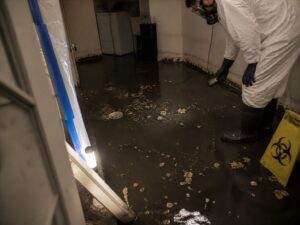
In August 2023 — during a North American Monsoon event that dropped 1.4 inches of rain in under 90 minutes across the southwest Salt Lake Valley — we responded to a sewage backup at a home in an established South Jordan neighborhood near 1300 West. The floor drain and the basement bathroom toilet had backflowed simultaneously — the dual-fixture pattern that indicates sewer main hydraulic surcharge rather than a localized lateral blockage. By the time we arrived, Category 3 water had reached approximately 160 square feet of the finished basement floor to an average depth of two inches. The water had been in contact with carpet, pad, drywall, and the lower 4 inches of the framed wall assembly for approximately three hours. Hydrogen sulfide was detectable from the basement staircase before entry. We donned full PPE — powered air-purifying respirators, double-gloved nitrile, sealed Tyvek coveralls — before descending. Containment was established at the staircase landing with HEPA air scrubbers in negative air pressure mode before extraction began. Carpet, pad, and the lower 8 inches of drywall on three perimeter walls were removed and double-bagged within the containment zone before transport. Three passes of EPA-registered broad-spectrum disinfectant were applied to all hard surfaces and the lower 24 inches of exposed framing. Structural drying equipment ran for six days. The day-six moisture readings at all 22 monitoring points were within dry standard. The homeowner — a retired teacher who had lived in the home for 22 years — stood in the rebuilt basement two weeks later and said it looked better than it had before the backup. She was not being generous. We had replaced the carpet with a cleanable luxury vinyl plank and repainted the walls in a color she had always preferred over the original. Her Bear River Mutual policy covered the loss under a sewer backup endorsement. Total approved: $14,200. Deductible: $1,000. She told us that the night of the backup, standing in her driveway while her basement held sewage, she had thought the home was ruined. The gap between that feeling and the finished result — two weeks later — is the actual product of what we do.What Category 3 Requires
Full personal protective equipment — nitrile gloves, chemical-splash goggles, half-face respirator with P100 and organic vapor cartridges at minimum, powered air-purifying respirator for confined spaces; physical containment with HEPA air scrubbers in negative air pressure mode; physical removal and regulated disposal of all porous materials that contacted sewage — carpet, padding, insulation, all drywall at the affected level; multi-stage EPA-registered hospital-grade disinfection of all retained hard surfaces; complete structural drying; and thermal fogging plus hydroxyl generation for odor elimination.- Is it safe to be in my home after a sewage backup?
- No, not without respiratory protection. Sewage produces hydrogen sulfide — toxic at concentrations above the 20 ppm OSHA ceiling. Until physical containment is established and the affected space is remediated, stay out of the affected area.
- Why is outdoor floodwater Category 3 if it looks clear?
- Category 3 is based on source and exposure history, not visual appearance. All outdoor floodwater has contacted soil organisms, agricultural and urban runoff, and chemical contaminants from urban land uses. Visual clarity does not indicate safety. All outdoor floodwater entering a structure is Category 3.
What Category 3 (black water) damage actually means
The IICRC S500 Standard defines Category 3 as grossly contaminated water containing pathogenic, toxigenic, or other harmful agents. This is the most severe category — the one that drives the fullest remediation scope and the strictest PPE and containment requirements.
Typical Category 3 sources
- Sewage backup, whether from a mainline block or a lateral-line failure
- Toilet overflow containing feces
- Surface water from flooding, storm runoff, rivers, or ground-water intrusion
- Standing water (Cat 1 or Cat 2) that sat past 72 hours and now hosts bacterial growth
- Water from waste pipes (not supply)
- Any water that contacted soil contaminants or chemical runoff
Our S500 Category 3 protocol
Containment first — plastic sheeting and HEPA-filtered negative-air machines to isolate the affected area. Full PPE: Tyvek suits, N95 or P100 respirators, gloves, boot covers. Dedicated Cat 3 equipment (we never cross-contaminate with Cat 1 jobs). Full structural removal of all porous materials in the affected footprint — drywall, carpet, pad, insulation, cabinets below water line, particleboard subfloor. Antimicrobial application with EPA-registered thymol and accelerated hydrogen peroxide on all remaining structure. Post-remediation verification with moisture meters and documented photos before reconstruction begins.
What’s discarded, no exception
Everything porous that contacted Cat 3 water. Drywall, carpet, pad, insulation, upholstery, mattresses, pillows, particleboard subfloor, cardboard. Hard surfaces can be sanitized; porous cannot be made safe to retain.
What Cat 3 (black water) response actually looks like on site
Cat 3 water contains or is likely to contain pathogens, raw sewage, chemicals, or significant microbial content. The scope isn’t just “extract and dry” — it’s a full containment event, like a biohazard scene. Here’s the actual on-site setup, not a sanitized summary:
- Tyvek Category 3 chemical suit, taped seams
- Full-face respirator with P100 cartridges (not a nuisance mask)
- Nitrile gloves inside heavy-duty chemical-resistant outer gloves, taped to suit
- Rubber waders or chemical-resistant boots
- Eye protection even behind the respirator face shield for splash protection
Containment setup
- Affected area sealed off from the rest of the house with 6-mil poly sheeting and zippered access
- Negative air machine (NAM) with HEPA filtration pulling air out of the containment zone to the exterior through a vented poly duct — the containment stays under negative pressure for the entire job
- HVAC supply and return registers in the affected area sealed with poly and tape
- Dedicated entry/exit zone with Tyvek doffing station; separate clean/dirty sides
Material-removal protocol (IICRC S500 Cat 3)
- Carpet and carpet pad in affected area
- Drywall from floor up to at least 24 inches above the water line (often 48 inches)
- Insulation (fiberglass, cellulose, foam board) that got wet
- Baseboards and casing
- Particleboard underlayment, OSB that saturated, laminate flooring
- Wooden cabinet bases that absorbed Cat 3 water
- Any porous material (books, paper, soft furniture, mattresses) in the affected zone
What stays (with aggressive cleaning + disinfection)
- Framing lumber that gets cleaned, disinfected, and dries to spec
- Hardwood flooring if it was sealed and dried before warping (case by case)
- Hard-surface finishes (tile, stone, glass, finished metal) after mechanical cleaning + antimicrobial
- Concrete slab after mechanical cleaning + disinfectant per IICRC guidelines
Cat 3 scope is significantly more involved than Cat 1 or 2. On the insurance side, it’s covered under the same water-damage line but priced per Xactimate’s Cat 3 line items. The homeowner usually sees a larger line-item total because the material-removal and PPE line items are substantial.
A worked Cat 3 example: finished-basement sewage backup
Specific scenario walked through pricing + timeline + decisions — so you have a realistic reference against your own Cat 3 situation.
Finished basement, 650 sq ft affected. Mainline sewer backup overnight. Discovered at 7 AM when homeowner smelled it. Approximately 2 inches of sewage over carpet; backed up through floor drain and basement toilet. Standing water 8-10 hours before extraction began. HVAC return in affected area ran briefly during the night.
Dispatch and arrival (hour 0-1)
- Phone call at 7:15 AM; dispatched by 7:30; crew arrives 8:00
- HVAC immediately shut off at breaker
- Full Cat 3 PPE: Tyvek, full-face respirator, taped seams, boot covers
- Family evacuated to upstairs area; basement sealed with poly
- Insurance FNOL started with homeowner (confirming water-backup rider present on policy)
Day 1 (hours 1-8)
- Containment setup: 6-mil poly across stairwell top; HEPA negative-air scrubber vented out basement window
- Extraction: truck-mount with portable backup; ~85 gallons extracted + bagged solids
- Material removal: all carpet + pad (bagged in biohazard double-bags); drywall from floor to 24" (base cuts); baseboard; MDF cabinet bases around a built-in; affected insulation in open framing
- HVAC duct inspection: residue in floor-return boot; flex duct section replaced; return trunk cleaned
- Antimicrobial fogging: all exposed framing + concrete slab
- Equipment set: 8 air movers, 2 LGR dehus, 1 HEPA scrubber running continuously
Days 2-7
- Daily moisture-check visits; wood framing MC drops from 24% toward 16% target over 5-6 days
- Antimicrobial reapplied day 3 for persistent-contamination areas
- Post-remediation verification scheduled for day 7 if MC is at target
- Mold air sample taken day 6 (sent to lab; interior-vs-outdoor control)
Day 8-9
- Lab results in: interior spore count below outdoor baseline — passes PRV
- Equipment removed; containment taken down; final cleaning
- Written clearance documentation to homeowner + adjuster
- Mitigation phase complete
Day 10+: rebuild phase
- Rebuild starts after insurance scope approval on mitigation + rebuild line items
- New drywall + mud + prime + paint on affected walls
- New insulation in open framing
- Flooring: homeowner elected LVP replacement (vs. new carpet) — moisture-resistant for the basement
- Cabinet base rebuild (plywood instead of MDF)
- Trim and baseboard reinstall
- Rebuild timeline: 3-4 weeks
Rough cost breakdown (ballpark)
- Mitigation (Xactimate): $14,500-18,000
- Rebuild (Xactimate): $12,000-16,000 (depends on finishes selected)
- Total: $26,500-34,000
What insurance paid (with water-backup rider at $25,000 coverage)
- Rider limit: $25,000
- Deductible: $1,000 (standard)
- Carrier payment: $24,000 to the contractor (direct bill)
- Homeowner out-of-pocket: $1,000 deductible + any upgrade over rider limit (homeowner chose standard-grade LVP; stayed within rider limit)
What would have happened without the rider
- Carrier denies the claim under drain/sewer exclusion
- Homeowner pays full $26,500-34,000 out of pocket
- Wisetack financing of $25,000 at 12 months would have monthly payment around $2,250 at typical rates
Your specific job may differ, but the structure — mitigation first with containment, rebuild following, insurance interaction specific to your policy terms — follows this pattern.
Clearance verification after Cat 3 remediation (what makes a job “done”)
Finishing Cat 3 water remediation isn’t just “equipment comes out, floor is dry.” Clearance verification confirms that contamination has been addressed and the area is safe for reoccupancy. Here’s what that process looks like:
- Visual inspection: no visible residue, no visible mold, no discoloration remaining on treated surfaces
- Moisture content: all materials under warranty-grade dry threshold (framing ≤16% MC, drywall ≤1%)
- Odor check: no perceivable musty, biological, or sewage odor during a 10-minute closed-up test
- Air quality (if required): interior spore count at or below outdoor baseline via lab air sample
When air sampling is required vs optional
- Required: any insurance claim where the carrier asked for post-remediation verification (PRV); any case with occupant health concerns; any case where the sale of the property is pending; any case where legal proceedings may follow
- Optional: straightforward small-area Cat 3 jobs with no occupant health concerns, no insurance scrutiny, no legal considerations — we don’t push the extra $300-500 lab cost if it won’t change anything
How we do the air sample
- Interior sample (affected area) + outdoor control sample taken same day, same conditions
- Standard IAC-2 air pump collecting on specific media (spore trap cassette typical)
- Sent to independent accredited lab (NVLAP or AIHA)
- Results report compares interior-vs-outdoor spore count by species
- Pass criterion: interior count equal to or below outdoor baseline
What the final clearance package includes
- Written PRV report with all four verification results
- Lab air sample report (if sampled) — direct from the lab, not edited
- Final moisture-meter readings at specific locations with photos
- Odor check documentation + time of test
- Visual inspection sign-off with photos
- Our signature + date + crew member names involved
What happens if PRV fails
- Re-remediation of specific areas identified by the failure
- Re-test after additional work
- No sign-off until PRV passes
- Documentation of the failure and corrective action in the file
How clearance affects warranty + liability
- Clearance documentation is the baseline for our 90-day mold warranty on remediated areas
- Future mold in a cleared area is covered by the warranty (unless caused by new event)
- For insurance subrogation or legal proceedings, clearance documentation establishes job completeness
- For sale of home 1-5 years later, clearance documentation + original scope is the paper trail
Why we won’t skip clearance verification
- Cat 3 contamination that wasn’t fully addressed causes health issues or future mold claims
- Our 90-day mold warranty depends on knowing the baseline was clear
- Insurance subrogation on future claims is harder without clearance
- Property sale disclosure 2 years later is easier with the clearance file in hand
Common clearance questions
- “Can we sleep in the house during the clearance test?” Usually yes, after post-remediation work is complete and equipment is removed; final occupancy decision is yours
- “Can we start putting furniture back before clearance?” Soft furniture no (should wait); hard furniture OK in treated areas
- “How long does the clearance test take?” On-site: 30-60 minutes for air sample. Lab turnaround: 3-7 business days typically; rush options available
Every Cat 3 job we do ends with written clearance verification. If the specific documentation isn’t shared with you at job close, ask — it’s part of your file.
Post-Cat 3 sanitization verification (specific checks before re-occupancy)
After Cat 3 remediation, the physical cleanup is done but sanitization verification determines whether the space is safe to re-occupy. Here’s what the specific verification looks like:
- Visual: no residue, no biofilm, no visible contamination. Specific surfaces (framing, concrete slab, remaining materials) inspected individually. Photos documented.
- ATP (Adenosine Triphosphate) testing (optional): Rapid surface test measuring biological residue; results in minutes. Pass criterion: readings below industry threshold indicating effective sanitization.
- Air sampling (if required): Interior spore count at or below outdoor baseline. Lab-reported with specific species identification.
- Odor check: No perceivable biological, sewage, or musty odor during a 15-minute closed-up test with HVAC off.
When ATP testing is useful
- Food-service or medical commercial scope with sanitation re-certification
- Health-sensitive residential occupants wanting objective verification
- Insurance dispute requiring quantified cleanliness evidence
- Pre-sale documentation for a property with past Cat 3 history
What ATP testing doesn’t do
- Doesn’t replace air sampling for mold verification
- Doesn’t identify specific pathogens (just overall biological residue)
- Doesn’t test porous materials inside (just surface)
- Not required by IICRC S500 as mandatory; it’s an additional tool
When air sampling is required
- Insurance carrier requested PRV (post-remediation verification)
- Occupant health concerns (respiratory, immune)
- Pre-sale documentation
- Legal proceedings
- IICRC S520 compliance for mold-remediation portion
What happens if any verification fails
- Specific location re-cleaned + re-treated
- Repeat verification until passing
- No sign-off until all four checks pass
- Documentation of each cycle in the file
- Occasionally lab results reveal issues that visual + odor missed — that’s exactly why we test
What makes a sanitization pass meaningful
- Comparison to outdoor control (interior should be at or below outdoor baseline)
- Specific thresholds (not just “looks clean”)
- Independent lab (not us running the lab ourselves)
- Dated documentation at verification
- Written statement of what was tested + what passed
Timing for sanitization verification
- Visual + odor + ATP: same-day as the final cleaning
- Air sampling: 3-7 business days for lab turnaround (standard)
- Rush air sampling: 24-48 hours for additional cost
- Sign-off happens after the slowest result returns
What goes in your file after verification
- Visual verification photos with timestamps
- Odor check documentation
- ATP results (if performed) with specific location + reading
- Air sample lab report (if performed) direct from lab
- Our written sign-off statement with date + crew member names
- Clearance documentation + our 90-day mold warranty start date
What to do before re-occupying
- Verify all four checks are documented
- Keep documentation accessible (physical + digital copy)
- Watch for any symptoms during first 2 weeks of re-occupancy and report to us if anything unusual
- Note any lingering odors — occasionally need final odor-remediation pass
Cat 3 verification isn’t a formality — it’s what separates a job that’s cleaned-looking from a job that’s actually safe. We don’t sign off without it.
Happening right now? Sewage and black water are a health hazard. Keep everyone out of the area — our crew arrives in PPE and sets up containment. Call (385) 247-9359 — live-answered 24/7.
In South Jordan? Inside city limits we’re on site within 45 minutes, 24/7, or your emergency inspection is free. Michael Bass is paged on every sewage call.
Common sources of Category 3 water
- Sewage backing up through a floor drain, toilet, or shower.
- Toilet overflow containing waste.
- Outside floodwater entering the house.
- Clean or grey water that sat long enough to become contaminated.
All are handled with PPE, containment, removal of soaked porous materials, and antimicrobial treatment. Sewage cleanup →