
Verify us in one click before you call
- IICRC Certified Firm #927354-5258 — search the IICRC Global Locator for “True Day”.
- Utah contractor license #960332-3505 — look it up on Utah DOPL.
- BBB — see our BBB profile.
- Insured: general liability $1M/$2M (Liberty Mutual); workers’ compensation (The Hartford).
- Technicians: Marcus Rivera (IICRC WRT/ASD/AMRT #246893) and Sofia Mendoza (WRT/AMRT #305127) hold Applied Microbial Remediation certification.
Sewage backup in your home? Keep people and pets out of the area and don’t run water or flush. True Day removes the sewage, discards contaminated porous materials, treats surfaces with antimicrobials and dries the structure. Owner Michael Bass is paged on every sewage call. Live-answered 24/7 from South Jordan, UT.
Sewage Backup Cleanup in South Jordan, UT
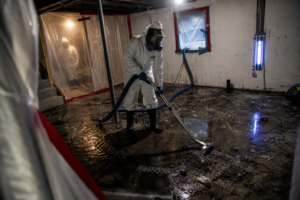
Some property emergencies announce themselves gradually. A slow leak under the sink. A stain on the ceiling that gets slightly larger over a few weeks. A musty smell that the homeowner attributes to something they cannot quite identify.
Sewage backup is not one of those emergencies. It arrives without warning and communicates everything immediately — through the floor drain that should not be wet, through the basement toilet that is running backward, through an odor that makes the cause unmistakable before the visual confirms it. The homeowner knows exactly what has happened and exactly how wrong it is. What they usually do not know is what to do next, or how serious the health risk is while they are standing there trying to figure it out.
The answer to the first question is: call True Day Water Damage Restoration at (385) 247-9359 immediately and do not re-enter the affected area without proper protective equipment. The answer to the second question is addressed in detail below — and the short version is that raw sewage is a genuine biohazard containing fecal coliform bacteria, enteric viruses including norovirus and hepatitis A, and protozoan parasites including Cryptosporidium and Giardia that pose real health risk through contact, aerosolization, and surface contamination.
We are a licensed Utah Contractor (#960332-3505) and IICRC-Certified Firm (ID #927354-5258) based at 11268 S 2865 W in South Jordan. Sewage backup cleanup is among the most technically demanding situations in property restoration. We respond to it regularly across South Jordan and Salt Lake County — with the training, equipment, and documentation process that this type of event requires.
Why Sewage Backs Up Into South Jordan Basements
The cause of a sewage backup determines how it is classified, how the insurance claim is framed, and what the appropriate remediation protocol is. Not all sewage events have the same origin — and misidentifying the source has consequences both for cleanup adequacy and for claim outcomes.
Municipal Sewer Hydraulic Surcharge
The North American Monsoon pattern generates intense, convective precipitation events across the Salt Lake Valley from early July through mid-September. These events — sometimes delivering an inch or more of rainfall within an hour in localized areas — overwhelm the storm runoff capacity of South Jordan’s combined and separate sewer collection systems. When inflow and infiltration exceed the hydraulic capacity of the sewer main, the hydraulic grade line in the collection pipe rises above the elevation of the lowest connected fixtures — typically basement floor drains and basement-level toilets. The pressure differential forces sewage to flow backward through those fixtures into the basement.
South Jordan’s rapid residential development — the city has added more than 10,000 housing units over the past two decades, including the Daybreak master-planned community and subsequent Herriman-adjacent subdivisions — has increased sewage volume loads on collection infrastructure built for a substantially smaller service population. Some of the collection mains serving older South Jordan neighborhoods along the Jordan River corridor were originally sized in the 1980s and have not been upsized to match current population density. During significant monsoon events, these mains surcharge reliably — and the homeowners connected to the lowest points in those drainage basins receive the consequences.
Private Sewer Lateral Failure
The private sewer lateral is the underground pipe connecting a home’s internal plumbing to the municipal collection main at or near the property line. In South Jordan’s pre-1995 construction stock — neighborhoods along the 10200 South and 11400 South corridors, established communities near Towne Center Square — many laterals were originally installed in vitrified clay pipe. Vitrified clay is durable under dry conditions but is susceptible to two failure modes common in this region: tree root intrusion through pipe joints, and joint displacement from the shrink-swell cycling of the region’s expansive clay soils.
The shrink-swell behavior of expansive clay — the same montmorillonite-rich smectite soil that characterizes much of the Salt Lake Valley’s subsurface geology, a legacy of ancient Lake Bonneville lacustrine deposits — creates seasonal lateral and vertical stress on underground pipe joints. Over decades, these stress cycles cause joint separation that allows both root infiltration and soil infiltration into the pipe bore. A lateral reduced to 40% of its original diameter by root intrusion and soil infiltration handles normal household wastewater flows adequately — until a washing machine discharge, dishwasher cycle, and shower coincide, creating a peak flow that the partially blocked lateral cannot pass. The result is backup through the lowest connected fixtures. We have responded to multiple lateral-related backups at the same address in consecutive years because the lateral was hydro-jetted rather than replaced — roots cleared temporarily, pipe structurally unchanged.
Fat, Oil, and Grease Accumulation
Fats, oils, and grease discharged through kitchen drains — including the liquid fats from cooking that solidify on cooler pipe walls downstream — accumulate as a progressively thickening deposit on the interior of residential sewer laterals. Organic debris including non-dispersible wet wipes marketed as flushable, paper products that do not adequately disperse, and other non-biodegradable materials compound this accumulation. The resulting restriction narrows the effective pipe bore progressively and eventually produces complete blockage — typically presenting as backup through the lowest connected fixtures in the building, often during periods of above-average flow.
Main Line Blockage with Upstream Pressure
When the municipal sewer main itself develops a blockage — from construction activity, root intrusion at a main junction, or a collapsed pipe section — the upstream pressure from continued sewage flow pushes against the blockage point and finds the path of least resistance into connected structures. Properties on the upstream side of the blockage experience the backup first. This is distinguishable from hydraulic surcharge by timing: main line blockage backups occur independent of precipitation events and often affect multiple consecutive addresses on the same block.
The Biology of What Came In
Understanding the specific pathogen profile of sewage-contaminated water is not abstract. It determines the personal protective equipment our technicians wear, the specific disinfection agents we select, the contact times we apply, and — critically — which materials can be cleaned and which must be removed regardless of how they appear after drying.
Fecal Coliform Bacteria
Raw municipal sewage contains fecal coliform bacteria at concentrations typically measured in the tens of millions of colony-forming units per 100 milliliters. The species present include Escherichia coli — including pathogenic strains like O157:H7, which can cause hemolytic uremic syndrome — Salmonella enterica, Shigella dysenteriae, and Campylobacter jejuni. These organisms survive on moist hard surfaces at ambient temperatures for hours to several days — well beyond the period that any reasonable domestic surface drying takes. E. coli O157:H7 has a documented infectious dose as low as ten organisms, meaning a surface that appears visually clean after simple drying may still carry a sufficient pathogen load for infection through incidental hand-to-face contact.
Enteric Viruses
Norovirus — the leading cause of acute viral gastroenteritis in the United States — is shed in fecal matter at concentrations that can reach one billion viral particles per gram and is present in raw sewage at detectable concentrations. Its infectious dose is fewer than 20 viral particles, it survives on hard surfaces for days to weeks depending on environmental conditions, and it is highly resistant to many standard disinfectants at dilutions commonly used in household cleaning. Hepatitis A virus, also shed in fecal matter, can persist in the environment for weeks and causes acute viral hepatitis — a potentially serious liver disease — in exposed individuals who have not been vaccinated. Rotavirus, a leading cause of severe diarrheal illness in young children, is also present in sewage and particularly relevant for households with infants and toddlers.
Protozoan Parasites
Cryptosporidium parvum and Giardia lamblia are protozoan parasites that form environmentally resistant oocysts and cysts, respectively, that can survive for months in cool, moist environments and are resistant to chlorine disinfection at concentrations used in potable water treatment. Cryptosporidiosis causes acute profuse watery diarrhea that can be life-threatening in immunocompromised individuals — those undergoing chemotherapy, organ transplant recipients, and people living with HIV. Giardiasis causes chronic gastrointestinal illness that persists for weeks without treatment. Both pathogens require specific EPA-registered products or physical removal of contaminated material for effective control — they cannot be addressed by standard household bleach at typical dilution ratios.
Hydrogen Sulfide and Ammonia
The anaerobic decomposition of sulfate-reducing bacteria in sewage produces hydrogen sulfide — the compound responsible for the characteristic sewage odor — through the reduction of sulfate ions to hydrogen sulfide gas. At concentrations above 100 parts per million, hydrogen sulfide causes olfactory paralysis — the temporary loss of the ability to detect the gas by smell — which creates a dangerous condition in which exposed individuals can no longer use odor as a warning of continued exposure. The Occupational Safety and Health Administration’s permissible exposure limit for hydrogen sulfide is 20 parts per million for general industry. Ammonia, produced by bacterial decomposition of urea and protein in sewage, irritates the respiratory mucosa at concentrations above 25 parts per million and can cause chemical pneumonitis at sustained high exposures in enclosed spaces. Both gases accumulate in enclosed basement environments and make unprotected entry a genuine occupational health hazard — not a bureaucratic caution.
What the Backup Did to Your Materials
The question we hear most often on sewage backup calls — after “how serious is this” — is “what can be saved.” The answer is determined by a material’s porosity, the depth of contamination penetration, and the irreducible limitations of disinfection chemistry on porous organic substrates. It is not determined by how the material looks after the water recedes.
Must Be Removed: Porous Materials
Porous materials that absorbed Category 3 black water cannot be adequately disinfected to any defensible standard of pathogen reduction. This is not a conservative position — it is a physical reality. Antimicrobial agents applied to a porous surface penetrate the outermost few microns of the material but cannot follow the capillary pathways through which the contaminated water traveled into the interior. The pathogens in those interior pore spaces survive treatment and remain a contamination source. The ANSI/IICRC S500 Standard for Professional Water Damage Restoration requires removal and disposal of all porous materials contaminated by Category 3 water. This includes:
- Carpet and carpet padding — always removed; the fibrous matrix retains contaminated water at concentrations that cannot be reduced by any cleaning or extraction protocol
- Drywall gypsum board — the paper facing absorbs sewage by capillary action and harbors pathogens in the cellulose substrate; the gypsum core wicks moisture to heights well above the visible flood line
- Fiberglass batt and cellulose insulation — both materials retain liquid and cannot be effectively dried or disinfected in place
- Upholstered furniture, mattresses, box springs, and soft furnishings — porous fibrous materials with no effective disinfection pathway
- Cardboard, books, paper records, and organic stored materials
- Oriented strand board and plywood subfloor panels saturated beyond their surface layer by direct contact or capillary wicking
Can Be Disinfected and Retained: Non-Porous Surfaces
- Sealed concrete and concrete block — physically cleaned and disinfected with EPA-registered agents; unsealed concrete may require mechanical preparation before disinfection
- Ceramic and porcelain tile with intact grout — thoroughly cleaned and disinfected; grout with visible cracking or erosion may need regrouting before the surface is considered adequately treated
- Metal structural components, pipes, and hardware
- Glass surfaces
- Solid wood structural framing — when contamination is limited to the surface and the member has not been saturated through its cross-section; severely saturated framing members may require replacement
Our Sewage Backup Cleanup Process
Step 1 — Emergency Dispatch and Full PPE
We respond throughout Salt Lake County as quickly as possible after your call. Our technicians arrive in full personal protective equipment — nitrile gloves, chemical-splash goggles, half-face respirators with combination organic vapor and P100 particulate cartridges, chemical-resistant boot covers, and disposable Tyvek coveralls. PPE is donned before entry and doffed in a designated decontamination area outside the affected space. Equipment that enters the Category 3 zone is decontaminated before leaving it.
We do not enter a sewage-affected enclosed space in paper dust masks. We do not perform sewage cleanup in standard work clothes. The pathogens and gases described above are real, and the protective equipment is matched to the actual exposure profile — not to the appearance of urgency or efficiency.
Step 2 — Full Scope Assessment and Source Identification
Before extraction begins, we assess the full extent of sewage contamination using visual inspection and FLIR thermal imaging cameras — which detect the temperature differential of wet contaminated surfaces beneath flooring and behind baseboards. We also document the likely source of the backup, which matters for both cleanup protocol selection and insurance documentation. A municipal hydraulic surcharge backup may require different framing in the insurance claim than a private lateral failure, and our source assessment provides the documentation to support accurate classification.
We establish physical containment barriers at the perimeter of the affected area and set HEPA air scrubbers to negative air pressure mode where geometry allows — exhausting HEPA-filtered air from the contamination zone to the building exterior to prevent aerosolized sewage particles and hydrogen sulfide gas from migrating to unaffected areas of the home through the HVAC system or through open doorways.
Step 3 — Sewage Extraction
All sewage and contaminated water is extracted using equipment dedicated exclusively to Category 3 use — separately maintained from clean water restoration equipment and properly decontaminated after each use. Extracted material is transported as contaminated waste and disposed of in compliance with applicable Salt Lake County environmental health regulations. We do not discharge extracted sewage into municipal storm drains or onto the property — it is managed as regulated waste from point of extraction to disposal.
Step 4 — Contaminated Materials Removal and Disposal
All porous materials that contacted sewage are removed within the containment zone, double-bagged in heavy-duty polyethylene, and transported for disposal without being carried loose through unaffected areas of the home. We document all removed materials with photographs and a written inventory for insurance documentation. The photography sequence for sewage backup cleanup is systematic: pre-extraction conditions, post-extraction before demolition, after demolition with all materials removed and structural assemblies exposed, and post-disinfection before drying equipment placement.
Step 5 — Physical Cleaning
All remaining hard surfaces undergo thorough physical cleaning before any disinfectant is applied. This sequence is mandatory — antimicrobial chemistry cannot penetrate the organic biofilm layer that raw sewage deposits on surfaces to reach pathogens on the substrate beneath. Physical cleaning removes that protective layer and exposes the surface for effective disinfectant contact. We use surfactant cleaning agents, dedicated scrubbing tools, and high-pressure rinse to achieve a physically clean surface at every point that will receive disinfectant treatment.
Step 6 — Multi-Stage EPA-Registered Disinfection
Physically cleaned surfaces are treated with EPA-registered broad-spectrum disinfectants formulated for the pathogen profile of Category 3 black water — with documented efficacy against fecal coliform bacteria, norovirus, hepatitis A virus, Cryptosporidium, and Giardia. Products are applied at manufacturer-specified concentrations with the required contact dwell time to achieve the rated log reduction of target organisms. We apply multiple treatment passes with appropriate dwell time intervals between applications. A single spray-and-wipe treatment is not a disinfection protocol for Category 3 contamination — it is a surface cosmetic that leaves the majority of the pathogen load undisturbed.
Step 7 — Structural Drying with Daily Monitoring
After cleanup and disinfection, we deploy industrial low-grain refrigerant dehumidifiers and high-velocity air movers configured through psychrometric analysis of the drying environment. Basement environments present specific challenges to structural drying: the high thermal mass of concrete and masonry releases moisture slowly; ground-contact surfaces remain at lower temperatures that reduce the evaporation rate; and the enclosed geometry concentrates moisture-laden air without natural ventilation. Equipment runs continuously and is monitored daily, with moisture readings recorded at all established monitoring points until all materials return to equilibrium moisture content within the IICRC S500 dry standard for each material class. Learn more about our structural drying and dehumidification services.
Step 8 — Odor Elimination
Sewage odor is caused by hydrogen sulfide, ammonia, and a complex mixture of microbial volatile organic compounds produced by the anaerobic decomposition of organic matter in sewage — and these compounds penetrate into porous structural materials and continue to off-gas after surface cleaning is complete. We apply thermal fogging — converting a professional deodorizing solution into a microscopic fog that penetrates wall cavities, wood grain, and subfloor assemblies — and hydroxyl generation, which produces hydroxyl radicals that oxidize and break down volatile organic odor compounds at the molecular level, eliminating them rather than masking them. A space that smells normal after this treatment is genuinely odor-free — not temporarily suppressed by a competing fragrance. Learn more about our odor removal services.
Step 9 — Verification, Documentation Package, and Insurance Submittal
Following cleanup and drying, we perform a final assessment: moisture readings at all monitored points, visual inspection of all treated surfaces, and odor evaluation. We provide a comprehensive documentation package that includes timestamped photos from each project phase, thermal imaging reports, daily drying logs with moisture readings from all monitoring locations, a detailed cleanup narrative identifying the water source and contamination category, an estimate formatted in Xactimate, and documentation for all materials removed. This package is provided to you and submitted to your insurance carrier in the format that adjusters require to process sewer backup endorsement claims.
Step 10 — Licensed General Contractor Reconstruction
With the space verified clean, dry, and odor-free, our licensed general contractor team (Utah License #960332-3505) performs all reconstruction — replacing drywall, insulation, flooring, baseboards, and trim, and completing all painting and finish work to return the space to pre-loss condition. One company manages the complete project from emergency call through final walkthrough. Learn more about our reconstruction and repair services.
A Sewage Backup We Cleaned Up Near the Jordan River Corridor
In late July 2022, during a monsoon event that dropped 1.4 inches of rain in 90 minutes across the southwest Salt Lake Valley, we received a call from a homeowner in an established South Jordan neighborhood near 11400 South and 1300 West — an area we knew from prior responses to sit in a low section of one of the older collection mains serving that part of the city. The homeowner had discovered approximately three inches of sewage across the entire floor of a finished basement: LVP flooring over a wood subfloor, two framed and drywalled walls, a sectional sofa, a built-in entertainment center, and a basement bathroom. The backup had entered through the floor drain and the basement bathroom toilet simultaneously — simultaneous failure of two separate fixtures was consistent with hydraulic surcharge rather than a localized lateral blockage.
We arrived in just over 40 minutes with a full Category 3 response — two technicians in complete PPE, dedicated Category 3 extraction units, containment materials, and our full disinfection kit. Containment barriers went up at the base of the stairs before extraction began. HEPA air scrubbers in negative air pressure mode were operating within the first fifteen minutes.
The LVP flooring came up — non-porous at the surface, but the click-lock seams had allowed sewage to penetrate the wood subfloor below. Penetrating moisture meter readings at the OSB subfloor ranged from 44% to 61% across nine monitoring points. The drywall came out to 24 inches above the flood line on all four perimeter walls. FLIR thermal imaging showed the drywall paper facing had wicked sewage-contaminated moisture above the removal line on two walls — we extended the cut an additional six inches on those walls based on the thermal data rather than the visible flood line. The sofa, padding under the LVP, and all insulation came out.
Physical cleaning of the concrete slab and exposed framing took four hours. Primary disinfection with an EPA-registered quaternary ammonium compound at label concentration followed immediately. Secondary application of a peracetic acid-based disinfectant — chosen for its documented efficacy against Cryptosporidium oocysts, which are resistant to standard quaternary ammonium treatment — followed after the required dwell time of the primary agent. A third application of EPA-registered antimicrobial was applied before equipment placement.
Structural drying equipment ran for six days. The final moisture log showed all 12 monitoring points within the 9% to 13% equilibrium range for the concrete and wood framing materials involved. Thermal fogging and hydroxyl generation for odor elimination were conducted on day seven before any reconstruction materials entered the space.
The homeowner carried a sewer backup endorsement through Bear River Mutual. We submitted the full documentation package — 63 timestamped photographs, the thermal imaging report with annotated infrared images, daily drying logs, the written source assessment documenting the hydraulic surcharge cause, and the Xactimate scope — on day three of the project. The claim was approved in full without a physical reinspection. The claim was approved; the homeowner paid their deductible.
The homeowner told us afterward that the basement had been finished the previous year — new flooring, new drywall, new furniture, a project they had saved for and completed themselves over six months of weekends. Standing in the empty space on day two, that context was present in everything about how they held themselves. We told them what the space would look like when it was finished. And then we built it back.
Frequently Asked Questions — Sewage Backup Cleanup
How long does sewage backup cleanup take?
Initial extraction and containment is typically completed within a few hours of arrival. Structural drying takes 3 to 5 days using industrial equipment, monitored daily. Reconstruction depends on the scope of materials removed. We provide a realistic timeline estimate after the initial assessment. See our full restoration process page for phase-by-phase detail.
Does homeowner’s insurance cover sewage backup?
Standard policies typically exclude sewage backup unless a sewer backup endorsement has been added. This endorsement is available from most carriers at a modest premium. If you carry it, cleanup is typically covered subject to your deductible. We document all damage and submit directly to your adjuster. Learn more on our Insurance Claims Assistance page.
Why does sewage backup happen more frequently during summer in South Jordan?
The North American Monsoon pattern generates intense precipitation events from July through September that can overwhelm sewer collection system hydraulic capacity — causing sewage to backflow through basement fixtures. South Jordan’s population growth has increased load on older collection mains, making surcharge events more frequent in some neighborhoods, particularly those in lower sections of older drainage basins near the Jordan River corridor.
What is the difference between a municipal backup and a private lateral blockage?
A municipal backup is caused by hydraulic surcharge in the city-owned collection main and often affects multiple properties simultaneously. A private lateral blockage occurs in the homeowner-owned pipe from the home to the main and affects only that property. The distinction matters for insurance documentation and for identifying whether the fix is the homeowner’s responsibility or the municipality’s. We document source assessment as a standard part of every sewage backup project.
Related Services
- Sewage Cleanup
- Toilet Overflow Cleanup
- Water Damage Restoration
- Basement Flooding Cleanup
- Mold Remediation
- Biohazard Cleanup
- Odor Removal Services
- Air Scrubbing & HEPA Filtration
- Structural Drying
- Dehumidification
- Reconstruction & Repairs
- Category 3 — Black Water Damage
- Insurance Claims Assistance
- Sewage Cleanup — South Jordan, UT
Call True Day for Emergency Sewage Backup Cleanup in South Jordan, UT
Sewage backup is a health emergency and a structural emergency simultaneously. The pathogens in raw sewage do not wait. The moisture penetrating your framing and subfloor does not pause while you research options. True Day Water Damage Restoration responds fast throughout South Jordan and South Jordan, West Jordan, Riverton, Bluffdale, Herriman and Draper — in full protective equipment, with Category 3-rated equipment, and with the documentation process running from the moment we arrive.
True Day Water Damage Restoration
11268 S 2865 W, South Jordan, UT 84095
Phone: (385) 247-9359
Email: info@truedaywaterdamagerestoration.xyz
Utah Contractor License: #960332-3505
IICRC Certified Firm ID: #927354-5258
What True Day guarantees on every job
Was it the city main or your private lateral? Both look identical in your basement.
A sewage backup can originate from the municipal main or from your home’s private lateral line to the main. The water in your basement looks the same either way, but who pays for what differs completely, and so does the claim path. Here is how we help identify which one it was.
The sewer main that runs under the street can’t handle the load — blockage, root intrusion, pump station failure, or heavy rain overwhelming a combined-sewer segment. The backup pushes up through every lower-elevation drain in your home.
- Responsibility: typically the municipality (South Jordan City or Jordan Basin Water Reclamation Facility).
- Claim path: file with the city’s risk-management office + your homeowners carrier.
- Reimbursement: often possible when city negligence can be shown; carrier may subrogate.
The lateral line from your home to the city main is blocked — usually from tree-root intrusion (older established neighborhoods), grease buildup, or a collapsed section of older clay or Orangeburg pipe. Backup is confined to your home.
- Responsibility: homeowner.
- Claim path: homeowners sewer-backup endorsement (sewer-backup coverage is a separate rider on most policies — check yours).
- Reimbursement: depends on whether you have the endorsement and what it caps.
Septic-system vs. municipal-sewer backup
Both are Cat 3 water. Both get IICRC S500 full protocol. But the source affects responsibility, insurance, and the plumbing fix.
Septic vs. municipal comparison
| Element | Septic system | Municipal sewer |
|---|---|---|
| Where it’s located | On your property (tank + leach field) | City-owned mainline downstream of your lateral |
| Who’s responsible | You (homeowner) | Depends on whether failure is on your lateral or city’s mainline |
| Common failure causes | Tank full, pump failure, leach field saturation, pipe break between house and tank | Root intrusion in lateral, mainline block downstream, surcharge during storm |
| Who to call for plumbing fix | Septic contractor (specialty trade; not standard plumber) | Standard plumber for lateral; city public-works for mainline |
| Insurance considerations | Septic systems often excluded from standard homeowner policy; separate endorsement needed | Sewer-backup rider covers most municipal-side backups |
| Cleanup scope (ours) | Identical IICRC S500 Cat 3 protocol regardless of source | Identical IICRC S500 Cat 3 protocol regardless of source |
Septic-specific considerations
- Leach field saturation during spring snowmelt can push sewage back into the home even without a plumbing failure. Common in older rural properties.
- Tank pumping schedule — most septic systems need pumping every 3-5 years. Skipped pumping is a leading cause of backup.
- System-age concerns — septic systems 30+ years old often need replacement. Backup event may trigger that conversation.
- Health-department notification may be required on septic releases depending on volume + location.
Municipal-sewer specifics
- Camera inspection of the lateral tells you whether the block is on your side (yours to fix) or past the property-line clean-out (potentially city’s responsibility).
- City claim process if the source was mainline — document the source via camera + plumber report; city claims take weeks/months typically.
- Combined sewer vs. separate storm/sanitary: older SLC neighborhoods have combined systems that overflow in storms; newer areas are separated.
Backflow preventer: the one plumbing device that stops a repeat
If you’ve had a sewer backup in a finished basement, there’s one plumbing modification that significantly reduces the odds of it happening again: a backflow preventer (also called a backwater valve). Many Salt Lake Valley homes don’t have one. It’s a plumber scope, not restoration — but it’s the single most useful follow-up conversation after a sewer cleanup.
Why it matters in Salt Lake Valley homes
- Main-line city sewer backups happen for reasons outside your control — blockages downstream, infiltration during heavy rain, pump station failures
- Without a backflow preventer, your basement is the low point in the city sewer system during a backup — sewage flows uphill into your home from the city main
- With a backflow preventer, the city-side backup can’t reach your basement
Who should strongly consider installing one
- Homes that have had one or more previous sewer backups
- Finished basements in older neighborhoods where city sewer infrastructure is aging
- Homes at the bottom of a slope (gravity-fed sewer lines where the home is the low point)
- Homes where the city has acknowledged localized sewer issues in your area
What it costs (roughly) and who installs
- Materials: $300-800 depending on size and type
- Installation labor: $1,500-3,500 depending on access (excavation to tie into main line is the biggest cost variable)
- Total typical cost: $2,000-4,500 installed by a licensed plumber
- Insurance may cover part of this as “preventive measure” after a covered backup event — worth asking your adjuster during the cleanup claim
Why we flag this on sewage-cleanup jobs
- Repeat sewer-backup customers are a specific pattern — same homeowner, same basement, 18-24 months apart
- The restoration cost of the repeat event is often more than installing a backflow preventer would have been
- It’s not our scope to install, but it IS our scope to be helpful enough to mention it
Maintenance (because it’s not install-and-forget)
- Backflow preventers have a cleanout cap for annual inspection — debris can accumulate on the valve seat and prevent proper closure
- Annual plumber inspection is recommended
- If you have a Protection Plan with us, our semi-annual inspection confirms the cleanout cap is accessible and reports visible evidence of debris
If you want a recommendation for a licensed Utah plumber who installs backflow preventers, we can give you a name. We don’t take a referral fee — the recommendation is operational, not commercial.
The water-backup rider: what it adds + what the base policy excludes
Standard homeowner insurance policies in Utah typically EXCLUDE damage from water or sewage backing up through drains and sewers. That’s one of the most-common insurance surprises after a sewer backup — the homeowner assumed they were covered, and they weren’t. The fix is a specific rider added to the policy. Here’s how to understand what’s in and what’s not:
Water or sewage that backs up through drains, sewers, or sump pumps — even if the cause is clearly outside your control (city main failure, pump station failure, root intrusion in your lateral). This exclusion is in nearly every standard homeowner policy sold in Utah.
What the water-backup rider typically adds
| Coverage | Typical rider terms |
|---|---|
| Covered events | Water or sewage backup from drains, sewers, or sump pump failure |
| Coverage limit | Varies by rider: $5,000, $10,000, $25,000, up to full policy limits |
| Deductible | May share standard policy deductible; may have a separate rider deductible |
| Cost | Typically $40-200 per year added to premium depending on coverage limit |
| Exclusions still in effect | Flood from outside water sources (that’s FEMA flood coverage); gradual seepage; wear-and-tear plumbing failures |
What the rider doesn’t cover
- Flood damage from outside water (surface water entering during storm) — still FEMA policy territory
- Gradual seepage from pipes or ground — wear-and-tear exclusion applies
- Damage from a backup that occurred before the rider was effective
- Costs above the rider limit (if damage exceeds $10,000 and rider is $10,000, you’re out-of-pocket for the overage)
What we see on claims without the rider
- Carrier denies the claim entirely under the drain/sewer exclusion
- Homeowner pays out-of-pocket, often $8,000-25,000+ for a finished-basement sewage event
- Wisetack financing is often the bridge to pay for cleanup without the insurance safety net
- Lawsuit against the city (if municipal failure was clear) is sometimes considered but usually not pursued for cost/time reasons
What we see on claims WITH the rider
- Carrier pays mitigation + rebuild up to rider limit, minus deductible
- You pay deductible out-of-pocket (or finance via Wisetack if cash flow is tight)
- Overage above rider limit is out-of-pocket — so pick rider coverage amount that matches realistic worst case
How to check your coverage
- Look at your current homeowner declaration page
- Find any endorsements or riders listed; look for “water backup,” “sewer backup,” or “sump overflow”
- Note the coverage limit if present
- If you don’t see it, call your insurance agent or broker to ask if a rider is attached — sometimes they’re attached but not clearly labeled
If you don’t have the rider and you’ve had a backup
- Even without the rider, the mitigation of the Cat 3 water contamination is still something you have to do — health and property safety
- Call us for scope and estimate; we’ll work with you on payment (direct cash, Wisetack financing, or hybrid)
- Consider adding the rider for future coverage; most insurance agents can add it mid-policy
If you’re reading this before you’ve had a backup, the rider is cheap insurance against a scenario most Utah homes aren’t actually covered for. Worth the 10-minute conversation with your agent.
Response protocol when the home is on septic (not municipal sewer)
Septic-system homes have an added complexity on sewer backup: the exterior system has to be addressed before the interior cleanup can be effective. Here’s the specific protocol:
- Confirm septic (vs. municipal) — owner knows, OR look for riser caps or inspection ports in yard
- Septic contractor pumps tank + inspects condition
- Common findings: full tank (pump), damaged inlet/outlet baffle (repair), drain-field saturation (wait + possibly rehabilitate), lateral root intrusion (clear or replace)
- Interior cleanup can start in parallel with tank pumping — we don’t wait for the field diagnosis unless it’s a drain-field saturation issue (then we delay heavy use)
Access and location challenges specific to septic
- Tank and field locations may not be in county records for older homes
- Inspection ports can be buried under landscaping, decks, or pavers added after installation
- Larger lots may require vehicle access routing that’s not obvious
- Winter: frozen ground can delay septic contractor response
Water-use restrictions during septic work
- If tank is full and awaiting pump: no plumbing use at all until pumped
- If drain field is saturated: minimize water use (flushing, showers, laundry) for several days to a week while field recovers
- If drain field has failed: significantly longer restriction; may require field repair or replacement scope
- Alternatives during restriction: portable toilet rental (vendor-provided); use of other locations
Insurance treatment of septic-system backups
- Interior damage from backup is covered the same way as municipal-sewer backup — with water-backup rider
- Septic tank or field repair cost is a separate matter — usually NOT covered under homeowner policy; may be covered if cause-of-failure was sudden (like tree-root rupture caught early)
- Septic system wear-and-tear replacement is almost never covered
- Some septic failures have federal or state cost-share programs (rural development loans, well-and-septic programs) — worth asking
Well-water interaction
- Homes on septic are often also on well — and septic drain-field failure can contaminate the well
- After major septic events, we recommend water testing for the well before resumption of normal use
- Utah DEQ-certified labs do coliform + nitrate testing typically for $25-75
- If contamination is confirmed, shock chlorination of the well + retest is the typical response
What we handle on septic jobs
- Interior cleanup, extraction, drying, demo, antimicrobial, PRV — all our standard Cat 3 scope
- Coordination with the septic contractor
- Documentation that notes septic system status at time of job
What we don’t handle
- Tank pumping (septic contractor)
- Field rehabilitation or replacement (septic contractor)
- Well testing or shock chlorination (specialist or DEQ-certified lab)
- Permitting for septic system replacement if needed (homeowner or septic contractor + county)
Common Utah septic contractor referrals
- We maintain working relationships with a few Utah-licensed septic contractors in the valley
- Not a formal referral partnership — we recommend contractors we’ve worked with and seen do good work
- Homeowner contracts directly with the septic contractor; we don’t mark up their work
Multi-family sewer backup — specific coordination challenges
A sewer backup in a single-family home is contained to one owner’s decision-making. A sewer backup in a multi-family building (townhome, condo, apartment, mixed-use) involves multiple affected parties, shared infrastructure, and coordinated authorization. Here’s the specific protocol:
- Unit(s) with direct sewage intrusion (immediate scope)
- Adjacent units that may share walls or utilities with the affected area
- Common-area spaces (hallways, laundry, mechanical rooms)
- HVAC-shared systems that may have been contaminated
- Insurance side: unit owner (contents), association (common area + structure), tenant (contents in rented units)
Authorization chain
- Immediate mitigation inside an affected unit: unit owner or occupant can authorize
- Common-area work: HOA board or property manager authorization required
- Shared-utility impact (HVAC decon, shared plumbing stacks): HOA + utility coordination required
- Insurance interaction: each affected party’s carrier may need its own documentation
Scope separation across parties
- We write separate line-item estimates for each party whose scope we touch
- Unit-level scope (inside one owner’s unit) → that owner’s insurance
- Shared-wall scope → HOA scope (association insurance) if the shared material belongs to the structure
- Common-area scope → HOA scope
- Each party sees their estimate but the overall coordination keeps the response unified
Specific challenges we see on multi-family backups
- HVAC return-air contamination: in buildings with shared returns, Cat 3 water that entered a return may have contaminated the whole building’s HVAC — much bigger scope than one unit
- Shared waste line: clearing the clog may require coordination between units; sometimes multiple fixtures across units must stop running water
- Occupied unit protocol: if the affected unit is rented, tenant + landlord may both need to be informed and may have different scope-decision authority
- Timing: some HOAs have specific contractor-work hour restrictions (quiet hours, parking rules)
- Neighboring unit notification: adjacent units may need to be told we’re working next door (odor, equipment noise)
What we handle vs what others handle
- We handle: our scope (cleanup, mitigation, rebuild of our portion)
- Plumber handles: clearing the sewer line itself
- HOA handles: common-area access authorization + inter-unit coordination
- Property manager handles: tenant coordination for rented units
- Insurance adjuster(s) handle: coverage determination for each party
Common insurance coverage patterns in multi-family
- Unit owner has HO-6 (condo) or HO-4 (renters) policy for their contents + unit-level improvements
- HOA has master policy covering structure + common areas (varies by HOA bylaws)
- Mortgage lender may require specific coverage levels
- Water backup rider may be at unit level or HOA level or both; often check both
HOA board process on larger-scope multi-family events
- Property manager usually authorizes immediate mitigation on an emergency basis
- Formal board approval follows for larger-scope rebuild if common area is involved
- Our estimate often reviewed in a board meeting; we attend if useful
- Written authorization from the board kept with job records
What we tell owners of individual units when they call
- We need to understand the building type and your position (owner-occupant, tenant, landlord)
- We may need to coordinate with HOA or property manager before common-area work
- Your personal unit scope can start immediately with your authorization
- Overall job timeline may be longer than single-family because of coordination overhead
Multi-family sewer events are more complex but we handle them regularly. Call (385) 247-9359 and tell us the building type on the first call — we adjust dispatch and plan accordingly.
Sewage backup cleanup — the specific scope for drain-side events
Sewage backup is distinct from other water loss types. The water carries active microbial content from the first minute, meaning normal “extract and dry” doesn’t apply. Here is the specific scope for a drain-side backup:
The homeowner’s safety during the active phase: stay out of the containment zone. Children and pets kept clear. HVAC off until our verification confirms it’s safe to run. Household lives in the unaffected part of the house.
Who owns which part of the sewer line — SJ homeowner responsibility map
A sewer backup can originate in a part of the line you own or a part the city owns. The responsibility split affects who repairs the line and whose insurance covers what. Here’s the map for South Jordan:
If you don’t know where your lateral tap sits, SJ’s utility map can tell you. We can look it up with you on the first visit if the responsibility question is unclear.
Sump pump + sewer backup — the SJ basement combo-event
A sump pump sits in a pit in finished-basement SJ homes to pump away groundwater before it rises into the basement. In some setups, the sump pit shares plumbing with the sewer system. When things go wrong, you get both scenarios at once. Here’s the pattern we see most often:
If you have a finished basement in SJ and don’t know how your sump pump is configured, the Protection Plan spring inspection documents this. It’s a 20-minute check that may be worth more than the plan’s annual fee if it catches a combined-setup before an event happens.
Pets and sewage events — immediate protection and veterinary considerations
Sewage backup is a biohazard. Pets in the home at the time of the event may need veterinary attention and specific handling. Here’s the sequence:
Note: True Day scopes environmental remediation. We don’t provide veterinary guidance beyond immediate common-sense protection. For specific health decisions about your pet after sewage exposure, your veterinarian is the right call — we’re flagging the question, not answering it.
Sewage in your home right now? Stop using sinks, toilets, and appliances, keep everyone out of the area, and call (385) 247-9359 — live-answered 24/7. Michael Bass is paged on every sewage call.
In South Jordan? Inside city limits we’re on site within 45 minutes, 24/7, or your emergency inspection is free. Michael Bass is paged on every sewage call.
Common causes of sewage backups
| Cause | Clues |
|---|---|
| Clog in the house’s main drain | Several drains slow; backup at the lowest drain |
| Tree roots in the lateral | Repeated slow drains over months, worse in older lines |
| Grease, wipes, or debris | Kitchen or toilet lines clog first |
| Overloaded city line | Starts during heavy rain; neighbors affected too |
| Broken or sagging pipe | Recurring backups even after clearing |
A plumber’s camera inspection confirms which one. We clean up the damage either way.
How a sewage backup cleanup works
- Protective gear and containment before anyone enters the area.
- Extraction of standing sewage.
- Removal of carpet, pad, drywall, and insulation that sewage soaked into.
- Cleaning and antimicrobial treatment of everything that stays.
- Drying with daily moisture readings.
- Documentation for you and your insurer before rebuild.
In South Jordan? South Jordan sewage cleanup →
Documenting a sewage backup for insurance
- Photos and video before anything is moved or cleaned.
- The date and time it started, and what fixtures were in use.
- The plumber’s invoice and, if available, sewer camera video showing the cause.
- A list of damaged belongings with photos before they’re discarded.
- Receipts for any extra costs, like a hotel.
Our moisture map, photos, and Xactimate scope go with your claim.