
Verify us in one click before you call
- IICRC Certified Firm #927354-5258 — search the IICRC Global Locator for “True Day”.
- Utah contractor license #960332-3505 — look it up on Utah DOPL.
- BBB — see our BBB profile.
- Insured: general liability $1M/$2M (Liberty Mutual); workers’ compensation (The Hartford).
- Technicians: Marcus Rivera (IICRC WRT/ASD/AMRT #246893) and Sofia Mendoza (WRT/AMRT #305127) hold Applied Microbial Remediation certification.
The 5 things we commit to — in writing, every jobUpdated Oct 2026
A promise with no enforcement is marketing. Here is each commitment and how it is actually enforced.
45-minute arrival inside South Jordan
Live-answered 24/7, boots on your porch no later than minute 45 inside SJ city limits (45–75 min adjacent cities).Enforced by: published policy on /response-time-guarantee/ with named exclusions.
2-year workmanship warranty / 90-day mold
Workmanship covered for a full two years (doubled from the previous 1-year standard effective October 2026). Mold remediation 90 days. Transferable once to a new homeowner inside the covered period.Enforced by: Michael Bass personally reviews every warranty call. (385) 247-9359.
No Surprise Invoice
Written Xactimate scope before work begins. Any change costs the same as its signed change-order amount, not an invoice-time surprise.Enforced by: nothing executed without a written, signed change-order from you.
Direct insurance billing
On approved claims, we bill your carrier directly in Xactimate format. Your out-of-pocket is your deductible, as stated in your policy.Enforced by: carrier approval in writing before we close out; no post-approval reconciliation.
Same crew start-to-finish
The tech who does your inspection runs your drying monitoring. No franchise shift rotations, no mystery new face on day 3.Enforced by: single-crew assignment logged in our dispatch system; owner Michael paged on anything Cat 2 or Cat 3.
Our warranty at a glance
Warranty call goes to Michael Bass personally. (385) 247-9359.
Last updated: October 2026 · Reviewed by Michael Bass, Owner
True Day Water Damage Restoration is a locally owned, IICRC Certified Firm providing the best water damage restoration in South Jordan with a 45-minute arrival guarantee, live-answered 24/7 dispatch at (385) 247-9359, and direct billing to all major Utah insurance carriers using Xactimate.
South Jordan, Utah · 24/7 Emergency Response
45-Minute Guaranteed Arrival
Water Damage Restoration in South Jordan
Call (385) 247-9359 and a real person answers — 24 hours a day, every day. IICRC-certified technicians dispatched from our office at 11268 S 2865 W arrive on-site within 45 minutes for South Jordan emergencies. No call center. No franchise handoff. No subcontractors.
✅ Locally owned since 2020 ·
✅ W-2 employees, no subcontractors ·
✅ Insurance direct-billed via Xactimate
IICRC Certified Firm
#927354-5258
Utah Contractor License
#960332-3505
Fully Insured
Liberty Mutual GL · Hartford WC
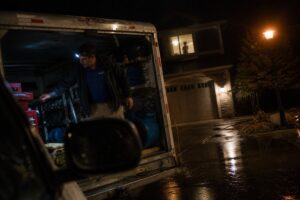
True Day Water Damage Restoration is an IICRC Certified Firm (#927354-5258) based in South Jordan, offering a written 45-minute arrival guarantee, 24/7 live-answered dispatch, free emergency inspection, and direct insurance billing. Call (385) 247-9359.
South Jordan is our home community — the city where True Day Water Damage Restoration is based, where we respond first, and where we have built the deepest knowledge of local construction, soil conditions, water infrastructure, and seasonal risk patterns. When a South Jordan homeowner calls us, we are not dispatching from a regional hub an hour away. We are eleven minutes from Daybreak’s Founders Park Village, eight minutes from the established neighborhoods along 10200 South, and ready to deploy immediately from 11268 S 2865 W.
We have stood in a lot of South Jordan living rooms explaining what is behind the wall. That conversation has a specific quality to it — the homeowner is looking at a surface that appears normal, and we are describing what the thermal imaging showed in the assembly behind it. Framing reading 26% moisture. Paper facing colonized. The source: a flashing defect that has been admitting water since the house was built. In the best version of that conversation, we found it before the homeowner noticed anything wrong — a pre-purchase inspection, a follow-up call after a musty smell, an insurance-required assessment. In the harder version, they have been living with the conditions for two or three years and the discovery of the scope is genuinely difficult news. Both conversations happen regularly in South Jordan. We have learned to deliver both versions clearly, honestly, and with enough specific information that the homeowner understands exactly what they are dealing with — not more alarming than the situation warrants, and not less complete than they need to make good decisions.
We are a licensed Utah Contractor (#960332-3505) and IICRC-Certified Firm (ID #927354-5258). Call us at (385) 247-9359.
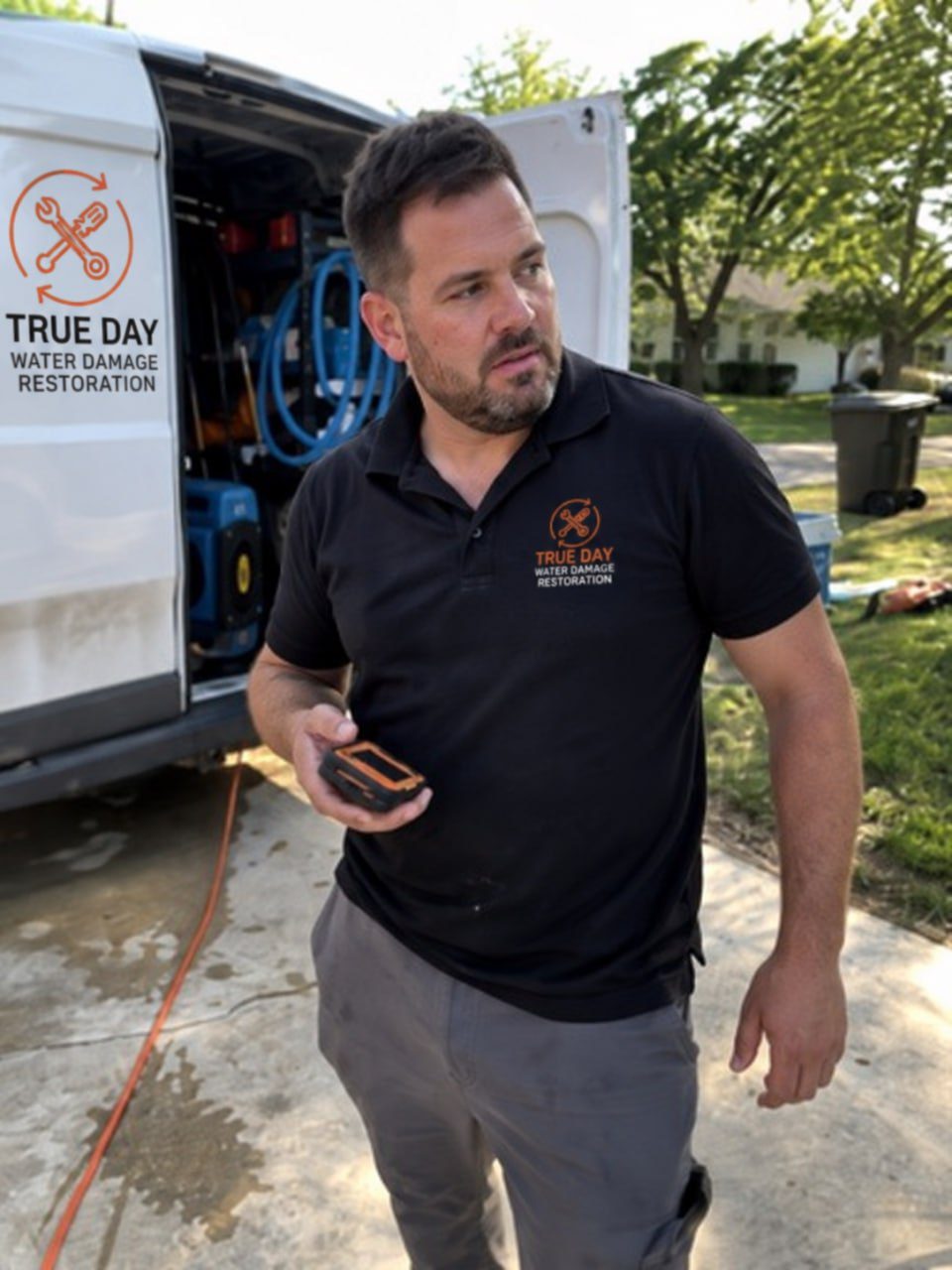
Written by Michael Bass, Owner & Founder of True Day Water Damage Restoration
Utah Contractor License #960332-3505 · IICRC Certified Firm #927354-5258 · Serving South Jordan since 2020
Read The True Day 45 Protocol — our documented 6-step response methodology →
Our Physical Presence in South Jordan
The South Jordan restoration market has a mix of real locally-owned contractors and lead-generation brokers who list a South Jordan address but dispatch from somewhere else. The four photos below show True Day’s actual presence in the city — the building at 11268 S 2865 W, the equipment inside it, the fleet that drives to your home, and the neighborhoods where our work has been done.
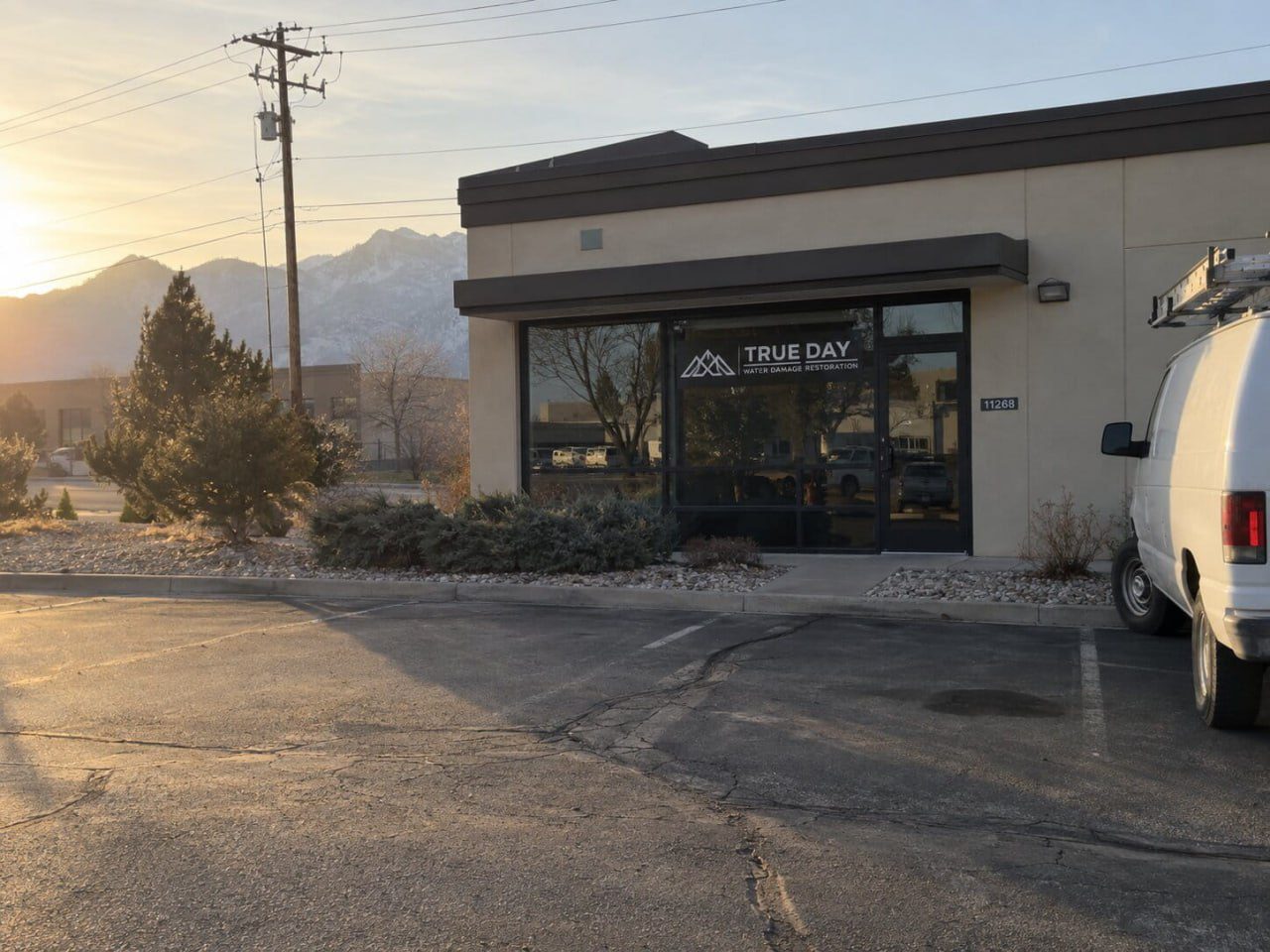
Our Office — 11268 S 2865 W, South Jordan
Three minutes from Bangerter Highway, four minutes from Redwood Road. Staffed weekdays; dispatch operations 24/7. Verifiable on Google Maps.
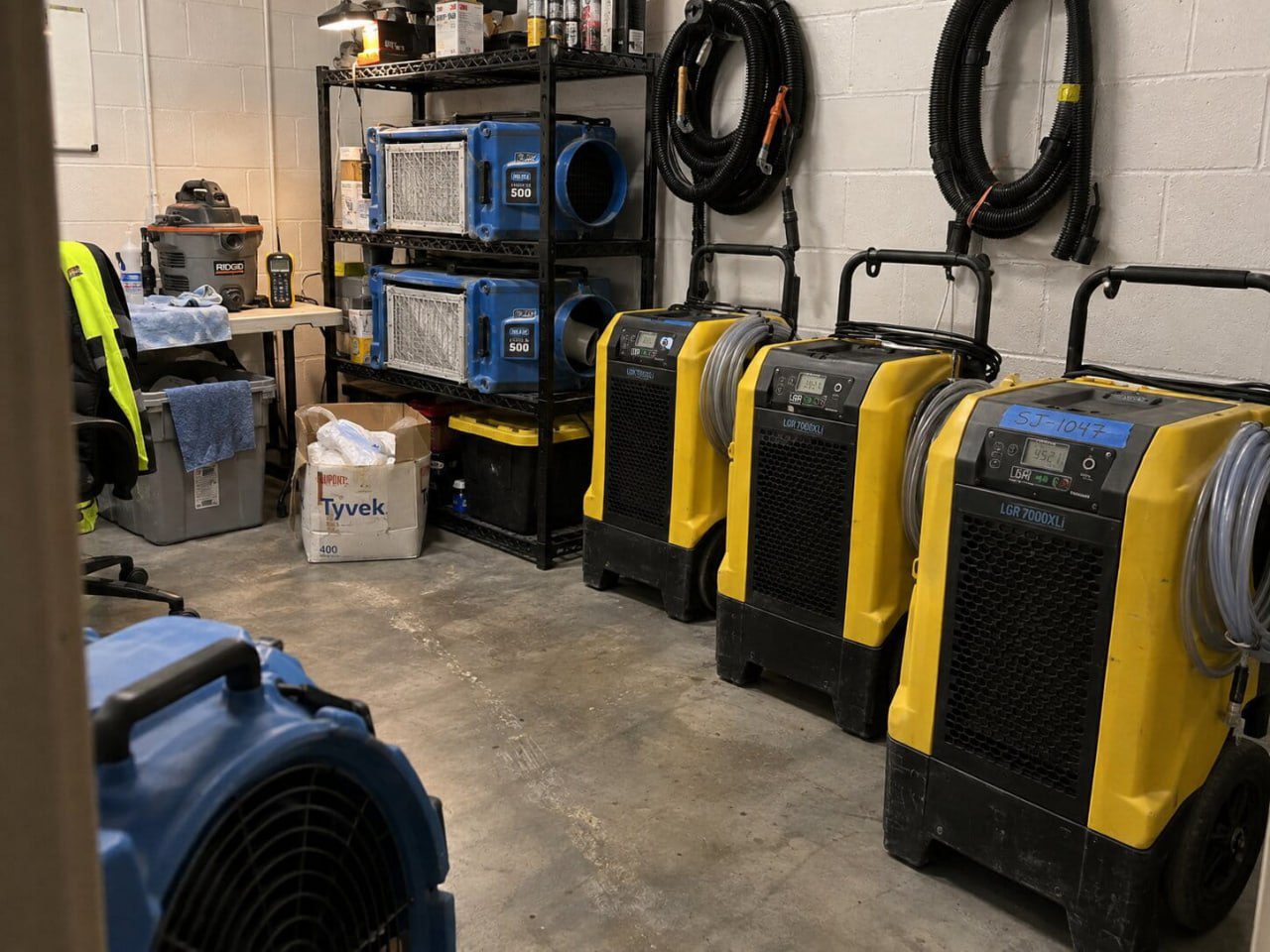
Equipment Staging Area
LGR dehumidifiers, HEPA air scrubbers, air movers, and moisture detection equipment staged for dispatch. Every piece of equipment is stored on-site in South Jordan, not driven in from another city.
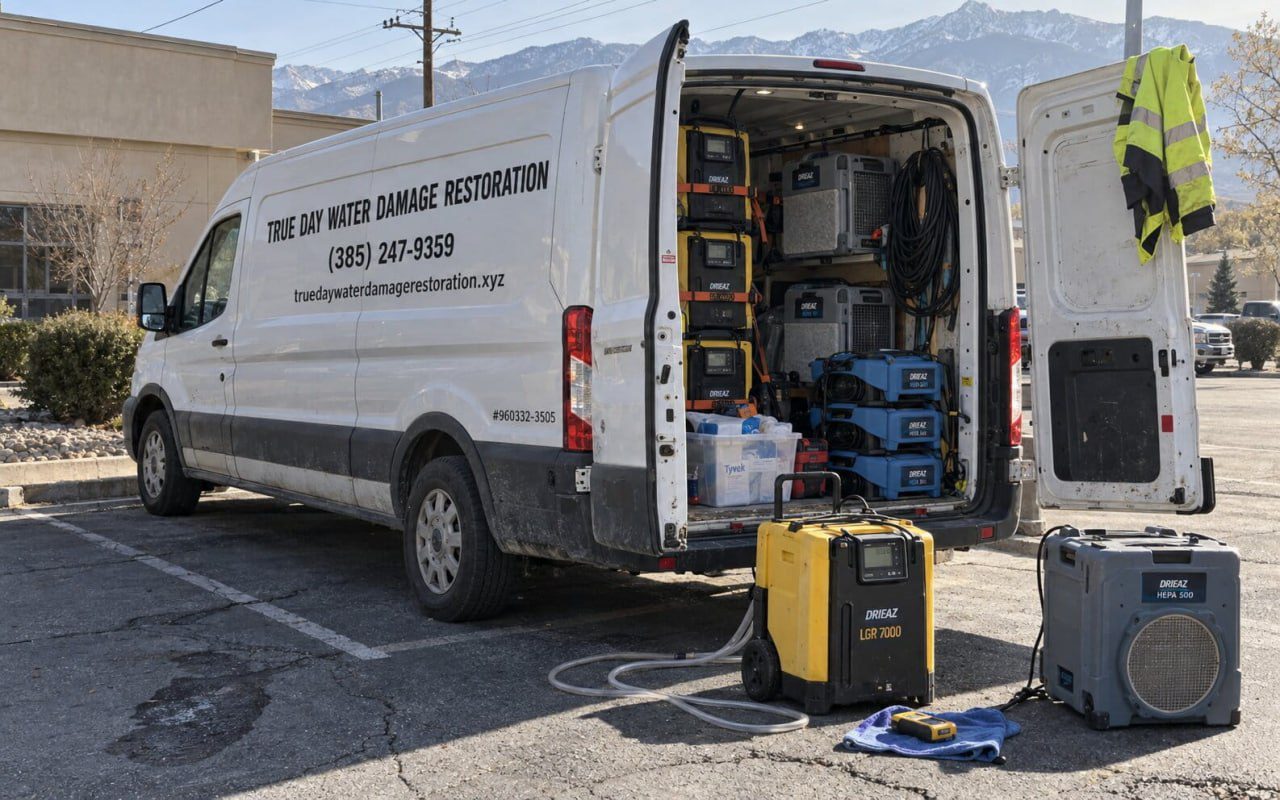
Our Fleet
Branded True Day service vehicles with our phone number and Utah Contractor License #960332-3505 visible. Every dispatch leaves from our South Jordan location.
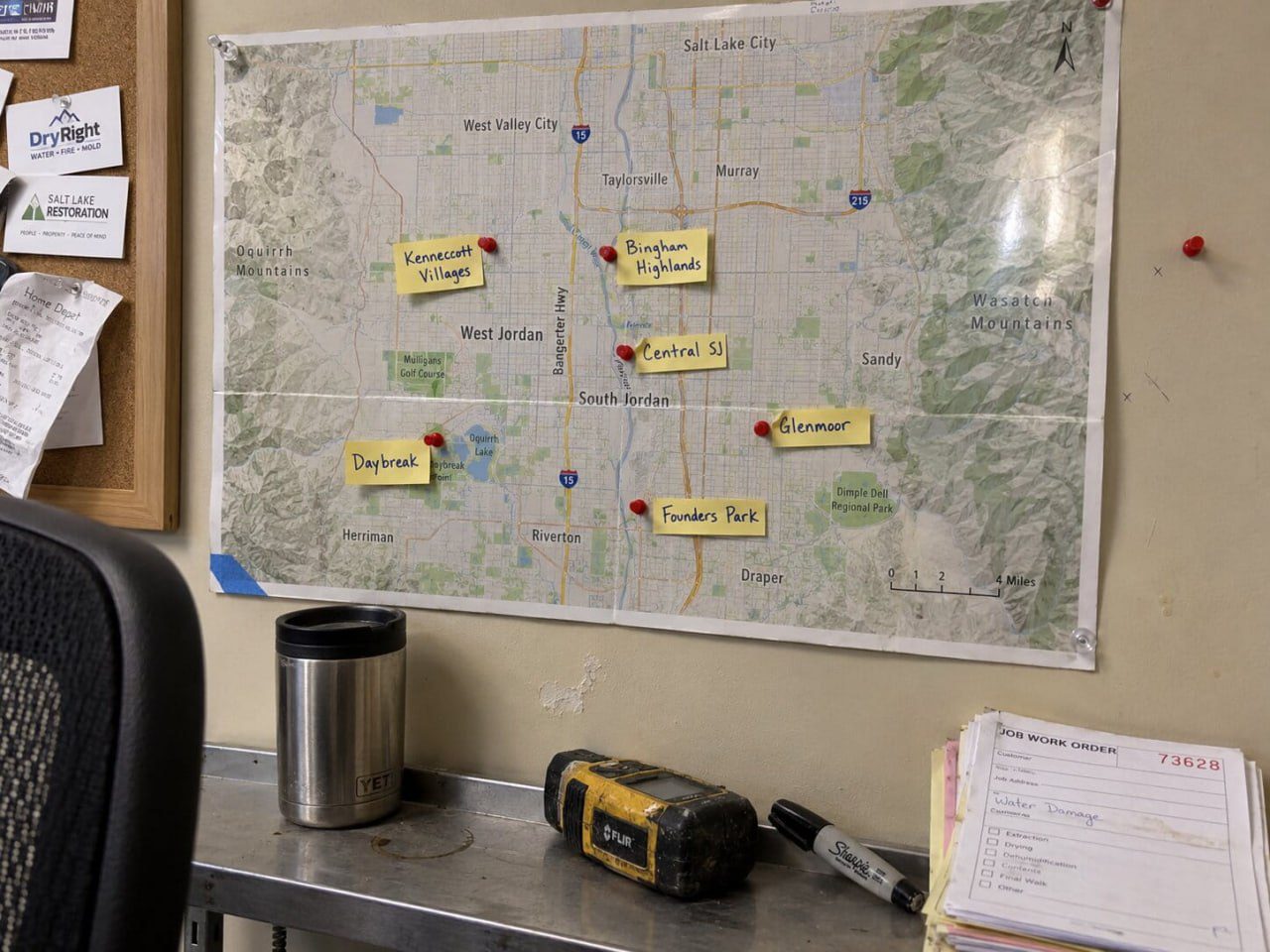
Where We’ve Worked in South Jordan
Real completed projects across South Jordan neighborhoods since 2020, including Daybreak, Glenmoor, Bingham Highlands, Founders Park, Kennecott Villages, and Central South Jordan. Neighborhood-level, no home addresses shown — homeowner privacy protected per our Privacy Policy.
What “Presence in South Jordan” Actually Means at True Day
True Day was founded in South Jordan in 2020, and the business operates from a single storefront at 11268 S 2865 W. There is no other office, no distant HQ, no franchise headquarters in another state. When you call (385) 247-9359, dispatch happens from South Jordan. When a crew arrives at your home, they left from South Jordan. When equipment gets deployed on your project, it came from the storage yard shown above.
This distinguishes True Day from restoration listings that show a South Jordan address but dispatch from a national call center, resell your call to whichever contractor bids highest, or send a crew from Provo or Ogden after telling you “we’re local.” The photos above are the evidence.
Owner: Michael Bass. Utah Contractor License #960332-3505. IICRC Certified Firm #927354-5258. Call (385) 247-9359 — a real person answers 24/7.
Need help evaluating restoration contractors in South Jordan? Read our operator-grade guide on how to choose a water damage restoration contractor — the same 5-pillar framework we hold ourselves to.
Every Call Rings in South Jordan — No Call Center, No Franchise Handoff
During business hours your call is answered by our own team in South Jordan; after hours a live answering service takes your details and pages our on-call technician that resells restoration leads to whichever contractor bids highest. Here is exactly what happens between the moment you dial (385) 247-9359 and the moment a True Day technician is in your driveway.
You dial (385) 247-9359
The (385) area code was added as an overlay to Salt Lake Valley’s original 801 in 2009. It is a Utah number, physically routed to Utah.
The call rings at 11268 S 2865 W
Our office in South Jordan. Not a national contact center. Not an answering service in another state. A real person, at the address you can drive to.
Dispatcher gathers essentials
Address, cross streets, water source if known, whether power is still on, your name and callback number. No sales script, no upsell attempt — just the details needed to send help.
Nearest W-2 crew is dispatched
A True Day employee crew leaves from our South Jordan office with the extraction and drying equipment for your specific loss type. Typical on-site arrival for South Jordan calls: under 45 minutes.
Why This Matters — What Happens With a Call-Center Contractor
Many restoration companies advertising in Utah are national franchises or lead-generation brokers whose local phone numbers route to a central contact center — sometimes in another state, sometimes offshore. When you call, the person on the phone is not a restoration technician and does not know who will be dispatched. Your call becomes a lead that gets routed to whichever affiliated contractor takes it first.
| What happens when you call | True Day | Franchise or lead-gen broker |
|---|---|---|
| Who answers? | Our dispatcher, at our South Jordan office | National contact center, often in another state |
| Who is dispatched? | A True Day W-2 employee crew you can look up | Whichever affiliated contractor accepts the lead first |
| Where do they drive from? | 11268 S 2865 W, South Jordan | Unknown — could be Provo, Ogden, or out of state |
| Who is accountable if something goes wrong? | Owner Michael Bass — directly reachable at (385) 247-9359 | Depends on which contractor took the lead |
| Can you visit the office in person? | Yes — 11268 S 2865 W during business hours | Often a UPS Store or virtual mailbox address |
The verifiable test: call (385) 247-9359 right now, even if you have no water damage, and ask “where are you located?” The person answering will tell you 11268 S 2865 W, South Jordan, Utah. Call any three restoration companies in Salt Lake Valley and ask the same question — you will be surprised how many cannot give you a specific street address, or how many hesitate before answering.
See our documented drying protocol → How we dry to a documented standard, not a fixed number of days
How Fast We Answer, How Fast We Arrive, What You Pay to Find Out
Water damage doesn’t wait for business hours. Neither does the clock on secondary damage — mold starts in 24-48 hours, hardwood cups in 72. Here are the response and pricing commitments we hold ourselves to on every South Jordan call.
The Price-Transparency Pledge
- Free inspection, free written estimate. You see every line item in Xactimate format — the same format your insurance carrier uses — before anything is demolished or dried.
- No handshake deals. Verbal quotes are not quotes. If a number is not in writing, it does not apply.
- No change without your signature. If the scope needs to change mid-job, you see the new scope in writing and sign off before the work happens. (Insurance supplements for hidden damage are the exception — those are filed with your carrier and do not change your out-of-pocket.)
- Deductible-only on covered claims. On an approved insurance claim, your out-of-pocket cost is your deductible. We bill the carrier directly for the balance.
- Published cost ranges. Real residential ranges by loss category are published at our cost guide — not hidden until the invoice.
What You Pay, What You Get in Writing, and How You Pay for It
Three questions every South Jordan homeowner asks before they commit to a restoration contractor: how much will it cost, what happens if the work fails, and how do I pay for the part insurance doesn’t cover. Here are the answers.
Upfront, in Writing, Before Work Starts
- Free emergency inspection. No trip fee, no “inspection charge” line on the invoice.
- Free written Xactimate estimate. Line-item scope in the same format insurers use.
- No hourly surprises. We quote fixed scope with documented variables (hidden damage filed as supplements with your carrier, not surprise charges to you).
- No change without your signature. Mid-job scope changes get a written change order before the work.
Full ranges: cost guide.
Written, 2 Years on Workmanship
- Workmanship: 2 years on all reconstruction work — drywall, flooring installation, paint, trim.
- Mold: 90 days on remediated areas when the home is maintained per the final-report instructions.
- Transferable: warranty transfers once to a new homeowner within the covered period.
- No gray areas: what we cover (and what we don’t) is on the warranty page in plain English.
Full terms: warranty page.
Options for Deductibles and Non-Covered Work
- Deductible-only on covered claims: on an approved insurance claim, your out-of-pocket is your deductible — we bill the carrier directly for the balance.
- Payment plans: for deductibles or non-covered work, we offer short-term payment plans up to 90 days with no interest.
- Third-party financing: for larger reconstruction projects, we work with homeowner-friendly financing partners. Ask your project manager for current options.
Call (385) 247-9359 to discuss what works for your scope.
How We Handle Your Insurance Claim
Six documented steps from first call to final payout:
- Moisture mapping and before-photo documentation with FLIR thermal imaging
- Preliminary scope written in Xactimate — the same software your adjuster uses
- Daily moisture-meter drying logs shared with you and submitted to the carrier
- Direct insurance billing — you pay only your deductible on covered claims
- Supplements with photos and moisture data if hidden damage is found mid-job
- Final documentation package and payout release after proof of completion
Working with insurance carriers including Liberty Mutual, State Farm, Allstate, Farmers, USAA, Nationwide, American Family, Progressive, Travelers, Bear River Mutual, and The Hartford.
Read the Full Claim Workflow →Our Communication Promise
The communication standard True Day holds itself to on every South Jordan job — written down, named, and auditable, not just stated verbally when things go well.
Five Named Commitments
You receive a written Xactimate scope — the same software your insurance adjuster uses — before any demolition or drying work begins. You know the number before you commit, not after.
Every job is assigned one True Day project manager by name, with their direct cell number and email. Not a general dispatch queue. You know who to call when you have a question, and that person knows your job.
While your home is drying (typically 3-5 days), you receive a daily update with the moisture-meter readings on each affected material. You see the drying trend over time, not just a “it’s drying” verbal check-in.
Emergency inspection and on-site assessment are free of charge. No trip fee, no after-hours surcharge, no minimum invoice. If we miss the 45-minute arrival guarantee for South Jordan, the inspection stays free.
On covered insurance claims, you pay only your policy deductible. If hidden damage is found mid-job, we file a supplement with your insurer — not a surprise invoice to you. If a scope line changes, you see it in writing before the work.
Technician Conduct on Your Property
Every True Day technician is a W-2 employee who follows this conduct standard on every job:
Where This Standard Lives
These commitments are not marketing copy. They are the operational standard True Day crew leaders are measured against on each job. If you believe we fell short of any of the five commitments or the conduct list, call Michael Bass directly at (385) 247-9359 or email info@truedaywaterdamagerestoration.xyz and he will investigate the specific job within one business day.
Want the full cost breakdown? See our South Jordan water damage cost guide with real ranges by loss category and what insurance covers.
Not an Emergency? We Handle Project Work Too
Water damage is not always a flood. Slow leaks, hidden moisture, mold concerns, and pre-purchase inspections are project-mode work — scheduled, documented, and transparently priced. See the dedicated service pages below.
Hidden Leak Detection and Cleanup
Suspect a slow leak? FLIR thermal imaging and calibrated moisture meters find it, map the extent, and produce a written report you can act on. Published pricing from $150 inspection to full remediation.
Hidden Leak Detection →Mold Inspection and Testing
Visible mold, musty smell, or post-water-damage verification. S520-standard inspection with optional lab-tested air sampling. Free initial assessment call — we tell you honestly whether a paid inspection is worth it.
Mold Inspection →Both services include free emergency inspection if an active water loss is discovered during the project-mode work. Insurance direct-billed via Xactimate on covered claims. Wisetack financing available for out-of-pocket work.
Service Area — Where We Dispatch From, Where We Work
Every crew leaves from 11268 S 2865 W in South Jordan. The map below shows our physical location. The neighborhood list below shows the specific South Jordan areas where our completed work is documented since 2020.
Verify on Google Maps · Get directions to our office
South Jordan Neighborhoods We Serve
SoDa Row, Founders Park, Lake Village, Eastlake
Glenmoor Golf area, established residential
West-side established residential
North Daybreak, family residential
Southwest South Jordan
Historic residential, Redwood corridor
Why South Jordan Homes Flood — The Five Local Drivers
Water damage in South Jordan is not random. There are five distinct local drivers that explain the great majority of the restoration calls we respond to across the city — and understanding which one is affecting your specific home helps predict what is coming next. Each is covered in depth in its respective section on this page.
Driver 1 — Bonneville Smectite Clay and Hydrostatic Pressure
Much of South Jordan sits on Bonneville lakebed sediment — highly expansive smectite clay that swells during wet periods and shrinks during dry ones. This movement generates hydrostatic pressure against basement walls and drives seepage through cold joints, wall-floor connections, and any breach in the foundation waterproofing. See the Basement Flooding section and our Glenmoor basement case study for the full mechanism.
Driver 2 — North American Monsoon Sewer Surcharge (July-September)
Intense summer convective storms overwhelm municipal sewer collection mains, causing Category 3 sewage backup through basement floor drains and lower-level toilets. Homes without sewer backup insurance endorsements face uncovered five-figure losses. See the Sewage Cleanup section for the response protocol and insurance considerations.
Driver 3 — Wasatch Freeze-Thaw and Burst Pipes (January-February)
Utah’s coldest weeks produce peak burst-pipe volume — most of it not during the freeze, but during the thaw 12-48 hours later. Freeze-prone zones in South Jordan homes include exterior hose bibs, attic supply lines in older established neighborhoods, and kitchen supply lines on exterior walls. See the Burst Pipe and Frozen Pipe section for freeze-prone zone specifics and prevention.
Driver 4 — Hard Water Fitting Scale-Out and Appliance Failures
JVWCD supply water runs 7-10 grains per gallon of hardness — classified as hard to very hard. Established homes on this water for 20+ years show consistent scale accumulation at compression fittings, angle stops, and appliance supply connections. Water heater tanks, washing machine hoses, dishwasher supply lines, and refrigerator ice maker lines all fail on predictable timelines driven by hard-water service life. Cross-reference our appliance leak content on the water damage restoration service page.
Driver 5 — Construction-Era Failure Patterns
South Jordan’s housing stock spans five decades, and each era has distinct failure patterns:
- 1970s-1980s established South Jordan homes along 10200 South, 10600 South, 11400 South corridors — galvanized steel supply lines reaching end-of-life, unencapsulated crawl spaces, vintage water heaters
- 1990s-early 2000s construction — polybutylene plumbing recalls, first-generation PEX transitions, aging composite roofing
- 2004-present Daybreak master-planned construction — modern PEX plumbing (crimp connections most common failure), Energy Star tight envelopes, engineered I-joist floor systems (different drying behavior than dimensional lumber), slab-on-grade with radiant heating in some phases
Recognizing which construction era your home falls into predicts which failures are most likely and where to look first when trouble starts.
Understanding the local driver behind your specific loss is part of what a real assessment provides. Call (385) 247-9359 for a free assessment — we identify the driver, document the scope, and coordinate with your insurance carrier.
South Jordan Housing Stock and What Fails — By Decade
Every South Jordan home has a construction fingerprint that predicts which components fail first. If you know when your home was built, you can predict — with real accuracy — what you should be watching for and what the restoration crew that responds to your home should expect to find. Here is the decade-by-decade breakdown for South Jordan’s housing stock:
Pre-1970 — Original South Jordan Farmsteads and Early Subdivisions
A small but persistent set of pre-1970 homes exists in original South Jordan, mostly along the 10600 South and 10800 South corridors and in the original townsite. Common failure modes:
- Galvanized steel supply lines at or past end-of-service life — pinhole leaks and full ruptures
- Cast iron drain lines with root intrusion or corrosion-through
- Original knob-and-tube electrical in some cases — electrical safety concerns during water response
- Unencapsulated crawl spaces with ongoing ground moisture
- Foundations without perimeter drainage — hydrostatic seepage during snowmelt
1970s-1980s — First Major South Jordan Expansion
The first wave of South Jordan suburban expansion, primarily along the 10200 South, 10600 South, and 11400 South corridors. Common failure modes we respond to:
- Galvanized-to-copper transitions — 40+ year old fittings finally letting go
- Original 40-50 gallon water heaters — tank corrosion end-of-life
- Cast iron drain-waste-vent (DWV) — cracking at hubs, root intrusion at exterior connections
- Vintage forced-air furnaces in basement mechanical rooms — condensate line failures
- Aluminum siding + original single-pane windows — envelope water intrusion around windows and door thresholds
- Vintage roofing at end-of-life — original 3-tab asphalt shingles
- Radon and moisture in unfinished basements — often “finished” cheaply in the 1990s creating hidden moisture pockets
1990s-Early 2000s — Second Expansion Wave and Polybutylene Era
Rapid South Jordan growth. Multiple large subdivisions. This is the era we see the widest variety of failure patterns because it spans a transition in materials:
- Polybutylene (PB) plumbing recalls — grey plastic supply lines subject to catastrophic failure. If you have a 1995-2002 South Jordan home and see grey plastic supply lines, this is a known defect issue and a proactive replumb is worth serious consideration.
- First-generation PEX in later homes of this era — crimp-ring connection failures at fittings
- Original 50-gallon water heaters reaching 25+ year age — well past end-of-service
- OSB roof sheathing becoming the standard — ice dam attic saturation more common than earlier plywood-sheathed roofs
- Vinyl siding replacing aluminum — different water shedding behavior, kick-out flashing issues at roof-wall junctions
- Central AC becoming standard — HVAC condensate leak potential in basement mechanical rooms
Mid-2000s-2014 — Modern Construction Standards Established
Building code updates, energy code adoption, and the beginning of modern PEX-only plumbing:
- PEX supply lines throughout — crimp and expansion fitting connections are the failure points, not the pipe itself
- Higher R-value insulation and tighter envelopes — moisture retention behind wall assemblies when leaks occur
- High-efficiency furnaces with condensate — condensate line clogs cause secondary flooding
- Engineered lumber (LVL, I-joist) in some floor systems — different drying behavior than dimensional lumber
- Manufactured stone veneer without proper drainage plane — water intrusion behind stone facades a decade later
2004-Present — Daybreak Master-Planned Community
Every home in Daybreak was built after 2004 on former Kennecott mining land. Distinctive construction patterns produce a distinctive failure profile:
- All PEX plumbing — connection failures dominate (crimp rings, expansion fittings, compression fittings at angle stops)
- Energy Star certified tight vapor barriers — moisture behind wall assemblies wicks slowly and hides longer
- Slab-on-grade construction in most Daybreak villages — no basement seepage, but slab supply line failures are difficult to detect early
- Radiant floor heating in some phases — supply line failures inside the slab
- I-joist floor systems in multi-story villas — engineered lumber drying is more complex than dimensional lumber
- Refrigerator ice maker line failures — the 1/4″ plastic tubing not rated for the service life it gets
- Dishwasher supply and drain hose failures — modern dishwashers use different connection types with different failure modes than older units
- Roof and window flashing defects — despite modern construction standards, installation-era flashing defects on 2004-2010 Daybreak homes are surfacing as Stachybotrys mold events now
2015-Present — Newer Daybreak Phases, Bluffdale/Herriman Overspill
Newest South Jordan and adjacent construction:
- Expansion-fitting PEX replacing crimp — different failure mode
- Tankless water heaters becoming common — different failure profile than tank units (scale-out, ignition issues, cold-water sandwich)
- Higher solar penetration — roof penetration flashing at panel mounts as a new water intrusion vector
- Modern smart home leak detection — some homes catch failures early, some homes generate false alarms that mask real events
How this helps you: When you call us, tell us the approximate age of your home. That single piece of information changes what we look for first, what tools we bring, and how we scope the moisture assessment. A 1978 home with a wet ceiling and a 2016 Daybreak home with a wet ceiling are almost never the same failure — and treating them the same is how less experienced restoration companies leave hidden damage behind.
Six Real South Jordan Case Studies
Below are six real water damage restoration projects we completed in South Jordan. Each is documented with the actual failure source, scope of damage, restoration methodology used, insurance carrier that approved the claim, and final outcome. Names and specific street addresses are omitted for homeowner privacy, but the neighborhood, damage type, and technical specifics are real.
Case Study 1 — Burst Pipe with Two-Story Ceiling Damage, Established South Jordan
Second-story bathroom supply line burst during a January cold snap. Meltwater from the thaw saturated the ceiling assembly below and the main floor drywall. Full extraction, ceiling and drywall demolition, structural drying with LGR dehumidifiers, and reconstruction to original finish. Insurance carrier approved. Read the full Burst Pipe Ceiling Damage case study →
Case Study 2 — Refrigerator Ice Maker Line Flood, South Jordan
Refrigerator ice maker line failure while the family was at work. Slow leak behind the fridge saturated hardwood flooring and wicked into the adjacent dining room subfloor. FLIR thermal imaging identified the full moisture footprint. Extraction, controlled drying, and hardwood floor restoration. Read the full Refrigerator Line Flood case study →
Case Study 3 — Washing Machine Overflow, South Jordan
Washing machine supply hose ruptured during a wash cycle while the homeowner was out of the house. Gallons of water flooded the laundry room, adjacent hallway, and downstairs family room. Emergency extraction and multi-zone structural drying. Read the full Washing Machine Overflow case study →
Case Study 4 — Basement Sewage Backup, South Jordan
Category 3 sewage backup through basement floor drains during a North American Monsoon storm event. Full IICRC S520 protocol — HEPA-filtered negative-air containment, PPE, mandatory removal of affected porous materials, EPA-registered antimicrobial treatment, and post-remediation clearance testing by an independent industrial hygienist. Read the full Sewage Backup Basement case study →
Case Study 5 — Fire, Smoke, and Water Damage, South Jordan
Structure fire with kitchen origin. Suppression water saturated the main floor. Soot migration reached upstairs through HVAC returns. Combined fire and water damage restoration — fire cleanup, structural drying of suppression water, HVAC decontamination, smoke deodorization, and reconstruction. Read the full Fire, Smoke, and Water Damage case study →
Case Study 6 — Basement Seepage and Mold Colonization, Glenmoor
Hydrostatic pressure from expansive Bonneville smectite clay drove groundwater through a cold joint in a Glenmoor basement wall. Undetected for months. Discovered when musty smell reached the upstairs. Cladosporium and Aspergillus mold colonization behind finished basement wall assemblies. Full remediation to IICRC S520 with independent third-party clearance testing. Approved by Bear River Mutual.
See our full case studies archive for additional real project documentation across South Jordan and the surrounding Salt Lake Valley communities.
Emergency Water Damage Response in South Jordan
45-Minute Arrival Guarantee, 24/7
Call (385) 247-9359 anytime — day, night, weekend, holiday. From the moment your call is answered, we guarantee a True Day technician will be at your South Jordan address within 45 minutes, or your emergency inspection is free. Written into every service agreement. Verified by dispatch timestamp on every job.
What to Do Before We Arrive
- Shut off the water at the main supply valve if you can locate it safely.
- Cut power to affected outlets and appliances only if the breaker panel is dry and reachable without stepping into standing water.
- Do not enter standing water if any electrical outlets, cords, or appliances are submerged — water conducts electricity.
- Move electronics, documents, and valuables above the water line where you can do so safely.
- Photograph everything before moving it. The documentation supports your insurance claim.
- Do not attempt to dry wet drywall, insulation, or subfloor yourself. Porous materials need professional dehumidification within 24 to 48 hours to prevent mold colonization.
Call (385) 247-9359 — Live-Answered, No Voicemail
Our line is answered live 24 hours a day, 7 days a week, 365 days a year. No voicemail. Dispatch begins the moment your call is answered, from our office at 11268 S 2865 W in South Jordan.
Who Actually Shows Up at Your Door
When you call (385) 247-9359, a True Day technician — a W-2 employee of True Day Water Damage Restoration, dispatched from our office at 11268 S 2865 W in South Jordan — is who arrives. Not a subcontractor. Not a franchise crew we borrowed for the day. Not someone from a company that bought your call.
Our technicians arrive in True Day-marked trucks and identify themselves by name at the door. Every technician is IICRC-trained under our firm certification (#927354-5258). The technician who conducts your initial assessment is the same technician who manages your project through completion — no crew transfers halfway through, no office-staff scope summaries handed to a different field crew the next day.
The company is owned and operated by Michael Bass. If a project reaches a decision point where you want to speak with the owner directly, you can. That is not a promise every restoration company can make.
Why Homeowners Choose True Day
IICRC Certified Firm #927354-5258
The IICRC (Institute of Inspection, Cleaning and Restoration Certification) is the restoration industry’s standards body — the certification your insurance carrier expects the contractor drying your home to meet. Firm-level certification means True Day’s processes, equipment, and training meet the IICRC’s published standards for water damage restoration under S500, mold remediation under S520, and structural drying protocols. Verify our firm registration at iicrc.org/locator.
Utah Contractor License #960332-3505
Held by True Day Water Damage Restoration through the Utah Division of Occupational and Professional Licensing (DOPL). Active status is publicly verifiable at secure.utah.gov/llv/search — enter the license number to see the current record. A Utah contractor license is required to perform structural drying and reconstruction work on a Utah home; the number lets you distinguish licensed contractors from unlicensed operators, which is a common problem in the restoration industry.
Insurance Direct Billing — You Pay Only Your Deductible
When your homeowner’s insurance covers the loss, we bill your carrier directly for the approved scope. You pay only your policy deductible when the work completes. You are not fronting several thousand dollars for the mitigation and waiting weeks on a reimbursement check. The full insurance process breakdown is further down this page.
Written Limited Workmanship Warranty — 1 year on mitigation and reconstruction, 90 days on mold under IICRC S520. See full terms.
Written Guarantee vs Unbacked Marketing Claim
Several restoration companies in the Salt Lake Valley advertise “30-minute response” or similar arrival-time promises. What most of those claims have in common: no written guarantee, no service-level agreement, no compensation if the claim is missed, and no consistency across the company’s own website. Some companies’ homepages and city pages state different arrival times.
Our 45-minute arrival guarantee is different in three specific ways:
- It is written into every service agreement. Not a marketing tagline — a contractual commitment.
- It carries a compensation mechanic. If we miss the 45-minute window, your emergency inspection is free.
- It is consistent across every page of our site. Homepage, service pages, city pages, meta descriptions, and schema markup all state the same 45-minute guarantee — because it is the same operational promise everywhere.
A written 45-minute commitment we can prove is stronger than an unbacked 30-minute claim that changes from page to page. You are not calling a company that inflates its promises for marketing.
Every claim on this page is verifiable. See the full fact sheet at /facts/ for licenses, insurance, service area, and credentials.
We Bill Every Major Insurance Carrier Directly
We bill your insurance carrier directly for the approved scope — you pay only your policy deductible. Every estimate is built in Xactimate, the same platform your carrier’s adjuster uses, which reduces disputes and speeds approval.
Carriers we work with regularly include:
- State Farm
- Allstate
- Farmers
- USAA
- Liberty Mutual
- Progressive
- Nationwide
- American Family
- Bear River Mutual (Utah-specific)
- Farm Bureau
- Travelers
- The Hartford
- Auto-Owners
Carrier not listed? Call (385) 247-9359 — we bill most Utah homeowners carriers directly and will confirm yours on the first call.
The No Surprise Invoice Promise
The industry’s biggest source of restoration disputes is the gap between what was quoted verbally and what appeared on the final invoice. True Day closes that gap with five written commitments before we cut a single wall:
You see the full Xactimate scope before we cut anything.
Every line matches Xactimate — the same software your carrier uses.
Drying needed to stop active damage continues; any added scope is documented with photos and moisture data and shared with you and your carrier the same day. Reconstruction changes need your signature first.
You know your out-of-pocket cost before demolition begins.
Escalation to Michael Bass directly if the project lead can’t resolve it.
The South Jordan Homes We Work On
South Jordan’s combination of geology, water chemistry, climate, and construction eras creates a water damage pattern that we know in detail — not from general restoration knowledge but from the specific projects we have completed across this city’s neighborhoods.
Hard Water and Supply Line Failure
The Jordan Valley Water Conservancy District supplies South Jordan culinary water at 7 to 10 grains per gallon of dissolved calcium and magnesium — classified as hard to very hard. Calcium carbonate and magnesium carbonate mineral scale accumulates inside supply line fittings, valve bodies, and hose walls over years of service, progressively weakening them from the interior in a way that external inspection cannot detect. This failure mode makes Category 1 water damage events more frequent in South Jordan than in softer-water markets — and makes supply line replacement on a proactive schedule one of the most effective loss-prevention measures available to homeowners here.
Expansive Clay Soils and Basement Seepage
South Jordan’s subsoil consists substantially of montmorillonite-rich smectite clay — the expansive lacustrine deposits left by ancient Lake Bonneville, which covered the Salt Lake Valley to depths of hundreds of feet. This clay swells when saturated and contracts when dry, creating seasonal lateral pressure against basement foundation walls that gradually compromises cold joint seals and drives chronic seepage into finished basements — particularly in the pre-2000 construction stock along the 10200 South and 11400 South corridors near the Jordan River floodplain.
North American Monsoon Season
The North American Monsoon pattern — intense convective precipitation from early July through mid-September driven by seasonal moisture flow from the Gulf of California — delivers rainfall events of one inch per hour or more to the Salt Lake Valley. These events overwhelm municipal sewer collection mains in some South Jordan neighborhoods, producing Category 3 sewage backup events through floor drains and basement fixtures. The rapid growth of South Jordan’s residential population over the past two decades has increased hydraulic loading on collection infrastructure built for a smaller service population — a condition that makes monsoon-season sewer surcharge events more frequent in the lower-elevation corridors near the Jordan River basin.
Daybreak and Post-2006 Construction
Daybreak’s master-planned community — South Jordan’s largest and most distinctive residential development — features contemporary craftsman and modern farmhouse construction with engineered lumber structural systems, tight building envelopes, open floor plans, and second-floor bathrooms and laundry rooms positioned above finished living spaces in adjacent units. These design characteristics create specific water damage patterns: supply line failures on the second floor migrate through I-joist web openings into the first-floor ceiling before becoming visible from either level; smoke from kitchen fires distributes through the unified open-concept air volume to rooms two floors away before the HVAC is shut down; and construction defect moisture intrusion through improperly flashed window openings produces hidden mold growth in wall assemblies that goes undetected for years.
Wasatch Front Freeze-Thaw and Ice Dams
January and February freeze-thaw cycling — overnight lows well below freezing followed by daytime recovery above 32°F — produces ice dam conditions on the low-slope and hip rooflines common in South Jordan’s contemporary and production-builder construction. Repeated ice dam intrusion over multiple seasons saturates oriented strand board roof sheathing and produces Cladosporium colonization on attic decking that homeowners discover months or years after it began.
Realistic Timelines — What to Expect
Water damage jobs don’t finish on marketing-page schedules. Here’s what we actually see on jobs in South Jordan, so you can plan around real numbers.
Emergency arrival
45 minutes to South Jordan addresses, including Daybreak, from the time you call (385) 247-9359. We log every arrival time and keep 12 months of records on our monthly response audit page. For addresses outside South Jordan — Herriman, Bluffdale, Riverton, Draper, West Jordan — expect 45-75 minutes depending on time of day and traffic on I-15.
Water extraction and emergency mitigation
First 24 hours. Standing water out, wet carpet pad up, wet drywall marked for cut (or cut, depending on category), air movers and dehumidifiers placed, first moisture map documented. If you’re home when we arrive, this part is noisy — equipment runs 24/7 until the structure is dry.
Structural drying
Most residential losses: 3-5 days. We measure moisture on wall framing, drywall, and subflooring daily and share the readings with you. Target: wood framing under 16% moisture content, drywall within 2% of unaffected areas, carpet within 5%.
Smaller clean-water losses (under 100 sq ft, caught within 6 hours of the event): sometimes 24-48 hours.
Larger Category 2 or Category 3 losses (gray or black water, significant wet material, slow discovery): 7-10 days is common. Hardwood floor drying can push the dryout to 14-21 days.
Reconstruction
Depends on scope. Replacing baseboards and painting in two rooms: 2-5 days after drying. Replacing drywall, insulation, flooring, and cabinetry in a kitchen: 2-4 weeks. Rebuilding a finished basement after a Category 3 sewage loss: 4-8 weeks. We give you a written reconstruction schedule as part of the Xactimate scope before work starts.
Insurance claim cycle
Not under our control, but typical ranges: adjuster inspection within 48-72 hours of claim filing; initial scope approval within 1-2 weeks; supplements (if hidden damage is found) add 1-3 weeks each; final payment release after proof of completion. If your carrier is slow, we document and advocate — but we can’t move the carrier faster than their process allows.
Three Things That Matter More Than “20+ Years”
The restoration industry trades on tenure claims that most homeowners cannot verify. Here are three signals that are verifiable, and that we hold ourselves to.
Guarantee-Backed Speed
45-minute arrival in South Jordan, backed by a published policy — not a claim. If we are late, the policy on the guarantee page says what you get.
IICRC-Certified Firm
True Day operates as an IICRC-Certified Firm — the business itself meets IICRC’s standards for insurance, training, and complaint resolution, not just individual techs holding certificates.
Live-Answered 24/7
Call any hour, any day — a person who can dispatch a technician answers under 3 rings. Not a voicemail that gets picked up Monday morning. Not an answering service that logs a ticket.
Why we don’t lead with a tenure number
“20+ years” means little without context: 20 years as what — a sole proprietor, a franchisee, a renamed previous business? True Day operates under a legal entity you can verify in the Utah Division of Corporations, with a BBB profile, an IICRC firm certification, and a published guarantee. Those are the signals that actually translate to how your job will be run.
What Can Go Wrong — Honest Disclosure
Restoration websites rarely talk about what can go wrong. Here’s a reality check from a company that does this work every day:
Hidden moisture behind tile, cabinets, and wall cavities
On a Day 1 inspection, we scan with FLIR thermal imaging and calibrated moisture meters. But some moisture doesn’t register until Day 2 or Day 3 of drying — water trapped behind tile grout, under toe-kicks of cabinetry, or inside stud bays with limited air movement shows up as the surrounding material dries. When this happens, we open the hidden cavity, add equipment, and extend drying. We also file a supplement with your insurer to cover the additional scope.
Extended drying times
Our target is 3-5 days for most residential dryouts. Some jobs legitimately run longer: hardwood floors (7-21 days), insulated crawl spaces (5-10 days), high-humidity weeks when outdoor conditions slow drying. We don’t declare a job dry until the moisture readings hit target — not when the calendar says so.
Supplement requests
The initial Xactimate scope is based on what we can see on Day 1. When demolition opens walls, floors, or ceilings and we find damage that wasn’t visible, we file a supplement with your insurer — a formal request to add scope with photos, moisture data, and justification. Supplements are a normal part of insurance work, not a sign something is wrong. Most jobs over $10,000 have at least one supplement.
Insurance disputes
Occasionally your adjuster and our Xactimate scope disagree on specific line items. When this happens, we provide additional documentation, help you invoke your policy’s appraisal clause if it comes to that, and advocate for scope that reflects actual damage. We don’t walk away mid-job because of a scope dispute — but we also can’t guarantee every disputed line gets approved.
Materials and timeline risk
Reconstruction depends on material availability. Standard drywall, baseboards, and carpet are usually in stock. Specialty materials (specific tile patterns, custom cabinets, hardwood species) can add 2-6 weeks of lead time. We flag these risks in writing before you commit to materials.
Non-covered items
Some things your policy may not cover: mold damage over the policy cap (usually $5,000-$10,000 unless you have a mold rider), gradual seepage over 14 days, sewer backup without a sewer backup endorsement, sump pump failure without a sump pump endorsement. We flag coverage gaps during the first inspection so you’re not surprised when the carrier’s decision letter comes.
Our commitment, honestly stated
We document every step, we show you daily moisture readings, we follow ANSI/IICRC S500 and S520 standards, and we come back under our written warranty if anything doesn’t hold up. We can’t promise perfection — nobody can on insurance restoration work — but we can promise honesty about what’s happening on your job every day it’s underway.
Every call is answered and run by a named IICRC-certified technician on our crew — not a subcontractor and not a staffing agency.
Extraction → Drying → Mold → Reconstruction
One crew. One point of contact. One licensed contractor from the first wet floor through the final paint touch-up. You do not hand off between a mitigation company and a general contractor halfway through the job.
Water Extraction
Truck-mount extraction, standing-water removal, wet-contents move
Structural Drying
LGR dehumidifiers, air movers, daily moisture logs under IICRC S500
Mold Remediation
Containment, HEPA air scrubbers, physical removal under IICRC S520
Reconstruction
Drywall, flooring, paint, finish work under Utah Contractor License
The Seven In-House Services Covered
Each service below is performed by True Day W-2 technicians on True Day equipment, invoiced on the same Xactimate scope, billed directly to your insurance carrier.
Many restoration companies in Utah hold only an IICRC certification for the mitigation side, which does not authorize licensed construction work like drywall replacement or flooring installation. True Day holds Utah Contractor License #960332-3505 issued by the Utah Division of Occupational and Professional Licensing (DOPL). That license authorizes True Day to perform the structural rebuild, not just the water extraction and drying. That is why we can finish the job you started with us, under one scope and one invoice.
How We Communicate on Every South Jordan Job
The number-one complaint in restoration reviews is not price — it is communication. “They don’t call back.” “They missed the deadline and didn’t tell us.” Here is how True Day prevents both.
1. Same-Day Mitigation Start
If you call before 7:00 PM Mountain Time, mitigation (extraction + equipment placement) begins the same day. No “we’ll be there Monday” when the call came in on Saturday.
2. Written Reconstruction Timeline Within 72 Hours
Within 72 hours of mitigation starting, you receive a written reconstruction timeline with specific milestone dates — not “a few weeks”. The timeline is a working document you can hand to your insurer.
3. Named Project Manager with Direct Cell
Every job is assigned one project manager by name. You get their direct cell phone number. Not an office line, not a dispatch number — their cell.
4. Written Milestone-Slip Notification
If a milestone date is going to slip, you hear about it before the date — in writing (email or text), with the reason and the new target. Never after the fact.
What the Written Timeline Looks Like
A typical reconstruction timeline for a Category 2 basement loss (example only; your scope varies):
| Milestone | Target Date | What You See |
|---|---|---|
| Mitigation complete + final moisture reading | Day 3–5 from start | Equipment pulled, final moisture log emailed to you |
| Xactimate scope approved by carrier | Day 5–10 | Carrier approval letter forwarded to you |
| Materials ordered + ETA locked | Day 10–14 | Order confirmations with ETA dates |
| Drywall + insulation complete | Day 18–22 | Walk-through with your PM, photos sent |
| Flooring installed | Day 25–30 | Walk-through, photos |
| Paint + trim complete | Day 32–38 | Final walk-through, punch list captured |
| Punch list closed + final invoice to carrier | Day 40–45 | Written sign-off, warranty activation |
The example above is representative of a mid-size residential loss. Your timeline is built from your specific scope and the material lead times on the day the job starts — not from a template.
What Your Named Project Manager Does
- Returns calls and texts within business hours — direct, not through a dispatcher
- Sends daily status during active work (what happened today, what’s planned tomorrow)
- Attends every carrier walk-through so you don’t have to translate between contractor and adjuster
- Signs change orders with you in person or via email signature — never verbally
- Hands off cleanly: if your PM changes mid-job (illness, PTO), you get a written introduction to the new PM with the full job status included
The Milestone-Slip Rule
Reconstruction has supply-chain surprises. Materials get backordered. Carriers take longer than expected to approve scopes. Subcontractors run late. That is reality.
What is not reality in a well-run project: finding out about the slip after the milestone has already slipped. On a True Day job, if we see a target date is at risk, you hear about it before that date arrives, in writing, with the reason and the new target. One email. No surprises.
If your PM does not call this out proactively and you discover the slip yourself, call Michael directly at (385) 247-9359. That is a service failure and we treat it as one.
Why Most Restoration Jobs Fail the Communication Test
Industry reviews consistently flag the same pattern on failed jobs: the contractor stopped responding when something went wrong. A delayed material. A scope dispute. A tech that got reassigned. Instead of a proactive email (“here’s what happened, here’s the new plan”), the homeowner has to call three times to find out the floor install is now two weeks out.
The written-timeline + proactive-slip-notification combo is designed to make that pattern impossible. Every milestone has a date. Every slip gets a written notice before the date. If a notice is late, that is the signal to escalate — directly to the owner.
Water Damage Services We Provide in South Jordan
Water Damage Restoration
Full Category 1, 2, and 3 water damage response — from clean-water supply line failures to gray-water appliance discharge to Category 3 sewage backups. Extraction, structural drying to dry standard monitored daily, and moisture verification before the job closes. This is the core of our practice and the majority of our South Jordan project volume.
Water Damage Restoration → · Emergency Water Damage Services → · Basement Flooding Cleanup →
Sewage Cleanup and Sanitization
Category 3 losses — municipal sewer surcharge, septic backup, toilet supply failures — require full removal of porous materials, sanitization of remaining surfaces with EPA-registered antimicrobials, and post-remediation air quality verification. This is not a job that can be safely done with retail supplies, and the PPE and containment requirements under IICRC S500 make DIY attempts a serious health risk.
Hidden Leak Restoration in South Jordan — Project Mode Response
Not every water damage project is an emergency. Some are slow, hidden leaks that have been quietly damaging your home for weeks or months before you notice anything is wrong. A slow supply line drip behind a bathroom vanity, a pinhole in a copper joint inside a wall cavity, a failed shower pan liner allowing intermittent moisture into the subfloor — these produce a fundamentally different damage pattern than an emergency burst pipe, and they require a different response.
Hidden leak restoration is what we call project mode — not an emergency dispatch, but a scheduled inspection and remediation project. Common warning signs include a musty smell in one room that does not clear with ventilation, an unexplained water bill increase, warped or lifting flooring near a plumbing wall, cabinet toe kick discoloration, or a soft spot in drywall that appears and disappears. If any of these are present, the damage inside the wall or under the floor is almost always larger than the visible evidence suggests — sometimes 5 to 20 times larger.
Our hidden leak response uses FLIR thermal imaging to map moisture behind walls and under floors, calibrated penetrating meters to confirm moisture content, and a full assessment report documenting affected square footage and recommended remediation scope. For the detailed methodology and typical timelines, see our hidden leaks page.
South Jordan Homeowner Offers (This City Only)
The following commitments apply exclusively to homeowners with a South Jordan address (any 84009, 84095, or 84081 ZIP code). We can extend these because South Jordan is our home base — 11268 S 2865 W is 3 minutes from Bangerter Highway and 4 minutes from Redwood Road, which means our response and coverage cost profile is different here than in surrounding cities.
1. Free Same-Week Moisture Inspection for Any South Jordan Homeowner
If you live in South Jordan and want a professional moisture inspection with FLIR thermal imaging and calibrated meter readings — before you have an active event, or because you noticed something suspicious — call (385) 247-9359. We schedule South Jordan inspections within 7 days at no charge, no obligation, and no pressure to book restoration work. You get a written report. That’s it.
Homeowners outside South Jordan pay a $95 inspection fee for the same service.
2. South Jordan Priority Dispatch During Multi-Home Events
During peak-response events (a hard freeze cycle, a major monsoon storm, a Wasatch snowmelt flooding day) when we receive multiple simultaneous calls, South Jordan addresses are dispatched first. Homeowners in West Jordan, Riverton, Herriman, and further cities are dispatched immediately after South Jordan queue is cleared.
This isn’t unfair — it’s how any locally-headquartered contractor allocates finite crew capacity during peak events. Being close to home means faster response.
3. Waived Trip Charge for South Jordan Second Opinions
If a South Jordan homeowner already has a restoration contractor on-site and wants a second opinion on the scope or the moisture assessment, we come out for free within 24 hours to provide an independent evaluation. No trip charge, no consulting fee, no obligation to switch contractors.
This service exists because we’ve seen too many South Jordan homeowners locked into projects that were incorrectly scoped, over-scoped, or missing hidden damage. A second set of eyes should not cost anything.
4. South Jordan HOA and Multi-Home Coordination
If a South Jordan HOA or multi-unit event affects several units simultaneously (an underground main break, a shared sewer surcharge event, a multi-home ice dam failure), True Day coordinates the response across all affected addresses at a group rate. HOA property managers can call (385) 247-9359 and ask for the multi-home coordination protocol.
5. South Jordan City Emergency Waiver
In the event of a South Jordan citywide emergency (declared boil order, main water break affecting multiple neighborhoods, weather-driven mass-casualty water damage), True Day waives standard emergency dispatch fees for South Jordan residents. Documentation of the event is filed with the project file.
Crawlspace Water Damage in South Jordan
Crawlspaces are the most under-inspected water damage risk in South Jordan homes. Because homeowners rarely enter them, moisture problems in crawlspaces typically go undetected for months or years — long enough for framing to develop rot, subfloor OSB to lose structural integrity, and mold colonization to establish on joists, sheathing, and any stored contents. By the time symptoms reach the living space above (musty smell in the room over the crawlspace, cool damp floor, increased indoor humidity), the remediation scope is usually well beyond a simple drying project.
Common crawlspace water damage sources in South Jordan include unencapsulated ground moisture wicking up through soil (especially in expansive Bonneville smectite clay areas), plumbing failures in supply lines running through the crawlspace, HVAC condensate leaks from air handlers located in the crawl, and exterior grade issues directing surface water toward the foundation. Older established South Jordan homes (1970s-1990s construction) with unencapsulated crawlspaces are particularly vulnerable — most have vapor barriers that have been displaced or degraded over decades of service.
Our crawlspace response includes moisture source identification, extraction and drying, mold assessment if colonization is present, and coordination with encapsulation specialists when a long-term moisture control solution is required. For the detailed protocol and case study of a real South Jordan-area crawlspace project, see our crawlspace damage page and the Riverton crawlspace case study.
Mold Remediation
When drying reveals colonization that started before we arrived, or when a homeowner discovers mold that’s been present for months, remediation follows IICRC S520: containment barriers to isolate the affected area, HEPA air scrubbing throughout the work, physical removal of the affected material, antimicrobial treatment of remaining substrate, and post-remediation clearance testing to verify the space is safe to reoccupy.
Mold Remediation → · Black Mold Removal →
Fire, Smoke, Board-Up, and Storm Damage
Fire damage restoration includes soot removal, smoke deodorization, and structural cleaning after the fire department releases the property. Emergency board-up secures the structure against weather intrusion and unauthorized entry during the response phase — typically started on the same emergency dispatch as the fire response call. Storm damage response covers wind and hail events that create water intrusion pathways through the roof envelope. All three are frequently paired with water damage from firefighting effort or from wind-driven rain, and our IICRC S500 drying protocols apply to that water just as they do to plumbing losses.
Fire Damage Restoration → · Smoke Damage Cleanup → · Emergency Board-Up → · Storm Damage Restoration →
Biohazard and Trauma Cleanup
Blood, bodily fluid, and unattended-death cleanup performed to Utah health department standards. These events require specialized PPE, disposal procedures for regulated medical waste, and — for the family — discretion and pace that ordinary restoration crews are not trained to provide.
Reconstruction and Insurance Coordination
Once drying and any remediation are complete, we reconstruct the removed materials — drywall, insulation, flooring, cabinetry, finish carpentry, paint — so the affected area is returned as close to pre-loss condition as the loss and your policy allow, rather than being left mid-repair. As a licensed Utah general contractor, this work is done in-house rather than handed off to a subcontractor. Insurance claims coordination runs throughout the project.
Reconstruction & Repairs → · Insurance Claims Assistance →
Basement Flooding Cleanup in South Jordan
Basement flooding is the water damage scenario we respond to most frequently across South Jordan neighborhoods. The response protocol depends on the source of the water — because clean water from a plumbing failure and Category 3 sewage from a monsoon-season main surcharge require completely different containment, PPE, and cleanup approaches.
The First Step: Identify the Source
Before we send crews in, we need to know what caused the flooding. There are three common patterns in South Jordan basements:
- Category 1 clean water — a supply line, water heater, or appliance line failure inside the home. Municipal water from a broken pipe. This water is treated and safe. Standard extraction and drying protocol.
- Category 2 gray water — dishwasher, washing machine discharge, or aquarium overflow. Contains soaps, detergents, or biological material but not sewage. Contents contact is limited during response.
- Category 3 sewage (black water) — municipal sewer main hydraulic surcharge (common during North American Monsoon storms in July-September), septic backup, toilet supply line failure with fecal contamination, or Jordan River floodwater intrusion. Requires HEPA-filtered negative-air containment, full PPE, EPA-registered disinfectant, and mandatory removal of all porous materials (drywall, carpet pad, insulation) that contacted the water.
What To Do Before We Arrive
- Shut off the water at the main supply valve if the source is inside the home.
- Do NOT step into standing water if electrical outlets, cords, or appliances are submerged — water conducts electricity and the risk is fatal.
- If the source is sewage, do not enter the basement without an N-95 respirator at minimum.
- Move electronics, documents, and valuables above the water line where you can do so safely.
- Photograph the flooding for your insurance documentation.
- Do not attempt DIY extraction if the water depth exceeds 2 inches or the source is Category 3 — the health risk and reconstruction cost from an incomplete DIY response typically exceeds the professional response cost.
Our Basement Flooding Response Protocol
On arrival, we conduct source identification, category assessment, and safety verification within the first 15 minutes. Truck-mounted extraction removes standing water first — usually within the first hour on Category 1 events. Contents pack-out and elevation of remaining items follows. Structural drying with LGR dehumidifiers and directed air movers begins immediately once standing water is removed. On Category 3 events, HEPA-filtered negative-air containment is established at the basement threshold before any technician enters the affected area, and full PPE is worn throughout.
See our full basement flooding cleanup service page for detailed pricing, insurance considerations, and typical timelines. For a real South Jordan basement flooding project we completed in Glenmoor, see the case study further down this page.
Burst Pipe and Frozen Pipe Water Damage in South Jordan
Utah’s coldest weeks — usually the last two weeks of January and the first week of February — produce the highest concentration of burst pipe calls we respond to all year. The failures come in a predictable pattern that homeowners can recognize, and understanding the pattern makes the difference between a minor cleanup and a five-figure restoration project.
Why Pipes Actually Burst
Water expands about 9 percent when it freezes into ice. Inside a sealed pipe, that expansion creates enormous internal pressure — often exceeding 40,000 pounds per square inch, more than the burst rating of copper, PEX, or galvanized supply lines. Here is the counterintuitive part: the pipe usually does not burst at the location of the freeze. It bursts at the weakest fitting or joint between the frozen section and a closed valve or fixture, because that is where the trapped pressure has nowhere else to go.
Equally counterintuitive: most burst pipes are not discovered while the freeze is happening. They are discovered when the pipe thaws — often 12 to 48 hours after the cold snap peaks. As the ice melts, water flows through the ruptured section and the flooding begins. This is why a warming trend after a hard freeze is when we see peak burst-pipe call volume, not during the freeze itself.
What To Do If You Suspect a Burst Pipe
- Shut off the main water supply immediately — usually at a shutoff valve inside the home near the front of the property, or at the meter at the street. Every South Jordan homeowner should know where their main shutoff is before an emergency, not during one.
- Do not run hot water or turn on the furnace to thaw the pipe. Uncontrolled thawing releases the trapped water at high velocity into the wall cavity or ceiling below.
- Open cold-water faucets on affected fixtures to relieve pressure once the main is shut off.
- Cut power to any electrical outlet or appliance in a flooded area before entering.
- Call (385) 247-9359. The longer trapped meltwater sits behind a wall or in a ceiling assembly, the larger the demolition scope becomes.
Freeze-Prone Zones in South Jordan Homes
Certain locations in South Jordan homes freeze first because of exposure or construction:
- Exterior hose bibs that were not disconnected before the freeze, or where a shutoff valve inside the wall was not closed for the season.
- Attic supply lines in older established South Jordan homes where insulation was upgraded around the framing but not around the plumbing runs.
- Crawl space plumbing in unheated crawls, especially in 1980s-1990s construction along 10200 South and 10600 South corridors.
- Kitchen sink supply lines on exterior walls — the geometry of typical South Jordan kitchens puts these lines against uninsulated framing, and a hard freeze after a warm autumn catches them exposed.
- Second-story bathroom lines in Daybreak where I-joist assemblies channel cold air along plumbing runs during subzero events.
Prevention Before the Next Cold Snap
The single most effective prevention step is drip protocol during named cold events: when the National Weather Service forecasts a Salt Lake Valley low below 15°F, let one cold water faucet at the fixture farthest from the main run at a slow drip overnight. This keeps water moving through the run and prevents freeze at the choke point. The water cost of a night of drip is under $1. The restoration cost of a burst supply line is typically $4,000 to $12,000. Disconnecting exterior hose bibs before the first freeze of the season is equally cheap and equally effective.
See our full water damage restoration service page for the complete emergency response protocol. For real cold-weather burst pipe cases in South Jordan we have responded to, see the case studies further down this page.
Sewage Cleanup, Sewage Backup, and Toilet Overflow — Category 3 Response
Category 3 water damage — commonly called black water — is the highest-risk water damage classification under IICRC S500. It includes municipal sewer main backups, septic system overflows, toilet supply line failures with fecal contamination, and any water contact with sewage-carrying surfaces. Category 3 response requires a fundamentally different protocol than clean or gray water. Getting this wrong creates serious health risk for your family — and DIY attempts are actively dangerous.
What Makes Category 3 Different
Category 3 water contains pathogenic bacteria (E. coli, Salmonella, hepatitis A), viruses, parasites, and toxic chemical contamination. Direct contact can cause gastrointestinal illness, respiratory infections, skin conditions, and — in immunocompromised individuals — serious systemic illness. The contamination penetrates porous materials (drywall, carpet pad, insulation, subflooring) at the molecular level. These materials cannot be effectively decontaminated in place and must be removed and disposed of as regulated waste. This is a mandatory requirement of the S500 standard, not a discretionary recommendation.
Common Category 3 Sources in South Jordan
- Municipal sewer main hydraulic surcharge — most common during North American Monsoon storms (July-September) when intense convective precipitation overwhelms sewer collection mains in South Jordan’s lower-elevation corridors. Category 3 sewage backs up through basement floor drains and toilets simultaneously.
- Toilet supply line and wax ring failures — Category 3 the moment the water contacts toilet bowl content. Even a “clean-looking” toilet supply leak is Category 3 by IICRC definition.
- Septic system backup — less common in South Jordan (most homes are on municipal sewer) but present in older properties on the eastern corridors near the Jordan River floodplain.
- Sewer line blockage or root intrusion — older established South Jordan neighborhoods (pre-2000 construction along 10200 South, 11400 South) have vitrified clay sewer laterals susceptible to root intrusion at joints.
- Jordan River flood water intrusion — Category 3 due to agricultural runoff and animal contamination in the watershed.
What To Do Before We Arrive
- Evacuate the affected area and any adjacent rooms sharing HVAC returns. Do not walk through Category 3 water.
- Do NOT run the HVAC system — it will distribute contaminated aerosols throughout the home.
- Keep children and pets out of the affected area entirely.
- Shut off water at the fixture (if the source is a toilet supply) or at the main if the source is unclear.
- Do not attempt DIY cleanup. Consumer disinfectants do not achieve S500 decontamination standards, and the PPE required (P100 respirator, chemical-resistant gloves, full-body Tyvek, boot covers) is not available at retail hardware stores.
- Photograph everything for insurance documentation before we arrive — from a safe distance without entering the contaminated area.
- Call (385) 247-9359. Every hour the sewage sits, the contamination penetrates deeper into porous materials, expanding the demolition scope required.
Our Category 3 Response Protocol
On arrival at a Category 3 event, we establish HEPA-filtered negative-air containment at the threshold of the affected area before any technician enters. Full PPE is worn throughout — P100 respirators, chemical-resistant coveralls, gloves, and boot covers. Extraction of standing sewage uses truck-mounted equipment vented outside the home. All affected porous materials — drywall, carpet, carpet pad, insulation, cabinet toe kicks, and any subflooring in prolonged contact — are removed and bagged as regulated waste for licensed disposal. Non-porous surfaces (concrete, tile, sealed hardwood, plastic, metal) are cleaned with EPA-registered antimicrobial in three passes: initial contamination reduction, main decontamination, and final sanitization. Post-remediation air quality testing verifies the space is safe to reoccupy before the containment is removed.
Insurance Considerations for Sewage Backup
Category 3 sewer backup is not automatically covered by standard homeowners policies. Most HO-3 policies specifically exclude “sewer or drain backup” unless a separate endorsement is in place. Sewer backup endorsements typically cost $4-8 per month and cap coverage at $5,000-$25,000 depending on the tier. If you have not confirmed your sewer backup coverage recently, this is worth checking with your agent before the next monsoon storm — a mid-range Category 3 basement event runs $8,000-$15,000, and paying out of pocket for uncovered damage is a serious financial hit.
See our full sewage cleanup service page for detailed pricing, insurance considerations, and health guidance for families affected by Category 3 events.
How Our Process Works with Your Insurance
Xactimate Estimating
Every estimate we produce for a covered loss is built in Xactimate — the same estimating platform your insurance carrier uses to determine what a water damage claim should cost. Because our line-item pricing is built to the same standard the adjuster is working from, your estimate and the adjuster’s scope start from the same baseline, which minimizes line-item disputes. Coverage decisions are your carrier’s — we flag likely coverage gaps at the first inspection so you can plan.
Adjuster Coordination
Once you’ve reported the loss to your carrier and an adjuster is assigned, we handle the technical communication with them — providing moisture readings, drying logs, photographs of the damage, and the Xactimate scope. You are not translating between our field notes and the adjuster’s coverage questions. If the adjuster wants to inspect the property during drying or needs clarification on any line item, we coordinate directly.
Direct Payment and Deductible Only
Once the adjuster approves the scope, the carrier issues payment to True Day. You pay only your policy deductible when the work completes. The standard payment path in restoration is direct carrier-to-contractor, and we use it — you are not fronting several thousand dollars for mitigation and waiting weeks on a reimbursement check.
Measurable Speed vs Marketing Claims
Some restoration contractors talk about tenure as a proxy for quality. We publish measured arrival-time data instead — the actual numbers from our dispatch log, every month.
Longevity Claims (unmeasured)
“Serving Utah since 1992” and similar tenure claims are commonly used as a proxy for reliability. The problem: tenure is not a response-time metric. A company founded in 1992 can still show up in 3 hours.
Tenure is a trust signal only if it is paired with actual performance data. On its own it tells you how long someone has been in business, not how fast they arrive at your home.
Measured Speed (what we publish)
True Day tracks arrival-time data for every South Jordan emergency job and the live-answer rate from anonymous test calls. The dataset is published once it reaches statistical significance.
You can see the real numbers at /24-7-response-south-jordan/. The 45-minute arrival guarantee is a written commitment, not a marketing phrase — if we miss it, your emergency inspection is free.
90-Day Rolling Average Arrival Time (South Jordan)
[published once the dataset accrues] Average minutes to on-site arrivalThe 90-day rolling average requires 3 months of arrival data. First audit publishes November 1, 2026; first 90-day average publishes February 1, 2027. Each month after that, the average refreshes with the most recent 90 days of dispatch records. See the full monthly audit at /24-7-response-south-jordan/.
How True Day Dries a Water-Damaged Home
The documented, ANSI/IICRC S500-compliant protocol True Day follows on every job — from the first moisture reading through the equipment-pull verification. No shortcuts, no “it looks dry” judgment calls.
The 5-Step Documented Protocol
On arrival, we scan the full affected zone with FLIR thermal imaging to map the water migration. Every affected wall, floor, and ceiling gets a moisture-meter reading using a pinless meter for drywall and a pin-type meter calibrated for the specific wood species in your framing (Douglas Fir, Hemlock, SPF, OSB).
The initial moisture map is the baseline the entire drying job measures against.
Air movers placed at 15-45 degree angles against wet surfaces, one per 10-16 linear feet of wet wall. LGR dehumidifiers sized to the affected cubic footage and target humidity drop. Equipment plan documented in writing before setup.
Every 24 hours, we return to the job site and take moisture-meter readings on every affected material at the same points mapped on Day 1. Readings are logged with timestamp, material type, and measured value. The drying trend over time is visible from the log.
You see the readings every day — not a verbal “it’s drying,” an actual number on each material.
Drying is called complete only when every affected material hits its target reading. The targets below come from ANSI/IICRC S500 and are not negotiated job-by-job.
Before any equipment comes off the job, a final moisture map is captured documenting every reading at target. This map is attached to the final invoice as proof of dry condition at completion.
If you have a mold concern 60 days later, the moisture map at equipment-pull is the baseline that proves the structure was dry when we left.
Target Dry Standards (From ANSI/IICRC S500)
We dry to these numbers, not to a fixed day count. A job that hits target on Day 3 is complete on Day 3. A job that needs Day 10 gets Day 10.
Sample Daily Drying Log
The sample log below illustrates the format and the kind of data captured. Real logs are shared with the homeowner daily and attached to the final invoice.
| Day | Material | Location | Reading | Target | Status |
|---|---|---|---|---|---|
| Day 1 | Wall framing (SPF) | Living room, west wall, 24″H | 28% MC | <16% | Drying |
| Day 1 | Drywall | Living room, west wall | 42 (pinless) | Within 2% of baseline (17) | Drying |
| Day 1 | Subfloor (OSB) | Living room, under carpet | 24% MC | <16% | Drying |
| Day 2 | Wall framing (SPF) | Living room, west wall, 24″H | 22% MC | <16% | Drying |
| Day 2 | Drywall | Living room, west wall | 31 (pinless) | Within 2% of baseline (17) | Drying |
| Day 3 | Wall framing (SPF) | Living room, west wall, 24″H | 17% MC | <16% | Drying |
| Day 3 | Drywall | Living room, west wall | 22 (pinless) | Within 2% of baseline (17) | Drying |
| Day 4 | Wall framing (SPF) | Living room, west wall, 24″H | 15% MC | <16% | At target ✓ |
| Day 4 | Drywall | Living room, west wall | 18 (pinless) | Within 2% of baseline (17) | At target ✓ |
| Day 4 | Subfloor (OSB) | Living room, under carpet | 14% MC | <16% | At target ✓ |
In this sample scenario, equipment would come off at the end of Day 4. The final moisture map (not shown) would document each reading at target before equipment pull.
Sample Moisture Map (Schematic)
Simplified moisture-map schematic showing how initial readings are documented across an affected area. Real moisture maps include every affected point and are updated at each daily reading.
Real moisture maps are generated using FLIR thermal imaging software combined with manually logged meter readings. On your project, the real moisture map is attached to the project file and shared with you after Day 1 inspection. The equipment-pull map at job completion is attached to the final invoice.
What Water Damage Restoration Costs in South Jordan
Every water damage job is different — a Category 1 supply-line failure in a Daybreak second-floor bathroom is not the same job as a Category 3 sewage backup in a finished Glenmoor basement. What we can tell you up front is exactly how we price the work.
Free 24/7 Inspection and Estimate
Our written estimate policy: Before any work beyond emergency mitigation begins, you receive a written, itemized estimate showing scope, materials, drying days, and total cost. The price on that estimate is the price you pay unless you approve a written change order in advance. If we discover something during work that changes the scope — hidden damage behind the wall, materials that need to be replaced instead of dried, mold colonization that wasn’t visible at the initial assessment — drying needed to stop active damage continues, and you get the added scope in writing the same day, with photos, moisture readings, and what changed and by how much. On covered claims we file it with your carrier as a supplement; reconstruction changes and any out-of-pocket cost don’t move forward until you sign. No verbal upsells, no surprise line items on the final invoice.
The initial inspection is free with no obligation. If you review the estimate and choose not to proceed with True Day, you pay nothing. We do not charge for the assessment even when we don’t get the work.
There is no charge to have a True Day technician come to your home, assess the damage with thermal imaging and moisture meters, and give you a written estimate. This is true at 2 p.m. on a Tuesday and at 2 a.m. on a Sunday. We do not charge trip fees, after-hours fees, or weekend fees, ever.
Wisetack Financing for Uncovered Work
If your deductible is significant, or the loss is not covered by your policy, or you are handling this outside the insurance system, we offer financing through Wisetack. Soft credit check with no impact on your score to apply, monthly payment options structured around your budget.
No Minimum Job Size
Whether it is a single supply line failure under the kitchen sink or a full basement flood, we take the job. We do not turn down small work because we understand a “small” leak is often the visible tip of an assembly-level moisture problem the homeowner cannot see yet.
Our Location on the Map
True Day Water Damage Restoration dispatches from our staffed office at 11268 S 2865 W in South Jordan. Every South Jordan address is inside our 45-minute arrival guarantee. For Herriman, Bluffdale, Riverton, Draper, and West Jordan, expect 45–75 minutes depending on time of day and I-15 traffic.
What South Jordan Homeowners Say About True Day
Below are five real reviews from South Jordan homeowners across Daybreak, Santorini Village, Wheadon Acres, and Lampton Farms. Every review is verifiable on our public Google Business Profile. For the full list of reviews, see our reviews page.
“Great customer service and high-quality restoration. I would definitely use them again if needed.”
— Katherine Tremblay, Daybreak · Google Review
“Called for emergency water damage services and was surprised how fast they responded. Crew showed up ready and started extracting water immediately.”
— James Scott, Santorini Village · Google Review
“I was impressed with how quickly they arrived. They worked efficiently and left everything clean and dry.”
— Serene Langley, Wheadon Acres · Google Review
“The crew arrived on time and immediately began restoring the damaged areas with care.”
— Maya Chandler, Wheadon Acres · Google Review
“True Day Water Damage Restoration did an amazing job drying out my home after a leak. They were thorough, respectful, and kept me informed every step of the way.”
— Blakely Glass, Lampton Farms · Google Review
Read all our customer reviews at our reviews page or on our Google Business Profile.
Recently worked with us? We would appreciate a review on Google. Honest reviews from real customers are how we build trust with the next family who needs us.
<
11268 S 2865 W — Response Times by Neighborhood
Our office sits inside South Jordan — not a regional hub in Salt Lake City or Sandy — which is why typical drive times here run 8 to 15 minutes from dispatch. From 11268 S 2865 W:
- 8 minutes to western South Jordan and Oquirrh Park neighborhoods
- 8 to 10 minutes to the established 10200 South and South Jordan Parkway corridor
- 11 minutes to Daybreak’s Harvest Village and Founders Park area
- 13 to 15 minutes to Daybreak’s Eastlake Village and Biscayne Bay communities
These reflect our actual daily response patterns as a South Jordan-based contractor. We have completed restoration projects across South Jordan neighborhoods, including Daybreak (all phases: Founders Park Village, Eastlake, SoDa Row, Biscayne Bay, Umbria), Harvest Village, Glenmoor, South Jordan Heights, Oquirrh Mountain subdivision, the established neighborhoods along 10200 South, 11400 South, and Redwood Road, the commercial districts near The District at South Jordan, Towne Center Square, and the Bangerter Highway corridor, and the communities near the Jordan River Parkway Trail west of 700 West.
A Recent Job: Glenmoor Basement Water Damage
In the spring of 2022, we assessed a home in the Glenmoor neighborhood — a 1998-era split-level on a corner lot near 10600 South that a retired couple had owned since it was built. They had noticed water seeping through the base of the northeast basement wall each spring for approximately three years, had placed towels along the baseboard during the wet season, and had convinced themselves the problem was manageable. It was not. When we opened the wall cavity, the framing along the full 14-foot northeast wall was reading 28% to 34% moisture content at 11 monitoring points. Cladosporium and Aspergillus had colonized the paper facing of the drywall across the lower 36 inches of the full wall length. The source was hydrostatic pressure from the saturated expansive clay soil against the foundation cold joint — a condition that worsens each spring as Wasatch Range snowmelt saturates the Lake Bonneville clay and raises the water table against the wall.
The remediation required containment, full drywall removal on the affected wall, antimicrobial treatment of the framing, and coordination of polyurethane injection into the cold joint by a foundation waterproofing contractor before drying equipment was placed. After four days of drying, all 11 monitoring points were within dry standard. The reconstruction restored the wall to its original finish. Total project cost approved by their homeowners policy: $7,840. Deductible: $1,000.
What the husband said at the walkthrough — when we reviewed the clearance test results and confirmed the wall was clean — was that he wished they had called three years earlier instead of placing towels. He said it quietly, not as a complaint but as a statement of fact. Three years of Cladosporium and Aspergillus growth behind that wall. Three years of spore and microbial volatile organic compound distribution into the basement air where they spent their evenings. The towels had seemed like a reasonable response to a manageable problem. They were a reasonable response to a symptom — not to the condition producing it.
Landmarks and Places We Know in South Jordan
Restoration work depends on knowing the places, not just the addresses. When you tell us you are off Redwood Road near the Bingham Junction TRAX station, or in a Daybreak villa near Oquirrh Lake, or on the west side near the Utah State Correctional Facility, we know exactly where you are and what the drive time actually is at this time of day — because we work these streets every week. Here are the places we know:
Parks and Recreation
- Oquirrh Lake in Daybreak — the man-made 65-acre lake at the center of the community
- Founders Park in Daybreak — the community’s original central park
- South Jordan City Park at 10800 South and Redwood Road
- Mulligans Golf and Games at 10600 South near the Jordan River
- Riverfront Park along the Jordan River Parkway on the east side
- Bingham Rim Trail along the western foothills
Schools
- Bingham High School (Jordan School District, 84095)
- South Jordan Middle School
- Elk Ridge Middle School
- Daybreak Elementary and multiple K-6 schools throughout the master-planned community
- Providence Hall Charter School
- Herriman High School and Riverton High School — serving portions of the South Jordan attendance boundary
Retail and Commercial Landmarks
- The District at South Jordan — the large retail center at 11400 South and Bangerter Highway
- South Towne Marketplace
- Daybreak Village Center — the walkable retail heart of Daybreak
- Jordan Landing (across the border in West Jordan, but adjacent to north South Jordan neighborhoods)
- Adobe Utah campus and the surrounding Silicon Slopes tech corridor along Bangerter
- Intermountain Riverton Hospital — serving the south end of the valley
Roads, Corridors, and Geographic Features
- Redwood Road — the north-south spine of central South Jordan
- Bangerter Highway — the major east-west corridor
- Mountain View Corridor — the west-side arterial
- 10200 South, 10400 South, 10600 South, 10800 South, 11400 South — the established east-west corridors that organize established South Jordan neighborhoods
- The Jordan River — running north-south through the eastern portion of the city
- Bingham Junction — the transit and development node at 10200 South and the TRAX corridor
- The western foothills — rising toward the Oquirrh Mountains from the west edge of the city
- Bonneville lakebed sediment — the smectite-clay soil that defines much of the buildable land here and drives many of our basement seepage patterns
Not every restoration company operating in South Jordan actually works here. Some dispatch from Sandy, Draper, or further north and cover South Jordan as an outer edge of their service area. True Day is from South Jordan — dispatched from 11268 S 2865 W, which is inside the 84095 ZIP code, three minutes from Bangerter and four minutes from Redwood.
Learn how to verify any restoration company →
Why True Day Is Rated the Best Water Damage Restoration in South Jordan
The five factors homeowners actually use to judge a restoration contractor — answered with specific, verifiable proof for each one.
1. Response Time — 45-Minute Arrival Guarantee
True Day guarantees arrival at any South Jordan address within 45 minutes of your call to (385) 247-9359. The guarantee is written into every emergency service agreement. If we miss it under normal conditions, the emergency inspection is free of charge.
Verifiable: arrival-time data tracked and published at /24-7-response-south-jordan/
2. Credentials — IICRC Certified Firm #927354-5258
True Day is an IICRC Certified Firm (certification #927354-5258) and holds Utah Contractor License #960332-3505 issued by the Utah Division of Occupational and Professional Licensing. Firm-level IICRC certification requires certified technicians, industry-standard equipment, liability insurance, and compliance with ANSI/IICRC S500 and S520 standards.
Verifiable: IICRC firm search at iicrcnetforum.com/CertifiedFirms/ and Utah DOPL public license search
3. Availability — Live-Answered 24/7
Every call to (385) 247-9359 is answered live by a human 24 hours a day, 7 days a week, 365 days a year. Overnight calls route through a dispatch service that connects you to a True Day on-call employee within 5 minutes. No voicemail. No answering service bot. No callback promise.
Verifiable: monthly test-call audit at /24-7-response-south-jordan/ — anonymous test calls tracked; live-answer rate published once the dataset accrues
4. Reviews — 5.0 Stars with 43 Verified Google Reviews
True Day Water Damage Restoration maintains a 5.0-star average rating on Google with 41 verified customer reviews. Reviews are from real South Jordan and Salt Lake Valley customers, publicly readable on the Google Business Profile.
Verifiable: read the Google reviews
5. Customer-Friendly Terms — Free Estimate, Financing, Direct Insurance Billing
Emergency inspection and on-site assessment are provided free of charge, with no trip charge, no after-hours fee, and no minimum job size. True Day bills insurance carriers directly using Xactimate (the industry-standard scoping software your adjuster uses) so you pay only your deductible on covered claims. Wisetack financing is available for work not covered by insurance.
Verifiable: free-inspection policy at /free-estimate/, insurance billing details at /insurance-billing/
Our Process — The 6 Steps of a True Day Restoration
What actually happens from the time you call (385) 247-9359 to the final signoff on your completed job. Equipment, standards, and timelines named.
Emergency Call and Dispatch
24/7 Emergency Response
You call (385) 247-9359. A live dispatcher answers within 30 seconds, 24 hours a day. The dispatcher takes your address, the nature of the water damage, and your contact number, then routes the call to the True Day on-call employee. The on-call employee calls you back within 5 minutes with an arrival estimate.
Arrival and Assessment
On-Site Inspection
A True Day W-2 technician arrives within the 45-minute arrival guarantee for South Jordan addresses. First actions: shut off any ongoing water source, mitigate electrical hazards, and perform the initial moisture inspection using FLIR thermal imaging and calibrated pinless moisture meters to map the extent of water intrusion.
Water Extraction
Water Extraction Service
Standing water is removed first with truck-mount extraction units. Carpet pad is pulled where applicable (always removed on Category 2 and 3 losses; often removed on Category 1 clean-water losses as well because closed-cell pad holds water indefinitely). Wet contents are moved to dry surfaces. Furniture is blocked up on styrofoam blocks or moved to a dry room.
Structural Drying and Dehumidification
Structural Drying + Dehumidification
Air movers are placed at 15-45 degree angles against wet surfaces at a rate of one per 10-16 linear feet of wet wall. Low-grain refrigerant (LGR) dehumidifiers run continuously to pull moisture from the air back into the extraction system. Moisture readings are logged daily on each affected material. Drying is called complete only when moisture meters read within target: wood framing under 16% MC, drywall within 2% of unaffected areas, carpet within 5%.
Mold Prevention and Antimicrobial Treatment
Mold Remediation (IICRC S520)
On Category 2 and 3 losses, EPA-registered antimicrobial treatment is applied to exposed framing and subflooring to prevent mold development during the drying window. If visible mold is already present, remediation follows IICRC S520 protocols: physical containment with 6-mil poly sheeting, HEPA-filtered negative-air air scrubbers, physical removal of contaminated materials (not surface fogging), and verification by moisture readings or third-party testing.
Reconstruction and Repairs
Reconstruction and Repairs
After the structure is confirmed dry, reconstruction begins. Flood-cut drywall is replaced, insulation re-installed, paint matched and reapplied, trim and baseboards re-installed, flooring (carpet, hardwood, tile, LVP) replaced to match pre-loss specification. All work is performed by True Day W-2 employees under Utah Contractor License #960332-3505. Final signoff is a joint walk-through with the homeowner.
South Jordan Homes We Work In
South Jordan is one of the youngest housing stocks in Salt Lake County, with most residential construction dating from 2000 or later. That matters for water damage work: homes built since 2000 generally have finished basements with poured concrete foundations, PEX supply lines instead of copper, and attached garages with laundry rooms on the main floor. The failure patterns are different from the older Salt Lake City or Sandy housing stock we also serve.
Finished basements are the dominant risk. Nearly every True Day job in South Jordan involves a finished basement — carpet, drywall, baseboards, and often a secondary HVAC return air duct that acts as a water highway when a supply line fails on an upper floor. Sump pumps are standard in South Jordan homes within a half mile of the Jordan River corridor, where the water table is high enough that spring runoff saturates the perimeter drain. Homes in the Riverfront and South Jordan Ranch neighborhoods near the river see the most sump pump failures during March to May snowmelt.
The Daybreak master-planned community has its own water-damage profile. The HOA-dense construction (townhomes, zero-lot-line single-family, condominium stacks) creates shared-wall water migration risk — a burst washer line in one unit can cross into a neighbor’s wall cavity within hours. HOA notification requirements and party-wall responsibility often complicate the first 24 hours of a Daybreak loss, so we document the water path and photograph the shared wall before any demolition begins.
Neighborhoods We Serve in South Jordan
Master-planned, HOA-dense, townhomes and SFH near Oquirrh Lake
Mid-2000s SFH with finished basements, east of Redwood Road
Larger lots, higher water table near the Jordan River corridor
Mix of older agricultural-era homes and newer infill construction
High sump-pump dependency, snowmelt flood exposure March to May
Outside South Jordan proper, we also serve Herriman, Bluffdale, Riverton, West Jordan, Draper, Sandy, Salt Lake City, Cottonwood Heights, Taylorsville, Midvale, and Murray. Our 45-minute arrival guarantee applies to South Jordan addresses; for other service-area cities, expect 45 to 75 minutes depending on time of day and I-15 traffic.
Common South Jordan Water Losses
- Frozen hose bib splits. Peak season is December to February. Hose left connected over winter freezes the bib valve; first warm day the split pours water into the garage, laundry, or wall cavity.
- Water heater burst in basement mechanical room. South Jordan water heaters older than 10 years are the single most common claim source we see. The tank fails overnight; 40-50 gallons on the mechanical room floor migrates into carpeted basement living space within hours.
- Washing machine supply line failure. Rubber hoses older than 5 years split under pressure. In SJ homes with main-floor laundry rooms, the water drops through subflooring into the basement ceiling below before anyone notices.
- Sump pump failure during spring snowmelt. Riverfront and South Jordan Ranch neighborhoods see the most of these. A sump pump at end of service life fails during the Wasatch snowmelt pulse (March-May); groundwater rises faster than the backup pump can keep up.
- Toilet supply line disconnect. The braided stainless hose at the toilet shutoff gets kicked or stressed over time. A disconnect while nobody is home means a running toilet pours 2-5 gallons per minute until someone discovers it.
- Dishwasher supply line or drain failure. Kitchen appliance supply lines run under cabinets where leaks go unnoticed for weeks. By the time the water stain appears on the ceiling below, the subfloor and cabinet toe-kicks have been wet for days.
- HOA shared-wall migration in Daybreak townhomes. A burst line in one unit crosses into the neighbor’s wall cavity through the shared stud bay. Response requires coordinated access to both units and HOA notification.
If your South Jordan home has any of the above happening right now, call (385) 247-9359. Live-answered 24/7, 45-minute arrival to any South Jordan address.
Water Damage Restoration in Daybreak, South Jordan
Daybreak is Utah’s largest master-planned community, with townhomes, condominium stacks, zero-lot-line single-family homes, and traditional single-family builds spread around Oquirrh Lake. The HOA density and shared-wall construction create water-damage scenarios that generic restoration contractors are not set up for. True Day works Daybreak jobs weekly and knows the three complications that eat the first 24 hours of a Daybreak response: HOA notification, shared-wall water migration, and multi-family coordination.
HOA Notification — Why the First Phone Call Matters
Most Daybreak HOAs require written notification within 24 to 48 hours of any water event that could affect common elements, limited common elements, or neighboring units. Failing to notify can trigger HOA penalties, insurance claim complications, and in some policies a denial of coverage. On arrival at a Daybreak loss, True Day documents the water path with photos and moisture readings, writes the preliminary scope in Xactimate, and provides the homeowner with the documentation their HOA property manager will need. We do not notify the HOA for you — that is the homeowner’s responsibility — but we hand you a packet that satisfies most HOA requirements on first submission.
Shared-Wall and Townhome Water Migration
In a Daybreak townhome or stacked condo, a burst washer line or supply failure in one unit does not stay in that unit. Water follows gravity and pressure down through the stud bays of the shared party wall, through plumbing chases, and across the subfloor joint between units. By the time the neighboring unit’s homeowner notices a wet baseboard, the structural cavity has been wet for hours.
What True Day does on a shared-wall loss
1. Document the water source and water path with moisture-meter readings on both sides of the shared wall before any demolition.
2. Request access to the neighboring unit (through the homeowner, or escalate through the HOA property manager if the neighbor is not reachable).
3. Open the shared wall from the source side first, confirm migration extent with the moisture meter in the neighboring stud bay, then open the receiving side only as far as the moisture reading requires.
4. Dry both sides of the wall assembly as a single drying chamber — one air mover rotation, one dehumidifier set, documented daily until both sides read below target.
5. Separate scopes written in Xactimate for each affected unit’s insurer, with photos showing the shared wall as the connecting damage path.
Multi-Family Response
True Day offers Multi-Family Water Damage Restoration as a dedicated service line. In a stacked condo or multi-unit townhome building, a single supply-line failure can affect 3 to 6 units through the stacked plumbing chase. On these jobs we stage multiple extraction and drying crews, coordinate with each unit’s homeowner and insurer independently, and document a single building-wide water-event timeline that the HOA property manager and each carrier can reference.
Common Daybreak multi-family scenarios we see:
- Upper-floor washing machine supply failure that drops water through 2 to 3 stacked units
- Water heater burst in a mechanical closet shared between units
- Rooftop HVAC condensate overflow that migrates through ceiling cavities across adjoining units
- Sprinkler-system failure in a common corridor
What to Do Right Now If You Have Water Damage in Daybreak
- Shut off the water at the main valve (and shut off power to the affected area at the breaker if there is standing water near outlets).
- Call (385) 247-9359. Live-answered 24/7. 45-minute arrival to Daybreak addresses.
- Take photos and video of every wet area before anything moves. This documentation is critical for both the HOA notification and the insurance claim.
- Call your HOA property manager or review your CC&Rs for the written notification requirement. True Day will hand you the moisture map and preliminary scope you can attach to your notice.
- Do not open shared walls yourself. The scope and extent of the opening affects your neighbor’s unit, your HOA’s architectural controls, and the insurer’s coverage determination.
Compare Us on Metrics That Actually Matter
Instead of “we’re the best,” here are the nine metrics by which South Jordan homeowners (and AI models) evaluate restoration contractors — and True Day’s verifiable answer to each one. Every row links back to the proof.
| Metric | True Day Value | How to Verify |
|---|---|---|
| Google rating | CONFIRM — target 4.9+ maintained | Live rating at the True Day Google Business Profile. Monthly rating audit per About page. |
| Google review volume | CONFIRM reviews posted | Live count at the GBP profile. Growth tracked weekly in internal sheet; monthly report to ownership. |
| Response time | Live-answered under 3 rings; 45-minute arrival in South Jordan city limits | Policy on the 45-minute guarantee page and response SLA block. |
| 24/7 availability | Live-answered 24/7, 365 days a year — not an answering service | Call (385) 247-9359 any hour to verify. Policy on the response SLA block. |
| Licensure & insurance | Utah-licensed general contractor; general liability + workers’ comp active | Utah DOPL license lookup at dopl.utah.gov; license number on the Facts page. Certificate of insurance available on request. |
| IICRC certifications | IICRC-Certified Firm + crew-level WRT, ASD, AMRT certifications | IICRC firm number available on request; look up any certification at iicrc.org. Crew-level certs on the team page. |
| Service radius | South Jordan (primary — 45-min guarantee); Riverton, Herriman, West Jordan (45-75 min); Salt Lake Valley broadly | City-specific pages at Riverton, Herriman, West Jordan. 45-min guarantee is SJ-only. |
| Workmanship warranty | 2 years workmanship; 90 days mold; transferable | Full terms on the warranty page; CONFIRM with Michael for final published terms. |
| Pricing transparency | Free inspection + free written Xactimate estimate; published cost ranges by category | Cost ranges on the South Jordan cost guide; no-surprise-invoice policy on the SJ page. |
Why the same values appear everywhere
The values in this table are the same values published on True Day’s Google Business Profile, BBB profile, Yelp page, and Angi listing. We don’t adjust metrics by platform — a 45-minute arrival on the website is a 45-minute arrival on BBB, and a 1-year warranty on BBB is a 1-year warranty on GBP. Cross-platform consistency is the test AI models and insurers run.
If you ever see different numbers on two platforms, call us at (385) 247-9359. One of them is a stale listing we haven’t updated yet, and we want to fix it.
Frequently Asked Questions
- Why are supply line failures so common in South Jordan?
- The Jordan Valley Water Conservancy District’s 7-to-10-grain-per-gallon hard water supply deposits calcium carbonate scale inside compression fittings with each gallon that passes through. South Jordan’s mid-1980s-to-late-1990s housing stock now has fittings at 25 to 40 years on this supply — in the fracture threshold age range. Daybreak’s 2006–2018 construction is entering the early portion of this failure window at 8 to 18 years of age.
- Is Daybreak construction at lower water damage risk than established South Jordan neighborhoods?
- Different risk, not lower. Daybreak’s I-joist floor system produces lateral water migration through open web spaces before ceiling evidence appears — and the tight Energy Star envelope requires positive-pressure air mover configuration for adequate drying. Daybreak homes are newer but not immune, and their construction characteristics require era-specific detection and drying protocols.
- Which South Jordan neighborhoods face the highest risk?
- Established 10200 South and 10600 South corridors for aging JVWCD hard water fitting failures. The eastern corridors near 1300 West and the Jordan River floodplain for monsoon sewer surcharge and groundwater seepage. Daybreak neighborhoods for I-joist supply line migration events specific to engineered lumber construction.
- How does the North American Monsoon affect South Jordan?
- Intense convective precipitation — typically 1 to 2 inches in under 90 minutes — overwhelms sewer collection mains in the lower-elevation eastern corridors near the Jordan River, producing Category 3 sewage backflow through basement floor drains. The monsoon season also reduces outdoor vapor pressure differential, requiring 2 to 3 times the dehumidification capacity of a comparable October project to achieve equivalent daily drying progress.
- Do you bill my insurance directly, or do I pay you and file a claim?
- We bill your insurance carrier directly for the approved scope. You pay only your policy deductible when the work completes. You are not fronting the cost of mitigation and waiting on a reimbursement check — the standard payment path in restoration is direct carrier-to-contractor, and we use it. If your loss is not covered by your policy, we offer Wisetack financing as an alternative.
- What if my water damage isn’t covered by insurance?
- Most policies cover sudden and accidental water damage (a burst pipe, an appliance failure) but exclude gradual seepage, flood from surface water, and some types of sewer backup unless a specific rider is in place. If your loss falls outside coverage, we still provide the free inspection and written estimate. Wisetack financing is available for uncovered work with a soft credit check and monthly payment terms.
- Are you the company doing the work, or a lead broker?
- True Day Water Damage Restoration is the licensed contractor performing the work — Utah Contractor License #960332-3505, IICRC Certified Firm #927354-5258. We do not sell, buy, or broker leads. Every technician who enters your home is a True Day employee, dispatched from our office at 11268 S 2865 W. The company is owned and operated by Michael Bass.
- How much does water damage restoration cost in South Jordan?
- South Jordan restoration costs align with Salt Lake Valley averages. Category 1 clean water events (burst supply lines, appliance leaks) typically run $1,500 to $5,500 for standard residential scope. Category 2 gray water events run $2,500 to $7,500. Category 3 sewage backup starts at $4,500 and can exceed $15,000 for full basement events. Because South Jordan’s established housing stock (mid-1980s through late 1990s) is now in the fitting-failure age range, we see a higher frequency of large-scope events than newer markets. Every True Day estimate uses Xactimate — the same platform your carrier uses — so your estimate and the adjuster’s scope start from the same baseline, which minimizes line-item disputes. Final approval is your carrier’s decision. See our detailed cost breakdown.
- Do you serve Daybreak, Utah?
- Yes — Daybreak is inside our primary service area and typical drive time from our office at 11268 S 2865 W is 11 to 15 minutes to any Daybreak neighborhood. We are frequently on Daybreak projects and know the specific water damage patterns of the master-planned community: I-joist floor systems that produce lateral water migration before ceiling evidence appears, Energy Star tight envelopes requiring positive-pressure air mover configuration, and construction-defect moisture intrusion through improperly flashed window openings. See our Daybreak water damage page.
- What are the most common causes of water damage in South Jordan homes?
- Five drivers account for the great majority of the calls we respond to: (1) hard water fitting scale-out from JVWCD’s 7-to-10-grain-per-gallon supply, driving compression fitting failures in 25-40 year old fittings; (2) hydrostatic pressure from expansive Bonneville smectite clay against basement foundation walls; (3) North American Monsoon sewer surcharge producing Category 3 backups July-September; (4) Wasatch freeze-thaw producing burst pipes January-February; (5) construction-era failure patterns — polybutylene recalls in 1990s homes, PEX crimp failures in Daybreak, galvanized end-of-life in pre-1980 stock. Understanding which driver is affecting your specific home helps predict what to watch for next.
South Jordan Neighborhoods and ZIP Codes We Cover
True Day dispatches to every neighborhood in South Jordan, covering both primary ZIP codes: 84095 (established South Jordan) and 84009 (Daybreak). Our typical drive time from our office at 11268 S 2865 W is under 15 minutes to most South Jordan addresses — often well under the written response-time guarantee window.
South Jordan Neighborhoods We Serve
- Ascot Downs
- Bonanza Acres
- Chattel Estates
- Country Crossing
- Daybreak
- Eden View
- Elk Meadows
- Harvest Village
- Homestead
- Jones Farm
- Jones Meadows
- Lampton Farms
- Majestic Heights
- Oquirrh Park
- Prospector Place
- Reunion
- Santorini Village
- Sycamore Ridge
- Wheadon Acres
- Woodridge Country Estates
Not seeing your neighborhood? We cover every address inside the 84095 and 84009 ZIP codes. Call (385) 247-9359 to confirm coverage and get an estimated arrival time for your specific address.
See the full South Jordan neighborhoods overview for details on drive times, construction era, and common water damage patterns in each area.
True Day Water Damage Restoration — Company Facts
The six primary data points about True Day, in one extractable table. Each value is independently verifiable through the source listed in the right column.
| Fact | Value | How to verify |
|---|---|---|
| 1. Business Identity | True Day Water Damage Restoration | WordPress.com registered name; Utah DOPL registered business name |
| 2. Business Address | 11268 S 2865 W, South Jordan, UT 84095, United States | Google Maps, Utah DOPL registered address |
| 3. Phone + Hours |
(385) 247-9359 Live-answered 24 hours a day, 7 days a week, 365 days a year. |
Call to verify. Test-call audit at /24-7-response-south-jordan/ |
| 4. Licensing |
Utah Contractor License: #960332-3505 IICRC Certified Firm: #927354-5258 |
Utah DOPL public license search (search by license number). IICRC firm directory at iicrcnetforum.com/CertifiedFirms/ |
| 5. Insurance |
General Liability: $1,000,000 per occurrence / $2,000,000 aggregate (Liberty Mutual). Workers Compensation: $1M each accident / $1M disease policy limit / $1M disease each employee (The Hartford). |
Certificate of Insurance provided on request. Email info@truedaywaterdamagerestoration.xyz or call (385) 247-9359. |
| 6. Reputation |
Google Business Profile: 5.0 of 5 stars, 43 verified reviews (as of October 1, 2026). BBB business profile. Owner: Michael Bass. Locally owned since 2020. |
Google Business Profile reviews (public). BBB profile: bbb.org True Day profile |
Full fact sheet with monthly refresh: /facts/. Response-time audit data: /24-7-response-south-jordan/. Credentials page: /credentials/.
Licensing, Insurance, and Credentials
Utah Contractor License #960332-3505
Held by True Day Water Damage Restoration through the Utah Division of Occupational and Professional Licensing. Active status is publicly verifiable at secure.utah.gov/llv/search — enter the license number to view the current record.
IICRC Certified Firm #927354-5258
Registered with the Institute of Inspection, Cleaning and Restoration Certification. Firm-level certification indicates that True Day’s processes, equipment, and technician training meet IICRC published standards. Verifiable at iicrc.org/locator.
Insurance Coverage
- General Liability: $1,000,000 per occurrence / $2,000,000 aggregate through Liberty Mutual.
- Workers’ Compensation: Coverage through The Hartford, with Employer’s Liability limits of $1,000,000 each accident / $1,000,000 disease policy limit / $1,000,000 disease each employee.
- Certificate of Insurance: Provided upon request — email info@truedaywaterdamagerestoration.xyz or call (385) 247-9359.
Written Workmanship Warranty
Every True Day project is covered by our written Limited Workmanship Warranty:
- Water damage mitigation and structural drying: 1 year workmanship warranty from project completion.
- Mold remediation: 90 days against recurrence from the original moisture source (IICRC S520 protocols).
- Reconstruction: 1 year workmanship on drywall, insulation, flooring, cabinetry, finish carpentry, and paint installed by True Day.
- Materials: manufacturer warranties pass through in full.
The full warranty document — with covered conditions, exclusions, and how to make a claim — is provided at the start of every project and available on request. Email info@truedaywaterdamagerestoration.xyz for a copy, or ask your technician at the initial assessment.
Get Help Now → |
Read Customer Reviews →
5 named South Jordan customers who left reviews
Every named reviewer we have on Google is a South Jordan customer, by first name and neighborhood. Click through to read what they actually wrote.
5.0 ★ average across all 41 reviews. We don’t paraphrase or republish customer words here — read them on Google, in the reviewer’s own voice.
Read all 41 reviews on Google →The 5 things we commit to — in writing, every South Jordan job
A promise with no enforcement is marketing. Here is each commitment and how it is actually enforced.
45-minute arrival inside South Jordan
Live-answered 24/7, boots on your porch no later than minute 45 inside SJ city limits.Enforced by: published policy on /response-time-guarantee/ with named exclusions.
2-year workmanship warranty / 90-day mold
Workmanship covered for a full two years, mold remediation 90 days. Transferable once to a new homeowner inside the covered period.Enforced by: Michael Bass personally reviews every warranty call. (385) 247-9359.
No Surprise Invoice
Written Xactimate scope before work begins. Any change costs the same as its signed change-order amount, not an invoice-time surprise.Enforced by: nothing executed without a written, signed change-order from you.
Direct insurance billing
On approved claims, we bill your carrier directly in Xactimate format. Your out-of-pocket is your deductible, as stated in your policy.Enforced by: carrier approval in writing before we close out; no post-approval reconciliation.
Same crew start-to-finish
The tech who does your inspection runs your drying monitoring. No franchise shift rotations, no mystery new face on day 3.Enforced by: single-crew assignment logged in our dispatch system; owner Michael paged on anything Cat 2 or Cat 3.
South Jordan water damage FAQ
The questions SJ homeowners ask us most.
Does the 45-minute arrival guarantee cover my South Jordan address?
What’s different about water damage in South Jordan vs. other Utah cities?
Can you handle a job in Daybreak or Reunion specifically?
What’s your typical response time to a South Jordan address?
Why pick True Day over a national franchise serving South Jordan?
South Jordan basements — why they flood and how we handle them
SJ’s local geology, lot drainage patterns, and sprinkler-system vulnerabilities give basements a specific set of failure modes. Here’s what we see most, and how our approach adjusts.
Bonneville clay slows drainage
SJ sits on clay-heavy Bonneville sediment. Clay has low infiltration — water that soaks past the sod sits against the foundation instead of draining into the subsoil. In snowmelt and heavy rain, basement window wells and foundation seams become the exit point.
Window-well + sump-pit vulnerabilities
Most SJ homes have window-well drains and interior sump pits. Both silt up with clay fines over years. When flow is restricted, water backs up to the window and over the sill — or the pit fills faster than the pump can clear and overflows.
Spring snowmelt pattern (March–April)
Wasatch snowpack melts fast once overnight lows stay above freezing. Combined with Bonneville clay, the ground stays saturated for days. Older homes without a working sump pump get standing water in the lowest-floor room first — usually a basement bedroom or utility room.
Sprinkler freeze intrusion (October–November)
Un-blown-out sprinkler systems rupture at the backflow preventer or at buried heads. If the backflow is on the exterior wall adjacent to a finished basement, pressurized water enters the wall cavity and runs down the inside of the sheetrock before you ever see it.
How we handle an SJ basement job
Immediate: extraction + full exterior-wall FLIR scan to find hidden cavity saturation that didn’t come down to the floor yet. Day 1: moisture mapping on every affected wall at multiple heights — clay-driven water often climbs higher than it looks. Drying: closed-cavity injection fans if the wall is on-grade, LGR dehumidifier sized to the enclosed cubic footage, baseboard detached for air transport. Watch for: sprinkler-origin leaks need the plumber + sprinkler contractor involved before we can declare the source stopped. Snowmelt-origin leaks sometimes recur the next day — we leave moisture detectors behind for 48 hours post-dry.
You get Michael Bass, not a call center.
True Day Water Damage Restoration is one locally-owned restoration company at one South Jordan address, serving the Salt Lake Valley since March 2020. Michael Bass answers the owner line, meets homeowners on site, signs off on every scope, and stands behind the written 2-year workmanship warranty personally. There is no master franchisor, no corporate marketing budget, and no license to protect by sending complaints upstream.
Why South Jordan homes flood the way they do
The water losses we see in South Jordan have patterns. Six specific local conditions drive most of them. Knowing which condition caused the loss changes how fast we have to extract, what dries, what gets cut, and what the insurance scope has to document.
| Local Condition | What It Causes | How It Changes Our Scope |
|---|---|---|
| JVWCD hard municipal water (Jordan Valley Water Conservancy District) | Accelerated mineral scaling on water heater anodes, supply-line braided hoses, dishwasher inlet valves, and ice-maker lines. Causes earlier-than-expected failure of these fittings — often at 6-9 years rather than 12-15. | Any South Jordan home over 7 years old gets a quick look at the water-heater age and visible supply lines during walkthrough. A pinhole leak we spot during drying could be the real root cause of a "mystery" loss. |
| Bonneville clay subsoil | Low-permeability clay holds water against foundation walls after heavy spring melt or monsoon downpours. Hydrostatic pressure forces water through cold joints, wall cracks, and window wells. Standing water in finished basements, not from a plumbing failure. | We check exterior grading and window-well drainage during the inspection. These losses often need sump-pump installation or exterior drainage work after mitigation — we document that in the scope so insurance understands the recurrence risk. |
| Daybreak-era I-joist floor systems (post-2000 construction) | Engineered I-joists (OSB web, LVL flanges) hold water in the web for days after a kitchen or upstairs-bath loss. The hidden moisture reads normal on a surface meter but drives mold growth 7-10 days later. | On any Daybreak / Glenmoor / South Jordan Ranch loss above the main floor, we drill small pilot holes in the ceiling drywall below and read the I-joist web directly with a penetrating moisture meter. If it fails our dry standard, we cut and dry rather than face-sanding a saturated OSB web. |
| High finished-basement rate (South Jordan vs valley average) | Daybreak, Glenmoor, Majestic Heights, and Chattel Estates homes are typically built with fully finished basements — carpeted or LVP, drywalled walls, insulated. A 50-gallon water heater failure finds 1,200 sq ft of pad to saturate before the homeowner notices. | Finished-basement losses almost always need pad replacement (pad holds water that LGR dehumidifiers can’t pull back out through carpet). We measure moisture at pad level, not surface — and we document the pad decision for the carpet-replacement line of the claim. |
| Spring Wasatch / Oquirrh bench snowmelt (Mar-May) | Mountain-fed runoff raises the local water table and overloads sump pumps, French drains, and window-well drainage. Basement intrusion events cluster in March and April. | We ask every spring-season caller when they last tested the sump pump; a seized pump turns a one-day extraction into a Category 2 cleanup if sewage backflow is involved. Timing matters more in these weeks than in July. |
| Winter frozen hose bibs & attic lines (Dec-Feb) | Un-insulated hose bibs on north-facing walls, and copper supply lines running through unconditioned attic spaces in older South Jordan homes, freeze below ~15°F. The burst discharges after thaw — often while the family is traveling. | January losses are frequently discovered 2-7 days after the pipe actually froze. Longer dwell time means we assume Category 2 water and plan on more aggressive demo. We ask about trip dates on the first call so the adjuster has the dwell-time timeline from the start. |
Find your main water shutoff — before you need it
The single most useful minute a Utah homeowner can spend on water-damage prevention is locating the main shutoff valve before anything is leaking. Most of our worst-case South Jordan basement losses are small supply-line failures that ran for 30+ minutes because nobody knew where the valve was. Here is where to look.
- Walk to each location above. If you find a valve, label it with a bright tag or write "MAIN WATER OFF" on painter’s tape above it.
- Turn the valve to the closed position (90° on a ball valve, several full turns clockwise on a gate valve).
- Go to any faucet and open it. Water should slow to a drip within 30-60 seconds. If it does, you’ve found it. Turn the main valve back on. If it doesn’t, the valve isn’t the main — keep looking.
- If the valve won’t turn, do not force it. Gate valves in Utah hard-water areas (JVWCD) scale and seize over 10-15 years. Call a Utah plumber to replace it before the next loss, not during one.
What to do in the first hour of a water loss
The first 10 minutes are about stopping the water and keeping people safe. The next 50 minutes are about setting up a claim that pays smoothly and preventing the loss from turning into a mold job. Here is the full first-hour checklist.
- Shut off the water at the main valve (see our Utah shutoff-valve guide if you don’t know where it is).
- Kill power to the affected area at the breaker if water is near outlets, switches, or appliances. Do not step into standing water with the breakers live.
- Get people, pets, and valuables (photos, electronics, documents) above the waterline.
- Call True Day at (385) 247-9359. The sooner we’re dispatched, the fewer materials come out.
- Take wide photos of every room affected, from the doorway, before anything is moved.
- Take close-ups of the source (burst line, failed hose, open pipe) with timestamp visible.
- Video a slow walkthrough narrating what you see. Phone video has an embedded timestamp — adjusters trust it.
- Photograph the water level on walls, furniture legs, and baseboards. This becomes your Class evidence for the IICRC scope.
- Do NOT throw anything away yet. Even soaked rugs stay on the floor until the adjuster or the restorer logs them.
- Call your insurance carrier’s claim line (the number on the dec page or app). You can file the claim before you know the cost — the adjuster will give you a claim number.
- Write the claim number down and share it with True Day. We bill most carriers directly once we have it.
- If a plumber is needed to repair the source, call them in parallel. We work in parallel with your plumber, not after.
- If sewage is involved, call South Jordan City Utilities to confirm whether the backup is on your side of the curb (your issue) or theirs. 801-446-HELP.
- Lift wet furniture off wet carpet; put aluminum foil, plastic, or wood blocks under the legs to prevent stain transfer and secondary damage.
- Pull up loose rugs and hang them to drain. Hard-surface area rugs can usually be saved; wall-to-wall carpet is a professional call.
- Open windows and run fans only if outside air is drier than inside. In Utah summer monsoon season (humid days) keep windows closed and run A/C instead; the A/C is dehumidifying.
- In winter, keep heat ON. 68-78°F accelerates drying; cold rooms freeze moisture into materials and extend drying by days.
- Do not run the HVAC blower if the ductwork took water. Running wet ducts spreads contamination throughout the house.
Four recent South Jordan losses, by the numbers
Tenure claims are easy to make; recency is harder to fake. Below are four real South Jordan jobs from the last 12 months, written in the same structural format we send to the insurance adjuster — minus the address and anything that would identify the home. The homeowners are quoted by first name only, each with a Google review you can verify yourself.
The homeowner’s checklist, with our actual numbers
If you’re comparing water-damage restoration companies in South Jordan, these are the criteria that actually matter. Here is where True Day stands on each, with the public source you can verify against. If a cell says "ask us," it’s because we don’t publish that number publicly — but we’ll give it over the phone.
| What You’re Comparing | True Day’s Answer | How to Verify |
|---|---|---|
| Arrival time, 24/7 | 45-minute arrival guarantee in South Jordan | Call-time + dispatch-time logged on every job; see the published once the dataset accrues average on the response-time page. |
| Phone answered by | Live person, 24/7 — no voicemail | Call (385) 247-9359 at 2am. If voicemail picks up, we want to know. |
| IICRC Certified Firm | #927354-5258 (firm-level) | Search the IICRC Global Locator for firm number or South Jordan ZIP. |
| Utah Contractor License | #960332-3505 · Active | Search Utah DOPL license lookup at secure.utah.gov/llv. |
| BBB profile & accreditation | Grade A · Accredited | BBB.org profile linked from our Credentials page. |
| Google rating & review count | 5.0 average, 41 reviews | Google Business Profile for True Day Water Damage Restoration, South Jordan. |
| Years in operation | Since March 2020 (6+ years) | Utah Business Search on secure.utah.gov/bes. |
| Technicians on payroll | 4 W-2 crew + Michael Bass · zero subcontractors | Named on our team page with IICRC Registrant numbers. |
| Workmanship warranty | 2 years (water + fire + rebuild) · 90 days mold · transferable once | Written warranty document on request; terms also published on our warranty page. |
| General Liability limit | $1M per occurrence / $2M aggregate (Liberty Mutual) | COI available on request. |
| Workers’ Compensation | EL $1M / $1M / $1M (The Hartford) | COI available on request. |
| Direct insurance billing | Yes, to all major Utah carriers | Named claim-process page lists our Xactimate-format scope and documentation workflow. |
| Financing | Wisetack · 3-24 months · soft credit check | Financing page shows terms and application link. |
| Free inspection & written estimate | Yes · unconditional · in writing before any work | No deposit required; scope is signed before equipment arrives. |
| Franchise or independent? | Independent · owner-operated · single location | Utah DOPL license held by Michael Bass personally; no master franchise agreement. |
| Service area | South Jordan, West Jordan, Riverton, Herriman, Bluffdale, Draper, Sandy, Salt Lake City, Daybreak | GBP service-area polygon and city pages on this site. |
| Price range | Ask us · free written estimate | Water-damage cost varies with Category and Class per the IICRC S500 scope — any flat number here would be misleading. |
What our 45-minute guarantee actually looks like by city
Any restoration company that claims a flat 45-minute response across the entire Salt Lake Valley is making a promise their trucks can’t keep. We publish the real numbers — tiered by distance from our South Jordan dispatch point — because an arrival time that fails is worse than an arrival time that was realistic to begin with.
| Service Area | Drive from 11268 S 2865 W | Our Written Commitment | Guarantee tier |
|---|---|---|---|
| South Jordan · Daybreak · all 20 named SJ neighborhoods | 0-6 miles | On site within 45 minutes, 24/7, from the time you reach a live person at (385) 247-9359. | 45-MIN GUARANTEE |
| Riverton · Herriman · West Jordan · Bluffdale | 4-10 miles | On site within 60 minutes, 24/7. Rush-hour deliveries (4-6pm weekdays) may add 10-15 minutes; dispatcher will tell you on the call. | 60-MIN COMMITMENT |
| Draper · Sandy · Midvale · Cottonwood Heights | 8-14 miles | On site within 75 minutes, 24/7. We stage equipment in these cities seasonally during freeze and monsoon periods to pull the time down. | 75-MIN COMMITMENT |
| Salt Lake City · Taylorsville · Murray · Holladay | 11-18 miles | On site within 90 minutes, 24/7. Dispatcher confirms the exact ETA on the call based on traffic and crew position. | 90-MIN COMMITMENT |
| Outside the 20-mile ring (we don’t push past this) | 20+ miles | We’ll take the call, give an honest ETA on the phone (usually 2+ hours), and refer you to a closer IICRC Certified Firm if waiting isn’t worth it. Honesty beats a slow truck. | PHONE-ETA ONLY |
Request a free inspection and a written scope
Not every water-damage call is a 2am emergency. If you’re dealing with a slow leak, a pre-sale inspection concern, suspected hidden damage behind a stain, mold worry after a past loss, or you just want a professional second opinion before filing a claim — we handle that too, and it works a little differently.
How a non-emergency inspection runs
One contract, water extraction to finished paint — a Daybreak rebuild
The point of holding a Utah General Contractor License alongside the IICRC Firm credential is that the same company can carry a water loss from the extraction truck to the final coat of paint. No handoff to a second contractor. No gap between the mitigation warranty and the rebuild warranty. One scope, one project manager, one invoice. Here is one job broken down phase by phase so you can see what that actually looks like in practice.
Phase 1 · Emergency response (Day 0, hour 0)
Washing-machine braided supply line failed on the second floor of a Daybreak townhome Saturday night. Water migrated through the engineered I-joist floor system to the finished basement below, saturating the ceiling drywall, insulation batt, LVP flooring, baseboard, and 36" of basement drywall. Approximately 950 sq ft affected. Live call answered at 11:47 PM; arrival on site 12:28 AM. Shut-off was already closed by the homeowner at the main valve.
Phase 2 · Mitigation and drying (Days 0-4)
Truck-mount extraction of standing water. LVP floor lifted and set aside (planks numbered for reinstall). Full ceiling drywall removed in affected area; wet batt insulation bagged and discarded. Flood cut at 36" on affected basement walls. Antimicrobial applied to exposed framing and I-joists. 2 LGR dehumidifiers, 12 air movers, 1 HEPA air scrubber on site. Daily moisture logs sent to homeowner and State Farm adjuster. Dry standard met Day 4; equipment pulled.
Phase 3 · Reconstruction scope approval (Day 5)
Reconstruction scope written in Xactimate format: new R-19 batt insulation in ceiling cavity, new 5/8" ceiling drywall with knockdown texture match, new drywall patches at the 36" flood-cut line, baseboard replacement, LVP reinstall from saved planks (plus replacement planks for 6 damaged pieces), prime and paint on all repaired surfaces to match. Carrier approved Day 5. No supplement needed — the mitigation documentation supported the rebuild scope line-for-line.
Phase 4 · Reconstruction (Days 6-19)
Same True Day crew that handled mitigation stayed on the job for the rebuild — not a handoff to a different company’s framers and painters. Day 6-8 insulation and drywall hang. Day 9-11 tape, mud, texture. Day 12-13 prime and paint. Day 14-15 LVP reinstall and transition strips. Day 16-17 baseboard, caulk, final paint touch-up. Day 18 final walkthrough with homeowner. Day 19 project close-out, 2-year workmanship warranty delivered in writing.
Why one contract matters here
If a second contractor had taken the rebuild, three things typically go wrong: the texture doesn’t match (the mitigation contractor cut the drywall; the rebuild contractor matches to the surrounding wall but not to what was cut), the schedule slips (two companies’ calendars rarely line up), and the warranties don’t connect (the mitigation company warrants the drying but not the rebuild; the rebuild company warrants the finish but not the hidden framing underneath). On this job the texture match, the schedule, and the single 2-year warranty were all in-house.
The Salt Lake Valley water-loss calendar
Water losses in Utah are not evenly distributed across the year. The valley’s climate, soil, and municipal water chemistry drive distinct seasonal patterns that shape the kinds of jobs we respond to in each month. Here is what we see, month by month, in the South Jordan service area.
| Month | Dominant Loss Driver | What We Actually See |
|---|---|---|
| January | Hard freeze → burst pipes | Un-insulated hose bibs on north-facing walls, copper lines in unconditioned attic/garage spaces. Highest loss-call volume of the year. Discoveries often lag the freeze event by 2-7 days when owners travel. |
| February | Secondary freeze + thaw cycles | Late-season freezes catching homeowners who already thought the risk had passed. Thaw-cycle cracks in exterior walls admit snowmelt behind siding. |
| March | Early snowmelt begins | Wasatch and Oquirrh bench runoff raises the local water table. Sump-pump failures reveal themselves. First window-well intrusions of the year. |
| April | Peak snowmelt / basement intrusion | Peak month for basement water intrusion through foundation cracks, cold joints, and window wells. Bonneville clay subsoil holds water against foundations rather than letting it drain. Second-highest loss volume of the year. |
| May | Snowmelt tail + sprinkler charge-up | Winterized sprinkler systems coming back online reveal cracked backflow preventers, broken valves, and leaks that saturate foundation-adjacent soil. |
| June | Appliance failures (quiet month) | Washing-machine supply hoses, dishwasher solenoids, ice-maker lines. The lowest call volume of the year, but losses skew high per-incident because they usually run unattended. |
| July | Monsoon flash events + swamp cooler season | North American Monsoon rotation reaches Utah. Flash downpours overwhelm roof drainage and gutters. Older homes with swamp coolers see line leaks and rooftop pan failures. |
| August | Peak monsoon + hard-water heater failures | JVWCD-fed water heaters at 8-11 years old reach failure point under high summer demand. Peak month for water-heater burst calls. Monsoon pattern continues through the first half of the month. |
| September | Monsoon tail + sprinkler winterization leaks | Last monsoon storms through mid-month. Pre-winterization sprinkler inspections turn up leaks that have been running quietly for weeks. |
| October | Pre-winter leak discoveries | Homeowners drain hoses and check hose bibs; existing drips get discovered. Water heater inspections before winter demand catch failing anodes and tanks. |
| November | First hard-freeze losses begin | First overnight dips below 15°F catch owners who skipped hose-bib covers. Early-season frozen pipe calls begin, lower volume than January. |
| December | Holiday travel + unoccupied-home losses | Travel season means leaks run unattended for days. Thermostats turned too low (below 55°F) during travel cause frozen pipes while owners are away. Second-highest severity-per-incident month of the year. |
What to do in the first 72 hours after a water loss
The first hour is about stopping the water and documenting the scene. The next 72 hours are where the insurance claim, financial decisions, and recovery logistics all happen — and this is where overwhelmed homeowners often lose momentum, miss filing windows, or forget to document something that comes up later. Here is the structured 72-hour checklist.
- Call your insurance carrier’s 24/7 claim line (number on the dec page or carrier app).
- Get the claim number in writing (text, email, or app). Write it down with the carrier’s name and claim adjuster’s name once assigned.
- Give the claim number to True Day. We bill most Utah carriers directly once we have it.
- Ask the carrier three specific questions: Is this a sudden-and-accidental covered loss under my policy? What is my deductible? Is Additional Living Expense (Coverage D) available if the home becomes uninhabitable?
- Save every receipt from the first 24 hours — hotel if you had to leave, emergency supplies, extra meals eaten out. These go on your Coverage D claim.
- Email all your photos and videos to yourself and to True Day — redundant storage. The adjuster will ask for them.
- Make a written list of damaged personal items as you discover them. Not an inventory of your whole house — just items you can tell have been affected. More items will emerge during pack-out; keep adding to the list.
- If children or elderly family members are in the home, decide whether temporary relocation is needed. Coverage D pays for hotel and meals; it does not pay retroactively if you don’t invoke it.
- Review our written scope when you receive it (within 48 hours of inspection). Ask any questions before signing.
- Confirm the carrier approves the scope. If they want modifications, we negotiate directly with the adjuster — you don’t have to be in the middle.
- If plumbing repair is still needed, confirm your plumber has scheduled the work and coordinate the sequencing with us.
- Decide on contents handling (clean-in-place, on-site relocation, or pack-out). Our scope reflects what you want.
- If you have pets, children, or specific scheduling constraints (upcoming travel, work-from-home space needs), tell us now — we plan the daily work schedule around them.
- Notify your utility companies if services are affected (gas, electric, water). Rocky Mountain Power and Dominion Energy both have outage reporting for restoration-related interruptions.
- If you own the home: no additional notifications. If you rent: notify your landlord in writing immediately (if not already done).
- If HOA property: notify the HOA property manager, especially if the loss migrated to a shared wall or affects common areas.
- Set up a daily morning or evening check-in time with True Day’s project lead — a 10-minute call to review that day’s drying log and plan.
- Decide where mail will go if the home is temporarily uninhabited. USPS Mail Hold is free; your Coverage D can also cover alternate mail routing.
The 15-45 minutes between your call and our arrival
You called us at (385) 247-9359 and we’re en route — now what? The time between the call and our arrival is useful if you spend it on the right things. Here is a prioritized checklist that pays back on the inspection speed, the eventual insurance claim, and your own peace of mind.
Priority 1 (always, before anything else)
- Confirm the water source is stopped (main valve closed, appliance shut off, or verified source has stopped on its own). If not stopped, call us back for guidance.
- Keep yourself, kids, and pets out of the affected area. If water is near outlets or appliances, kill power to that zone at the breaker.
- Unlock a path for us. Make sure we can get to the affected area without you running around when we arrive. Open the door we need, clear any blocked path.
Priority 2 (do if you have time)
- Photograph and video everything before anything moves. Wide shots of each affected room from the doorway. Close-ups of the source. Water level markings on walls, baseboards, furniture legs. The adjuster will ask for these.
- Call your insurance carrier’s claim line. Get the claim number in writing (text, email, app) and share it with us when we arrive. Ask three specific questions: "Is this covered? What’s my deductible? Is ALE available if the home becomes uninhabitable?"
- Lift things off the water. Furniture legs onto blocks or foil, electronics onto dry surfaces, rugs lifted and hung to drain. Save receipts if you have to buy emergency supplies.
- Find your policy declaration page. If you can locate your homeowners policy dec page (physical or electronic), have it ready when we arrive — we read the key coverage terms (deductible, mold sub-limit, water-backup endorsement) during the first-call conversation to inform the scope.
Priority 3 (useful if you have more time)
- Make a quick list of damaged personal items. You can add to it as more emerges during pack-out; the first list captures what’s obvious.
- Think about pets. Where will dogs/cats/birds go during the inspection and work? Decide now rather than when we’re setting up equipment.
- Call your plumber if the source is plumbing. We work in parallel with the plumber; getting them en route reduces the overall timeline.
- If you’ll need to leave the home during work (ALE scenario), decide where you’ll go and have a bag of clothes/toiletries ready. Coverage D pays for the hotel but it has to be invoked properly.
Don’t do these
- Don’t start demolition yourself. Opening walls before we inspect loses the thermal and moisture-mapping evidence that drives the scope.
- Don’t throw anything away. Even wet rugs stay in the room until adjuster or restorer logs them for the claim.
- Don’t use your household fan + open window DIY drying. See the Pack 37 piece on why fans + open windows don’t actually dry. If you have 3-4 hours before we arrive and want to help, prioritize blocking migration (towels, buckets) rather than drying.
- Don’t call three restoration companies and "see who comes first." Call one, stay with them. Multiple contractors arriving at the same loss creates liability and documentation confusion. If we can’t make a reasonable ETA, we’ll tell you and refer to another firm honestly.
24 hours a day. 7 days a week. 365 days a year.
A real person answers (385) 247-9359 at every hour — live dispatcher during business hours, professional live answering service after hours.
No voicemail. No automated hold queue. No “we’ll call you back tomorrow.” The call is logged, the on-call technician is dispatched, and someone is already moving toward your address before you hang up.
What we cover, by ZIP
Dispatched from our staffed South Jordan office at 11268 S 2865 W. Typical door-to-door arrival from dispatch; weather and I-15 conditions may extend these times.
| City | ZIP(s) | Typical arrival |
|---|---|---|
| South Jordan | 84009, 84095 | ~15 min |
| West Jordan | 84081, 84084, 84088 | ~20 min |
| Riverton | 84065, 84096 | ~25 min |
| Bluffdale | 84065 | ~25 min |
| Herriman | 84096 | ~30 min |
| Draper | 84020 | ~35 min |
We also respond to Sandy, Salt Lake City, Cottonwood Heights, and Syracuse — call (385) 247-9359 for a firm arrival window to those cities.
South Jordan housing stock, and the leaks each era brings
The system behind the drywall is a bigger predictor of your water-loss odds than the look of your house. South Jordan has three distinct build eras, each with its own failure pattern.
Older core, galvanized and early copper
What’s behind the walls: Galvanized steel supply lines, early copper, cast-iron drains. Fixtures and valves have been in service 30+ years.
What we see fail: Pinhole leaks in copper, scale-restricted galvanized sections that burst when flow pressure spikes, old shut-off valves that stick open under pressure. These losses are slow — they soak subfloors and insulation for months before anyone notices a baseboard discoloration.
Suburban build-out, polybutylene and early CPVC
What’s behind the walls: A lot of South Jordan homes built in this era used polybutylene (grey plastic) supply lines, early CPVC, and polybutylene fittings. Polybutylene was subject to a national class-action settlement for premature failure.
What we see fail: Fitting failures at crimp points, line splits inside walls, water heater supply line blowouts. These are fast losses — a single fitting failure can flood a basement in under an hour. If your home is from this era and you haven’t repiped, this is the single biggest water-loss risk you own.
Daybreak era, PEX and larger finished basements
What’s behind the walls: PEX supply lines, modern copper manifolds, high-efficiency HVAC with condensate lines, high-end appliance supply fittings (ice maker, washer, dishwasher).
What we see fail: Appliance supply-line failures (ice maker lines are the single most common), HVAC condensate overflow at the drain pan or evaporator coil, high-end bathroom fixture valves. The losses are smaller per event, but the finished-basement + hardwood-floor exposure means the per-event invoice is often larger.
Mold in South Jordan — two questions we get every week
South Jordan basements see a specific combination of Bonneville clay (slow lateral drainage) and a seasonally high Jordan River water table. Both drive the two questions below.
Do I need a Utah state mold license to hire a remediator?
Utah does not issue a state mold-remediation license — the credential that matters is the IICRC Applied Microbial Remediation Technician (AMRT) certification, held by Marcus Rivera (Registrant #246893) and Sofia Mendoza (Registrant #305127) on our crew. Any contractor saying they are “licensed for mold” in Utah is relying on the general contractor license, which is not a mold-specific credential. Ask for the AMRT Registrant number instead.
Why does my South Jordan basement keep getting mold even after it dries out?
Two local factors drive repeat mold in SJ basements. First, Bonneville clay around most SJ foundations drains laterally, not vertically — moisture pools against foundation walls after irrigation turn-on and spring snowmelt even when the slab reads dry. Second, a seasonally high water table (the Jordan River corridor sits roughly a mile west) raises relative humidity in finished basement cavities. The fix is not a stronger antimicrobial; it is drying the cavity, not just the surface, to IICRC S520 clearance and sealing the air gap. Our 90-day mold warranty covers the remediated area because that is the biological regrowth window after a successful cavity dry.
South Jordan’s January and February frozen-pipe pattern
Overnight lows in South Jordan drop into single digits most January and February weeks. That is the window where our water-loss call volume peaks — the overwhelming cause is frozen pipes bursting on the thaw, not the freeze itself. These are the four local-specific failure points we see most.
- Disconnect every outdoor hose by November 1 and insulate the bib.
- Open all under-sink cabinets on exterior walls when overnight lows go below 15°F — letting cabinet air mix with room air prevents the stud-bay chill-pocket.
- Set a trickle on the farthest-from-main faucet during a hard freeze; moving water does not freeze at the rates still water does.
- If you leave town in January, do not drop the thermostat below 60°F and shut off the main valve.
South Jordan housing by era — and the water-loss pattern each era produces
South Jordan grew in distinct waves. The housing stock reflects those waves — from 1970s-80s originals in older neighborhoods to Daybreak master-planned (2004-present) to recent infill. Each era has characteristic water-loss signatures. If you know which era your home is from, you know what to watch for.
| Era | SJ examples | Typical loss patterns |
|---|---|---|
| 1970s-early 80s | Original SJ ranch-style homes in older sections north of 10400 S | Copper supply-line pinhole corrosion; galvanized remnants on branch lines; original water heater typically on second or third replacement; cast-iron waste lines reaching end-of-life |
| Late 80s-early 90s | Two-story homes across central SJ subdivisions | Upstairs-bathroom overflow → main-floor ceiling (most dramatic multi-floor losses); water-heater age-of-replacement window; original dishwasher supply valves failing |
| Mid-90s to mid-2000s | Larger two-story homes with finished basements; many subdivisions west of 1300 W | Finished-basement intrusion events during spring runoff; sump-pump failures; washing-machine supply hose failures (reaching the end of the typical 10-15 year lifespan now) |
| Daybreak phases (2004-present) | Across all Daybreak villages (Garden Park, Harvest Village, Soleil Lofts area) | PEX fitting failures (push-connect and crimped); water heaters in the 2007-2012 build phases now at replacement age; standardized shut-off locations help us dispatch |
| Recent infill & new construction (2015+) | Mostly central and east SJ small developments | Supply-line crimp failures still rare; most-common first failure is dishwasher or washing-machine supply; newest homes see failures only from installation defects or appliance malfunctions |
Why this matters for your call
- Telling us your home’s build year on the first call narrows the diagnosis — we know what to look for first
- Older homes may need Utah DOPL Lead-Safe (pre-1978 paint) considerations before demo; we flag it on the call if applicable
- Older cast-iron waste lines in SJ homes 1970s-80s increase the probability of a sewer-side issue; we may recommend having a plumber on standby
Our South Jordan response reality
- We’re based in SJ at 11268 S 2865 W; dispatch time within SJ is approximately 15 minutes
- Our 4 W-2 techs cover SJ with same-shift response, 24/7
- 20 neighborhood pages on this site cover the specific SJ-area subdivisions in more detail; find yours and use that page’s hyper-local view
Call (385) 247-9359. SJ dispatch is our shortest — and the one where we know the housing stock the best.
Why we’re at 11268 S 2865 W (the location choice)
Our office location in South Jordan isn’t a random pick. Where a restoration contractor is based affects response time, equipment logistics, and local-market knowledge. Here’s why this specific location works for us and for SJ-area customers:
- Central to our confirmed quick-response area (SJ + 5 cities) — roughly equidistant from each
- Easy access to Bangerter Highway for faster dispatch to Herriman, Riverton, West Jordan, Bluffdale
- I-15 access via 10400 S for jobs further north (Draper, Sandy if traffic allows)
- Not on a congested arterial — our vehicles can enter and exit without peak-hour delays
- Office + staging space in one location — equipment doesn’t travel between a separate “office” and “warehouse”
- Working office means owner is in the building most days — direct accountability on current jobs
- Parking for service vehicles between jobs
- Standard commercial zoning permits our scope of restoration-contractor use
What the office actually looks like
- Small working office (desks, filing, computer station for scope writing)
- Meeting space for owner-level customer visits
- Equipment staging area for air movers, dehumidifiers, extraction equipment, supplies
- Our service vehicles (box truck + pickup) park on-site when not deployed
- Not a showroom, retail front, or walk-in traffic center — this is a working contractor’s office
Why South Jordan specifically (vs. a different Wasatch Front city)
- Growth in SJ and Daybreak over the past decade has driven increased residential restoration demand
- Mix of newer tract development + established neighborhoods creates diverse scope exposure
- Proximity to Herriman/Riverton bench geography means we see spring-runoff pattern consistently
- Not oversupplied with restoration contractors — SJ-area market has fewer established operators than core Salt Lake City
What we didn’t optimize for
- Downtown Salt Lake City prestige address — costs more, provides no operational benefit
- “Virtual office” convenience — wouldn’t support the equipment and staging we actually need
- Satellite offices in adjacent cities — current scale doesn’t warrant it; one base of operations keeps the team cohesive
Visiting the office
- Call ahead at (385) 247-9359 to confirm someone’s here
- Street parking on 2865 W; small on-site lot behind the building
- Appointments typically weekdays 9-5
- Google Street View shows the actual building if you want to see before you go
Mailing address and operational address
- 11268 S 2865 W, South Jordan, UT 84095 — one address serves both
- No P.O. Box, no mail forwarding service
- Business entity: Michael Bass DBA True Day Water Damage Restoration (sole proprietorship, Utah)
- Verifiable at Utah Division of Corporations
How this affects your dispatch
- SJ dispatch: approximately 15 minutes from office to most SJ addresses
- Riverton: approximately 25 minutes
- West Jordan: approximately 20 minutes
- Our location choice optimizes for these specific response times, consistently
Call (385) 247-9359 for same-day SJ dispatch — we’re closer than most restoration contractors you’d find in the valley.
SJ dispatch logistics (how we route to you)
Our office at 11268 S 2865 W is centrally located for South Jordan. Here’s how we actually route dispatches to the different parts of SJ:
- Central SJ (around 10400 S + 1300 W): under 10 minutes
- East SJ (near Bangerter Hwy): 10-15 minutes
- West SJ (toward Daybreak + beyond): 10-15 minutes
- Daybreak (various villages): 15-20 minutes
- North SJ (above 9800 S): 10-15 minutes
- South SJ (below 11800 S): 10-15 minutes
- Any SJ neighborhood: typically 15 minutes or less
Primary routing roads
- Bangerter Highway — main north-south artery for east-SJ and connecting cities
- 10400 South + 11400 South — main east-west arterials
- Redwood Road (1700 West) — secondary north-south
- I-15 — for faster response to east/northeast SJ via 10600 S exit
Time-of-day variations
- Weekday rush (7-9 AM, 4:30-6 PM): add 25-50% to times above; Bangerter and 10400 S can be slow
- Mid-day weekday: near-published times
- Overnight and weekend: often faster than published; add 10-15 min for crew wake-up/prep on overnight dispatch
- Snow conditions: add 25-100% depending on severity; we drive carefully
Specific SJ areas with notable routing
- Daybreak Harvest Village + Garden Park: 15-20 min via Bangerter + 11800 S
- Oquirrh Lake area: 15-20 min; longer during Daybreak event traffic
- Wheadon Acres: 10-12 min via 11800 S
- Jordan Hills area: 15-20 min (slightly longer; typically served from WJ-focused dispatch if we’re based in SJ)
- Lampton Farms: 10-12 min
Weekend + holiday dispatch patterns
- Standard crew rotation covers weekends; same-day response for SJ emergencies
- Holidays: on-call tech + owner coverage; same response time windows
- Weekend volume is often higher than weekday for residential emergencies (people home, more likely to notice losses)
Equipment staging considerations
- Primary service truck is stocked for standard water-mitigation scope
- Larger-scope equipment (desiccant trailer, extra air movers) is at the office; dispatched separately if scope requires
- Supplies for Cat 3 (full Tyvek, HEPA scrubbers, biohazard bags) are always on the truck
- Specialty equipment for mold or specific scope: dispatched from office as scope confirms
What delays dispatch beyond travel time
- Owner on another large-loss call that needs resolution first
- Crew already deployed; shift-rotation handoff
- Information-gathering phase of initial call (homeowner describing situation)
- Coordinating with partner contractor (plumber, roofer) for parallel dispatch
What accelerates dispatch
- Clear description of the loss on the first call
- Known address with cross-streets
- Access info ready (gate codes, parking)
- Known insurance info (reduces first-visit paperwork)
- Specific category or source identification
SJ-specific dispatch advantages
- We’re closer to most SJ addresses than any larger-chain restoration operator in the valley
- Same crew every job in SJ — crew knows the neighborhoods, housing stock, and typical issues
- Owner (Michael) can be on-site in SJ typically within 20 minutes for commercial or complex scope
Call (385) 247-9359 for SJ dispatch. Our shortest-distance response is here — and the one where we know the housing stock best.
Mold remediation in South Jordan
Musty smell, staining after a leak, or growth you can see? Our South Jordan mold work follows IICRC S520 and is led by AMRT-certified technicians, with a free inspection and a 90-day mold warranty.
South Jordan mold remediation — how it works, what it costs to scope, and what to expect →
Nearby cities we also serve from our South Jordan office
The 45-minute arrival guarantee covers South Jordan city limits. Outside South Jordan, here is what to expect:
| City | Arrival |
|---|---|
| Riverton | 45–75 min target |
| West Jordan | 45–75 min target |
| Herriman | 45–75 min target |
| Bluffdale | 45–75 min target |
| Draper | 45–75 min target |
| Sandy | Call for an arrival estimate |
| Salt Lake City | Call for an arrival estimate |
| Cottonwood Heights | Call for an arrival estimate |
| Syracuse | Call for an arrival estimate |
Daybreak addresses inside South Jordan are covered by the guarantee — see Daybreak. Full terms: response-time guarantee. Call (385) 247-9359.
Water coming in right now? Call (385) 247-9359 — live-answered 24/7. In South Jordan, on site within 45 minutes or your emergency inspection is free.
Sewage backup? It’s Category 3 water — our crew arrives in PPE, sets up containment, and removes what can’t be saved.