
HEPA air scrubbing from True Day Water Damage Restoration: commercial scrubbers under negative pressure for mold, smoke, and sewage jobs. Based in South Jordan, UT and serving the Salt Lake Valley — live-answered 24/7 at (385) 247-9359. IICRC Certified Firm #927354-5258, Utah license #960332-3505.
Air Scrubbing & HEPA Filtration Services in South Jordan, UT
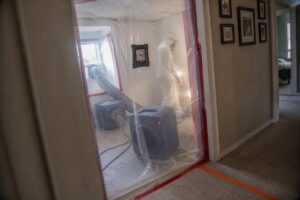 Every significant restoration project — fire damage cleanup, mold remediation, sewage extraction, demolition — generates airborne contaminants that the restoration work itself puts into the air. Cutting mold-contaminated drywall releases spores. Extracting sewage disturbs pathogenic aerosols. Cleaning smoke residue mobilizes fine carbon particles. Removing water-damaged building materials produces construction dust and particulates that carry contaminant residue.
Without active air filtration running continuously throughout the restoration process, those contaminants remain suspended in the indoor air — settling on recently cleaned surfaces, being inhaled by technicians and occupants in adjacent areas, and migrating through the building to rooms that were not originally affected. The restoration work that is supposed to solve the contamination problem inadvertently spreads it.
Industrial HEPA air scrubbing is the intervention that captures airborne contaminants at the source — before they settle, before they migrate, and before they undo the cleaning work already completed. True Day Water Damage Restoration deploys HEPA air scrubbers as a standard component of every applicable restoration project throughout South Jordan and Salt Lake County.
We have set up HEPA air scrubbers in a lot of homes where children sleep on the other side of a containment barrier while mold remediation work happens on the opposite side of the same wall. The barrier is visually reassuring. The physics of containment are what actually protect those children. Understanding why the equipment works — not just that it exists — is what makes the difference between a project that genuinely isolates contamination and one that spreads it while appearing not to. That distinction is the reason this page exists.
We are a licensed Utah Contractor (#960332-3505) and IICRC-Certified Firm (ID #927354-5258), based at 11268 S 2865 W in South Jordan.
Call us at (385) 247-9359 for any fire, mold, sewage, or water damage situation in Salt Lake County.
Every significant restoration project — fire damage cleanup, mold remediation, sewage extraction, demolition — generates airborne contaminants that the restoration work itself puts into the air. Cutting mold-contaminated drywall releases spores. Extracting sewage disturbs pathogenic aerosols. Cleaning smoke residue mobilizes fine carbon particles. Removing water-damaged building materials produces construction dust and particulates that carry contaminant residue.
Without active air filtration running continuously throughout the restoration process, those contaminants remain suspended in the indoor air — settling on recently cleaned surfaces, being inhaled by technicians and occupants in adjacent areas, and migrating through the building to rooms that were not originally affected. The restoration work that is supposed to solve the contamination problem inadvertently spreads it.
Industrial HEPA air scrubbing is the intervention that captures airborne contaminants at the source — before they settle, before they migrate, and before they undo the cleaning work already completed. True Day Water Damage Restoration deploys HEPA air scrubbers as a standard component of every applicable restoration project throughout South Jordan and Salt Lake County.
We have set up HEPA air scrubbers in a lot of homes where children sleep on the other side of a containment barrier while mold remediation work happens on the opposite side of the same wall. The barrier is visually reassuring. The physics of containment are what actually protect those children. Understanding why the equipment works — not just that it exists — is what makes the difference between a project that genuinely isolates contamination and one that spreads it while appearing not to. That distinction is the reason this page exists.
We are a licensed Utah Contractor (#960332-3505) and IICRC-Certified Firm (ID #927354-5258), based at 11268 S 2865 W in South Jordan.
Call us at (385) 247-9359 for any fire, mold, sewage, or water damage situation in Salt Lake County.
What HEPA Actually Means — and Why the Distinction Matters
HEPA — High-Efficiency Particulate Air — is a specific filtration standard, not a marketing descriptor. A filter that meets the true HEPA standard captures at least 99.97% of airborne particles at the most penetrating particle size, which is 0.3 microns. This particle size is called the most penetrating particle size because it represents the hardest size for filters to capture — particles smaller than 0.3 microns are captured more efficiently by diffusion mechanisms, and particles larger than 0.3 microns are captured more efficiently by inertial impaction and interception. The 0.3 micron threshold is where capture efficiency is at its minimum, which is why it is the standard test point. The particle size range that includes most restoration-relevant contaminants falls within or above this threshold:- Mold spores: 1 to 40 microns in diameter — well above the 0.3 micron threshold; true HEPA filtration captures mold spores at all sizes produced by common indoor species including Stachybotrys chartarum, Aspergillus, Cladosporium, and Penicillium
- Fine smoke particles: 0.1 to 10 microns — spanning the HEPA threshold; at 0.3 microns, true HEPA captures 99.97% of particles; at larger smoke particle sizes, capture efficiency is even higher
- Sewage aerosol droplets: Typically above 1 micron — captured effectively by true HEPA filtration
- Construction dust: 0.5 to 100+ microns — entirely within the HEPA capture range for the fine fraction that poses inhalation risk
- Bacteria: 0.5 to 5 microns — captured by true HEPA filtration
The Multi-Stage Filter System — What Each Stage Does
Industrial restoration air scrubbers do not use a single filter. They use a staged filter system in which each stage addresses a different category of contaminant, with each stage protecting the filters downstream from it:Pre-Filter Stage
The pre-filter is the first filter in the series — typically a polyester or fiberglass filter with a coarser filtration rating than the HEPA filter downstream. Its function is to capture large particles — construction dust, debris, coarse particulates — before they reach the HEPA filter. This has two purposes: it removes the bulk of large contaminants from the airstream, and it protects the HEPA filter from loading too quickly with large particles that would increase the pressure drop across the filter and reduce airflow volume. The pre-filter is a consumable that is replaced more frequently than the HEPA filter; in a heavy demolition environment, a pre-filter may be replaced daily while the HEPA filter remains in service for weeks.Activated Carbon Filter Stage
Activated carbon — a processed form of carbon with an extremely large internal surface area created by physical or chemical activation — adsorbs gaseous contaminants through Van der Waals forces. The internal surface area of activated carbon is typically measured in hundreds to thousands of square meters per gram — providing an enormous capacity to adsorb volatile organic compound molecules from the airstream. In restoration contexts, the activated carbon stage is critical for capturing the gaseous contaminants that HEPA filtration cannot address — because HEPA filters capture particles but not gases. Smoke odor is partly caused by volatile organic compounds and polycyclic aromatic hydrocarbons that are in gaseous phase rather than particle phase after deposition. Mold produces microbial volatile organic compounds — the musty odor compounds associated with active mold growth — that are gaseous rather than particulate. Sewage produces hydrogen sulfide, ammonia, and other volatile gases. The activated carbon filter stage adsorbs these gaseous compounds from the airstream, reducing both the odor concentration and the chemical exposure in the work environment.True HEPA Filter Stage
The HEPA filter is the final stage — positioned downstream from both the pre-filter and the activated carbon filter so that it receives pre-cleaned air with the large-particle and gaseous loads already removed. The HEPA filter consists of randomly arranged borosilicate glass fibers in a pleated configuration that maximizes surface area within the filter housing. Particles are captured through three mechanisms: inertial impaction for large particles that cannot follow airstream curves around fibers; interception for medium particles that follow airstream curves but contact a fiber due to their physical size; and diffusion for the smallest particles, which move in Brownian motion paths that increase their probability of contacting a fiber even as they attempt to follow the airstream. At 0.3 microns — the most penetrating particle size — all three mechanisms contribute to the 99.97% capture efficiency rating.Negative Air Pressure — The Physics of Containment
One of the most important and least understood functions of industrial air scrubbers in restoration work is their role in creating and maintaining negative air pressure within contamination containment zones. The principle is simple and the consequences of getting it wrong are significant. In standard air scrubber operation within a containment zone, the unit draws air from inside the containment, filters it through the HEPA system, and returns the cleaned air to the same space — maintaining approximately equal pressure inside and outside the containment. In negative air pressure mode, the unit exhausts the filtered air to the building exterior — typically through a flexible duct run to an exterior window or door — rather than returning it to the room. This creates a volume deficit inside the containment: air is leaving but not being replaced from inside the containment. The building’s relatively higher-pressure exterior and adjacent clean rooms supply replacement air through any gaps in the containment barriers — around the edges of polyethylene sheeting, around doorway covers, at any imperfect seal point. This replacement air flows inward — from clean areas into the contaminated containment — rather than outward. The pressure differential means that any contaminant released inside the containment — a burst of mold spores when a drywall panel is cut, an aerosol release during sewage extraction, a cloud of demolition dust — cannot escape outward through gaps in the barriers. The air pressure itself prevents outward migration. This is why mold remediation under the ANSI/IICRC S520 Standard requires negative air pressure containment during the physical removal phase: the act of removing mold-contaminated materials is the maximum spore-release event of the entire project, and the containment integrity during that event determines whether the remediation stays local or spreads throughout the building. A containment barrier that is technically in place but not under negative air pressure is a barrier that a brief pressure perturbation — someone opening a nearby door, a gust of wind through an adjacent window — can temporarily reverse, pushing contaminated air outward. We maintain negative air pressure levels of approximately 0.02 to 0.05 inches of water column below ambient, which is validated by the inward deflection of the containment barrier sheeting. If the barrier is deflecting outward, the pressure differential is wrong and the containment is not performing its protective function.When We Deploy HEPA Air Scrubbers — and Why
Fire and Smoke Damage Restoration
Smoke particles remain airborne for extended periods after a fire, settling on surfaces throughout the building at a measurable deposition rate that continues for days. HEPA air scrubbers deployed during smoke damage cleanup capture these airborne particles before they can settle on recently cleaned surfaces — protecting the cleaning work already completed. In South Jordan’s residential construction — particularly in Daybreak’s open floor plan homes where smoke distribution during a fire covers a large unified air volume — the airborne particle load at the start of cleanup can be substantial, and continuous HEPA filtration throughout the cleaning process is what allows room surfaces to stay clean as the work progresses from one area to the next. The activated carbon stage of the air scrubber also captures gaseous smoke odor compounds — the volatile organic compounds and polycyclic aromatic hydrocarbons that produce smoke odor in the air — reducing the odor concentration in the work environment for our technicians and beginning the process of gaseous odor reduction before dedicated thermal fogging or hydroxyl generation treatment is applied.Mold Remediation Under ANSI/IICRC S520
Mold remediation requires HEPA air scrubbers in negative air pressure mode within the containment zone throughout the physical removal phase. When mold-contaminated drywall is cut, spores are released in a burst that can number in the millions per cut — far exceeding the background spore count in the room. Those spores must be captured within the containment before they settle on clean framing surfaces that will be enclosed in the rebuilt wall assembly, and before they reach the containment boundary and potentially migrate to unaffected rooms. For Stachybotrys chartarum remediation specifically — where the conidia are produced in a wet mucilaginous mass that releases large numbers of spores when the mass is disturbed — the HEPA air scrubber airflow must be calculated to turn over the containment zone air volume multiple times per hour during active removal. We calculate the required CFM based on the containment volume and target a minimum of four air changes per hour during active demolition, with the unit positioned to draw air across the work face rather than away from it. Learn more about our mold remediation services.Sewage Cleanup and Biohazard Remediation
Raw sewage contains pathogenic bacteria, enteric viruses, and protozoan parasites that can become aerosolized during extraction and cleanup operations — creating an inhalation exposure risk for technicians and occupants in adjacent spaces. HEPA air scrubbers in negative air pressure mode during sewage cleanup and biohazard remediation filter these pathogenic aerosols from the work environment and prevent migration to adjacent clean areas of the building. The activated carbon stage is particularly valuable during sewage cleanup for capturing the gaseous hydrogen sulfide and ammonia produced by the anaerobic decomposition of organic sewage matter — reducing the acute chemical exposure risk for technicians in the work environment. In South Jordan basement sewage backup events — which peak during the North American Monsoon season from July through September when municipal sewer mains experience hydraulic surcharge — the enclosed basement environment can concentrate these gases to levels that make unprotected entry genuinely hazardous without active ventilation and filtration.Demolition and Material Removal
Any significant demolition — removing water-damaged drywall, fire-charred materials, mold-contaminated structural components, or any building materials in a restoration context — generates substantial airborne dust and particulates. In homes built in South Jordan before 2000, tearing out materials from the 1970s and 1980s could disturb asbestos-containing materials found in floor tile adhesive, textured ceiling coatings, or pipe insulation. It’s crucial to evaluate these areas prior to demolition and to implement proper containment measures during any work involving these materials. HEPA air scrubbers running throughout demolition capture the fine particulate fraction that poses inhalation risk and prevent its redistribution throughout the building during the removal phase.Water Damage Restoration in Occupied Spaces
While HEPA air scrubbing is not universally required during straightforward water damage drying in unoccupied spaces, it is deployed when any of the following conditions exist: occupants with respiratory sensitivities or compromised immune systems remain in the building during restoration; demolition of water-damaged materials is required; any mold risk has been identified; the water source was Category 2 grey water or Category 3 black water; or the building is a commercial or multi-family property where unaffected units or common areas require protection from particulate migration during restoration work. Learn more about our water damage restoration services.Industrial Air Scrubbers vs. Consumer Air Purifiers — A Concrete Comparison
The gap between industrial restoration air scrubbers and consumer air purifiers is not a matter of degree — it is a matter of fundamental capability in the context of restoration work. Air volume capacity: Industrial restoration air scrubbers are rated at 500 to 2,000 cubic feet per minute (CFM) or more. A standard bedroom is approximately 1,000 cubic feet — meaning a single industrial unit can cycle the entire air volume of that space once per minute, or 60 times per hour. Consumer air purifiers typically process 50 to 200 CFM — less than one air change per hour in the same room. In a contaminated restoration environment where new contaminants are being generated continuously by the work itself, a unit that cannot cycle the room air multiple times per hour cannot maintain the clean-air conditions needed. Filter certification: Many consumer products marketed as “HEPA” or “HEPA-type” use filters rated at 85% to 99% efficiency — not the 99.97% at 0.3 microns required for true HEPA certification. In a standard household air quality application, this difference may be inconsequential. In a mold remediation containment zone, a filter that allows 5% of spores to pass — versus 0.03% — creates a substantially different exposure outcome for the occupants who return to that space after restoration. Negative air pressure capability: Industrial restoration air scrubbers are designed to exhaust filtered air to the building exterior through flexible duct runs — creating the negative pressure containment that is required for professional mold remediation and sewage cleanup. Consumer air purifiers recirculate air within the room; they have no provision for exterior exhaust and cannot create negative air pressure containment. Continuous duty construction: Industrial units are built to run continuously for weeks — 24 hours per day — in contaminated environments containing particulates that would rapidly clog and damage consumer-grade units. Consumer air purifiers are designed for maintenance of already-clean indoor air in residential settings; they are not rated for continuous operation in active restoration environments.A Project Where Air Scrubbing Made the Difference
In November 2022, we completed a Stachybotrys chartarum remediation in a 1997-era finished basement in an established South Jordan neighborhood near 11200 South — a chronic foundation seepage event that had produced colonization across approximately 30 linear feet of the basement perimeter wall drywall. The scope of physical removal was significant: drywall to 26 inches above the floor on all four basement walls, all insulation, and a section of oriented strand board subfloor that had been in sustained contact with the seeping wall assembly. The Stachybotrys colony — which produces conidia in a wet mucilaginous mass rather than releasing them freely — had the potential to release millions of spores during the physical removal phase. We established two HEPA air scrubbers in negative air pressure mode within the containment: one at 1,200 CFM positioned at the east wall where the most concentrated growth was located, drawing air across the removal face, and one at 800 CFM positioned at the stairwell containment barrier, maintaining the negative pressure across the full basement volume of approximately 2,400 cubic feet. Combined, the two units provided 2,000 CFM of filtration capacity — cycling the basement air volume approximately 50 times per hour during active removal. The containment barrier showed consistent inward deflection throughout the removal phase — confirming negative pressure was maintained. Post-removal air sampling within the containment, taken before the barriers were removed, showed Stachybotrys spore counts below detectable levels. The independent clearance test conducted after final HEPA vacuuming and antimicrobial treatment — by a certified industrial hygienist whose firm had no relationship with our company — returned spore counts within normal seasonal background for all species in all sampled locations. The homeowner’s two children had been sleeping in the bedrooms directly above the basement for the two years that the Stachybotrys colony had been developing. Both had experienced recurring respiratory symptoms during that period that their pediatrician had attributed to seasonal allergies. The parents mentioned this on the day we reviewed the clearance results. Both children’s respiratory symptoms resolved within three weeks of project completion. We cannot make a medical attribution — that requires a physician. What we can say is that the HEPA air scrubbing during the removal phase was what prevented those same spores from being distributed to the upper floors during demolition. The children were already living with Stachybotrys exposure from the basement. They did not need to receive it again from a restoration project that failed to manage its own work properly.A Second Project — HEPA Containment During a Daybreak Sewage Backup
In August 2023 — during an intense North American Monsoon afternoon event that dropped 1.6 inches of rain in under 90 minutes across the southwest Salt Lake Valley — we responded to a Category 3 sewage backup in a 2014-era Daybreak contemporary craftsman home on a finished lower level. The event was a hydraulic surcharge backup: the floor drain and basement toilet had backflowed simultaneously, the same dual-fixture pattern that indicates sewer main pressure rather than a localized lateral blockage. The specific challenge in this Daybreak layout was architectural. The open floor plan that characterizes most of Daybreak’s main level extended to the staircase — which opened directly into the lower level family room without a door. The lower level shared an HVAC return air grille with the main floor above. To contain the remediation without contaminating the main level — where the family’s two young children and a grandparent with a compromised immune system were sheltering during the cleanup — we needed to establish containment at the base of the open staircase using a temporary framed barrier rather than the standard polyethylene barrier clip system, which cannot seal against the non-rectangular geometry of an open stairwell in a contemporary craftsman frame. We ran one HEPA air scrubber at 1,400 CFM in negative air pressure mode within the lower level containment, exhausting through a utility room window to the exterior. A second unit at 600 CFM ran on the main floor above the staircase in standard filtration mode — not exhausted, but running continuously to capture any particulates that might pass the stairwell barrier. We also closed and taped the HVAC return air grille on the main floor nearest the staircase before extraction began, preventing the air handler from drawing from the contaminated zone into the duct system and distributing sewage aerosols to the upper floor rooms. The grandmother, who had been told by her oncologist to avoid biological contaminant exposure during her current treatment cycle, remained in the home throughout the project. The primary care physician overseeing her treatment was informed of the containment approach and confirmed it was adequate for her to remain on-site. Post-remediation air sampling on the main floor — conducted before the temporary stairwell barrier was removed — showed no detectable elevation of sewage-related indicators above outdoor baseline. The lower-level clearance was achieved on day four. That project is one we think about when we configure containment for Daybreak’s open floor plan homes. The standard approach — polyethylene barrier and HEPA unit in negative air pressure mode — is correct. The geometry of how you implement it matters as much as whether you implement it.Frequently Asked Questions — Air Scrubbing & HEPA Filtration
What does a HEPA air scrubber do during restoration?
It continuously draws room air through a multi-stage filter system — pre-filter, activated carbon, and true HEPA — capturing airborne smoke particles, mold spores, sewage aerosols, volatile organic compounds, and construction dust at 99.97% efficiency at 0.3 microns. Cleaned air is returned to the room or exhausted to the building exterior, cycling room air multiple times per hour throughout the restoration process.What is the difference between a HEPA air scrubber and a consumer air purifier?
Three fundamental differences: air volume capacity (500–2,000 CFM industrial vs. 50–200 CFM consumer); filter certification (true HEPA 99.97% at 0.3 microns vs. “HEPA-type” 85–99% in many consumer products); and negative air pressure capability (industrial units can exhaust to the exterior for containment — consumer units cannot). In a restoration context, all three differences are operationally consequential.What is negative air pressure containment?
Configuring a HEPA air scrubber to exhaust filtered air to the building exterior, creating a pressure deficit inside the containment zone — causing air to flow inward from clean areas rather than outward from the contaminated zone. Any contaminants released inside the containment cannot migrate outward through gaps in the barriers. Required by ANSI/IICRC S520 during active mold removal phases.When are HEPA air scrubbers used during restoration?
During fire and smoke cleanup (preventing smoke particle redeposition on cleaned surfaces), mold remediation (capturing spore burst-release during removal under negative pressure), sewage cleanup (filtering pathogenic aerosols and toxic gases), demolition (capturing construction dust), and any restoration project where airborne contaminants pose risk to occupants, technicians, or restoration progress.Related Services
- Fire Damage Restoration
- Smoke Damage Cleanup
- Mold Remediation
- Black Mold Removal
- Odor Removal Services
- Sewage Cleanup
- Biohazard Cleanup
- Water Damage Restoration
- Structural Drying
- Reconstruction & Repairs
HEPA Air Scrubbing Deployed on Every Applicable Restoration Project in South Jordan and Salt Lake County
True Day Water Damage Restoration 11268 S 2865 W, South Jordan, UT 84095 Phone: (385) 247-9359 Email: info@truedaywaterdamagerestoration.xyz Utah Contractor License: #960332-3505 IICRC Certified Firm ID: #927354-5258HEPA air scrubbing: what it actually filters and when it is required
HEPA air scrubbers are deployed on nearly every mold, sewage, fire, and reconstruction job we work. The specification (HEPA, "High Efficiency Particulate Air") has a specific regulatory meaning: 99.97% capture of particles at 0.3 microns. That number is not marketing — it is the particle size at which filter efficiency is lowest; larger and smaller particles are captured at higher rates. Here is what that means practically and when the air scrubber is a required scope line rather than an optional one.
What HEPA actually captures
| Particle Type | Size (microns) | HEPA Captures? |
|---|---|---|
| Mold spores | 2-20 | Yes, at >99.9% capture rate. |
| Bacteria (airborne) | 0.3-10 | Yes, at 99.97%+ capture. |
| Dust mites & allergens | 10-100 | Yes, >99.99%. |
| Fire soot particulate | 0.1-10 | Yes for larger soot; 0.1-micron fraction partially captured. Carbon pre-filter helps. |
| Smoke VOCs (gas-phase) | Molecular | No. VOCs are gas; HEPA captures particulate. Activated carbon filter handles VOCs; separate from HEPA. |
| Viruses (airborne) | 0.02-0.3 | Captured when attached to droplets. Free viruses: partially captured. |
| Asbestos fibers | 0.5-20 | Yes, by particle size — but asbestos requires licensed abatement, not just air scrubbing. |
When air scrubbing is required under IICRC standards
- Every S520 mold remediation (Full and Enhanced Full containment levels). HEPA scrubber maintains negative pressure (-5 Pa minimum) inside the containment, preventing spore release during demo.
- Every S500 Category 2 and Category 3 water job. Microbial contamination suppressed during demolition.
- Every S700 fire job during the demolition and cleaning phase. Soot particulate suppression during active work; often paired with carbon pre-filtration for VOCs.
- Any demolition in an occupied building where occupants have respiratory sensitivity. Discretionary but recommended.
Air change rate calculation
The scrubber’s effectiveness is measured in air changes per hour (ACH) — how many times per hour the full volume of the room is filtered. IICRC standards call for:
6-8 ACH for active mold or soot work
12 ACH for Category 3 water or active fire demolition
Calculation: Room volume (cuft) × desired ACH / 60 = required scrubber CFM.
Example: 20×15×8 ft room = 2,400 cuft. For 8 ACH: 2,400 × 8 / 60 = 320 CFM scrubber. A standard HEPA scrubber rated at 500 CFM handles this with capacity to spare.
Filter management
- Pre-filter: captures the largest debris (dust, hair, flakes). Replaced every job or when visibly loaded.
- Carbon filter (if equipped): captures gas-phase VOCs for fire or odor jobs. Replaced per job.
- HEPA primary filter: the 0.3-micron rated filter. Replaced when pressure differential rises past the manufacturer threshold (typically after 500-2000 hours depending on load). We log hours per unit.
HEPA air scrubbing — frequently asked questions
What HEPA air scrubbing actually does — and when it is required, not optional
“HEPA” is a specific efficiency standard, not a marketing word. Here is what the equipment removes, when IICRC standards require it on a job, and how the air-exchange math works.
When air scrubbing is required by IICRC standards
- IICRC S520 mold remediation. Negative-air HEPA scrubbing is required inside containment during Condition 2 or 3 mold remediation. Not optional.
- IICRC S500 Category 3 water losses (sewage). HEPA scrubbing supports containment of bioaerosols released during demolition of affected porous materials.
- Fire and smoke restoration (IICRC S700). HEPA scrubbing captures the sub-micron soot and combustion particulate that ordinary dust-collection fails on.
- Occupied-space drying. Larger water losses in occupied homes with asthma, allergy, or immuno-compromised residents — we run HEPA regardless of whether the loss category formally requires it.
Air-exchange math: ACH and why machine count matters
The number that actually matters is Air Changes per Hour (ACH): how many times the air in the containment is passed through HEPA filtration each hour. IICRC targets vary by scope, but 4–6 ACH is the floor for mold-remediation containment and 6+ ACH is the working minimum for Category 3 cleanup.
Example: 500 CFM scrubber in 10×12×8 ft room = 500 × 60 ÷ 960 = 31 ACH
A single scrubber usually clears a sealed small-room containment. Open-area work, multiple rooms, or two-story losses need more machines running in parallel to hold ACH during active demolition.
When HEPA air scrubbing is actually necessary
HEPA scrubbing isn’t needed on every restoration job. Here are the specific situations where we run it + the MERV / HEPA rating context that decides equipment choice.
When we run HEPA scrubbers
| Scenario | HEPA scrubber needed? |
|---|---|
| Cat 1 clean-water loss, no mold risk | Usually not. Air movers suffice. |
| Cat 2 grey-water loss | Yes, during active cleaning + 24-48 hr after antimicrobial |
| Cat 3 black-water loss | Always. Containment + negative-air HEPA throughout job |
| Visible mold > ~10 sq ft (S520 Condition 3) | Always. Negative-air isolation of containment zone |
| Post-fire smoke cleanup | Yes. HEPA + activated-carbon filtration during cleanup |
| Occupied-home air quality concern during work | Yes. HEPA scrubbers keep workspace separate from living areas |
| Allergy/asthma-sensitive occupants | Yes, as a precaution, even on smaller scopes |
HEPA vs. MERV ratings
Different standards; often confused.
- HEPA (High Efficiency Particulate Air): captures 99.97% of particles 0.3 microns in diameter. Industry standard for air scrubbers. Our Phoenix + Dri-Eaz commercial HEPA units meet this.
- MERV (Minimum Efficiency Reporting Value): rating system for HVAC filters. Residential systems typically run MERV 8-13. MERV 17-20 approaches HEPA performance but costs more and restricts airflow.
- Our HEPA units stay separate from your HVAC. Running your HVAC during active cleanup actually distributes contaminants; standalone HEPA on the containment zone is what works.
What HEPA scrubbing doesn’t do
Removes airborne particles. Doesn’t address source material. Running a HEPA machine in a room with active mold growth doesn’t solve the problem — it only addresses the symptoms while the growth continues. Source removal is step 1; air scrubbing is step 2.
What a HEPA air scrubber actually does during mold work
HEPA filtration is a specification, not a brand. A unit is “HEPA” if it filters 99.97% of particles at 0.3 micron. On a mold job, HEPA scrubbers do three specific things, and understanding each one tells you whether the setup is appropriate for the scope:
HEPA vs hydroxyl vs ozone — three different tools, three different jobs
Three technologies get mentioned together in restoration work. They do different things and are safe under different conditions. Confusing them is how people get hurt or pay for the wrong one.
| HEPA air scrubbing | Hydroxyl generation | Ozone generation | |
|---|---|---|---|
| What it does | Filters particulates (spores, soot, dust) at 0.3 micron 99.97% | Produces hydroxyl radicals that oxidize odor molecules | Produces ozone that oxidizes odor molecules and some biologicals |
| Safe with people and pets in the space? | Yes | Yes | No — requires evacuated space and HVAC off |
| Primary use | Mold remediation, fire/soot cleanup, dust-generating work | Light odor remediation (post-cleaning residual odor) | Heavy odor remediation (severe smoke, biohazard aftermath) |
| Timeline | Continuous during disturbance + 24-48 hr dwell | Days of continuous operation while occupied | 8-24 hours in evacuated space |
| Can replace source removal? | No — only captures what’s airborne | No — only addresses odor molecules | No — only addresses odor molecules |
| Material impacts | None | None at operational concentrations | Can degrade rubber, some plastics, and natural fibers with prolonged exposure |
| Where it fits in a mold scope | Core — runs during entire removal + dwell | Optional — if light odor persists after cleaning | Rarely — reserved for severe lingering odor cases where occupants can relocate |
True Day defaults to HEPA on every mold job. Hydroxyl is added when needed. Ozone is used only in specific, documented cases where occupants can be out and the material inventory tolerates it — and never as a substitute for physical remediation.
HEPA filter maintenance — the detail nobody asks about but everyone depends on
A HEPA scrubber is only as good as the filter inside it. Filters have a service life, and running past it defeats the whole point. Here’s how we manage filter cycles on jobs and on the equipment fleet:
If you’re on a long job and want to see the filter log, ask the lead tech on-site. The documentation is kept per job, not just internally.
Portable room HEPA vs whole-home HEPA — which (if any) you should buy
After a mold job, homeowners sometimes ask what HEPA unit to buy for their house. The honest answer depends on what you’re trying to accomplish:
| Scenario | Right option | Why |
|---|---|---|
| Clean air in one problem room (basement with ongoing humidity, bedroom for allergic occupant) | Portable room HEPA (true HEPA, 300+ CADR) | Targets the room where exposure happens; cheaper than whole-house |
| General household air quality improvement, allergic occupants in multiple rooms | HVAC MERV 13 filter upgrade + bath fan use + occasional portable | Addresses system-wide, no new equipment |
| Severe allergic occupant, home-wide protection | Whole-home HEPA bypass system on HVAC | True HEPA on the main air handler cleans air every HVAC cycle |
| Post-remediation “just in case” for a healthy household | Nothing — standard HVAC filter maintenance is enough | Adding a HEPA room unit “to be safe” is usually unnecessary spend |
| Pet dander + mold allergy combined | Portable room HEPA in bedroom + HVAC MERV 13 | Combines targeted + system-wide for the dominant exposure zones |
Buying tips:
- “True HEPA” vs “HEPA-type.” Only “True HEPA” (99.97% at 0.3 micron) is actual HEPA. “HEPA-type” is marketing — don’t buy on that label.
- CADR rating (clean air delivery rate). Higher is better. For a 300 sq ft room, target 200+ CADR for smoke/dust (which approximates spore performance).
- Noise level. Portable HEPAs are loud on highest setting. Buy one with the capacity to be effective on medium, so you can actually run it.
- Filter replacement cost. HEPA filters are consumable. Check annual replacement filter cost before buying the unit.
- Avoid combo units with UV, ionizer, or ozone. UV and ionizers in home air purifiers don’t help with mold; some ionizers produce ozone (which has its own issues). Stick to filtration-only.
What we actually use on jobs: commercial-grade portable units built for restoration work. These are overkill for a home — not something you need to buy for personal use.
What living with HEPA scrubbers running sounds like
If remediation runs in your home, HEPA scrubbers run 24/7 for the duration. Here is honestly what to expect so you can plan around it:
None of this changes the quality or outcome of the remediation. It affects how you live during it. Knowing upfront what to expect makes the week easier.
Commercial HEPA scrubber vs a home air purifier
Both may say HEPA on the label. They do different jobs.
| Commercial HEPA air scrubber | Home air purifier | |
|---|---|---|
| Airflow | Hundreds to over a thousand CFM | Typically a few hundred CFM or less |
| Filtration | Pre-filter stages plus true HEPA (99.97% at 0.3 microns) | Varies; HEPA-type labels are not always true HEPA |
| Negative pressure | Can be ducted to exhaust outside containment, pulling air inward | No — recirculates room air only |
| Purpose | Captures spores disturbed during removal and keeps them inside containment | Reduces everyday dust and allergens in occupied rooms |
| Role in remediation | Required equipment under IICRC S520 containment practice | Not a substitute; does not contain anything |
A home purifier is a fine everyday appliance. It is not a reason to delay remediation, and running one does not make removing moldy material safe.
How we know the air scrubbers are doing their job
A scrubber that is running is not automatically a scrubber that is working. These are the checks behind it: