
The three categories of water damage: Category 1 is clean water (a supply line or faucet), Category 2 is gray water with some contamination (a washing machine or dishwasher), and Category 3 is black water (sewage or outside floodwater). The category decides what can be dried in place and what has to be removed. Not sure which you have? Call and describe what you see.
Types of Water Damage in South Jordan, UT
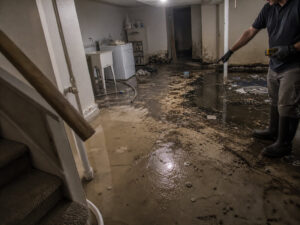 Water damage is not one problem with one solution. It is a spectrum defined by four interacting variables: the source of the water, the contamination level that source carries, the building materials and structural locations affected, and the time elapsed since the event began. Every decision in the restoration process — what can be dried in place, what must be removed, what cleaning protocol applies, what your insurance claim will cover — flows directly from correctly classifying what type of water damage is present.
In South Jordan specifically, those classifications are shaped by local variables that define this community’s specific exposure profile. The hard water supplied by the Jordan Valley Water Conservancy District — testing at 7 to 10 grains per gallon of dissolved calcium and magnesium — accelerates supply line failures in ways that make Category 1 clean water events more frequent here than in softer-water markets. The expansive clay soils left by ancient Lake Bonneville — montmorillonite-rich smectite that swells when saturated and creates seasonal hydrostatic pressure against basement foundations — drives both chronic basement seepage and sudden intrusion events that produce Category 2 and Category 3 damage. The Wasatch Front’s freeze-thaw cycling creates ice dam conditions on residential rooflines on a predictable seasonal schedule. The North American Monsoon pattern from July through September overwhelms municipal sewer collection mains and produces Category 3 sewage backup events in South Jordan neighborhoods near the Jordan River basin.
True Day Water Damage Restoration is a licensed Utah Contractor (#960332-3505) and IICRC-Certified Firm (ID #927354-5258), based at 11268 S 2865 W in South Jordan. Call us at (385) 247-9359.
Water damage is not one problem with one solution. It is a spectrum defined by four interacting variables: the source of the water, the contamination level that source carries, the building materials and structural locations affected, and the time elapsed since the event began. Every decision in the restoration process — what can be dried in place, what must be removed, what cleaning protocol applies, what your insurance claim will cover — flows directly from correctly classifying what type of water damage is present.
In South Jordan specifically, those classifications are shaped by local variables that define this community’s specific exposure profile. The hard water supplied by the Jordan Valley Water Conservancy District — testing at 7 to 10 grains per gallon of dissolved calcium and magnesium — accelerates supply line failures in ways that make Category 1 clean water events more frequent here than in softer-water markets. The expansive clay soils left by ancient Lake Bonneville — montmorillonite-rich smectite that swells when saturated and creates seasonal hydrostatic pressure against basement foundations — drives both chronic basement seepage and sudden intrusion events that produce Category 2 and Category 3 damage. The Wasatch Front’s freeze-thaw cycling creates ice dam conditions on residential rooflines on a predictable seasonal schedule. The North American Monsoon pattern from July through September overwhelms municipal sewer collection mains and produces Category 3 sewage backup events in South Jordan neighborhoods near the Jordan River basin.
True Day Water Damage Restoration is a licensed Utah Contractor (#960332-3505) and IICRC-Certified Firm (ID #927354-5258), based at 11268 S 2865 W in South Jordan. Call us at (385) 247-9359.
The IICRC Water Damage Category System
The IICRC — the Institute of Inspection, Cleaning and Restoration Certification — established the water damage category system used as the industry standard by every professional restoration company and every major property insurance carrier. The system classifies damage by the contamination level of the water source, which determines the health risk to occupants and technicians, the appropriate personal protective equipment, the cleaning and disinfection protocol required, and which building materials can be dried in place versus which must be removed and replaced. The most important aspect of the category system that homeowners rarely know: categories are not fixed at the time of the original event. Category 1 clean water that sits in contact with cellulose-based building materials at ambient indoor temperature for 24 to 48 hours begins supporting bacterial growth and degrades toward Category 2. Category 2 water containing sufficient biological contamination or that has stood long enough may be reclassified as Category 3. Prompt professional response is the only mechanism that prevents a manageable Category 1 event from becoming a substantially more expensive Category 2 or 3 project.- Category 1 — Clean Water — Water from sanitary sources posing no significant health risk: burst supply lines, water heater discharges, appliance failures, clean rainfall. Most common type in South Jordan residential properties.
- Category 2 — Grey Water — Water containing biological or chemical contaminants posing health risk through ingestion or contact with broken skin. Washing machine overflows, dishwasher failures, sink drain backflows, secondary irrigation system intrusions.
- Category 3 — Black Water — Grossly contaminated water containing fecal coliform bacteria, enteric viruses, and protozoan parasites. Sewage backflows, outdoor floodwater, long-standing microbially amplified water. Full biohazard protocol required.
Water Damage by Location and Source
- Hidden Leaks — Slow chronic intrusion behind finished walls, under flooring, and in ceiling assemblies — accumulating structural damage and mold growth over months before any visible surface sign appears.
- Crawl Space Moisture — Chronic elevated humidity from soil vapor evaporation in unencapsulated crawl spaces, producing mold on joists and distributing spores to the living space above through the stack effect.
- Attic Leaks — Ice dam formation and roof membrane failures saturating attic oriented strand board sheathing and insulation — a predictable seasonal pattern in South Jordan’s Wasatch Front climate.
- What is the difference between Category 1, 2, and 3 water damage?
- Category 1: clean water, no source contamination. Category 2: significant contamination from appliance overflow or standing clean water at 24–48 hours. Category 3: sewage, outdoor floodwater, or water degraded beyond Category 2 threshold. The category determines PPE, material removal, disinfection, and in-place drying eligibility.
- Which type is most common in South Jordan?
- Category 1 supply line failures — washing machine hoses and toilet supply tubes at JVWCD hard water compression fittings. Category 3 sewer surcharge during North American Monsoon events is common in West Jordan’s lower-elevation Jordan River corridor. Sandy adds galvanized pipe hidden leaks behind pre-1980 plaster walls not found in newer South Jordan housing stock.
Category 1, 2, or 3 water? It changes what we do next.
Water-damage severity is classified by the IICRC S500 standard, the industry standard every certified restoration firm follows. We make this call on arrival — it drives scope, PPE, drying method, and what’s salvageable.
| What we check | Category 1 — Clean | Category 2 — Grey | Category 3 — Black |
|---|---|---|---|
| Source | Broken supply line, overflowing sink, melting ice, rainwater through a clean roof | Dishwasher or washing-machine discharge, aquarium, shower overflow, toilet bowl without feces | Sewage, toilet overflow with waste, groundwater flooding, standing water older than 48 hours |
| Health risk | Low at the source; can escalate to Category 2 within 48 hours if left | Significant microbial contamination; can cause illness if ingested or exposed | Grossly contaminated; pathogens, bacteria, and biohazards present |
| PPE on-site | Standard protective gear | Respirators and chemical-resistant gloves | Full containment: Tyvek suits, respirators, boot covers, biohazard disposal |
| What’s salvageable | Most porous materials (drywall, carpet pad, insulation) if dried fast | Semi-porous materials with cleaning and antimicrobial; porous materials usually tear-out | Porous materials and most contents in direct contact are removed; non-porous surfaces are cleaned, sanitized, and verified |
| Containment | Not usually required | Zone containment with negative air | Full negative-air containment with air scrubbing; clearance testing before reconstruction |
A Category 1 loss ignored for 48 hours doesn’t stay Category 1 — it moves to Category 2 as microbial activity starts. That’s the single biggest reason emergency response time matters.
Water damage types we handle
What gets saved on a water loss, and what gets discarded, depends on two things: what kind of water hit the structure, and where in the structure it ended up. The IICRC S500 Standard sets the categories for the first; the location pages below cover the second.
By water category (how contaminated)
| Category | What it is | Full page |
|---|---|---|
| Category 1 | Clean water from a sanitary source — supply-line breaks, overflowing clean sinks or tubs, rainwater | Clean water |
| Category 2 | Grey water with significant contamination — dishwasher discharge, washing-machine drain, toilet bowl water without feces | Grey water |
| Category 3 | Black water with gross contamination — sewage, flood water, standing water past 72 hours | Black water |
By location in the structure
| Where | Why it matters | Full page |
|---|---|---|
| Hidden leaks | Water inside walls, under floors, or above ceilings — the leak you don’t see until the stain appears | Hidden leaks |
| Attic leaks | Roof or vent failures — water migrates down through insulation into ceiling drywall | Attic leaks |
| Crawlspace | Chronic moisture or ground-water intrusion in unfinished crawlspaces — drives whole-home mold and air-quality issues | Crawlspace |
Why categories drive scope
A clean-water loss at hour 2 might save every porous material in the affected area with proper drying. The same water at hour 50 is a Cat 2 scope with more removal. By hour 72 it is a Cat 3 scope with full porous-material discard. Response time is not a sales line — it is what literally decides which category above applies to your loss.
Which category of water damage do you actually have? (Decision chart)
IICRC S500 defines three categories of water. The category decides what gets saved, what gets removed, and whether what you have is a straightforward dry-out or a Cat-3 contamination event. Here’s how to narrow it down before you call:
| What you see / smell | Likely category | Why |
|---|---|---|
| Clear water, no smell, source is a known clean supply line (sink supply, washer line, water heater fresh-fill) | Cat 1 (clean water) | Standard extraction + drying; most materials can be dried in place |
| Clear or slightly tinted water, mild smell, source is clean but water has been sitting more than 48 hours | Cat 2 (greywater) — Cat 1 degrades to Cat 2 past 48 hours in warm, humid conditions | Carpet pad usually comes out; many materials still salvageable |
| Washing machine discharge, dishwasher discharge, aquarium rupture, waterbed leak | Cat 2 (greywater by source) | Soaps, detergents, organic matter make this Cat 2 from the start |
| Toilet bowl overflow with only clean bowl water (urine/feces not present) | Cat 2 | Toilet-bowl water above the trap seal is still Cat 2 |
| Toilet overflow with urine/feces, sewer backup, mainline backup, flooding from outside | Cat 3 (black water) | Full S500 Cat 3 protocol: PPE, containment, most porous materials removed |
| Standing water older than 72 hours, visible mold starting, strong musty smell | Cat 3 regardless of original source | Age + biological activity moves any water into Cat 3 |
| Water from firefighting with sprinkler or hose discharge | Cat 2 | Pipe-system water, plus whatever it mixed with on the way; often degraded further by heat |
What this means for your call
- If you can tell us the category on the phone, we know what truck configuration to send and how long to budget
- If you can’t tell — or if you’re guessing — describe what you see and smell and we’ll categorize on the phone with you
- Category 3 and age-degraded losses are the ones we won’t delay on — those are the first dispatch priority
How water category drives cost (why Cat 3 is 2-5x Cat 1)
The IICRC Category classification system isn’t just about safety protocols — it directly drives the labor, equipment, materials, and timeline that make up the mitigation cost. Here’s how each category translates to actual Xactimate line items:
| Scope line item | Cat 1 clean | Cat 2 greywater | Cat 3 blackwater |
|---|---|---|---|
| PPE for crew | Standard work clothes + nitrile gloves | Tyvek suit + half-mask respirator | Full Tyvek + full-face respirator + taped seams + decon zone |
| Containment setup | None required | Limited poly if HVAC concern | Full 6-mil poly containment + negative air + HEPA scrubber |
| Materials removal scope | Minimal demo; dry in place | Pad removed; some wall-cavity flood cuts; carpet case-by-case | Everything porous: carpet + pad + drywall + insulation + MDF trim + baseboards |
| Antimicrobial application | Not typically used | Spot application to wet areas | Full application to all affected surfaces + framing after demo |
| Air scrubbing | Not typically used | Supplemental if HVAC may have moved air through loss area | Mandatory HEPA negative-air for duration of containment |
| Disposal | Standard construction debris | Double-bagged; manifest tracking | Biohazard-rated bags; chain-of-custody manifest; DEQ-permitted disposal |
| Drying timeline | 3-5 days typical | 5-7 days typical (more removal, less to dry in place) | 7-14 days typical with containment ventilation |
| Documentation level | Standard moisture + photo log | Enhanced documentation for carrier scrutiny | Full-contamination documentation + any required health/compliance records |
Ballpark Xactimate line-item comparison
For a 400 sq ft affected area in a typical SJ-area home, the Xactimate mitigation scope roughly compares as:
- Cat 1 clean water: $2,500-5,500 (depends on specific scope)
- Cat 2 greywater: $5,000-11,000
- Cat 3 blackwater: $10,000-25,000+
Why the cost jump is non-linear
- Cat 2 adds materials-removal scope that Cat 1 doesn’t need; carpet pad, some drywall, some wall-cavity exposure
- Cat 3 adds containment + PPE + full material removal (not just pad; carpet, drywall, insulation, cabinet bases) + extensive antimicrobial + biohazard disposal
- Labor per sq ft doubles or triples on Cat 3 because each sq ft requires more time
- Equipment time is longer on Cat 3 because the removal is more aggressive and the drying has more exposed framing
What makes insurance claims pay for the full scope
- Clear documentation of water category at time of inspection (photos, meter readings, source documentation)
- Scope narrative explaining why Cat 3 protocol applies
- Each scope line item mapped to a specific Xactimate code the carrier can reference
- Dated photos of containment, PPE, and material removal supporting the scope
Why right-category matters for the homeowner
- Classifying as Cat 1 when it’s really Cat 2 (saved a few hundred on scope) means contamination remains and mold develops later
- Classifying as Cat 3 when it’s actually Cat 2 (padded the estimate) is a fraud problem on our side and overcharges you
- Right-category is both an honest practice and the thing that gets claims paid correctly
When a loss doesn’t fit cleanly in one category — mixed cases
IICRC categories (Cat 1, 2, 3) are helpful because they drive specific protocols — but real-world losses sometimes have mixed characteristics. Here’s how we handle the ambiguous cases:
Clean-water loss discovered 72+ hours after it started. Original source was clean (supply line), but biological activity has started in warm, humid conditions. S500 rule: age-degraded water is treated as the category it has become, not what it started as. If it looks and smells like Cat 3, we scope it as Cat 3.
Fire with firefighter water (Cat 2 by pipe system) + burned materials in the water (Cat 2+ contamination) + possible chemical contamination from burned synthetics. We scope the dominant category and PPE for the worst-case contaminant.
Toilet overflow where bowl water is clean but the overflow stream touched a bathroom floor that had previous staining or where sewage had been earlier (even if cleaned). Treat as Cat 3 if there’s any uncertainty — the small added cost of Cat 3 protocol is cheaper than contamination that wasn’t addressed.
IICRC classifies flood water (surface water entering) as Cat 3 regardless of visible appearance. The reasoning: outdoor water passes through soil, agricultural runoff, lawn chemicals, pet waste, and more before reaching your interior. Scope: Cat 3 protocol.
Specific industrial scenarios (glycol, hydraulic fluid, cleaning chemicals, pesticides). Not Cat 1/2/3 in the usual biological sense; these go to specialist contractors with chemical-specific handling. We refer, we don’t take.
How we decide when it’s ambiguous
- When in doubt, scope up. It’s safer to apply Cat 3 protocol to a borderline Cat 2 than Cat 2 to a borderline Cat 3
- Time elapsed matters. If more than 48 hours have passed in a warm house, assume degradation
- Source history matters. If source is unknown or has multiple possible paths, scope conservatively
- Occupant health matters. If someone with respiratory sensitivity will reoccupy, scope more aggressively
- Insurance scope matters. We write the scope at what the material warrants, not at what seems cheapest to the adjuster — because contamination that wasn’t addressed is our liability later
How we handle the Xactimate scope on mixed cases
- Document the ambiguity in the scope narrative: “Water appears clean (Cat 1 source) but 72+ hours elapsed; treated as Cat 2 per S500 degradation rule”
- Carrier can review and dispute if they think we over-scoped — and we can defend the scope with the specific standard reference
- Line items match the category we scoped at, not the apparent category at first glance
- Lab testing (air sample, surface swab) available on request to confirm — sometimes worth the cost on disputes
What we tell homeowners up front
- Right-category matters more than apparent-category — if the clock elapsed matters, we tell you why we’re scoping as we are
- Scope-up isn’t padding — it’s addressing what the materials and contamination actually need
- If you want a specific lower-category scope and the loss doesn’t warrant it, we tell you that honestly and don’t take the job that way
Specific examples from our work
- Washing-machine overflow caught at 60 hours in a basement: looks like Cat 2 but age-degraded; scoped as Cat 3 with lab confirmation
- Dishwasher failure where discharge hose had contamination in it from previous food particles: Cat 2+ source; scoped as Cat 2 with enhanced disinfectant protocol
- Spring runoff into basement with past sewer-backup history: Cat 3 by both path and precedent
If you want to understand why your specific job was scoped at the category it was, ask. The reasoning should be specific and defensible, not generic.
Category quick-reference card (save this for an actual loss)
Here’s a condensed version of the Cat 1/2/3 identification you can save or print and keep handy. The full detail is on the specific category pages; this is the fast-decision version:
- Burst supply line (sudden) — your plumbing supply
- Water heater sudden failure
- Appliance supply hose failure within hours of occurrence
- Clean rainwater through a small roof opening
- Water looks clear, no odor
- Less than 24-48 hours since the loss started
- House temperature is normal
- Washing machine overflow or supply failure
- Dishwasher overflow or supply failure
- Shower or tub overflow (soapy water)
- Toilet overflow (clean bowl water only, no sewage)
- Clean-water loss aged 24-48 hours in warm conditions
- Water may be slightly tinted
- May smell of detergent or soap
- Contains some organic matter
- Sewer backup (toilet with sewage, floor drain backup)
- Rising groundwater or surface flooding
- Toilet overflow past the trap seal
- Water aged more than 48-72 hours in warm conditions
- Water that contacted soil-contaminated surfaces
- Visible contamination (debris, sewage, discoloration)
- Strong odor
- Health risk; family should vacate affected area
What to do before calling (any category)
- Shut water source if you can safely reach it
- Shut power at breaker if water is near outlets
- Move salvageable items up out of standing water
- Call us at (385) 247-9359 — we triage based on your description
Why categories matter for your call
- Right-category means we show up with the right PPE, equipment, and crew size
- Honest scoping starts with the right category — not padding up or down
- Insurance coverage can vary by category and by cause
Downloadable version
- This content is also available as a printable one-page PDF — email us to request a copy
- Save to your phone for reference during an actual event
- Protection Plan members get a printed copy during onboarding
If you’re reading this during an actual loss, dial (385) 247-9359 now — we help identify the category over the phone while we dispatch.
Sewage backup? That’s Category 3 black water — keep everyone away from it and call (385) 247-9359.