
Commercial water damage restoration: extraction and structural drying for offices, retail, multi-family and industrial buildings, with documentation your carrier and property manager can follow. Utah license #960332-3505, IICRC Certified Firm #927354-5258. Live-answered 24/7 from South Jordan, UT.
Commercial Water Damage Response for South Jordan, UT
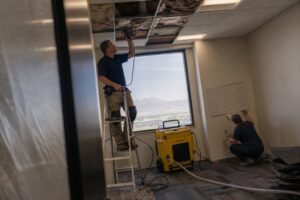 A water intrusion in a commercial property is an immediate threat to operations. A failed fire sprinkler head over a weekend or a pipe burst during a Wasatch Front freeze-thaw cycle does not just soak drywall and flooring. It stops revenue, creates tenant liability, and forces complex insurance negotiations that can disrupt a business for months.
True Day Water Damage Restoration is structured for these specific scenarios. As a licensed Utah Contractor (License #960332-3505) and an IICRC-Certified Firm (Firm ID #927354-5258), we provide documented, professional restoration for property managers and business owners across South Jordan. Our office is at 11268 S 2865 W, grounding our team in the community we serve. We understand that with nearly 2,000 active businesses in South Jordan, a single extended closure sends ripples through the local economy. Our primary objective is restoring structural integrity while minimizing operational downtime — whether for a retail space in The District at South Jordan or a Class A office in the 1.7-million-square-foot RiverPark Corporate Center.
Call our direct line at (385) 247-9359. We dispatch IICRC-certified technicians who understand the absolute urgency of reopening your doors.
When Operations Stop, The Real Damage Begins
There is a moment — often before sunrise — when a keyholder arrives to find sagging ceiling tiles, saturated carpet in a main corridor, or standing water on a server room floor. The decisions made in the next few hours determine whether this is a manageable disruption or a catastrophic financial event. Waiting for business hours to make calls is not a strategy. It is compounding damage. Commercial and residential water damage are fundamentally different. A business requires logistical scale, equipment capacity, and forensic documentation that residential-focused restoration crews simply cannot provide.- Scale of Operations: A water event in a 50,000-square-foot warehouse or a multi-story office building requires a response far beyond a standard residential van load. We deploy the personnel and truck-mounted equipment to manage large-footprint extractions and dense drying environments efficiently — staging resources to match the scope of the loss, not the other way around.
- Business Continuity: Most South Jordan businesses cannot survive a multi-week full shutdown. After a winter storm caused pipe failures at a large retail anchor in The District, we confined our drying operations to the hours between 10 p.m. and 8 a.m., isolating the affected zone with containment barriers and staging equipment in service corridors. The store remained open, preserving both revenue and customer traffic throughout the entire project.
- Complex Building Systems: Commercial HVAC, fire suppression, and multi-floor plumbing systems create migration pathways that are not intuitive. Our technicians are trained to trace water through suspended ceiling grids, fire-rated wall assemblies, mechanical chases, and electrical conduit runs — the same complex systems found in buildings like those at RiverPark.
- Liability & Documentation: Commercial leases, tenant agreements, and property insurance policies demand meticulous, timestamped documentation. We provide daily moisture logs, FLIR thermal imaging reports, and photographic evidence that satisfy commercial carrier requirements and protect property owners from coverage disputes and tenant liability claims.
The Specific Challenges of Commercial Properties in South Jordan
A medical clinic is not a warehouse. A restaurant in the Oquirrh Mountain Marketplace has entirely different regulatory and material concerns than a law office on River Front Parkway. Applying a one-size-fits-all restoration approach guarantees that something important gets missed. A dental office on Redwood Road may have lead-lined X-ray suites, custom millwork, and sterilization systems that cannot tolerate the elevated humidity of a standard drying setup. A food service business faces specific Salt Lake County Health Department protocols that dictate the entire restoration sequence — including what must be discarded, what must be certified before reopening, and how the restoration timeline is communicated to the department. A multi-tenant office building along the Bangerter Highway corridor has lease obligations that can be triggered if common area access is compromised beyond a certain threshold, creating legal exposure for the property owner that is entirely separate from the physical damage itself. These nuances are not edge cases — they define the project scope from the first assessment. Our experience working across South Jordan’s diverse commercial sectors means we identify these constraints before they become problems.Our IICRC-Standard Commercial Restoration Process
Mapping Moisture Migration with Thermal & Non-Invasive Meters
Water’s path through a commercial structure is rarely obvious from visual inspection alone. In a building with suspended ceiling systems — common across South Jordan’s office parks and retail centers — water can travel 30 or 40 feet horizontally from its point of entry before pooling above a grid tile that eventually fails. Identifying that full travel path at the outset is the difference between a complete remediation and a partial one that leaves hidden moisture to become a mold problem 30 days later. We begin every commercial project by mapping the full extent of water migration using FLIR thermal imaging cameras and Protimeter non-invasive moisture meters. Every reading is documented and included in the thermal imaging report that becomes a permanent part of your insurance claim file. Learn more about our moisture detection services.High-Volume Extraction for Large Commercial Footprints
We utilize powerful truck-mounted extraction units — the highest-capacity equipment available in the restoration industry — to remove standing water from large commercial floor plates. Where truck access is limited, we deploy multiple high-capacity portable units simultaneously across the affected footprint. Rapid, thorough extraction is the single most important factor in salvaging high-value commercial flooring, millwork, cabinetry, and other materials that become write-offs the longer they remain in contact with water. Every hour of unnecessary water contact converts salvageable material into a reconstruction line item. Learn more about our water extraction services.Applied Structural Drying & Aggressive Dehumidification
After extraction, our IICRC-certified Applied Structural Drying (ASD) technicians deploy fleets of high-capacity Low-Grain Refrigerant (LGR) dehumidifiers and high-velocity air movers throughout the affected areas. This creates a controlled drying environment engineered to remove moisture from structural assemblies at the fastest rate the materials can safely sustain. We monitor the drying process daily, recording temperature, humidity, and moisture content at every established monitoring point — building a drying record that demonstrates full compliance with IICRC S500, the industry standard for professional water damage restoration. That daily documentation is also how we catch problems early: a wall cavity that is not drying at the expected rate signals a hidden moisture pocket that needs to be addressed before it becomes a secondary loss. Learn more about our structural drying and dehumidification services.Business Asset & Sensitive Environment Management
Inventory, client records, specialized equipment, and sensitive business assets demand handling that is separate from — and often more time-sensitive than — structural restoration. Client files in a law office. Patient records and medical supplies in a clinic. Finished goods inventory in a distribution facility. Server hardware in a data center. Each category carries different urgency, different cleaning and decontamination requirements, and different documentation needs for the insurance claim. Our contents division inventories, packs out, and transports salvageable items to our secure facility for professional cleaning, deodorizing, and restoration — then returns everything with complete item-by-item documentation that your adjuster will require for the personal property and business contents component of your claim. Learn more about our contents cleaning and pack-out services.Single-Source Reconstruction and Build-Back
As a licensed Utah General Contractor (License #960332-3505), we manage the entire recovery from initial mitigation through final reconstruction — drywall replacement, painting, commercial flooring installation, ceiling tile and grid replacement, and all finish work required to return your space to pre-loss condition. This single point of contact eliminates the delays and communication gaps that occur when restoration and reconstruction are handled by separate companies, and it means there is never a question of which contractor is responsible for what. Learn more about our reconstruction and repair services.Documented Mitigation for South Jordan’s Climate Risks
Our work is shaped by the specific environmental risks facing commercial properties along the Wasatch Front. The Salt Lake Valley‘s semi-arid high-desert climate, combined with dramatic seasonal temperature swings and the Oquirrh Mountains‘ influence on local weather patterns, creates a set of water intrusion risks that differ meaningfully from what businesses face in more temperate climates.- Winter Pipe Bursts: Rapid freeze-thaw cycles — January and February regularly bring overnight lows below 15°F followed by above-freezing daytime highs — put immense stress on plumbing in exterior walls, mechanical rooms, and uninsulated utility spaces. This is one of the primary causes of commercial pipe failures along the Bangerter Highway corridor and in older commercial construction throughout South Jordan.
- Ice Dam Roof Leaks: Heavy snowpack followed by above-freezing temperatures creates ice dams on the low-slope and flat roofs that dominate South Jordan’s commercial construction — forcing meltwater under roofing membranes and into ceiling cavities below. The intrusion often appears inside a building days after the weather event, making the source difficult to identify without thermal imaging.
- Monsoon Season Overflows: The dramatic humidity spike during North American Monsoon season — typically early July through mid-September — overwhelms HVAC condensate drain lines and building drainage systems that performed adequately throughout the dry spring months. We see a predictable seasonal uptick in ceiling and wall damage from condensate overflows every summer.
- Sewer Line Backups: South Jordan’s rapid commercial growth has placed increasing demand on both municipal sewer infrastructure and internal building plumbing systems. Backups through floor drains, restroom fixtures, and utility areas require specialized equipment and strict health protocols for removing Category 3 contaminated water and materials. Learn more about our sewage cleanup services.
- Sprinkler System Activations: A single fire sprinkler head activation releases water at 25 gallons per minute — and a commercial system running for even five minutes before shutdown can release thousands of gallons. The distribution pattern from a sprinkler event rarely corresponds to intuitive expectations, making thorough thermal imaging assessment essential before drying begins.
Your Local Firm at 11268 S 2865 W
We are not a national franchise dispatch center routing calls through a regional office. We are a South Jordan company. Our technicians are your neighbors — people who understand this community’s commercial landscape from firsthand familiarity, not from a database. That familiarity has practical consequences. We know the building stock along Towne Center Square and the industrial parks west of Bangerter Highway. We understand the construction eras that define different sections of South Jordan’s commercial development — the retail build-out along South Jordan Parkway, the medical office campus construction near Jordan Valley Medical Center, the Class A office development at RiverPark. That knowledge informs our initial assessment, makes our moisture mapping more accurate, and reduces the time between the first call and a functioning drying setup. South Jordan’s business community has built something worth protecting — and when a water event threatens that, our job is to make sure it stays a disruption rather than becoming a defining setback.We Restore Operations to These Salt Lake Valley Properties
- Office buildings and professional suites — including RiverPark Corporate Center and Class A parks throughout South Jordan
- Retail stores and shopping centers — including The District at South Jordan and Oquirrh Mountain Marketplace
- Restaurants and food service facilities
- Medical, dental, and clinical offices
- Warehouses and industrial facilities west of Bangerter Highway
- Hotels and hospitality properties
- Schools and educational buildings
- Churches and houses of worship
- Multi-family apartment and condominium complexes
- Property management portfolios across the Salt Lake Valley
- Commercial Flood Cleanup
- Industrial Water Damage
- Multi-Family Water Damage Restoration
- Commercial Water Damage — South Jordan, UT
Commercial Water Loss: Frequently Asked Questions
Can you work around our operating hours?
Yes. Where possible, we isolate affected areas with containment barriers and schedule the most disruptive work — demolition, noisy equipment operation, heavy air mover staging — for nights and weekends. The goal is always to keep every square foot that is not actively being restored available to your tenants and customers. We have completed multi-week commercial drying projects in occupied buildings without a single day of full closure.What is your immediate response capability?
Call (385) 247-9359 for immediate dispatch. We mobilize IICRC-certified teams around the clock from our South Jordan location. We arrive with the equipment needed for a commercial property — not a residential crew asked to scale up.Can you service large-scale industrial or office parks?
Yes. We have the scalable manpower, equipment inventory, and project management experience required for large and complex commercial losses — including properties like the RiverPark campus and the industrial facilities along South Jordan Parkway. Equipment capacity is not a constraint we ask clients to work around.How do you document everything for a commercial insurance claim?
We use a systematic approach: daily moisture mapping at established monitoring points, FLIR thermal imaging at project initiation and close, comprehensive photography at every phase, timestamped equipment logs, and precise invoicing that aligns with commercial insurance industry software and documentation standards. Our goal is to give your adjuster a clear, indisputable record of the full scope of the loss and every step of the mitigation process — documentation that holds up if a coverage dispute arises. Learn more on our Insurance Claims Assistance page.Related Services
- Water Damage Restoration
- Water Extraction
- Structural Drying
- Dehumidification
- Moisture Detection
- Commercial Flood Cleanup
- Industrial Water Damage
- Multi-Family Water Damage Restoration
- Mold Remediation
- Sewage Cleanup
- Contents Cleaning & Pack-Out
- Reconstruction & Repairs
- Insurance Claims Assistance
Contact True Day for Documented Commercial Restoration
Commercial water damage requires a restoration partner with the capacity, credentials, and commercial experience to handle your property at the scale it demands — not a residential crew scaling up. True Day Water Damage Restoration is built for commercial response, licensed for general contractor build-back, and based in South Jordan. True Day Water Damage Restoration 11268 S 2865 W, South Jordan, UT 84095 Phone: (385) 247-9359 Email: info@truedaywaterdamagerestoration.xyz Utah Contractor License: 960332-3505 IICRC Certified Firm ID: 927354-5258- Request a Free Commercial Estimate →
- Read Customer Reviews →
- View Before & After Photos →
- View Our Credentials →
What True Day guarantees on every job
Commercial water damage — what’s actually different
Commercial losses are not scaled-up residential losses. Business continuity, employee safety, property-manager coordination, and commercial-insurance scope all change how the job runs.
Business continuity first
On a residential loss, the question is “how fast can we dry this out.” On a commercial loss, the first question is often “can the business keep operating during mitigation?” We containerize affected areas with plastic sheeting + negative-air so unaffected floors or departments stay productive. Overnight work scheduled around business hours when the scope allows.
Commercial-scale equipment
- Truck-mount extraction units for high-volume removal (gallons per minute, not per hour)
- Desiccant dehumidifiers for large open floor plates where LGR unit count would be impractical
- Commercial air movers rated for continuous duty across larger footprints
- HEPA-filtered negative-air machines for IAQ control during active cleanup
Insurance differences
Commercial policies are typically written with higher deductibles and specific endorsements for business interruption, loss of rents, and extra-expense coverage. We bill commercial carriers direct, scope against Xactimate just like residential, and document for both the property-damage and business-interruption adjusters when they’re separate.
Who we handle
Office buildings, retail, light industrial, multi-tenant commercial, HOA common areas, property-management portfolios. Utah GC license #960332-3505 for the reconstruction phase, IICRC Certified Firm #927354-5258 for mitigation.
Commercial handling by sector
Commercial isn’t one scope type. Retail, office, restaurant, and medical facilities each have specific considerations that shape the work.
Sector-specific considerations
| Sector | Key considerations |
|---|---|
| Retail / storefront | Inventory protection + relocation, display damage, point-of-sale system continuity, customer-traffic coordination, signage during work |
| Office / professional services | Document + file preservation, electronics protection, HVAC coordination to prevent spore distribution across floors, client-meeting space during work |
| Restaurant / food service | Health-department coordination, food inventory handling, cleanroom-level sanitation for prep areas, grease-trap considerations if sewer involved |
| Medical office / dental | HIPAA document protection, patient records securing, bloodborne-pathogen protocols if biohazard involved, equipment calibration preservation |
| Light industrial / warehouse | Inventory shelving + racking, forklift traffic coordination, OSHA + process-safety considerations, equipment uptime priorities |
| Multi-tenant commercial | Tenant notification + displacement, common-area vs. unit boundary scoping, property-manager coordination |
| HOA / condo common areas | Board approval processes, resident notification, common-element insurance master policy coordination |
What’s universal across commercial
- Business continuity planning — can operations continue during work, or is total shutdown needed?
- Business interruption + extra expense documentation (see BI/EE coverage)
- Property manager + facility manager coordination
- Commercial insurance adjuster involvement (often different from residential adjusters)
- COI (certificate of insurance) requirements for most commercial facilities
- After-hours work scheduling to minimize disruption
What’s different vs. residential
- Scale: commercial jobs typically 5-50x residential square footage
- Equipment: desiccant dehumidifiers for large open floor plates, not residential LGR
- Timeline: documentation + approval chains take longer
- Specialty subcontractors coordinated more often (electricians, HVAC, specialty flooring)
Commercial scope — genuinely different from residential, in 6 ways
Commercial water damage looks superficially similar to residential but scopes very differently. If you’re a facility manager, business owner, or property manager, here’s what commercial scope actually means and what to expect that residential customers don’t deal with:
| Residential scope | Commercial scope | |
|---|---|---|
| Access timing | Whenever homeowner is home, or key box | Overnight or weekend to avoid business disruption; coordinate with security, alarm, and facility manager |
| Business operation | Family lives there | Business continues or shuts down; business-interruption documentation matters |
| Insurance | Homeowner policy with one adjuster | Property + business-interruption + extra-expense + maybe landlord + tenant — multiple adjusters |
| Scale | Rooms (hundreds to thousands of sq ft) | Floors or buildings (thousands to tens of thousands of sq ft); equipment staging is a logistics problem |
| Compliance | Homeowner’s own | Health department (food-service), HIPAA (medical), OSHA (industrial), tenant lease exhibits |
| Documentation | For insurance + homeowner records | For insurance + landlord + tenant + possibly multiple sub-tenants + health-department compliance + corporate-office audit |
| Payment | Deductible + insurance disbursement to homeowner + homeowner pays contractor | Often direct-billed to carrier; sometimes split-billed to multiple parties; may involve certificate-of-insurance requirements before work starts |
Our commercial capability
- Our 4-tech crew can run two overlapping commercial jobs if neither exceeds 5,000 sq ft affected — past that we scope and tell you honestly if we’re the right fit
- Owner (Michael) typically takes lead on commercial jobs — direct accountability on scope and insurance interactions
- We carry $1M/$2M GL and workers comp sufficient for standard commercial COI requirements; larger industrial jobs may require higher limits — call to discuss
- Our Xactimate-formatted estimates integrate directly into commercial carrier claim systems
When we’re NOT the right fit for commercial
- Large-loss commercial over 20,000 sq ft affected — we scope but likely bring in a larger partner
- Hospital, healthcare facility, or lab space with specialty-compliance requirements beyond standard IICRC
- Chemical process areas, plating lines, hazmat facilities — refer to industrial-hazmat specialist
- Property outside our Utah service area — we’re based in SJ and don’t travel beyond the valley
If you’re the facility contact responsible for a commercial loss, call (385) 247-9359. We’ll scope on-site before signing a contract and tell you honestly if we’re a fit or if a larger partner would serve you better.
How we approach commercial water losses by industry type
Commercial water-damage response has standard elements, but each industry type adds specific requirements. Here’s how we adapt the scope and coordination for the major industry categories in Salt Lake Valley commercial properties:
| Industry type | Specific considerations | Compliance |
|---|---|---|
| Medical / healthcare / dental | Infection-control protocols; isolation of clinical zones; HEPA requirements elevated; HIPAA for records; patient and provider schedule continuity; equipment handling (sensitive) | Health department; Joint Commission (if applicable); HIPAA |
| Food service / restaurant / bar | Hood system cleaning; prep surface sanitation re-certification; health-department reinspection before reopening; walk-in cooler and freezer food loss documentation; alcohol inventory handling | County/city health department; Utah Dept. of Agriculture and Food (grocery); Utah DABC (alcohol) |
| Retail / clothing / hard-goods store | Inventory damage assessment and documentation; cleaning or disposal of soft-goods; display rebuild; signage replacement; sales floor rearrangement for continued operation | Insurance inventory valuation; vendor relationships for replacement inventory |
| Grocery / fresh-food retail | Immediate food-safety assessment; cold-chain documentation; vendor contact for perishable losses; health department communication; floor and shelving sanitation | Utah Dept. of Agriculture; county health; USDA (meat/dairy if applicable) |
| Office / professional services | IT equipment handling (don’t power on anything that got wet); server-room coordination; document and record protection; staff workstation relocation; conference room scheduling | Minimal regulatory; business privacy requirements for client records |
| Warehouse / distribution | Inventory and equipment damage assessment; forklift and heavy-equipment access during work; dock access during restoration; outside-storage weather protection | OSHA for operational safety during work; fire-marshal for sprinkler system |
| Manufacturing / light industrial | Production equipment protection or shutdown coordination; process material handling (some materials have specific wet-handling requirements); power lockout; machine-tool protection | OSHA; specific industry regulations by type |
| Daycare / preschool / school | Child-safety first (isolation of work area); scheduling around student presence; staff and parent communication; health-department awareness | Utah Office of Child Care Licensing; county health |
| Veterinary clinic / pet boarding | Animal safety and isolation during work; infection-control similar to medical but animal-specific; waste handling; scheduling around appointments | Utah Veterinary Medical Examining Board; county animal services |
| Hair / nail / spa | Chemical storage safety during work; equipment protection; sanitation re-certification before reopening; client scheduling continuity | Utah Barber/Cosmetology; county health; chemical handling |
| Fitness / gym | Equipment protection or temp-location; locker room sanitation; member communication; schedule continuity | Minimal regulatory; member liability |
What we coordinate for each
- Health department notification if the industry requires reopening clearance
- Specific equipment protection or temp-move protocol per industry
- Business-interruption documentation tailored to the business type
- Communication with specialized vendors (hood cleaning, IT recovery, inventory valuation) as scope requires
- Working-hours or after-hours scheduling to match the business’s operational pattern
What we don’t do
- Hood-system specialized cleaning for restaurant hoods — refer to a certified hood-cleaning contractor
- Server-rack electronics restoration — refer to an IT electronics recovery specialist
- Specialized medical equipment restoration — refer to the equipment manufacturer or an authorized service shop
- Industry-specific inventory valuation for retail/grocery — typically a dedicated contents specialist does this
If you’re a facility contact at any of the industry types above, mention your specific business type on the first call. We adjust the response plan to match.
Certificate of Insurance (COI) + contract language for commercial jobs
Commercial customers often require specific insurance documentation and specific contract language before any work can start. Here’s what we provide + what to expect in the paperwork flow:
- General Liability: $1,000,000 each occurrence / $2,000,000 aggregate (Liberty Mutual)
- Workers Compensation: Statutory + $1,000,000 Employer’s Liability (The Hartford)
- Certificate issued by our broker; emailed as PDF typically same business day on request
Additional insured endorsements
- Standard COI can list your business, your landlord, or your property management company as additional insured when you request it in writing
- Blanket additional insured endorsement is on our GL policy — covers most standard requests
- Specific language or policy riders may require broker review; add 1-2 business days for custom requests
Hold-harmless and indemnification language
- Standard commercial restoration agreements include mutual indemnification language — we hold you harmless for pre-existing conditions; you hold us harmless for things outside our scope
- Industry-standard contract (based on AGC or ICC templates with modifications) is what we work from
- Your legal counsel can review before signing; we accept reasonable modifications to the contract on commercial jobs
What’s typically in a commercial contract we sign
- Scope of work (Xactimate-formatted or detailed per the job)
- Price basis (fixed, time-and-materials, or capped) and payment schedule
- Change-order process and limits
- Timeline for performance
- Compliance representations (licenses, insurance, Utah DOPL)
- Indemnification and limitation-of-liability
- Dispute-resolution process
- Governing law (Utah) and venue
What we won’t sign
- Unlimited indemnification that would transfer another party’s liability to us without limit
- Pre-signed releases that waive our standard liability for our own work
- Payment terms significantly longer than net 30 unless specifically agreed with the owner
- “Hold payment pending full satisfaction” language that would make full payment contingent on subjective criteria
- Non-compete or exclusivity language that would prevent us from working for the facility’s other tenants
Facility-specific SOP compliance
- Many commercial facilities have third-party contractor SOPs covering sign-in procedures, PPE, waste handling, access windows
- We review and comply with facility SOPs when provided before start of work
- Our standard PPE and safety practices typically exceed most facility SOPs; where they differ, we comply with whichever is stricter
Payment terms for commercial jobs
- Direct-billed to the carrier for insurance claims — usual terms match the carrier’s claim-pay cycle
- Direct-billed to the facility for non-covered work — typically net 30
- Progress billing on large jobs (mitigation complete, rebuild milestones)
- Letter of intent or signed contract required before work begins
If you’re a facility manager and need specific insurance documentation before authorizing work, let us know at the first call. We can email COI within business hours typically same-day.
Commercial after-hours scheduling — the discipline that keeps business running
Scheduling restoration work in a commercial facility isn’t just “overnight.” Different scopes fit different time windows, and matching them well keeps the business operational while the work gets done. Here’s our discipline:
| Scope activity | Preferred timing | Why |
|---|---|---|
| Initial scope assessment + estimate | Standard business hours (with facility contact) | Needs facility representative to walk-through; sign authorizations |
| Extraction + heavy demo | Weekend or overnight | Noise + staff disruption; needs floor space clear of business activity |
| Air mover + dehumidifier running | 24/7 | Equipment runs continuously; staged to not block operational areas |
| Daily moisture checks | Early morning or late afternoon | Can be done in 30-45 min outside peak hours; staff mostly present but not disrupted |
| Containment setup / takedown | Overnight or weekend | Involves poly, tape, and some noise; cleaner during off-hours |
| Rebuild / drywall / flooring | Mix: overnight for noisy phases + weekday-daylight for finish work | Rebuild often spans weeks; coordinates with business operations |
| Final walk-through + sign-off | Business hours with facility contact | Decision-makers present; written sign-off |
Specific scheduling practices for commercial
- Confirmed access window agreed in writing before each visit (e.g., “10 PM Thursday to 6 AM Friday”)
- Named point of contact available by phone during each access window
- Alarm bypass or disarm arrangement documented
- Security notified of our vehicle + crew identity before each visit
- Shift log entry for property manager / facility director at every visit
What we won’t do during off-hours work
- Enter areas not authorized (facility SOPs are respected; we don’t improvise)
- Make noise beyond unavoidable work noise (quiet-run equipment where options exist)
- Leave equipment in operational pathways that would block morning staff
- Depart without a written handoff note for the next-business-day shift
Night-shift-specific equipment choices
- Quieter-run air movers available for jobs where overnight sound matters (adjacent hotel rooms, residential units above)
- LED work lighting that doesn’t disrupt security cameras
- Decibel-rated dehumidifiers for environments with strict noise ordinances
Challenges with commercial scheduling
- Facility manager availability for authorization is sometimes the longest-pole item
- Multi-tenant buildings have multiple parties to coordinate — adds time
- Code-compliance requirements (health department, fire marshal) sometimes gate the schedule
- Weather or facility events can force last-minute shifts
Weekend availability
- Saturday + Sunday emergency response is standard (same crew structure, rotating on-call)
- Weekend scheduled work for commercial is available when scope requires
- Weekend rates don’t exceed weekday Xactimate standard — no “weekend premium” on our side
Owner-level involvement on commercial jobs
- Owner (Michael) typically on-site for scope assessment + major decision points
- Lead tech on-site for actual work phases
- Direct communication with facility contact at owner level during active job
- Scope changes authorized at owner level same business day typically
If you’re a facility manager with an active commercial loss, call (385) 247-9359 and ask for Michael. Commercial scheduling discipline starts from the first conversation.