
Multi-family water damage restoration from True Day Water Damage Restoration: one scope for owners, associations, and property managers in condos, townhomes, and apartments. Based in South Jordan, UT and serving the Salt Lake Valley — live-answered 24/7 at (385) 247-9359. IICRC Certified Firm #927354-5258, Utah license #960332-3505.
Multi-Family Water Damage Restoration in South Jordan, UT
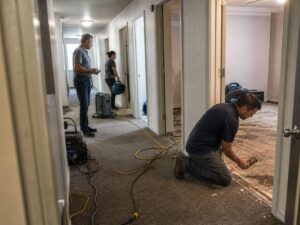
Water damage in a multi-family property — apartments, condominiums, townhomes, HOA-managed communities — involves a layer of complexity that single-family residential water damage does not. A water event that originates in one unit affects neighboring units below, beside, or above it. Lease agreements and condominium declarations establish clear responsibilities for restoration timelines and standards of habitability. Insurance coverage may be divided between the property owner’s master policy, individual unit owner policies, and tenant renter’s insurance — with each party’s adjuster requiring their own documentation and their own scope.
True Day Water Damage Restoration is a licensed Utah Contractor (#960332-3505) and IICRC-Certified Firm (ID #927354-5258), based at 11268 S 2865 W in South Jordan. We collaborate with property managers, HOA boards, and multi-family property owners across South Jordan and the wider Salt Lake County area. Call us at (385) 247-9359.
Multi-Family Water Damage in South Jordan — The Local Context
Daybreak’s master-planned community includes a significant inventory of townhomes, condominiums, and multi-family residential buildings — many of which feature stacked floor plans where second-floor bathrooms and laundry rooms sit directly above ground-floor living spaces in adjacent units. A supply line failure in a second-floor bathroom of one townhome unit creates a water damage event that immediately affects the ceiling and upper walls of the unit below — with the moisture migrating through the shared floor-ceiling assembly before either unit’s occupant may be aware the event has occurred.
The hard water supplied by the Jordan Valley Water Conservancy District at 7 to 10 grains per gallon accelerates supply line failures throughout the Daybreak townhome stock — washing machine supply hoses, toilet supply valves, and water heater connections degrade through internal mineral scale accumulation on a timeline that is shorter than most homeowners and property managers account for in their maintenance schedules.
Our Multi-Family Approach
We coordinate assessment and restoration across all affected units simultaneously — establishing the full scope of damage through FLIR thermal imaging of shared floor-ceiling assemblies and calibrated moisture metering in all affected units — before drafting separate scope-of-work documents for each unit’s applicable insurance carrier. We coordinate access with property managers and provide daily progress reporting to all stakeholders. We work during off-hours where restoration activities in common areas must be scheduled around building access requirements.
Our documentation distinguishes clearly between damage that originated in the source unit and damage that resulted from migration to adjacent units — a distinction that is critical for correctly attributing costs between the source unit’s policy, the adjacent unit policies, and the building master policy.
- How many units does a supply line failure typically affect?
- In traditional platform-framed multi-story buildings, 2 to 4 units in the water migration pathway depending on event duration and floor-ceiling assembly construction. Buildings with open plenum construction or central chase plumbing walls may see lateral migration to adjacent same-floor units as well.
- Who is responsible — tenant or building owner?
- Depends on the source location. Tenant-controlled fixtures typically fall under the tenant’s HO-4 renter’s insurance. Building supply plumbing system failures fall under the building owner’s commercial property insurance. We document source and migration pathway for each affected unit’s insurance file.
Learn more about our commercial services, structural drying, and insurance claims assistance.
True Day Water Damage Restoration | 11268 S 2865 W, South Jordan, UT 84095 | (385) 247-9359 | License: #960332-3505 | IICRC: #927354-5258
Our capacity for larger losses — what we can and can’t do
A 2,000-square-foot flooded basement is a different problem from a flooded HOA basement row or a two-story commercial loss. Here is what our standing crew and equipment can run on its own, and where we tell you up front that we’ll bring in a partner.
What makes a multi-family water loss different from a single-family one
A broken pipe in a townhome or condo is three problems at once: physical damage, inter-unit propagation, and a liability clock the HOA or property manager has to document from minute one. These are the three scenarios we’re called into most, and how each one is handled.
HOA common-area loss (hallway, parking garage, shared mechanical room)
Water in a common area is the HOA’s responsibility, not the individual unit owner’s. The HOA’s master policy covers it, but the HOA board or management company has to initiate the claim. We can be on site before that decision is made — mitigation is covered as a necessary emergency expense under virtually every HOA master policy — and we document the loss identically whether the final payer is the HOA, a unit owner, or a tenant policy.
Inter-unit water propagation (upstairs unit leak into downstairs unit)
This is the single most common multi-family loss we see. Water from one unit flows through the floor assembly into the unit below, often emerging in a different room than the one above it. Both unit owners’ policies may be involved; the HOA’s building policy sometimes covers the drywall between units. We dry the structure as one connected system (because it is), document each unit separately for the three possible claim paths, and coordinate access with both units’ residents — not just the one that called us.
Occupied-floor containment (large loss while units are still being lived in)
Everyone cannot evacuate. We set negative-air containment around the active drying area with HEPA air scrubbers, keep egress and life-safety paths clear, and schedule noisier work (fan placement, demolition) in daytime hours when residents are typically out. Dehumidifier noise runs 24/7 by necessity; we provide the HOA with the IICRC S500 justification letter if a resident complains, so the HOA doesn’t have to argue it alone.
- Property address and nearest intersection, plus which unit(s) are affected.
- HOA master policy carrier name and the number for the association’s claims adjuster (if available).
- Point-of-contact on the board or in the management office who can authorize work and sign the authorization.
- Whether the water is still active — if yes, which main valve (unit, riser, or building) has been shut.
Safety and liability documentation we provide to property managers
Property managers and HOA boards screen vendors on safety and liability before approving work. Here is the standing documentation package we provide on request, and what we comply with by default on every commercial or multi-family job.
Default compliance on every job
- OSHA 29 CFR 1926 construction standards — PPE, fall protection, electrical safety on wet-structure work.
- OSHA 29 CFR 1910.1030 Bloodborne Pathogen standard for any Category 3 water or BBP cleanup scope.
- IICRC S520 containment levels for mold remediation inside occupied buildings — negative air, HEPA scrubbing, Condition 2/3 clearance criteria.
- Daily moisture + equipment logs accessible to the PM or HOA board on request, shared through close-out.
- No subcontracted technicians — every tech on your site is a True Day W-2 employee, insured under our policy, not an independent contractor whose coverage you need to verify separately.
- Certificate of Insurance (Liberty Mutual GL $1M/$2M, Hartford WC EL $1M) — additional insured endorsements on request before work begins.
- IICRC Firm certificate (#927354-5258) and Utah GC license (#960332-3505) copies.
- Technician IICRC Registrant numbers for the specific crew assigned to the job.
- Safety Data Sheets (SDS) for every chemical we will use on-site — thymol, accelerated hydrogen peroxide, and any surface-cleaning chemistry.
- Written scope in Xactimate format before work begins, with daily log attachments through completion.
HOA + condo water losses — who pays for what
The hardest part of a condo or townhome water loss isn’t the water. It’s figuring out who owns the loss — the unit owner, the HOA, the HOA’s master policy, each unit owner’s HO-6 policy. Here’s how we scope it so the payment path is clean.
Who typically owns what
| What’s damaged | Who typically owns it | Which policy pays |
|---|---|---|
| Interior drywall + paint of the affected unit | Unit owner | HO-6 (walls-in) policy |
| Flooring inside the affected unit | Unit owner | HO-6 policy |
| Unit owner’s contents | Unit owner | HO-6 contents coverage |
| Framing + exterior walls | HOA common element | HOA master policy |
| Shared plumbing stacks and supply lines | HOA common element | HOA master policy |
| Hallway, lobby, common area water damage | HOA | HOA master policy |
| Damage to adjacent unit from this unit’s plumbing failure | Depends on CC&Rs and “original condition” language | Often this unit’s HO-6 liability, sometimes HOA master |
The scope-approval process
On a multi-family loss, we scope the entire affected area and then itemize by ownership on the paperwork. The unit owner’s HO-6 adjuster sees interior scope. The HOA’s master-policy adjuster sees common-element scope. Each one approves their portion independently.
Where it gets complex: the water source. If the loss started in a plumbing stack (HOA-owned) but damaged interior finishes (unit-owned), both policies owe. If the loss started in a unit-owned supply line but damaged structural framing (HOA-owned), same thing. The source matters more than the damage location.
Property manager involvement
On larger HOAs, the property manager is the signatory for the HOA portion. We coordinate directly with them + the HOA’s master-policy adjuster for approval on the common-element scope, while the unit owner handles their HO-6 side with us keeping documentation unified.
Why this matters
A scope done without the ownership split written in gets kicked back by both carriers. Clean itemization at the mitigation stage is what makes the claims actually pay.
Multi-family mold scenarios — HOA, condo, and apartment-complex scope
Multi-family mold claims have a complexity residential single-family claims don’t: the responsibility split between the unit owner, the HOA/condo association, and (sometimes) a neighboring unit’s owner. The scope must map to the responsibility — otherwise the right scope goes to the wrong insurance.
If you’re a unit owner looking at mold and don’t know which coverage applies, call us before you call insurance. We can usually tell you which responsibility zone the loss falls into on the first visit, which affects what you file where.
Tenants, displacement, and notification — the human side of multi-family mold
Multi-family mold work has a coordination layer that single-family work doesn’t: the tenants (if the unit owner rents it) and the neighboring tenants on shared walls. Here is what has to happen on the tenant side, and whose job each item is:
True Day’s communication during multi-family work routes through the property manager, not direct to tenants, unless the property manager delegates otherwise in writing. Keeps the chain of responsibility clear.
Apartment complex vs condo HOA — different scenarios, different scopes
Both are “multi-family” but the ownership and insurance structures are completely different. Here’s how we handle each:
Apartment complex (owned by one entity)
- Single owner — property management company or holding entity
- One insurance policy covers the whole structure plus common areas
- Tenants have renter’s insurance for their contents, not for the structure
- Scope is written to the property manager
- Decisions on scope, timing, access routed through one point of contact
- Tenant communication is the owner’s responsibility; we coordinate access through them
- Billing: direct to property owner’s insurance carrier
Condo / townhome HOA
- Multiple owners — each unit is individually owned
- HOA master policy covers common areas and sometimes exterior walls/roofs
- Each unit owner has their own HO-6 policy covering interior improvements
- Scope splits: common-area to HOA, unit-interior to individual owner
- Decisions coordinate between HOA (property manager) + affected unit owner
- Tenant communication (if owner rents the unit) is the owner’s responsibility
- Billing: splits between HOA master and individual HO-6 policies
For either scenario, True Day’s scope documentation is written to make the split visible. If a loss affects a shared wall between two units + a common hallway, the invoice has three line items — Unit A, Unit B, HOA — each ready for its own carrier.
Where this gets complicated: when the HOA property manager and an individual unit owner disagree about scope responsibility. We provide the documentation; the two parties resolve the dispute. We don’t take sides and we don’t delay work waiting for the dispute to resolve — critical mitigation continues under whichever party authorizes it, with the responsibility split documented for later resolution.
Master HOA policy vs HO-6 unit policy — who pays what on a condo mold claim
In a condo mold loss, there are usually two insurance policies in play: the HOA’s master policy and the unit owner’s HO-6. The split between them is decided by the HOA’s governing documents, not by either carrier. Here’s how it typically breaks down:
Before a loss happens, two things worth doing: (1) read your HOA’s bylaws section on insurance responsibility; (2) check that your HO-6 covers what the bylaws say is yours. Mismatches between the two are discovered during claims, not before.
Mixed-use buildings and multi-tenant commercial — business continuity in the mix
Multi-family work extends beyond condos and apartments. Mixed-use buildings (retail on ground floor, residential above) and multi-tenant commercial buildings (office suites, shared retail spaces) have their own scope complications when a water or mold event hits one tenant’s space. Here’s how we handle them:
If your business is one tenant in a multi-tenant building and you’ve had a loss, the first call includes your property manager — not just us. Coordination from day one is faster than coordination started after the scope is written.
Sewage backups in shared buildings
In condos and apartments, one blocked drain stack can back sewage into several units — usually the lowest ones. That means more than one owner, the association, and sometimes several insurers.
- We document each unit separately.
- One scope goes to the owners, the association, and the property manager.
- Containment protects shared hallways and units that weren’t affected.