
Fire and smoke damage restoration from True Day Water Damage Restoration: board-up, soot and smoke cleanup, odor removal, contents pack-out and rebuild, billed directly to your insurer through Xactimate. Owner Michael Bass is paged on every fire call. Based in South Jordan, UT, live-answered 24/7. Utah license #960332-3505, IICRC Certified Firm #927354-5258.
Fire or smoke damage right now?
Our crew dispatches 24 hours a day, 7 days a week, 365 days a year — live-answered. Once the fire department clears your property for re-entry, every hour matters: soot etches finishes, and the water used to put the fire out starts its own damage clock.
Call now: (385) 247-9359Live-answered 24/7/365 — on-call crew dispatched while you’re still on the phone
Our warranty at a glance
Warranty call goes to Michael Bass personally. (385) 247-9359.
2020
Fire Damage Restoration in South Jordan, UT
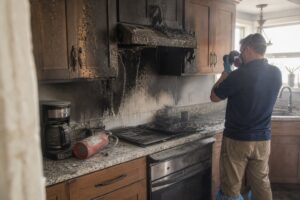
A house fire is the property emergency that changes the most things at once. In the hours after the fire department leaves, the family is displaced, the structure is compromised, the contents are at risk, the insurance claim is open, and the decisions made in the next 24 to 48 hours will determine whether the restoration is a six-week project or a six-month one. The smoke keeps settling. The soot keeps corroding. The water from firefighting keeps migrating through wall assemblies and subfloor panels. Nothing is waiting.
We have stood in a lot of South Jordan kitchens the morning after a fire. The smell is specific — acrid, chemical, layered with something that the word “smoke” does not adequately describe. The homeowner is standing in the yard, or in a neighbor’s driveway, watching our team carry equipment through the front door, and the thing they say most often is not about the damage. It is about the house. “It doesn’t look like our house anymore.” That observation is almost always accurate. And it is almost always temporary. The restoration scope follows the smoke, not the fire — and smoke can be addressed. It takes the right sequence, the right equipment, and the right documentation. But it can be addressed.
True Day Water Damage Restoration is a licensed Utah Contractor (#960332-3505) and IICRC-Certified Firm (ID #927354-5258), based at 11268 S 2865 W in South Jordan. We provide complete fire damage restoration throughout Salt Lake County — from emergency board-up in the first hours through licensed general contractor reconstruction at project close. One company, one point of contact, from the call after the fire to the walkthrough when it is done.
Call us immediately at (385) 247-9359. Every hour of delay is a measurable increase in scope.
The Three Damage Events Inside Every House Fire
Homeowners tend to think of fire damage as a single event — the fire — and fire restoration as addressing its aftermath. The more accurate frame is that every structural fire produces three distinct and simultaneous damage events, each requiring its own assessment and protocol, and each compounding in severity with every hour they go unaddressed.
The Fire Itself — Char, Structural Damage, and Material Loss
The direct thermal damage of fire — charring, melting, structural compromise, and material loss — is the most visible damage and the easiest to scope. Charred framing, burned flooring, collapsed ceiling assemblies, and destroyed contents define the primary loss area. This damage is confined to the areas the flames reached directly. It is also, in the vast majority of residential fires in South Jordan, smaller in scope than the combined smoke and water damage that surrounds it.
Structural stability assessment precedes any entry into a fire-damaged structure. Compromised floor joists, load-bearing walls with structural damage, and partially collapsed ceiling assemblies require engineering assessment before restoration work begins. This is not a formality — it is a safety requirement that protects both occupants and restoration crews.
Smoke and Soot — The Pervasive Secondary Damage
Smoke — the airborne suspension of fine carbon particles, ash, and partially burned organic compounds produced by incomplete combustion — travels through a burning building with a thoroughness that fire alone does not achieve. Hot smoke rises and moves through every available air pathway: open doorways, HVAC supply and return ducts, wall and ceiling penetrations, structural gaps in floor assemblies. It deposits soot residue on every surface it contacts throughout the building, including rooms on other floors and in other wings that were never exposed to flame.
Soot residue is not simply dirty. It is chemically active — containing acidic compounds including sulfur dioxide reaction products and polycyclic aromatic hydrocarbons that continuously corrode and etch surfaces after deposition. These organic compounds are classified as volatile organic compounds when they off-gas from surfaces where they have deposited. Metal fixtures begin to tarnish and corrode within hours. Porous surfaces — painted drywall, wood trim, fabric upholstery — absorb smoke residue progressively deeper with every passing hour, converting cleanable surfaces into surfaces requiring replacement.
The HVAC system deserves specific attention in any fire event. Smoke that enters the return air system is distributed by the air handler to every room connected to the duct network — including rooms that were never in the smoke path before HVAC distribution. A kitchen fire in a South Jordan split-level can deposit smoke residue throughout all three levels if the HVAC system was operating during the fire or was run afterward without awareness of smoke in the return air. HVAC duct cleaning is a required component of complete fire restoration, not an optional add-on. Learn more about our smoke damage cleanup and soot removal services.
Water — The Overlooked Third Damage Event
Firefighting — by the South Jordan Fire Department, by West Jordan Fire, or by whichever agency responds to the specific address — introduces significant volumes of water into the structure. A fire suppression sprinkler system activation releases water at 25 gallons per minute per head. A hand-line attack from a structural pumper truck delivers 150 to 200 gallons per minute at the nozzle. A significant structural fire that required a substantial suppression effort may have introduced thousands of gallons of water into the building before the fire was controlled.
That water migrates through the building exactly as any other water damage event does — saturating subfloor oriented strand board, wicking upward into wall assemblies by capillary action, penetrating ceiling drywall from above, and pooling in basement and crawl space areas. The difference from a standard water damage event is that this water is also contaminated with fire suppression chemicals, soot and ash particulate, and the products of incomplete combustion — elevating its contamination classification.
Without professional water extraction and structural drying, the firefighting water produces its own secondary damage independent of the fire and smoke — warped framing, swollen subfloor, drywall that fails, and mold that establishes in the wet cellulose materials within 24 to 48 hours. We begin water extraction and FLIR thermal imaging moisture mapping immediately after board-up, parallel to the initial smoke assessment, because the firefighting water damage does not wait for the smoke assessment to be complete. Learn more about our water extraction and structural drying services.
Why Soot Type Determines Everything About Cleanup
One of the most consequential decisions in fire restoration is the first one: identifying what type of soot residue is present and where. Different types of fires produce different soot chemistries — and applying the wrong cleaning technique to the wrong soot type does not simply fail to clean it. It makes the situation significantly worse.
Dry Smoke Residue
Produced by fast-burning, high-temperature fires with good oxygen supply — paper, wood, and natural materials burning cleanly. Dry soot is fine and powdery, ranging from light gray to black, and is the most easily airborne of the soot types. The critical mistake with dry soot is wiping it with a cloth or damp sponge — the contact smears the particles across a wider area and drives them deeper into the porous surface below. Dry soot must be removed with a dry chemical sponge using single-direction strokes — lifting the particles rather than smearing them — before any wet cleaning begins. HEPA vacuuming prior to dry sponging removes the loose surface deposit without contact pressure.
Wet or Oily Smoke Residue
Produced by slow-burning, low-temperature fires or smoldering events — often involving synthetic materials, rubber, foam upholstery, or petroleum-based products. Wet soot is sticky, oily, and carries a much stronger, more penetrating odor than dry soot. It adheres aggressively to surfaces and penetrates porous materials rapidly. Cleaning requires appropriate degreasers and emulsifiers applied in multiple passes. Wet soot situations are among the most expensive to remediate per affected square foot because the cleaning process is labor-intensive and the odor component is more resistant to elimination.
Protein Fire Residue
Produced by kitchen fires involving burning food, grease, and proteins. Protein residue is deceptive — it is often nearly invisible, leaving only a slight yellowish or greasy film rather than the dark soot associated with other fire types. But it creates an extremely strong, persistent odor and bonds tightly to surfaces — bonding that is chemically different from soot adhesion and requires enzymatic cleaning agents rather than standard degreasing products. Protein residue is frequently underestimated in scope because its visual presentation does not convey its odor intensity.
Fuel Oil Soot
Fuel oil furnaces are rare in South Jordan, where most homes heat with natural gas, but fuel oil soot still turns up in older properties and in homes with oil-fired backup heat. It is produced by furnace puff-back events — when a fuel oil furnace malfunction causes a combustion backfire that sends extremely fine oily soot through the HVAC system into every room connected to the duct network. Fuel oil soot is among the finest and most penetrating of soot types. A single furnace puff-back can deposit a thin black film on every surface in an entire home — walls, ceilings, contents, clothing in closets — through the HVAC distribution system. The response requires HVAC cleaning first, then systematic whole-building surface cleaning. Learn more about our soot removal services.
Our Fire Damage Restoration Process
Phase 1 — Emergency Board-Up and Property Stabilization
Before any restoration work can begin, the property must be secured and stabilized. Fire-damaged structures with broken windows, compromised doors, and damaged rooflines are exposed to weather intrusion, unauthorized entry, and ongoing structural deterioration that begins immediately after the fire. We dispatch board-up on the first call — under our 45-minute arrival guarantee at South Jordan addresses — and start securing the structure as soon as the fire department releases the property, covering all compromised window and door openings with secured plywood panels, tarping damaged roof areas, and sealing any secondary openings created by firefighting access.
Emergency board-up is typically covered by homeowner’s insurance as a reasonable mitigation expense — and failing to board up promptly gives the carrier grounds to dispute coverage for subsequent weather damage that enters through unsecured openings. Learn more about our fire damage board-up service.
Phase 2 — Structural Safety and Scope Assessment
Once the property is secured, our lead technician conducts a comprehensive assessment of structural safety and the full scope of damage. FLIR thermal imaging cameras map the extent of water migration from firefighting throughout the building — including hidden moisture in wall cavities, beneath flooring, and in ceiling assemblies that visual inspection does not reveal. Calibrated moisture meter readings at all thermal anomaly points quantify the saturation in specific materials.
The smoke and soot assessment covers every room in the building — not just the fire area. Soot residue in rooms far from the fire origin is documented, the soot type in each area is identified, and the scope of cleaning required in each space is established. The full scope assessment produces the documentation that your insurance adjuster requires to evaluate the claim — and because this documentation begins on day one, it establishes the loss date and condition for every surface in the building before any cleaning work converts them from assessable to assessed-and-treated.
Phase 3 — HEPA Air Scrubbing
Industrial HEPA air scrubbers — which capture 99.97% of airborne particles at 0.3 microns, well within the size range of smoke and soot particles — are deployed throughout the property immediately and run continuously throughout the restoration process. This serves two functions: it reduces the ongoing deposition of airborne smoke particles onto surfaces that have already been cleaned, and it protects our technicians and any occupants of adjacent unaffected areas from smoke particle inhalation. Learn more about our air scrubbing and HEPA filtration services.
Phase 4 — Water Extraction and Structural Drying
All firefighting water is extracted and the structure is dried to verified completion using industrial low-grain refrigerant dehumidifiers and high-velocity air movers — monitored daily with calibrated moisture meters until all affected materials return to equilibrium moisture content. This phase runs concurrently with smoke and soot cleaning in unaffected areas, maximizing the efficiency of the overall timeline. Learn more about our structural drying and dehumidification services.
Phase 5 — Contents Assessment and Pack-Out
All contents in the fire-affected areas are inventoried — documented with photographs and descriptions — and assessed for salvageability. Items that can be cleaned and restored are carefully packed out for professional cleaning at our facility, away from the ongoing smoke environment of the structure. Items that cannot be restored are documented for insurance claim purposes. The contents inventory is the personal property documentation component of the fire insurance claim — and its completeness directly affects the personal property settlement. Learn more about our contents cleaning and pack-out services.
Phase 6 — Smoke and Soot Removal
Beginning with the soot type and cleaning technique appropriate to each area — dry chemical sponging for dry soot, degreasers and emulsifiers for wet soot, enzymatic agents for protein residue — our technicians systematically clean all smoke-affected surfaces throughout the building. Walls and ceilings are cleaned from top to bottom. Metal fixtures are cleaned promptly to halt the corrosion process. HVAC systems are cleaned professionally to remove soot deposits from ductwork, registers, air handler components, and the blower — eliminating the distribution pathway that would continue delivering smoke residue to every connected room if left unaddressed.
The sequence matters as much as the technique: cleaning the HVAC system before cleaning room surfaces prevents the cleaned surfaces from being recontaminated by HVAC distribution. Cleaning surfaces before odor treatment ensures that the thermal fogging or hydroxyl treatment applied in the odor phase reaches the surfaces directly rather than through a layer of uncleaned residue. Learn more about our smoke damage cleanup and soot removal services.
Phase 7 — Odor Elimination
Smoke odor is caused by volatile organic compounds and polycyclic aromatic hydrocarbons that have penetrated into the porous materials of the building — not merely into the air. Eliminating these odors requires treatments that penetrate into the same spaces where the odor compounds are embedded, not surface sprays that mask them temporarily.
We use thermal fogging — converting a professional deodorizing solution into a microscopic fog that penetrates wall cavities, wood grain, and porous substrates to chemically pair with and neutralize odor compounds — and hydroxyl generation, which produces hydroxyl radicals that oxidize and break down volatile organic odor molecules at the molecular level. Both treatments are applied after cleaning is complete, when the surfaces they need to penetrate are exposed rather than coated with residue. Learn more about our odor removal services.
Phase 8 — Structural Assessment and Controlled Demolition
After smoke cleaning and odor treatment are complete, we assess all structural materials that were directly affected by fire and heat — charred framing, burned subfloor, heat-damaged roofing and sheathing — for removal and replacement. Materials are removed cleanly, to structural member boundaries, creating square edges for reconstruction. Structural framing that was damaged but not destroyed is evaluated for its structural integrity before any decision is made to sister, supplement, or replace it.
Phase 9 — Licensed General Contractor Reconstruction
With the structure cleaned, dried, and all compromised materials removed, our licensed general contractor team (Utah License #960332-3505) performs complete reconstruction — replacing framing, sheathing, insulation, drywall, flooring, trim, cabinetry, and all finish work needed to return the property as close to pre-loss condition as the loss and your policy allow. Surfaces are primed with shellac-based or oil-based stain-blocking primer before painting — a required step in fire restoration that prevents residual smoke odor compounds from off-gassing through the new finish paint layer. Learn more about our reconstruction and repair services.
Fire Damage in South Jordan — Local Context
South Jordan’s homes were built in distinct waves — the 1970s and 1980s ranch and split-entry construction in the established neighborhoods west of Redwood Road, the 1990s expansion along the 10200 South and 11400 South corridors, the early 2000s suburban buildout near Towne Center Square, and the post-2006 master-planned construction of Daybreak and its adjacent communities. Each construction era has a different framing system, a different envelope design, and a different set of fire behavior characteristics that inform where we start the structural assessment, what we expect to find, and what materials are most likely to require abatement coordination before demolition can begin. The valley’s semi-arid high-desert climate — low ambient humidity for most of the year, with extreme spikes during the North American Monsoon season — also creates a paradox in post-fire water damage: firefighting water introduced into a structure in December or January, in a South Jordan winter with outdoor relative humidity below 20%, can dry from exterior surfaces rapidly while remaining trapped in interior wall assemblies at saturation levels that sustain mold germination for weeks. The dry air that appears to be drying the building is not reaching the moisture that matters.
Daybreak and Contemporary Craftsman Construction
Daybreak’s post-2006 contemporary craftsman and modern farmhouse homes — which now represent a significant proportion of South Jordan’s housing stock — present specific fire damage characteristics. The tight building envelopes, engineered lumber structural systems, and open floor plans common in this construction era behave differently in a fire than earlier construction. Engineered lumber — including laminated veneer lumber beams and I-joist floor systems — loses structural integrity more rapidly under fire exposure than solid sawn dimensional lumber, because the adhesive bonds in engineered wood products are compromised by heat before the wood fiber itself reaches ignition temperature. Structural assessment of engineered framing in fire-affected areas requires conservative evaluation that accounts for this behavior.
The open floor plans common in Daybreak’s construction also create smoke distribution pathways that facilitate whole-home smoke contamination from fires that might have been contained in earlier construction with more compartmentalized layouts. A fire in the kitchen of an open-concept first floor distributes smoke to the open living area, the staircase, and the second floor in a unified air volume rather than through separate rooms with closed doors. The smoke assessment scope in these homes is typically the whole building from day one.
Established Neighborhoods and Older Construction
South Jordan’s pre-2000 construction — the split-entry and ranch-style homes in established neighborhoods along the Jordan River corridor, near Towne Center Square, and in the communities along 10200 South — present different fire restoration considerations. Older construction is more likely to contain materials that require specific handling during demolition: asbestos-containing materials in floor tile adhesive, pipe insulation, and textured ceiling coatings in pre-1980 construction; lead paint on pre-1978 interior surfaces. When fire damage involves materials of these ages, environmental testing before demolition and appropriate abatement protocols are coordinated before reconstruction work begins.
Commercial Properties Along the Bangerter Highway Corridor
South Jordan’s commercial properties — including the retail centers near The District at South Jordan, the office parks of the RiverPark Corporate Center, and the commercial and light industrial facilities along South Jordan Parkway west of Bangerter Highway — present fire restoration challenges at a scale and complexity well beyond typical residential work. Commercial sprinkler system activations discharge water at volumes and distribution patterns that require large-footprint extraction capacity. Commercial smoke damage restoration requires HVAC cleaning protocols scaled to the much larger duct systems in commercial construction. For commercial losses, we assess on-site and tell you up front whether the job fits our crew and equipment capacity — including when additional equipment has to be rented for a larger event. Learn more about our commercial restoration services.
Fire Damage and Your Insurance Claim
Fire damage is a covered peril under virtually every standard homeowner’s insurance policy — HO-3 open-peril forms and HO-5 comprehensive forms alike. Coverage typically extends to all three damage events: the direct fire damage, the smoke and soot damage throughout the building, and the water damage from firefighting suppression. What determines whether the claim is processed smoothly and completely is documentation.
From the moment we arrive, we document everything. Photographs of every affected surface in every room before any cleaning begins. Thermal imaging reports showing the extent of water migration from firefighting. Daily moisture logs. Soot type documentation by area. Contents inventory. And a Xactimate-format scope of work estimate — prepared in the industry-standard format that insurance adjusters use daily — that captures the complete restoration scope from board-up through reconstruction.
Initial adjuster estimates frequently underestimate the scope of fire restoration because they are based on visible damage at the time of the initial inspection — before the full extent of smoke migration, hidden water damage from firefighting, and HVAC contamination has been documented. We file supplemental claims with supporting documentation as additional scope is confirmed, and we communicate directly with your adjuster throughout the project. Learn more about our insurance claims assistance.
A Fire Restoration Project We Completed in South Jordan
In late October 2023, we were called to a 2011-era two-story contemporary craftsman home in South Jordan’s Harvest Village neighborhood following a kitchen fire that originated in an unattended stovetop and extended to the range hood and the cabinet assembly above. The South Jordan Fire Department suppressed the fire within approximately 20 minutes of arrival. The fire damage was confined to the kitchen — roughly 180 square feet of charred cabinetry, destroyed range hood, heat-damaged ceiling drywall directly above the range, and one compromised wall between the kitchen and the dining room.
The smoke damage was not confined to the kitchen. It was not close to confined to the kitchen.
Our whole-building smoke assessment documented soot residue — wet, oily soot from the synthetic materials in the range hood and cabinet finishes — on ceiling surfaces in the dining room, living room, master bedroom on the second floor, and the two additional bedrooms. The HVAC system had been operating at the time of the fire and had actively distributed smoke through the return air system to every connected room. The second-floor master bedroom, which shared no wall with the kitchen and was two rooms away from the fire on a different floor, had measurable soot deposition on the ceiling and on white fabric window treatments that had absorbed the oily residue before the HVAC was shut down by the fire department.
FLIR thermal imaging showed firefighting water had migrated through the kitchen subfloor assembly into the finished basement ceiling below — a ceiling the homeowners had assumed was unaffected because no water had dripped through it. Penetrating moisture meter readings in the OSB subfloor beneath the kitchen showed readings of 44% to 61% at seven monitoring points. The finished basement ceiling drywall was reading 28% at three points directly below the kitchen floor. The basement was added to the scope.
The homeowner’s State Farm HO-5 policy covered all three damage events. We submitted a complete documentation package on day three — 54 timestamped photographs, the whole-building soot assessment by room, the FLIR thermal imaging report showing the basement ceiling moisture, and the Xactimate scope covering kitchen reconstruction, whole-building smoke and soot cleanup, HVAC cleaning, basement ceiling replacement, and structural drying. The initial adjuster estimate had covered the kitchen only. The supplemental submission covering the whole-building smoke scope and the basement water damage was approved in full within ten business days. Total approved: $47,200. Deductible: $1,000.
The homeowner’s question at the first walkthrough — when we were explaining that the bedroom on the second floor needed cleaning too — was “but the fire didn’t get up there.” That is the question that fire damage restoration answers every time. The fire did not get there. The smoke did. And the smoke was already there before anyone called us.
She called us two weeks later, not with a question but to say that the adjuster had approved the supplemental and that the contractor who had given her a quote the previous evening — a kitchen-only scope at $9,400 — had told her that “smoke doesn’t travel that far.” She wanted us to know that she had almost taken that quote. She had almost signed a contract that would have left the oily soot residue in the master bedroom ceiling, the firefighting water in the basement assembly, and the HVAC system full of smoke residue to distribute every time the furnace ran. We do not say this to criticize another contractor. We say it because that gap — between what a visual inspection sees and what a thermal imaging assessment finds — is exactly the gap that costs homeowners money and health in the months after a fire that they thought was handled.
Frequently Asked Questions — Fire Damage Restoration
What should I do immediately after a house fire in South Jordan?
Do not re-enter until the fire department releases the property. Once released, call True Day at (385) 247-9359 for immediate board-up. Do not wipe soot — contact spreads it and drives it deeper. Do not run the HVAC. Call your insurance carrier and notify them that professional mitigation has been dispatched — this helps document that you met your Duty to Mitigate obligation from day one.
Does homeowner’s insurance cover fire damage restoration?
In almost all cases, yes. Fire is a covered peril under virtually all standard HO-3 and HO-5 homeowner’s policies. Coverage typically includes board-up, smoke and soot cleanup, firefighting water damage, contents cleaning, and reconstruction — subject to your policy limits and deductible, with your adjuster making the final scope decision. We provide complete IICRC-standard documentation and communicate directly with your adjuster. Learn more on our Insurance Claims Assistance page.
How far does smoke damage travel from the fire location?
Throughout the entire building in most cases — smoke travels through doorways, HVAC systems, and structural penetrations to deposit residue in every room, including distant rooms on other floors. In South Jordan homes with open floor plans and active HVAC during the fire event, whole-building smoke assessment is standard from the first day. The restoration scope follows the smoke migration, not the fire perimeter.
Why does fire damage need to be addressed immediately?
Soot residue contains acidic compounds that corrode metal and etch glass, along with polycyclic aromatic hydrocarbons that penetrate porous surfaces deeper with every passing hour. Surfaces that are cleanable on day one can become replacement items within a week. The firefighting water simultaneously migrates through the structure, creating mold conditions within 24 to 48 hours if not professionally extracted and dried. Every hour of delay is a measurable increase in restoration scope and cost.
Related Services
- Fire Damage Board-Up
- Smoke Damage Cleanup
- Soot Removal
- Odor Removal Services
- Air Scrubbing & HEPA Filtration
- Contents Cleaning & Pack-Out
- Water Extraction
- Structural Drying
- Dehumidification
- Drywall Repair
- Flooring Removal & Replacement
- Reconstruction & Repairs
- Commercial Water & Fire Restoration
- Insurance Claims Assistance
- Water Damage Emergency Guide — South Jordan, UT
Call True Day for Fire Damage Restoration in South Jordan, UT
Fire damage restoration is a race against compounding damage — smoke residue corroding surfaces, firefighting water migrating through structural assemblies, and every hour that passes converting what was salvageable into what must be replaced. True Day Water Damage Restoration responds within 45 minutes to South Jordan addresses under our written guarantee, and serves Daybreak, Herriman, Bluffdale, Riverton, Draper, West Jordan, and the Salt Lake Valley — licensed, IICRC-certified, and equipped for all three damage events simultaneously from the first call.
True Day Water Damage Restoration
11268 S 2865 W, South Jordan, UT 84095
Phone: (385) 247-9359
Email: info@truedaywaterdamagerestoration.xyz
Utah Contractor License: #960332-3505
IICRC Certified Firm ID: #927354-5258
Certified
Firm
Pay Over Time Through Wisetack — No Hit to Your Credit to Check
Insurance covers most restoration jobs. For the deductible, non-covered scope, or jobs filed out-of-pocket, True Day offers financing through Wisetack — a homeowner-friendly lender with soft-credit prequalification (checking your rate does not affect your credit score).
Your True Day project manager can prequalify you in a few minutes during the written-scope visit. Nothing to sign on the spot.
About Wisetack: loans are issued through independent lending partners. Rates and approval depend on your credit profile. Prequalification is a soft inquiry; final approval may involve a hard inquiry. True Day does not profit from or receive referral fees for financing.
What True Day guarantees on every job
Fire damage restoration FAQ
The 72-hour window, what smoke actually does, and how we close out a job without the smell lingering.
How soon do I need to start cleanup after a fire?
Does insurance cover fire damage?
What’s involved in fire restoration?
Can smoke damage affect areas that didn’t burn?
Will my belongings have to be removed?
What about the smell afterward?
What a real fire restoration actually involves
The IICRC S700 standard governs professional fire and smoke damage restoration the same way S500 governs water. The reason protocol matters more on a fire than on a water loss is sequencing — do the wrong steps in the wrong order and you push soot deeper into materials, bake smoke VOCs permanently into drywall, or spread contamination through the HVAC system. Here is the actual sequence.
Step 1 — Secure the structure (first 24 hours)
Step 2 — Soot classification
- Dry soot — natural wood or paper fire, light grey-to-black particulate, cleans with dry chemical sponges (the yellow "dry cleaning sponges") rather than wet methods. Wetting dry soot smears it permanently.
- Wet soot — slow-burning synthetic or plastic fire, oily black residue, requires surfactant cleaning agents and more aggressive techniques. Common from electrical fires with wire insulation involvement.
- Protein soot — kitchen fire from stovetop oil or protein combustion, nearly invisible but produces an intense putrid odor. Protein film coats surfaces behind kitchens and migrates far from the fire origin. Specialized enzymatic cleaners are required; standard surfactants spread it.
Step 3 — HVAC shutdown and containment
Step 4 — Structural cleaning
Step 5 — Contents pack-out and cleaning
Step 6 — Deodorization
Step 7 — Clearance and reconstruction
Fire damage restoration — frequently asked questions
Our fire-damage process — the IICRC S700 sequence we actually follow
S700 is the industry standard for fire and smoke restoration. Each step below is one of its phases — in the order that actually produces a clean, dry, odor-free structure, not a resequenced marketing version.
Pre-restoration assessment
Walk the structure with the lead technician and a FLIR thermal camera. We identify what the fire reached, what the fire-fighting water reached (always a bigger footprint), and what the smoke penetrated — smoke travels through plenums, chases, and return-air paths well beyond the burn.
Containment and air quality
Negative-air containment around the affected area, HEPA air scrubbers running continuously. This is the step that prevents smoke residue and ash from migrating to clean areas every time a door opens.
Residue identification and surface cleaning
Fire soot is not one substance. Dry soot (from paper/wood fires) wipes dry; wet soot (plastics, synthetic fabrics) smears and needs solvent-based chemistry; protein residue (kitchen fires) is thin, yellowish, and requires enzymatic cleaners. We identify the type on arrival, because the wrong chemistry sets stains permanently.
Structural drying of fire-fighting water
Every fire-affected room also has a water loss — fire-hose water is Category 2 or 3 by the time it has traveled through burned material. LGR dehumidifiers + Phoenix and Dri-Eaz air movers dry the structure to IICRC S500 benchmark before any surface restoration continues.
Odor neutralization — not fragrance cover-up
Odor is not solved with scent. We neutralize at the molecular level with thymol and accelerated hydrogen peroxide, applied as fog or vapor into the structure after cleaning. A room that only smells “cleaner” is a failed restoration — the smoke molecule has to be destroyed, not covered.
Verification and documented close-out
Final HEPA pass, air-quality verification, odor check with the homeowner on-site, written documentation. We don’t close a fire job until the homeowner can enter a sealed room, smell nothing, and sign off. Covered under our 2-year workmanship warranty.
Why this sequence matters: jumping to deodorization before full drying is the most common reason a professionally cleaned fire-damaged home smells again a month later. The smoke molecule rebinds to residual moisture. We dry first, deodorize last — in that order, every time.
Fire claims vs. water claims — what’s different
Insurance behavior changes substantially between water and fire losses. If you’ve filed a water claim before, don’t assume fire will work the same way.
Side-by-side comparison
| Element | Water loss | Fire loss |
|---|---|---|
| Adjuster assigned | Field adjuster | Often large-loss adjuster from day 1 |
| Initial response time | Days to a week | 24-48 hours typical — carrier wants eyes-on fast |
| Scope complexity | Mitigation + specific repair | Structural + contents + ALE (Additional Living Expense) + smoke + water |
| Timeline to close | 2-8 weeks typical | 3-9 months typical |
| Contents handling | Mostly stays in home | Full pack-out common; contents go to specialty cleaning |
| Additional Living Expense | Rare unless uninhabitable | Standard — home is uninhabitable during work |
| Public adjuster involvement | Occasional | Common on larger-value losses |
| Specialty trades needed | Mitigation + general reconstruction | Fire + smoke + water + contents + specialty finishes |
Why timelines run longer
A fire loss involves three overlapping damage types (fire, smoke, water from suppression), ALE coordination, contents inventory and cleaning (often weeks per room), and reconstruction scope that frequently requires structural engineering if framing was heat-damaged. Each of those phases has its own documentation chain and approval cycle.
What our GC license covers
Everything structural + reconstruction under our Utah GC License #960332-3505. We coordinate with specialty contents conservators for high-value items (we refer; don’t handle in-house) and keep documentation unified across all phases.
When a fire loss needs a structural engineer before we touch anything
Not every fire needs engineering. A kitchen grease fire with smoke damage to the hood and ceiling — no engineer. A bedroom fire where the ceiling joists are charred black — absolutely engineer first, then us. We don’t do structural engineering ourselves (Utah GC license 960332-3505 covers general contracting, not stamped engineering). Here’s how we decide.
Signs the structure needs an engineer’s sign-off first
- Visible charring on load-bearing framing (joists, posts, rafters, headers) — especially charring more than 1/4" deep
- Deflection, sagging, or sloping that wasn’t there before the fire
- Cracks in masonry walls or chimneys from heat exposure
- Any fire that reached the attic framing or roof trusses
- Water damage from fire suppression that soaked framing for more than 24-48 hours
- Fire department tagged the structure as unsafe or restricted entry
- We do an initial walk-through with the homeowner and insurance adjuster — no demolition yet
- We help the homeowner find a structural engineer (we have 2 we’ve worked with in Salt Lake County — names available on request; the homeowner hires them directly, not us)
- Engineer inspects, writes a report, and the report goes to the adjuster
- If the report says shoring or structural repair is needed first, that work gets scoped separately — often by the engineer’s recommended contractor
- Once structure is cleared, we start the mitigation side (water extraction from fire suppression, soot/smoke work, drying) and the restoration side (what we can rebuild under our GC license)
What we won’t do
- Begin smoke cleaning or demo in an area a structural engineer hasn’t cleared when conditions above are present — it’s not safe for our crew or the homeowner
- Make load-bearing calls ourselves — that’s not our scope and not our license
- Pressure the homeowner to skip engineering to speed up the job — the time to find out a joist can’t hold is before you re-occupy
Contents inventory and the save-vs-replace decision after a fire
Fire losses have two scopes: the structure itself (what we rebuild) and the contents (the personal items inside). Contents gets its own line item in your insurance claim, and the save-vs-replace decision for each item has to be made and documented. Here’s how we handle it so you don’t lose items to the paperwork process.
How contents inventory works
- Every item in the affected area gets a line in the inventory list — brand, model (if known), approximate age, condition before fire, condition after fire
- Items photographed in place (where they were when the fire happened), then photographed again after being handled
- Soft goods and textiles pulled first because odor and soot continue to damage them while they sit
- Electronics unplugged and bagged for an electronics-restoration specialist — we don’t power anything on
- Documents and photos stabilized in freezer bags if water-damaged, pulled aside for a document-restoration specialist if valuable
The save-vs-replace matrix
| Item type | Usually save | Usually replace |
|---|---|---|
| Furniture (hard wood) | Minor smoke exposure, sealed finish — cleanable and refinishable | Heavy soot penetration into raw wood; wet-smoke in upholstered pieces |
| Upholstery | Light smoke, no direct heat damage, salvageable with professional cleaning | Direct heat damage, foam core compromised, heavy smoke penetration |
| Clothing | Washable, non-synthetic, no heat damage — professional textile cleaning | Synthetic items that melted or stiffened; items with heavy wet-smoke; dry-clean-only with heavy smoke |
| Electronics | If sent to specialist within 48 hours and not powered on — often restorable | If powered on after exposure (corrosion already started); if direct flame contact |
| Appliances | Metal-cased, exterior clean, interior checked — often restorable with specialist cleaning | Internal electronics exposed; direct heat; soot into vents |
| Photos / documents | Specialist restoration if valuable; routine items copied if originals damaged | Water-damaged beyond stabilization window; direct flame |
| Books | Light smoke only; dry-chem sponge treatment | Wet; heavy smoke that penetrated binding |
What we tell you honestly
- “Pack-out” (removing everything to clean off-site) sounds thorough but is expensive and sometimes unnecessary — we scope it only where it’s warranted
- Items you want to keep for sentimental value get flagged for extra effort even when the replacement is cheaper — your call, not the insurance adjuster’s
- Items you’d rather replace than restore (even restorable items) get noted that way in the inventory — insurance usually pays either way, so your preference wins
Three types of smoke — and why each needs a different scope
IICRC fire restoration recognizes three distinct types of smoke residue, and each one requires fundamentally different cleaning methods, equipment, and timeline. The type that was in your fire decides the entire approach to the smoke-side of the job. Here’s each one:
| Type | How it burns | What it leaves |
|---|---|---|
| Dry smoke | Fast-burning fire at high temperature; paper, wood, light natural materials; typically a quick-flame event | Fine dry powdery residue; sits on top of surfaces; relatively easy to remove with dry sponge technique |
| Wet smoke | Slow-burning fire at low temperature; synthetics, plastics, rubber, upholstery; smoldering fires produce most of this | Sticky, oily, pungent residue; smears when wiped; penetrates porous materials; very difficult to remove without specialist chemistry |
| Protein smoke | Kitchen fire with proteins burned (meat, fish, pan grease) | Nearly invisible yellowish film on all surfaces; strong lingering odor; coats everything in affected area; often causes homeowner to clean “visible” residue but miss the real contamination |
Scope implications of each
Dry smoke
- Primary method: dry chemical sponge in one direction, HEPA vacuum follow-up, final neutral-pH clean
- Timeline: typically 1-3 days for a room-sized area
- Materials usually save: most hard surfaces, sealed wood, metal, glass
- Materials often replace: ceiling textures that crumble under sponge pressure, raw unfinished wood that absorbed residue
Wet smoke
- Primary method: specialist solvent cleaners, mechanical agitation, HEPA vacuum, often ozone or hydroxyl odor treatment
- Timeline: typically 5-10 days for a room-sized area
- Materials usually save: hard sealed surfaces, metals, glass, dense sealed wood
- Materials often replace: upholstery with heavy penetration, raw wood, popcorn ceilings, soft textiles unable to be solvent-cleaned
Protein smoke
- Primary method: specific enzymatic cleaners targeting protein residue, mechanical agitation, repeated passes, odor treatment
- Timeline: typically 3-7 days for a kitchen+adjacent-area scope
- Materials usually save: most surfaces if cleaned promptly — the challenge is the odor, not visible residue
- Materials often replace: items where protein residue penetrated and odor won’t release (porous cutting boards, open-cell foam, insulated food containers)
How we identify the type on first visit
- Visual: dry = powdery; wet = oily/streaked; protein = film/yellow tint
- Smell: dry = burnt paper/wood; wet = acrid/plasticky; protein = greasy/burnt-food
- Fire source confirmed: electrical fire vs grease fire vs structural fire — each tends to produce specific residue types
- Residue sample under magnification for ambiguous cases
Why this matters for your estimate
- “Smoke cleanup” is not one scope — it’s three different scopes with different costs and timelines
- Insurance Xactimate line items vary by residue type — wet-smoke labor is priced higher per sq ft than dry-smoke
- Getting the type right on day 1 means we scope accurately and don’t surprise you with scope changes mid-job
Fire reconstruction coordination (post-mitigation phase)
Fire mitigation (water extraction, soot cleanup, smoke decontamination) is one phase. Reconstruction (framing, drywall, flooring, roofing, finishes) is another. The reconstruction phase on a significant fire typically involves multiple trades coordinated over weeks or months. Here’s how it runs:
- Structural engineering sign-off (if needed) — before any demo or rebuild
- Roofing (if roof was damaged) — weather-dry structure first
- Framing repair/replacement — where fire damaged structural members
- Mechanical trades: plumbing, HVAC, electrical — rough-in
- Insulation + drywall
- Mechanical trades: trim-out (fixtures, outlets, registers)
- Flooring
- Trim + baseboards + doors
- Paint + finishes
- Final inspection + punch list
Who’s involved
- Us (GC + restoration) — overall coordination + specific scope in-house
- Structural engineer (if needed)
- Roofing contractor
- Framing contractor (may be us or a partner)
- Plumbing contractor
- HVAC contractor
- Electrical contractor
- Flooring installer
- Insurance adjuster — approves scope + releases payments
- Possibly your attorney if dispute arises
Our coordination role
- Master schedule across all trades
- Scope writing in Xactimate format for insurance approval
- Change-order management as scope evolves
- Weekly status update to homeowner (and adjuster if applicable)
- Final punch list management
- Written completion documentation
Why fire reconstruction takes longer than water reconstruction
- More trades involved (6-10 vs 2-4 for water)
- Structural scope often involved
- Larger scope = more material lead time (cabinets, flooring, specialty items)
- Insurance scope approval often involves more back-and-forth
- Specialty subcontractors (electronics restoration, document restoration, art restoration) may be involved for contents
Typical fire-reconstruction timeline
- Small fire (kitchen fire, limited scope): 3-6 weeks
- Medium fire (one room + adjacent + smoke damage): 6-12 weeks
- Large fire (multi-room, structural damage): 12-26 weeks
- Total loss (full rebuild from foundation): 6-12+ months
What makes it longer
- Multiple carrier approvals (if dwelling + contents are separate claims)
- Permit requirements (significant rebuild requires city permits)
- Material backorder (unlikely but possible)
- Weather (exterior work delayed in winter)
- Trade scheduling (busy trades have longer lead times)
What makes it shorter
- Pre-selected materials + finishes (no decision bottleneck)
- Signed contracts in place quickly after mitigation
- Clear scope + fewer change orders
- Permits already pulled
What the homeowner sees during reconstruction
- Rotating trades on-site; usually 1-3 trades at any given time
- Weekly status update from us
- Specific decision points where you need to make selections (flooring, paint, finishes)
- Partial payments released as milestones hit (if RCV policy with depreciation holdback)
- Final walk-through at completion
What we handle in-house vs partner on fire reconstruction
- In-house (our GC scope): framing (standard), drywall, insulation, trim, paint, flooring (standard), cabinet install
- Partner: structural engineering, roofing, plumbing, electrical, HVAC, specialty finishes, cabinet fabrication (we install)
What we tell homeowners up front
- Fire reconstruction is a long project; expect weeks to months
- Multiple trades + insurance interactions = complexity
- Patience + clear communication from us = less stress
- Written scope + timeline so there are no surprises
Fire reconstruction is where our GC license + restoration experience combines. If you’re facing a fire reconstruction decision, call (385) 247-9359 and ask for Michael — owner typically leads these jobs.
Contents and structure get separated — and why that matters for the claim
In a fire loss, the insurance claim splits into two coverage sections: structure (Coverage A on most homeowner policies) and contents (Coverage C). True Day’s scope writes these as two parallel tracks because the adjuster handles them separately. Here is how the split works in practice:
Most homeowners don’t know this split exists until they’re mid-claim. Writing it into the scope on day one is one of the simpler things that makes a fire claim run smoother.