
Mold inspection: True Day inspects with FLIR thermal imaging and GE Protimeter moisture meters to find the moisture feeding the mold. The inspection is free. If lab testing is needed, it’s done by an independent environmental firm. Live-answered 24/7 from South Jordan, UT.
Mold Inspection & Testing in South Jordan, UT
 The call we receive most often before a mold inspection is not “I can see mold.” It is “I smell something and I cannot find it.” Or “the inspector flagged elevated moisture in the wall and I don’t know what to do next.” Or “we had water damage three months ago and my wife’s allergies have been worse since.”
Those calls describe the reality of indoor mold in South Jordan residential construction — it is frequently hidden, its presence is inferred from indirect evidence, and the confirmation that something is actually there requires tools and methods that go well beyond what a homeowner can do with a flashlight and a consumer mold test kit from the hardware store. Understanding what professional mold inspection actually involves — and what it does not — is the foundation of a response that is proportionate, accurate, and actionable.
True Day Water Damage Restoration is a licensed Utah Contractor (#960332-3505) and IICRC-Certified Firm (ID #927354-5258), based at 11268 S 2865 W in South Jordan. We provide professional mold inspection through FLIR thermal imaging and calibrated moisture mapping — establishing the true scope of moisture and mold conditions before any remediation work begins. We coordinate post-remediation clearance testing through independent certified industrial hygienists who have no financial relationship with our remediation work.
Call us at (385) 247-9359.
The call we receive most often before a mold inspection is not “I can see mold.” It is “I smell something and I cannot find it.” Or “the inspector flagged elevated moisture in the wall and I don’t know what to do next.” Or “we had water damage three months ago and my wife’s allergies have been worse since.”
Those calls describe the reality of indoor mold in South Jordan residential construction — it is frequently hidden, its presence is inferred from indirect evidence, and the confirmation that something is actually there requires tools and methods that go well beyond what a homeowner can do with a flashlight and a consumer mold test kit from the hardware store. Understanding what professional mold inspection actually involves — and what it does not — is the foundation of a response that is proportionate, accurate, and actionable.
True Day Water Damage Restoration is a licensed Utah Contractor (#960332-3505) and IICRC-Certified Firm (ID #927354-5258), based at 11268 S 2865 W in South Jordan. We provide professional mold inspection through FLIR thermal imaging and calibrated moisture mapping — establishing the true scope of moisture and mold conditions before any remediation work begins. We coordinate post-remediation clearance testing through independent certified industrial hygienists who have no financial relationship with our remediation work.
Call us at (385) 247-9359.
Why Visual Inspection Alone Is Insufficient for South Jordan Homes
Visual inspection finds mold that is visible. The problem is that the mold that matters most in South Jordan residential construction — the colonies that have been growing long enough to warrant professional remediation, the Stachybotrys chartarum established in a chronically wet basement wall, the Cladosporium developing on oriented strand board roof sheathing after two seasons of ice dam intrusion — is almost never visible from the interior of the occupied living space until it has been growing for months or years. The barriers between a mold colony and a visual observer are precisely the materials that make a home livable: the painted drywall surface, the laminate or hardwood flooring, the finished ceiling, the insulation batts in the wall cavity. Mold growing on the paper facing of the drywall, on the surface of wood framing, or on the underside of oriented strand board sheathing is completely invisible from the room side of those assemblies regardless of colony size. The visible evidence — a stain, a dark spot, paint bubbling — represents the late stage of colonization, not the early or middle stage where professional assessment is most valuable. Three tools bridge the gap between visual inspection and what is actually happening inside building assemblies:- FLIR thermal imaging cameras detect the temperature differential created by evaporative cooling of wet material surfaces — revealing moisture migration patterns inside wall cavities, beneath flooring, and above ceiling panels that are invisible to visual inspection regardless of experience or thoroughness. A wall assembly where moisture is wicking upward by capillary action from a seeping cold joint at the foundation appears visually normal while producing a clearly defined cold zone on the infrared image.
- Calibrated penetrating moisture meters measure the actual moisture content of specific materials at specific points — quantifying what the thermal camera suggests. A penetrating moisture meter reading of 28% in a Douglas fir framing member, against a dry standard of 12% to 16% for this species in this climate, confirms sustained elevated moisture and probable mold colonization at that location regardless of the surface appearance.
- Laboratory air and surface sampling identifies the mold species present and quantifies their concentration — providing the information needed to assess health risk, determine protocol requirements, and establish the baseline against which post-remediation clearance testing can confirm completion.
What a True Day Mold Inspection Includes
Pre-Inspection Interview and History Review
Before any tool is deployed, we conduct a structured interview with the homeowner or property manager covering: the history of any water damage events in the property, the timeline of any musty odor complaints, the locations of any previous moisture problems or repairs, the age and construction type of the building, and any occupant health symptoms that have been attributed or possibly attributed to the indoor environment. This history shapes the inspection strategy — telling us where to point the thermal camera first, which assemblies are highest priority for moisture metering, and what species profile we might expect to find based on the moisture history. A homeowner who mentions that their basement has smelled musty since the spring of 2021 — and that they had a plumber clear a backed-up floor drain that same spring — has just told us that there may have been a Category 3 sewage backup event that was never professionally remediated, and that the mold we find may include Aspergillus and Penicillium colonization of drywall paper facing that has been growing in a saturated assembly for two or more years. That context changes what we look for, how we document what we find, and what the insurance documentation will need to establish.FLIR Thermal Imaging Assessment
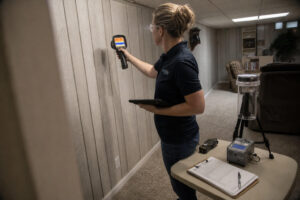
We systematically scan all suspect areas — and methodically work through adjacent and potentially affected areas — with a FLIR thermal imaging camera. The camera produces real-time infrared images showing surface temperature variation across the field of view. Wet building materials are typically cooler than dry surrounding surfaces due to evaporative cooling — the same physics that make wet skin feel cool. This temperature differential appears in the infrared image as a defined cold zone against the warmer background of dry material. Thermal imaging is particularly powerful for several common South Jordan mold scenarios:- Foundation seepage in pre-2000 construction: The expansive clay soils characteristic of the Lake Bonneville basin create chronic lateral pressure against basement foundations, gradually compromising cold joint seals. Moisture seeping through these joints wicks upward by capillary action into the drywall assembly above — often to 18 to 24 inches above the floor — while the floor surface shows no visible wetness. The thermal camera reveals the moisture extent on the wall face without destructive investigation.
- Ice dam attic intrusion in Wasatch Front construction: Ice dam formation on low-slope residential rooflines forces meltwater under roofing membranes into attic assemblies. The resulting moisture in oriented strand board sheathing and insulation appears as a pronounced cold zone on the underside of the attic floor when thermal imaging is conducted from the attic space. In homes where attic access is limited, thermal imaging of the ceiling surface from below can suggest moisture in the floor-ceiling assembly above even before the attic is accessed.
- Construction defect moisture intrusion in Daybreak: Improperly flashed window rough openings and missing kickout flashing at roof-to-wall intersections — defects documented in some Daybreak homes and other production-builder construction in South Jordan — allow chronic water intrusion into wall assemblies. The thermal image shows the moisture migration pathway from the intrusion point downward through the wall cavity, often extending well below the window frame where the entry point would suggest water should be confined.
- HVAC condensate overflows during North American Monsoon season: Condensate pan overflows from clogged drain lines during the humid July-through-September monsoon period deposit water into ceiling assemblies adjacent to air handler units. The thermal signature appears as a diffuse cold zone radiating from the air handler location in the ceiling surface below.
Calibrated Moisture Meter Assessment
Every thermal anomaly is followed by calibrated moisture meter readings at the point of maximum thermal contrast and at systematic intervals outward from that point. We use both non-invasive scanning meters — which measure the electrical impedance of a material at the surface without penetrating it — and calibrated penetrating meters that extend probes into the material to measure moisture content at specific depths. The readings are documented in a moisture map — a floor plan or elevation drawing showing the moisture content values at each measured point, with the material type and the corresponding dry standard for that material noted. A framing member reading 24% moisture content in a wall assembly with a dry standard of 12% to 16% is elevated by 8 to 12 percentage points above dry standard — providing an objective, quantified measure of the moisture condition that drives both scope determination and insurance documentation. Moisture readings also establish the drying baseline — the starting point against which daily monitoring readings during structural drying will be compared to confirm progress and eventual completion to dry standard. Learn more about our moisture detection services.Moisture Source Identification
Identifying where the moisture came from — and confirming that the source has been or can be corrected — is a required component of any mold inspection whose findings will be used to plan a remediation project. Remediating mold without correcting the moisture source produces recurrence. The moisture source also drives the insurance documentation, establishes the water damage category relevant to cleanup protocol, and determines what additional trades or contractors need to be involved before reconstruction begins. Common moisture sources we identify in South Jordan mold inspection projects include: hard water scale failure of supply line fittings from the Jordan Valley Water Conservancy District’s 7-to-10-grain-per-gallon supply; ice dam intrusion through the building envelope; chronic foundation seepage from expansive clay hydrostatic pressure; HVAC condensate overflow; construction defect building envelope intrusion; and previously undetected sewage backup events that left contaminated materials in place.Written Inspection Report
All inspection findings are documented in a written report provided to the property owner. The report includes: annotated thermal images of all identified anomalies with location descriptions; the moisture meter data table showing readings at all measured points with material type and dry standard comparisons; the moisture source assessment with supporting findings; the estimated mold colony extent based on the moisture boundary; and the recommended scope-of-remediation assessment based on the ANSI/IICRC S520 Standard criteria for material removal thresholds. This report is the document that drives everything downstream — the insurance claim, the remediation scope, the subcontractor coordination, and the clearance testing criteria. It is also the document that a real estate transaction party, a legal proceeding, or a medical evaluation may request if the mold situation has implications beyond the immediate property damage. We write it to be clear, specific, and defensible — not as a marketing document for the remediation work.Laboratory Testing — What We Do and Do Not Provide
True Day Water Damage Restoration provides the physical assessment and documentation described above. We do not conduct laboratory mold testing in-house — that work is performed by independent environmental testing professionals to maintain the separation between assessment, remediation, and verification that is an industry-standard best practice.Air Sampling — Spore Trap Method
Air sampling for mold uses a calibrated pump to draw a measured volume of air — typically 75 to 150 liters — through a spore trap cassette. The cassette captures airborne particles on a collection surface, which is then analyzed under light microscopy by a laboratory technician who identifies and counts mold spore types present in the sample. Results are expressed in spores per cubic meter of air, by species. Air sampling answers the question: what mold species are present in the air at this location and at what concentration? The result is compared against outdoor baseline samples taken simultaneously and against laboratory reference data for normal indoor background spore concentrations for the specific season. An indoor Stachybotrys chartarum air sample concentration significantly above outdoor background confirms active Stachybotrys colonization in the building and justifies enhanced remediation protocol decisions. The limitation of air sampling: Stachybotrys spores are released into air in low concentrations from undisturbed colonies — because the conidia are produced in a wet, mucilaginous mass that resists airborne distribution. An air sample in a building with a significant Stachybotrys wall cavity colony may show low Stachybotrys counts while showing elevated Aspergillus and Penicillium counts from the same or adjacent assemblies. Surface sampling provides complementary information.Surface Sampling — Tape Lift and Bulk Sampling
Surface sampling collects mold material directly from a suspect surface rather than from the air. A tape lift uses a piece of transparent adhesive tape pressed against the suspect surface — picking up spores and hyphal fragments — which is then examined under microscopy. Bulk sampling removes a small piece of the suspect material — a 1-to-2-inch section of drywall paper facing, a wood chip from a framing member — for direct laboratory analysis. Both methods provide direct species identification of mold present at a specific location. Surface sampling is more reliable than air sampling for identifying specific species present on specific materials — particularly for Stachybotrys, which does not disperse well into air but produces an identifiable colony surface that a tape lift captures directly. For post-remediation verification of Stachybotrys remediation specifically, we recommend that clearance testing include surface samples from structural framing within the remediated area in addition to air samples — because surface samples can detect residual spore deposits that air sampling may not capture at detectable levels.Mycotoxin Testing
In situations where confirmed Stachybotrys or other mycotoxin-producing mold is present and the homeowner or occupants are concerned about health effects from mycotoxin exposure, specialized mycotoxin testing of environmental samples can be coordinated. This testing uses enzyme-linked immunosorbent assay or mass spectrometry methods to detect specific mycotoxin compounds — including trichothecenes — in air and surface samples. This testing is more expensive than standard spore count analysis and is not routinely required for standard remediation scope determination — but it provides the most direct evidence of mycotoxin presence in the building environment when exposure-related health concerns are central to the assessment.Pre-Purchase Mold Inspections in South Jordan
South Jordan’s real estate market moves fast — and the construction and environmental characteristics of this specific community make pre-purchase mold and moisture assessment genuinely more valuable here than in many other markets. A standard home inspector’s visual inspection does not include thermal imaging moisture assessment. It does not include calibrated moisture metering. It does not assess whether the attic sheathing has undergone multiple seasons of ice dam intrusion. It does not assess whether the basement foundation wall assembly shows the chronic seepage pattern characteristic of the Lake Bonneville expansive clay soil conditions in the established South Jordan neighborhoods along the 10200 South corridor. It does not assess whether a Daybreak home’s wall assemblies show the thermal signature of construction defect moisture intrusion behind the finished surfaces. A homeowner who purchases a 2009-era Daybreak property with a confirmed construction defect moisture intrusion behind a west-facing wall — and who discovers Stachybotrys chartarum in that wall assembly 18 months after purchase — faces a remediation cost of $8,000 to $15,000 and a disclosure dispute with the seller that could have been avoided with a pre-purchase thermal imaging assessment that cost a fraction of that amount. We have been called to assess those situations after the fact. We would rather have been called before the purchase. Pre-purchase mold and moisture inspections include the full assessment protocol described above — thermal imaging of all exterior wall assemblies, attic, crawl space, and basement areas; calibrated moisture metering of all thermal anomalies; moisture source assessment; and a written report provided to the buyer, buyer’s agent, and real estate attorney as needed. The report documents what was found, what it means, and what the estimated remediation cost would be if the identified conditions require professional remediation — giving the buyer the information needed to negotiate, proceed, or withdraw.Post-Remediation Clearance Testing — Why Independence Matters
Post-remediation clearance testing verifies that the remediation achieved the standard required by the ANSI/IICRC S520 before reconstruction begins. The standard requires that spore counts and species profiles within the remediated area return to within normal background range — confirmed by laboratory analysis of air and surface samples collected after the physical remediation work is complete. The defining characteristic of valid clearance testing is independence: the testing must be conducted by a certified industrial hygienist who was not involved in performing the remediation and who has no financial relationship with the remediating contractor. This separation is an industry-standard best practice, expected by insurance carriers who are paying for remediation, required by many real estate disclosure standards, and fundamentally important for the credibility of the clearance result. A clearance test conducted by the same company that performed the remediation — or by a testing firm with a financial referral relationship to the remediating contractor — has an inherent conflict of interest. A contractor who discovers that their own remediation was incomplete faces financial and reputational consequences if the clearance test documents that fact. An independent third party has no such incentive to produce a passing result. We do not conduct our own clearance testing. We coordinate independent post-remediation clearance testing through certified industrial hygienists who operate completely separately from our company. We provide the testing party with the full documentation of our remediation work — the scope of materials removed, the areas treated, the drying verification data — and we make ourselves available to the testing party for any questions about the remediation that would help them assess the correct sampling locations. The clearance result is theirs to produce, not ours to influence. This approach occasionally produces a clearance result that identifies remaining issues requiring additional work. We address those issues and retest. The alternative — a clearance process that is structurally designed to produce passing results regardless of actual conditions — is one that we will not participate in, because it is the homeowner who lives in the space that the testing is supposed to protect.A Mold Inspection That Changed the Scope
In May 2022, we were contacted for a pre-remediation assessment by a homeowner in Riverton — a neighbor of South Jordan who had contacted us after seeing our response work in a Daybreak community Facebook group — who had received a quote from another contractor for removal of mold visible on a basement bathroom wall. The visible colony covered approximately six square feet of drywall at the base of the shower wall. The other contractor’s scope was six square feet of drywall removal, antimicrobial treatment, and replacement. Scope estimate: approximately $1,400. Our thermal imaging scan on arrival showed cold zones extending across the full 12-foot length of the bathroom’s exterior wall — not just the shower corner — and into the adjacent utility room wall, which was finished drywall on a framed wall system against the foundation. Calibrated moisture meter readings at 16 points showed framing readings ranging from 19% to 34% across the full exterior wall and into the utility room wall framing. The dry standard for this material in this climate zone is 12% to 16%. The visible six square feet of mold at the shower base was the fruiting surface of a colony whose mycelial network covered the paper facing of the drywall panel behind the tile — which we could not see — and had extended into the full exterior wall assembly along the path that the moisture seeping through a compromised cold joint had traveled. The Aspergillus and Penicillium colonization we confirmed through a tape lift covered an estimated 40 to 55 square feet of drywall paper facing, not six. The full remediation scope — based on the thermal and moisture data — was $5,200. The homeowner chose to proceed with the full scope rather than the original limited quote. Six weeks later, at the independent clearance test, spore counts in the basement were within normal background range. The homeowner called to tell us that she wished she had scheduled this inspection before getting any quotes at all — that the first quote would have left the majority of the mold in place, rebuilt a shower over it, and produced a recurrence claim within a year. That outcome — accurate scope from accurate assessment — is the value that professional inspection provides. It is not always a larger scope. Sometimes thermal imaging reveals that a homeowner’s concern about mold in a wall assembly is unfounded — that elevated surface moisture from a condensation event has resolved and the framing readings are within dry standard. That finding is also valuable. It saves the homeowner from unnecessary remediation cost and from the disruption of a project that was never actually needed.Frequently Asked Questions — Mold Inspection & Testing
What does a professional mold inspection include?
FLIR thermal imaging assessment of all suspect and adjacent areas; calibrated penetrating moisture meter readings at all thermal anomaly points; moisture source identification; written inspection report with annotated thermal images and moisture data; and scope-of-remediation assessment. We coordinate laboratory sampling through independent certified industrial hygienists whose findings are not influenced by their relationship to the remediating contractor. Learn more about our full mold remediation services.Why is a mold inspection important before buying a South Jordan home?
South Jordan’s specific risk factors — hard water supply line failures, Lake Bonneville expansive clay basement seepage, Wasatch Front ice dam attic intrusion, North American Monsoon HVAC condensate — mean that mold in this market is frequently hidden behind finished surfaces that show no sign at the time of standard visual inspection. Pre-purchase thermal imaging assessment identifies conditions a standard home inspection misses, at a fraction of the cost of remediation discovered after closing.What is post-remediation clearance testing and who should conduct it?
Air and surface sampling by an independent certified industrial hygienist — completely separate from the remediating contractor — to confirm that spore counts and species profiles have returned to normal background range, per ANSI/IICRC S520 criteria. We do not conduct our own clearance testing. We coordinate independent third-party testing because the independence of the verifying party is fundamental to the credibility of the result.Can mold testing tell me if my family has been exposed to mycotoxins?
Environmental testing confirms whether mycotoxin-producing species are present in the building environment. Specialized mycotoxin testing using enzyme-linked immunosorbent assay or mass spectrometry methods can detect specific compounds — including trichothecenes from Stachybotrys — in environmental samples. Whether your family has been exposed in a health-relevant sense requires medical assessment by a physician; environmental testing establishes whether the exposure conditions existed in the building.Related Services
- Mold Remediation
- Mold Removal
- Black Mold Removal
- Mold Prevention
- Moisture Detection
- Water Damage Restoration
- Basement Flooding Cleanup
- Air Scrubbing & HEPA Filtration
- Crawl Space Moisture Damage
- Attic Leaks
- Hidden Leaks
- Reconstruction & Repairs
- Insurance Claims Assistance
- Mold Remediation — South Jordan, UT
Schedule a Mold Inspection in South Jordan, UT
If you smell something you cannot find, if an inspector flagged moisture and you do not know what it means, if you have had water damage and want to confirm it was completely dried, or if you are buying a South Jordan home and want to know what the standard visual inspection did not assess — call us. The inspection either finds something and gives you actionable information, or it confirms that the situation is not what you feared. Either outcome is worth the assessment. True Day Water Damage Restoration 11268 S 2865 W, South Jordan, UT 84095 Phone: (385) 247-9359 Email: info@truedaywaterdamagerestoration.xyz Utah Contractor License: #960332-3505 IICRC Certified Firm ID: #927354-5258Suspected mold or a musty basement smell? Start here.
If you’re not in an active water emergency — the leak isn’t happening right now, there’s no standing water — you probably don’t need a dispatch. You need a diagnostic path. This is the one we use before quoting any mold scope.
1. Describe the smell and when it shows up
A musty basement smell that spikes with HVAC on usually points to the air handler or ductwork, not the walls. A smell that intensifies after rain points to foundation-side or crawl-space moisture. A smell that’s always there regardless of weather points to a long-term wet-material source behind drywall or under flooring.
2. Walk the usual suspects
Water heater pan, washer standpipe area, HVAC condensate drain, sump pump pit, crawl-space vapor barrier, bath-fan ductwork in attic above basement ceiling. 70% of “mystery” musty-basement smells trace to one of these six locations without any demolition.
3. Visual inspection with moisture meter
Before any air testing or sampling, our technician walks the suspected area with a penetrating moisture meter and a thermal camera. If we find wet material, we have a scope — testing confirms what the meter already told us. If we don’t find wet material, we move to Step 4.
4. Testing — only when it changes the answer
Air sampling (indoor + outdoor control) and surface sampling are useful in two specific situations: (a) a sale is pending and the buyer or lender is requiring documented clearance, or (b) a household member has a diagnosed respiratory issue that justifies species-level identification. For everyone else, testing without visible or detectable moisture rarely changes what we’d recommend.
The 4 inspection methods — what each one actually tells you
“Mold testing” is a catch-all for four very different techniques. Each one answers a different question. Here’s what each is for.
| Method | What it tells you | When we use it |
|---|---|---|
| Visual + moisture inspection | Where mold is visibly growing + where moisture conditions support growth | Always. First step on every job. |
| Air sampling (spore trap) | What’s airborne right now, compared to outdoor baseline | Suspect hidden growth or need pre/post remediation verification |
| Surface sampling (swab or tape lift) | What species a specific visible spot is | Confirming identity before remediation scope is written |
| Cavity sampling (wall-stud or inside wall) | What’s growing inside a wall cavity you can’t see from outside | Elevated outdoor-vs-indoor spore counts with no visible source |
What testing does NOT tell you
Testing doesn’t tell you whether YOU specifically will have a health reaction. Mold tolerance varies dramatically person-to-person. If you’re worried about health effects, we’ll do the inspection and provide results; a physician decides what the levels mean for you.
When testing is useful vs. a waste of money
Useful: Pre-purchase inspection of a home with history of water damage. Post-remediation verification that cleanup worked. Dispute with a landlord or seller requiring documentation.
Waste of money: You see visible mold on the wall. You already know you have mold — a lab test confirming it changes nothing about the remediation scope. Spend that money on the remediation instead.
Chain-of-custody mold testing — when it matters
Standard mold testing confirms what’s present. Chain-of-custody testing produces results that hold up in a dispute. If you’re in or anticipating a legal situation, this is the difference.
Standard testing vs. chain-of-custody
- Standard inspection and testing — samples collected, sent to lab, results returned to us or you. Appropriate for 95% of residential situations where the goal is “figure out what’s there and remediate.”
- Chain-of-custody testing — samples collected with specific documentation at each handoff: who collected, when, where, how, chain-of-custody form signed, shipped with tamper-evident seal to accredited lab, lab personnel verify unbroken seal before testing. Appropriate when results may be used as evidence in court or dispute.
Situations where chain-of-custody matters
- Landlord-tenant disputes where tenant is claiming uninhabitable conditions
- Real estate transaction disputes where buyer claims undisclosed mold at closing
- HOA common-element disputes where ownership of the source is contested
- Insurance claim denial where carrier disputes mold existence or source
- Health-exposure litigation where documented air quality becomes evidence
- Contractor malpractice claims after inadequate prior remediation
What’s involved on our side
- Independent third-party industrial hygienist or Certified Mold Assessor typically engaged
- We participate in sample collection as remediation contractor but don’t perform the testing ourselves (independence protects results)
- Documented protocols at every handoff
- Accredited lab (AIHA EMLAP) runs the samples
- Lab report delivered with chain-of-custody forms as supporting documentation
Cost + timeline
Chain-of-custody testing adds cost beyond standard inspection — typically 2-3x due to independent hygienist fees + accredited-lab turnaround. Timeline typically 1-2 weeks for results vs. 3-5 days for standard testing. Appropriate when the stakes justify it; overkill when they don’t.
Our honest take
Most homeowners don’t need chain-of-custody. If you’re not in or anticipating litigation, standard inspection serves you fine and costs less. If you ARE in that situation, we’ll coordinate with your attorney before testing so protocols meet the specific legal requirements of your case.
DIY mold test kits: what they tell you (and what they don’t)
Home-store DIY mold test kits are inexpensive and widely sold. They can give useful information in some situations, but they’re often misinterpreted. Here’s the honest comparison with a professional inspection — so you know when a kit is enough and when it isn’t.
| DIY mold test kit | Professional inspection | |
|---|---|---|
| What it does | Exposes a petri dish to air for a set time; mold spores land, grow if viable, and are visible after days or weeks | Visual inspection + moisture meter + thermal imaging + optional lab air sample (interior vs exterior comparison) + written report with recommendations |
| What it tells you | “Mold spores are in the air of this room” — which they always are, in every room, everywhere | Whether the spore count is elevated above outdoor baseline; whether visible growth is present; whether moisture conditions support ongoing growth |
| Baseline comparison | None — you can’t compare to outside air without a second control test | Outside control sample compared to inside sample; the comparison is the actual useful data |
| Species identification | Not reliable — the colony on the petri dish may not be the species that matters | Lab identification of specific species (if sampling); some species matter more than others |
| Moisture context | None — you don’t know if the condition that caused the mold is still active | Moisture meter readings on walls and floors; thermal camera scan; identification of ongoing source |
| Actionable output | “There’s mold” — but this is true everywhere; doesn’t tell you to do anything specific | Specific remediation plan with scope, timeline, and cost |
| Cost | $10-30 kit + optional $25-50 lab analysis | Free initial inspection from us; lab fee passed through only if an air sample is added |
When a DIY kit is enough
- You suspect mold but want a $20 confirmation before scheduling an inspection — a kit’s positive result justifies the inspection call
- You want to confirm a specific room smells “musty” vs just “old” — a kit will show the room
- You’ve already cleaned a visible area and want a general check of air quality — a kit with lab comparison can show if the area is back to baseline
When you need a professional inspection instead
- Visible growth more than 10 sq ft, or growth hidden behind drywall
- Health symptoms possibly tied to indoor air quality (respiratory, chronic)
- Pre-purchase home inspection follow-up — sellers’ disclosures of past water damage
- Insurance claim where documentation of condition matters
- Legal or dispute situation (sale of home, landlord-tenant)
- Pre- and post-remediation verification (clearance testing)
What we tell homeowners honestly
- If your DIY kit grew a colony and you have no visible growth, no musty smell, no moisture source, no health symptoms — it probably doesn’t warrant action beyond watching
- If the kit grew a colony AND you have a known water-damage history or visible growth — call us for an inspection to scope what’s actually there
- If you want to skip the kit and go straight to inspection, that’s reasonable too — the inspection is free
Buying a home: when a mold inspection is worth it + what to ask for
A standard home inspection catches some water-damage signs but doesn’t test for mold. If you’re buying a home and have specific reasons to be concerned, a dedicated mold inspection can be worthwhile. Here’s a buyer’s-perspective guide:
- Standard home inspection flagged visible moisture staining or past water damage
- Seller’s disclosure mentions past water losses (even if remediated)
- The home has been vacant for extended period; HVAC off; windows closed
- Musty smell detected during walk-through
- You or a family member has respiratory sensitivity or history of mold exposure
- Finished basement in older home with no documentation of past moisture handling
- Home with signs of previous insurance claims (ceiling patches, flooring replacement that doesn’t match adjacent rooms)
When it’s probably not needed
- Standard home inspection shows no moisture signs and no history disclosed
- Newer construction (under 5 years) with no visible issues
- No musty smell; no respiratory concerns in household
- Prior sellers have documented restoration work with moisture logs
What a thorough pre-purchase mold inspection includes
- Visual inspection of accessible areas (not just visible-mold-only; moisture signs, past-stains, suspicious ceiling patches)
- Moisture-meter readings at key points: around appliances, under windows, in basements, in bathrooms, at HVAC return
- Thermal imaging to flag hidden-moisture suspect areas
- Attic and crawlspace inspection with specific attention to insulation condition
- Air sample(s) if visual + instrument findings suggest further verification is useful — sent to independent accredited lab
- Written report with specific findings, locations, recommendations
What to ask for before hiring an inspector
- Independence: the inspector shouldn’t also be the remediation contractor (conflict of interest)
- Credentials: IICRC AMRT certification is relevant; some states require specific mold-inspector licensing (Utah does not require it specifically)
- Written report with photos and specific locations — not just a verbal opinion
- Lab accreditation for any samples taken (NVLAP or AIHA accreditation is the standard)
- Cost: our visual and moisture inspection is free; if lab air samples are needed, the lab fee is passed through and we tell you before any sample is taken
What we can and can’t do here
- We CAN provide an independent pre-purchase inspection as a stand-alone service — we’re IICRC AMRT certified at the firm level and techs
- We WILL be clear about our dual role: if we also become the remediator, we disclose that upfront and the inspection work has to stand on its own evidence
- Alternative: we can refer you to an independent home inspector who specializes in mold; sometimes an unaffiliated inspector is cleaner for a sale negotiation
How findings affect your purchase decision
- Visible or hidden mold confirmed: cost estimate for remediation; buyer can request seller remediate before closing, credit at closing, or pass on the house
- Prior remediation documented and verified clean: typically acceptable; the paper trail is the reassurance
- Moisture readings elevated but no mold: potential ongoing issue; investigation of source needed before closing
- No mold, no elevated moisture, no concerning history: proceed with normal closing
If you’re a buyer considering a home with any of the triggers above, a free inspection costs nothing, and finding hidden mold before closing can save far more. Call us for a scoped inspection or we’ll refer to an independent inspector.
Mold documentation for a real-estate transaction (what agents + sellers + buyers need)
Mold-related documentation during a home sale is one of the places where the paperwork matters as much as the physical condition. Here’s what each party in a transaction typically needs:
- Utah disclosure form requires you to disclose known past water damage and mold — honesty + documentation protects you from post-sale disputes
- If you’ve had a prior remediation: completion documentation (moisture log + before/after + post-remediation verification if lab testing was done)
- If you’ve had water damage but no mold concern: completion documentation showing materials returned to dry standard
- If a buyer requests an inspection and finds something: offer to remediate before closing OR credit buyer at closing OR renegotiate
- Review seller’s disclosure for past water-damage events
- Request documentation of past remediation if disclosed
- Consider an independent mold inspection if (a) seller disclosed water damage, (b) visible signs during walkthrough, or (c) musty smell detected
- Written mold inspection report + lab results (if sampled) — part of your closing file
- Help your client understand what disclosure obligations are
- Know a few local mold-inspection providers you trust — agents’ recommendations carry weight
- Avoid recommending the same company that does both inspection AND remediation unless the dual role is disclosed to buyer
- Help structure negotiations when mold is found (remediation vs credit vs renegotiation)
What makes a defensible mold-inspection report for transaction purposes
- Named licensed inspector or firm with verifiable credentials (IICRC AMRT firm cert or equivalent)
- Visual + moisture + thermal + lab air sample methodology clearly explained
- Specific locations identified with photos and readings
- Baseline (outdoor control) sample for air comparison
- Lab accreditation (NVLAP or AIHA) on any lab reports
- Written conclusions with explicit scope of what the inspection covered + didn’t
- Recommendations clearly separated from findings
What makes a weak mold report
- Visual inspection only without moisture or lab verification
- “Mold detected” without species identification or quantification
- No baseline/control sample for comparison
- Recommendations drive a specific contractor’s scope (conflict of interest)
- No clear scope of inspection coverage
Our role in real-estate transactions
- We provide inspection services as a stand-alone scope (we’re IICRC AMRT firm)
- If we inspect and also become the remediator, we disclose that upfront so you understand the dual role
- Alternative: we refer to an independent inspector for transaction cases where cleaner separation serves the sale
- Common practice: independent inspector + us as remediator if remediation is needed
Common patterns in SJ-area transactions
- Finished basement in older home — buyer requests moisture inspection even without disclosure trigger
- Home with recent water-damage event that’s documented — buyer verifies drying was complete
- Home with musty smell — inspection often reveals hidden-moisture issue even if no visible mold
- Home where seller disputes a disclosure — inspection becomes evidence either way
Timeline for inspection + remediation in a transaction
- Inspection: typically 1 day on-site; written report 2-5 days after
- If lab air samples: 5-10 business days for lab turnaround
- Remediation (if needed): 3-10 days typical; longer for larger scope
- Closing timing: usually 10-30 days from inspection to close; sellers may extend close date to complete remediation
Mold inspection vs mold testing — what each one actually gives you
Mold inspection and mold testing are two different services with two different outputs. Confusing them is why some homeowners pay for both when they only needed one. Here is the honest difference:
| Service | What you get | What it costs | When it’s worth it |
|---|---|---|---|
| Visual inspection + instruments | Walkthrough by a trained technician, moisture-meter readings, thermal camera scan, written assessment with findings and recommended scope | $0 — included free | Starting point for every call |
| Surface swab sampling | Species identification of visible growth; confirms it’s mold vs staining, deposit, or other | Lab fee pass-through | Visible growth where species matters (sensitive occupants, real-estate transaction) |
| Air sampling + outdoor baseline | Spore counts inside affected area vs outdoor reference, same day; indicates airborne contamination | Lab fee pass-through for both samples | Hidden-growth suspicion, pre-remediation baseline, or buyer-requested |
| Post-remediation verification (PRV) | Independent third-party clearance letter; confirms the remediation worked | IEP fee; True Day pays it on jobs over $5,000 — the tester still reports results to you directly and independently | Any mold job over $5,000 or pre-sale clearance |
| Full species panel (ERMI/HERTSMI) | DNA-based panel of 36+ mold species, scored environmental relative moldiness | Lab fee pass-through (higher than air sample) | Rarely needed for restoration purposes; sometimes requested by sensitive individuals |
What testing does not do: tell you whether a specific person will react to the mold identified. That’s a medical question, not a lab question. If you suspect your symptoms are mold-related, the sequence is: visit a doctor, confirm the medical concern, then test to see what’s in the environment. Running the lab panel first and interpreting it as a medical answer is a common and expensive mistake.
Our recommendation on any first call: start with the free inspection. If it tells us the next step is testing, we tell you which test and what it will and won’t answer before you authorize it.
When mold testing is wasted money — the honest version
The mold-testing industry has a strong incentive to test. Testing a lot of things that didn’t need testing is how some firms pad invoices. Here are the scenarios where testing is unlikely to help you — and we’ll tell you so on the inspection visit:
The question we ask before authorizing any lab test: “If this comes back positive, what will we do differently? If it comes back negative, what will we do differently?” If the answer to both is “nothing,” skip the test.
ERMI and HERTSMI — what the panels test and what they don’t
ERMI (Environmental Relative Moldiness Index) and HERTSMI-2 (its screening subset) are mold DNA panels you may have seen offered online. Here’s what they actually do, in plain terms:
DIY mold test kits — what they do and don’t do
$10-$40 mold test kits are sold at hardware stores and online. Here’s the honest take on what each type actually measures:
How to prepare for your mold inspection visit
A little preparation makes the visit faster and the findings more accurate.
Have ready:
- A rough timeline of past water events, leaks, or repairs in the area.
- Any photos you took when you first noticed the problem.
- Where you notice smell, and when it is strongest (morning, after rain, when the HVAC runs).
- Your homeowner’s policy details, if an insurance claim is possible.
Make accessible:
- Attic hatch, crawlspace entry, furnace or air-handler closet.
- Under-sink cabinets and the space behind the washer and refrigerator, if movable.
Please don’t, before we arrive:
- Bleach or scrub the area — it hides the growth pattern we need to see.
- Run a DIY test kit expecting it to settle the question.
- Change how you run the HVAC — normal conditions give honest readings.
What we bring: FLIR thermal cameras to find cold, wet areas behind surfaces, and GE Protimeter moisture meters to confirm them. You get a plain-language explanation of what we found and whether lab testing is warranted at all.
Before and after samples — how to read the comparison
If your job included sampling before work and again after, here is what a good result looks like.
Mold sample types — what each one answers
Different samples answer different questions. Choosing the right one avoids paying for information that will not change the decision.
| Sample | Answers | Limits |
|---|---|---|
| Air sample (with outdoor baseline) | Are indoor spore levels elevated compared to outside? | A snapshot of one moment; does not locate the source |
| Tape-lift | Is this visible spot actually mold, and what kind? | Only tells you about the spot sampled |
| Swab | Same as tape-lift, for textured or irregular surfaces | Only tells you about the spot sampled |
| Bulk (piece of material) | Is growth inside this material, not just on it? | Requires removing a piece |
| ERMI dust | A broad index of mold types in settled dust | Informational; not a clearance test |
Often no sample is needed: visible growth with a known moisture source is already a remediation scope. When sampling will help, we say which type and why, and lab fees are quoted at the lab’s cost.
How to read a mold air-sample lab report
Spore-trap reports look technical, but a few fields carry most of the meaning.
We walk through every report with you in plain language before any decision is made.