
Preventing mold after water damage: the key is drying fast and drying completely. True Day dries to the IICRC S500 standard and confirms with moisture-meter readings, not guesswork, so hidden moisture doesn’t feed mold later. Live-answered 24/7 from South Jordan, UT.
Mold Prevention for South Jordan Homes
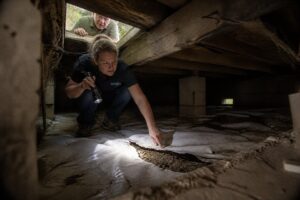
Mold prevention is not a product you apply. It is not a spray, a coating, a candle, or a bag of crystals sold at a hardware store. It is a condition you maintain — specifically, the condition of keeping building materials consistently below the moisture threshold at which mold spores can germinate, establish hyphae, and form a colony.
That condition is more difficult to maintain in South Jordan than in many other communities — not because South Jordan homeowners are less diligent, but because the local variables that drive moisture intrusion are specific, persistent, and not always obvious from inside the home. The hard water supplied by the Jordan Valley Water Conservancy District accelerates supply line failures. The expansive clay soils deposited by ancient Lake Bonneville create seasonal hydrostatic pressure against basement foundations. The Wasatch Front’s freeze-thaw cycles produce ice dam conditions on residential roofs. The North American Monsoon pattern spikes outdoor relative humidity from July through September in ways that overwhelm HVAC condensate systems designed for the dry conditions that prevail the rest of the year.
Understanding those specific variables — and building a prevention strategy around them — is what separates effective mold prevention from generic advice that does not account for where you actually live.
True Day Water Damage Restoration is a licensed Utah Contractor (#960332-3505) and IICRC-Certified Firm (ID #927354-5258), based at 11268 S 2865 W in South Jordan. We provide post-remediation moisture source correction documentation and mold prevention guidance as a standard component of every remediation project — because mold removal without moisture control produces recurrence.
Call us at (385) 247-9359.
The Physics of Mold Growth — Why Humidity Is the Variable That Matters
Mold spores are present in virtually every indoor environment on earth at low background concentrations. The question is not whether spores are present — they always are — but whether the moisture conditions in the building allow them to germinate. Preventing mold means controlling those moisture conditions.
The critical threshold is not the presence of standing water or visible wetness. It is the equilibrium relative humidity of the air in contact with building materials. When the relative humidity of the air adjacent to a porous building material — drywall paper facing, wood framing, insulation — exceeds approximately 70% for a sustained period, the material’s surface moisture content rises to the level at which mold spore germination becomes possible. At 80% relative humidity sustained over days, germination is probable on susceptible cellulose-based substrates. At 90% and above, mold amplification — the rapid proliferation of an established colony — can occur within 24 to 48 hours.
This means that mold prevention is fundamentally about maintaining indoor relative humidity below the germination threshold — not about killing spores that are already present, not about coating surfaces, and not about improving air circulation alone. Air circulation without dehumidification does not lower relative humidity; it distributes it. The intervention that actually prevents mold germination is removing water vapor from the air — through mechanical dehumidification, through improved building envelope sealing that reduces vapor infiltration, or through correction of the moisture sources that are introducing water vapor into the structure.
In South Jordan’s climate, the challenge is that maintaining indoor relative humidity below 60% — the generally accepted threshold below which mold cannot germinate on most building materials — requires different interventions in different seasons. The dry winter and spring months present minimal risk in above-grade living spaces under normal conditions. The North American Monsoon season from July through September introduces sustained elevated outdoor relative humidity that demands active mechanical dehumidification. And the basement and crawl space environments present year-round moisture challenges driven by the region’s soil and groundwater conditions regardless of outdoor seasonal humidity.
The South Jordan Moisture Risk Calendar
Mold prevention in South Jordan requires a seasonal awareness that generic national advice does not provide. The risk factors are predictable, they recur annually, and knowing when to act prevents the conditions that make remediation necessary.
January and February — Freeze-Thaw Pipe Failure and Ice Dam Season
The Wasatch Front’s most dangerous mold-precursor period is not summer — it is the freeze-thaw cycling of January and February, when overnight lows drop well below freezing and daytime temperatures recover above 32°F. Two specific risks concentrate in this window.
First: pipe failure from thermal stress combined with hard water mineral scale. Supply lines — washing machine hoses, ice maker connections, water heater inlet valves — that have been progressively weakened by calcium carbonate and magnesium carbonate scale from the Jordan Valley Water Conservancy District’s hard water supply at 7 to 10 grains per gallon are most likely to fail during sustained cold snaps. The thermal contraction of the metal fitting combined with the internal scale deposits that have been narrowing the wall thickness for years produces a sudden fracture. A supply line that fails on a Saturday afternoon in a finished basement — unoccupied until Monday — has 36 to 48 hours to soak oriented strand board subfloor, saturate drywall, and create the wet cellulose conditions in which Aspergillus and Penicillium germinate within the next 24 hours.
Prevention: Inspect all braided stainless and rubber supply lines — particularly washing machine hoses and water heater connections — annually. Replace rubber hoses on a five-to-seven-year schedule regardless of apparent condition. Consider installing auto-shutoff valves at washing machine supply connections. Know where your main water shutoff is and confirm it operates freely before each winter season.
Second: ice dam formation on low-slope and flat residential rooflines. Ice dams occur when heat loss through an inadequately insulated attic floor warms the roof deck, melting overlying snow — and the resulting meltwater refreezes at the cold roof edge where no heat escapes from below. The ice dam accumulates, meltwater pools behind it, and eventually forces its way under the roofing membrane into the attic assembly. Cladosporium on the underside of oriented strand board roof sheathing and Penicillium on insulation surfaces develop through repeated seasonal intrusion that goes undetected until the colony covers large sections of the attic decking.
Prevention: Ensure attic floor insulation meets current energy code for your climate zone — R-49 is the current International Energy Conservation Code recommendation for this region. Confirm attic ventilation is adequate and unobstructed. Inspect attic decking after each heavy snow event during the January-February period. Address any ice dam formation with professional ice dam removal rather than mechanical chipping that can damage roofing membranes. Learn more about attic leak damage.
March Through June — Snowmelt Hydrostatic Pressure Season
Spring snowmelt from the Oquirrh Mountains and Wasatch Range saturates the Salt Lake Valley’s expansive clay soils over a period of weeks, progressively elevating the groundwater table and increasing the hydrostatic pressure against basement foundation walls. Homes in South Jordan neighborhoods with documented elevated water tables — particularly in the 11400 South and 1300 West corridors near the Jordan River basin — experience peak basement seepage risk during April and May in high-snowpack years.
Hydrostatic pressure — the lateral force of water-saturated soil against a concrete or masonry foundation — forces water through hairline cracks, cold joint seals, and the interface between the foundation wall and floor slab. The resulting moisture entry is often too slow to produce visible standing water but sufficient to maintain basement relative humidity above the mold germination threshold. The Cladosporium and Aspergillus that colonize stored cardboard, wood shelving, and drywall paper facing in South Jordan basements frequently establish during this spring pressure window rather than during dramatic flooding events.
Prevention: Test sump pumps before the April melt begins — run the pump manually to confirm operation, inspect the discharge line for winter obstructions, and consider installing a battery backup system for pump operation during power outages that frequently accompany storm events. Inspect foundation walls for new hairline cracks or seepage traces that developed over the winter. Maintain basement relative humidity below 60% with a dedicated commercial dehumidifier sized for the basement volume. Learn more about our basement flooding cleanup services.
July Through September — North American Monsoon Season
The North American Monsoon pattern — the seasonal moisture flow from the Gulf of California and Gulf of Mexico that brings intense convective storms to the interior Southwest and Intermountain West from early July through mid-September — transforms South Jordan’s outdoor relative humidity from the 15% to 30% range typical in June to 50% to 70% or higher during active monsoon periods. This change happens abruptly, often within days of the monsoon onset, and catches building systems that have been operating in dry conditions entirely unprepared.
The primary mold risk during the monsoon season is not from outdoor flooding — it is from two indoor humidity-driven mechanisms. First, HVAC condensate drain lines that have been adequate for spring moisture loads become overwhelmed during sustained high-humidity periods, causing condensate pan overflows that discharge water into ceiling assemblies adjacent to air handler units. Aspergillus and Penicillium on saturated ceiling drywall and the framing above it are the predictable consequence. Second, the elevated outdoor dew point temperature during monsoon periods means that infiltration air entering the building through gaps in the building envelope introduces moisture that condenses on cooler interior surfaces — window frames, exterior wall assemblies, and the surfaces of underground structures like basements and crawl spaces where soil temperature keeps surfaces below the outdoor dew point.
Prevention: Service HVAC condensate drain lines — flush, clear any partial blockages, and confirm free drainage — before the monsoon season begins in early July. Consider installing a condensate overflow pan sensor with automatic shutoff. Monitor basement and crawl space relative humidity continuously through the monsoon period with a calibrated hygrometer, adjusting dehumidifier operation as outdoor conditions change. Seal building envelope penetrations — gaps around pipe entries, electrical conduit, window rough openings, and rim joist areas — that allow outdoor moisture-laden air infiltration. Learn more about our crawl space moisture services.
October Through December — Construction Defect and Hidden Leak Discovery Season
Autumn is when many South Jordan homeowners discover mold problems that developed during the preceding seasons. The cooling temperatures trigger increased heating system operation, which changes the building’s pressure dynamics and thermal gradients — sometimes revealing moisture sources that were producing mold growth invisibly through the summer. The smell that was absent in June becomes noticeable in October when the furnace runs for the first time. The ceiling stain that appeared faintly in September becomes obvious by November.
This is also the season when construction-defect moisture intrusion from improperly flashed window rough openings and roof-to-wall intersections — the type of slow, chronic intrusion documented in some Daybreak homes and in other South Jordan production-builder construction — becomes visible. Meltwater and rain events in October and November saturate inadequately flashed assemblies that have been accumulating moisture throughout the year, and the visible staining that finally breaks through the finished surface represents months or years of hidden mold growth in the wall cavity behind it.
Prevention: Conduct an annual post-summer inspection of all exterior wall assemblies — looking for new staining around window frames, soft spots in siding, or discoloration at roof-to-wall intersections. Inspect attic decking in October before the snow season begins. Have any new musty odors in the home professionally assessed with thermal imaging before attributing them to a cause you cannot confirm. Learn more about our mold inspection and testing services.
Moisture Control Strategies by Building Location
Above-Grade Living Spaces
The primary mold risk in above-grade South Jordan living spaces is appliance-failure water damage that is not immediately detected or not completely dried. The prevention strategy has two components: reducing failure probability and reducing detection delay.
Failure probability is reduced by a supply line inspection and replacement schedule informed by the hard water conditions of this specific supply system. A braided stainless washing machine supply hose that might last ten years on a soft water system in a coastal market may have an effective safe service life of five to seven years in South Jordan — because calcium carbonate scale is attacking the compression fittings from the inside in a way that external inspection cannot detect. Knowing this and replacing on a schedule rather than waiting for failure is the single most effective mold prevention measure for above-grade spaces in South Jordan residential construction.
Detection delay is reduced by smart leak detection devices — small sensors placed under washing machines, dishwashers, water heaters, and refrigerators that trigger an audible and phone alert within minutes of water contact. For homeowners who travel frequently or who have finished basements below second-floor bathrooms, these devices provide the detection speed that can mean the difference between a dried-in-place event and a full remediation project.
Basements
South Jordan basement mold prevention requires addressing two distinct moisture pathways simultaneously — internal plumbing-related moisture events, and chronic external moisture from the surrounding soil and groundwater.
For the chronic external pathway, the intervention depends on the mechanism. Foundation wall seepage through hairline cracks in poured concrete requires crack injection with polyurethane or epoxy sealant, followed by surface waterproofing treatment on the interior face of the wall. Cold joint seepage at the wall-to-slab interface may require interior drain tile — a French drain system installed at the perimeter of the basement floor to collect and redirect seeping groundwater to a sump pit rather than allowing it to saturate the floor assembly. Both interventions should be paired with a properly sized and maintained mechanical dehumidifier to manage residual vapor transmission through the foundation assembly that no waterproofing treatment eliminates completely.
The sizing of a basement dehumidifier matters more than most homeowners realize. A unit rated for 50 pints per day may be adequate in a tight, well-sealed basement with minimal vapor transmission. The same unit may be substantially undersized for a basement with chronic foundation seepage, unencapsulated floor penetrations, and high soil vapor pressure from the region’s expansive clay soils. Undersized dehumidification holds humidity below the catastrophic failure threshold but not consistently below the mold germination threshold — producing the slow, chronic Aspergillus and Cladosporium colonization of stored materials and wall paper facing that we encounter regularly in established South Jordan neighborhoods. Learn more about our dehumidification services.
Crawl Spaces
The crawl space is the most consistently underaddressed moisture environment in South Jordan residential construction, and it is frequently the primary source of the musty odors that homeowners attribute to basements, HVAC systems, or unidentifiable causes.
An unencapsulated dirt-floor crawl space — which represents a significant portion of South Jordan’s pre-2000 housing stock — allows direct soil vapor evaporation into the crawl space air. The evaporation rate is a function of the soil’s moisture content — which, in South Jordan, is driven by the same expansive clay conditions, seasonal groundwater fluctuations, and hydrostatic pressure from snowmelt that affect basements. The resulting elevated crawl space relative humidity produces Cladosporium, Penicillium, and Chaetomium growth on floor joists, rim joists, and the kraft-faced insulation batts attached to the subfloor above. This mold distributes spores and microbial volatile organic compounds to the living space above through the stack effect — the tendency of air to flow upward through a structure from lower to upper levels — regardless of whether the crawl space hatch is kept closed.
Crawl space encapsulation — the installation of a continuous vapor retarder, typically 10 to 20 mil reinforced polyethylene, across the crawl space floor and up the foundation walls — is the most effective intervention for homes with soil vapor as the primary moisture source. A properly installed encapsulation system reduces crawl space relative humidity dramatically, interrupts the moisture supply to existing mold colonies, and — combined with a dedicated crawl space dehumidifier — maintains conditions below the mold germination threshold year-round. The investment in encapsulation is substantially less than a crawl space mold remediation project, and it eliminates the recurrence that makes remediation without encapsulation a temporary solution. Learn more about our crawl space moisture services.
Attics
Attic mold prevention in South Jordan is primarily about managing two conditions: heat loss through the attic floor that produces ice dam formation, and ventilation adequacy that allows moisture-laden air to escape the attic assembly before it reaches the dew point on cold roof sheathing surfaces.
Attic condensation — distinct from ice dam intrusion — occurs when warm, moisture-laden air from the living space below infiltrates the attic through ceiling penetrations and deposits moisture on cold roof sheathing. This is a wintertime phenomenon that produces the same Cladosporium and Penicillium colonization on oriented strand board roof decking as ice dam intrusion, but from a different mechanism. Air sealing of ceiling penetrations — lighting fixtures, plumbing stacks, HVAC equipment, attic hatch perimeters — reduces the volume of warm air entering the attic and reduces the condensation risk proportionally. Adequate soffit-to-ridge ventilation allows winter moisture to escape the attic before accumulating on cold surfaces.
The post-monsoon season attic inspection — checking decking for dark staining on the underside that indicates condensation or intrusion — is among the most cost-effective mold prevention practices for South Jordan homeowners with any concern about attic assembly moisture. The Cladosporium that develops through two or three winter cycles before being discovered is far more expensive to remediate than the ice dam removal or air sealing intervention that would have prevented it. Learn more about attic leak damage.
Post-Remediation Mold Prevention — What We Provide
Following every mold remediation project we complete, we provide the homeowner with a written moisture source assessment and prevention recommendation document — specific to the moisture source that caused the original event, the construction characteristics of the specific home, and the neighborhood-level risk factors we have observed from our project history in that part of South Jordan.
This document is not a generic checklist. A homeowner in Daybreak whose event was caused by a hard water supply line failure gets different recommendations than a homeowner near the Jordan River corridor whose event was caused by chronic foundation seepage. The prevention strategy for an ice dam attic event in a 2019 craftsman home is different from the strategy for a crawl space vapor transmission event in a 1994 split-entry.
Where our assessment indicates that specific physical interventions are warranted — crawl space encapsulation, vapor retarder installation, foundation crack injection, improved attic air sealing — we provide referrals to appropriate contractors and, where the work falls within our licensed general contractor scope, can incorporate those measures into the reconstruction phase of the project.
The goal is a property that does not come back to us for a second remediation of the same underlying moisture source. That outcome is better for the homeowner and — frankly — reflects better on our work than a remediation that is technically excellent but fails to address why the mold was there in the first place.
A Prevention Conversation We Have Regularly
The most common prevention conversation we have is with homeowners who have just completed a remediation and want to know what to do differently. The answer depends entirely on the cause — and we have learned to be specific rather than generic.
For the Daybreak homeowner whose washing machine supply hose failed after nine years on a hard water system: replace all appliance supply lines on a five-year schedule rather than waiting for failure, install smart leak sensors under all appliances, and consider an automatic water shutoff device on the main supply line that can be triggered remotely. The Jordan Valley Water Conservancy District’s water chemistry is not going to change. The failure rate of unmanaged supply lines in this supply system is predictable. Managing it proactively costs far less than a second remediation.
For the homeowner near 11400 South whose basement drywall showed Aspergillus colonization from chronic seepage through a cold joint: the remediation addressed the mold. The cold joint is still there. Interior drain tile at the perimeter of the slab, combined with a commercial dehumidifier sized for the vapor load, is the intervention that converts the basement from a recurring mold environment to a controlled one. Without it, we will likely be back.
For the homeowner with a dirt-floor crawl space in the pre-2000 stock west of Bangerter Highway: the floor joists have Cladosporium and the living space above has been receiving those spores through the stack effect for years. Encapsulation is the answer. Not a dehumidifier sitting on a dirt floor — an encapsulated vapor retarder system with a dedicated dehumidifier on top of it.
These are not complicated messages. They are specific ones — and specificity is the difference between prevention guidance that works and prevention guidance that gets ignored because it does not clearly apply to the actual situation.
Frequently Asked Questions — Mold Prevention
What indoor humidity level prevents mold in South Jordan homes?
Below 60% relative humidity consistently inhibits mold germination on most building materials. The optimal target range for both mold prevention and occupant comfort is 30% to 50%. In South Jordan, maintaining this level requires active mechanical dehumidification during the North American Monsoon season — July through September — when outdoor relative humidity spikes significantly. Basement and crawl space spaces typically require dedicated dehumidification units year-round regardless of seasonal outdoor conditions.
How do I prevent mold from returning after remediation?
By correcting the moisture source that enabled the original colony and maintaining indoor relative humidity below the germination threshold. The specific measures depend on the cause: hard water supply line replacement schedules for appliance-failure events, foundation crack injection and drainage correction for seepage events, attic insulation and ventilation improvements for ice dam events. True Day provides specific post-remediation recommendations for every project. Learn more about our full mold remediation services.
Do I need a dehumidifier in my South Jordan basement?
Many South Jordan basements benefit from dedicated dehumidification — particularly those with any moisture history, those in neighborhoods near the Jordan River corridor with elevated water tables, and those with unencapsulated crawl spaces below them. The question is whether structural materials are consistently held below the mold germination humidity threshold. Sizing matters — an undersized unit maintains humidity below catastrophic failure level but not consistently below germination level, producing the slow chronic mold colonization we encounter regularly in established neighborhoods.
What is crawl space encapsulation and does my South Jordan home need it?
A continuous vapor retarder — typically 10 to 20 mil reinforced polyethylene — installed across the crawl space floor and up foundation walls to prevent soil vapor from entering the crawl space air. Homes with unencapsulated dirt-floor crawl spaces in South Jordan’s expansive clay soil conditions benefit significantly. The investment is substantially less than crawl space mold remediation and eliminates the moisture source that makes remediation-only approaches temporary. Learn more about our crawl space moisture services.
Related Services
- Mold Remediation
- Mold Removal
- Mold Inspection & Testing
- Black Mold Removal
- Water Damage Restoration
- Moisture Detection
- Structural Drying
- Dehumidification
- Basement Flooding Cleanup
- Crawl Space Moisture Damage
- Attic Leaks
- Hidden Leaks
- Insurance Claims Assistance
- Reconstruction & Repairs
- Mold Remediation — South Jordan, UT
Contact True Day for Mold Prevention Guidance in South Jordan, UT
If you have recently completed a remediation project — with us or with another contractor — and want specific, locally informed guidance on what to do differently, call us. If you have had recurring mold in the same area and want to understand why, call us. If you want a moisture assessment before a mold problem develops, call us. Prevention conversations cost far less than remediation ones.
True Day Water Damage Restoration
11268 S 2865 W, South Jordan, UT 84095
Phone: (385) 247-9359
Email: info@truedaywaterdamagerestoration.xyz
Utah Contractor License: #960332-3505
IICRC Certified Firm ID: #927354-5258
Mold prevention is water-source prevention — and South Jordan has four of them
Mold doesn’t appear out of nowhere. It needs persistent moisture (14+ days) and a cellulose food source. Prevent one of those two and you prevent the mold. Below are the four moisture sources we see most in South Jordan homes and the specific preventive action matched to each.
1. Plumbing supply lines
Why it matters here: SJ’s hard water (JVWCD) accelerates mineral deposit on copper and galvanized lines, weakening joints. Older Daybreak and Oquirrh Park homes with 2000s-era PEX manifolds also develop fitting failures over time.
- Check under every sink and behind every toilet twice a year — stains, flex-line corrosion, bubbled flooring.
- Replace rubber washing-machine supply hoses with steel braided every 5–7 years. Rubber fails without warning.
- Flush your water heater annually to remove sediment that accelerates tank failure — the single highest-dollar water loss we respond to.
2. Roof and exterior envelope
Why it matters here: Utah’s freeze-thaw cycle breaks sealant on flashing and vent boots. Hail events damage flashings without visibly damaging shingles — the leak reveals weeks later.
- Visual roof check after every hail event, not just annually.
- Clear gutters twice a year — after fall leaf drop and after spring blossom debris.
- Caulk around vent boots, chimney flashing, and skylights every 2–3 years.
3. Foundation and basement
Why it matters here: Bonneville clay around most SJ foundations drains laterally, not vertically. Jordan River water table rises seasonally. Finished basements multiply the mold risk because the materials are inside the moisture window.
- Grade should slope 6 inches down over the first 10 feet away from the foundation. Add soil if it’s flat or reversed.
- Extend downspout discharge at least 6 feet from the foundation — a 2-foot splash block isn’t enough on clay soil.
- Check your sump pump every spring before snowmelt. Run a bucket of water through it to confirm the float trips.
4. HVAC and interior humidity
Why it matters here: Utah’s dry air is the ally, but AC condensate pans and humidifier reservoirs are chronic hidden sources. HVAC return chases also move cold air into warm cavities, producing condensation.
- Keep indoor relative humidity between 30% and 50%. Below 30 cracks wood; above 50 feeds mold.
- Check the AC condensate drain pan every June — algae clogs it, water backs up through the attic chase.
- Clean or replace humidifier reservoirs monthly during winter use. Standing water in them is a continuous spore source.
Utah seasonal mold-prevention calendar
Four distinct seasonal windows in the Salt Lake Valley each drive specific mold-conditions. Here’s what to do in each.
March-May (spring snowmelt)
| Highest-risk period for basement intrusion and crawlspace moisture. Check: window-well drainage, sump-pump function, basement walls for new seepage, crawlspace vapor barrier integrity. Run basement dehumidifier if humidity > 60%. Address visible moisture before conditions warm into mold-growth range (above about 70°F). |
June-August (summer thunderstorms + irrigation)
| Check: irrigation system for leaks against foundation, roof flashing (summer hail), AC condensate drain. Keep HVAC running — occupied-home humidity should stay 30-50% RH. Watch for musty smell as early warning (bathroom exhaust fans + kitchen ventilation during cooking). |
September-November (fall pre-freeze)
| Primary prevention window. Disconnect outdoor hoses + drain lines. Insulate exposed supply lines in crawl/attic/garage. Clean gutters + downspouts (direct water away from foundation). Have HVAC serviced. Pre-fall basement + crawl inspection on our Protection Plan. |
December-February (freeze cycle)
| Watch: pipe-freeze events (biggest January-February risk). If you leave for extended travel, set thermostat 55°F minimum, drip faucets if going below freezing, consider shutting water main. Watch for ice damming on roof. First symptoms often don’t appear until spring thaw. |
Year-round baseline practices
- Keep indoor humidity 30-50% RH (dehumidifier in winter kitchens, bathrooms with poor ventilation)
- Run bathroom exhaust fans during + 15 minutes after showers
- Vent dryers to exterior, not into attic or garage
- Fix any plumbing leak within 48 hours of discovery
- Address any musty smell within a week of noticing — smell precedes visible growth
Preventing mold in a South Jordan home — season by season
Utah’s dry climate has one advantage against mold: the ambient outdoor humidity is low most of the year. That doesn’t make SJ homes mold-proof — it means the problems come from indoor moisture sources rather than outdoor humidity. Here is what to focus on in each season:
The Protection Plan ($249/year) covers two of these inspections — spring and fall — exactly in the two highest-leverage windows. The DIY version works just as well if you’re disciplined about the checklist.
Measure your home’s humidity — and know where to measure
Mold growth is driven by sustained relative humidity above 60%. A $15 hygrometer tells you whether your home is in the risk zone. The trick isn’t owning one — it’s measuring in the right places. Here’s where to put one in a South Jordan home:
| Location | Target RH | Risk threshold | What a high reading means |
|---|---|---|---|
| Main living space | 35-50% | Over 55% | Overall humidification needs reduction — check bath fan use, cooking ventilation |
| Basement (finished) | 40-50% | Over 55% | Dehumidifier needed, especially in warm months; foundation moisture possible |
| Crawlspace | 40-55% | Over 60% | Vapor barrier failure or dehumidifier capacity insufficient |
| Attic (summer) | Varies, close to outside | Significantly above outside | Ventilation blocked or interior moisture migrating up |
| Attic (winter) | Varies, close to outside | Condensation visible on sheathing | Dew point hitting sheathing — insulation or vapor barrier issue |
| Bathroom (post-shower) | Returns to under 55% within 30 min | Still above 60% after 30 min | Exhaust fan undersized or malfunctioning |
| Laundry room | Under 55% between loads | Over 60% between loads | Dryer vent problem, washing machine leak, or room needs separate ventilation |
| Behind sofas / against exterior walls | Within 5% of room center | Significantly higher than room center | Cold-wall condensation; move furniture or add insulation |
What a hygrometer doesn’t tell you: moisture that’s trapped behind drywall or under flooring. For that you need a moisture meter — or a professional inspection. If your hygrometer reads in the risk zone consistently, that’s the signal to look deeper. If it reads normal and you’re still seeing mold, there’s a localized source the room reading isn’t catching.
Picking a home dehumidifier that actually keeps up — SJ sizing guide
Buying the first dehumidifier at the hardware store is how most SJ basements end up with a unit that runs continuously without hitting target humidity. Sizing matters. Here’s the SJ-climate rule of thumb:
| Space | Minimum capacity (pints/day) | Why this size |
|---|---|---|
| Small basement (under 1,000 sq ft, dry) | 50 pints/day | Handles routine humidity if space is already dry; not enough during spring snowmelt |
| Medium basement (1,000-2,000 sq ft, moderately humid) | 70 pints/day | Mainstream residential size; handles SJ spring season for most homes |
| Large basement or multiple basement rooms | 90-120 pints/day | Needed for finished basements over 2,000 sq ft or homes with ongoing moisture pressure |
| Crawlspace (encapsulated) | Dedicated crawlspace unit, 70-120 pints/day | Standard residential units don’t survive crawlspace temperature swings; buy purpose-built |
| Whole-home (ducted) | 120+ pints/day | Mounted on the HVAC return; handles whole-house humidity; higher install cost but set-and-forget |
Beyond sizing: drainage matters. A unit with a drain hose connection + nearby floor drain or condensate pump runs unattended. A unit that fills a bucket runs until the bucket is full, then stops — missing the overnight humidity rise. For basement installs, always pick drain-hose capable.
Why SJ specifically: Utah’s dry outdoor air helps humidity in most of the house, but basement humidity is driven by soil moisture, which doesn’t care about the sky. Spring snowmelt + summer thunderstorms push basement RH into the risk zone for 2-4 months a year. A properly sized dehumidifier covers that window.
Mechanical ventilation (ERV/HRV) — the SJ home decision
Modern SJ homes are built tight for energy efficiency. Tight homes keep conditioned air in — but they also keep moisture, VOCs, and CO2 in. The energy code assumes mechanical ventilation picks up the slack. Here’s the ventilation decision in plain terms:
Not every mold-prevention conversation ends in “install an ERV” — some end in “use your bath fan correctly.” The scope matches the home, not the sales pitch.
Cheap prevention wins — under $50 fixes that prevent most residential mold
Mold prevention doesn’t need an ERV install or a whole-home dehumidifier. Here are specific under-$50 fixes that prevent the mold scenarios we see most often in SJ homes:
Total: under $300 if you did everything on the list. Prevents the majority of the mold scenarios we’re called for. The Protection Plan does the inspection; this list is what to do with the information.
The first 90 days after mold remediation — a homeowner checklist
Our mold warranty covers 90 days from job completion. These habits make that window uneventful.
Rental homes — who usually handles which part of mold prevention
In a rental, prevention works best when both sides know their part. This is a practical split, not legal advice — your lease and Utah landlord-tenant law govern the actual obligations.
- Plumbing, roof, and window repairs once reported
- Working bath fans and a range hood that vents properly
- Gutters, grading, and sump pump condition
- Professional remediation when growth exceeds routine cleaning
- Reporting leaks, drips, and musty smells promptly, in writing
- Running fans during showers and cooking
- Not blocking vents or pushing furniture tight to cold exterior walls
- Routine surface cleaning of shower grout and window sills
Choosing and setting a basement dehumidifier
A home dehumidifier is one of the best prevention tools for a South Jordan basement — when it is the right size and set correctly.
Preventing mold in a vacant or seasonal home
An empty house can have a leak run for weeks with nobody to notice. Whether it is listed for sale, between tenants, or you are away for the winter, these steps cut the risk.