
Emergency water damage service: a live person answers 24/7 at (385) 247-9359 — our own team in business hours, a live answering service after hours, never voicemail. Inside South Jordan city limits we guarantee arrival within 45 minutes; if we miss it, the emergency inspection is free.
True Day Water Damage Restoration dispatches a named W-2 crew to South Jordan and five neighboring Utah cities for water-damage emergencies, 24 hours a day, 7 days a week, 365 days a year. Our standing team is Marcus Rivera, Sofia Mendoza, Daniel, and Alex, supervised by owner Michael Bass. Live-answered on the first call.
Our warranty at a glance
Warranty call goes to Michael Bass personally. (385) 247-9359.
2020
Emergency Water Damage Services in South Jordan, UT
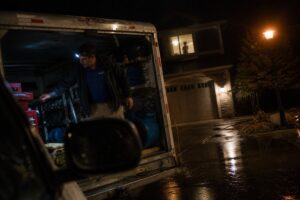
A 2 AM Pipe Burst Demands a Local, Certified Response
A water heater finally gives out in a Daybreak townhome. A main supply line bursts under pressure stress amplified by South Jordan’s notoriously hard water. A sump pump fails during a spring thaw and the basement fills while everyone is asleep. When your property is taking on water, you do not need a call center routing your request to an unfamiliar crew — you need a licensed and certified technician who understands the specific risks to homes in this valley. True Day Water Damage Restoration is a locally-owned, IICRC-Certified Firm (ID #927354-5258) based right here in South Jordan at 11268 S 2865 W. We are a licensed Utah Contractor (#960332-3505), dispatched to mitigate water damage across Salt Lake County. When you call, you speak directly to our team — people who understand the urgency of a basement flood in properties built on the Jordan River basin’s expansive clay soil, or a roof leak during a summer monsoon event. Call (385) 247-9359 now. Waiting allows Category 1 clean water to degrade into contaminated Category 2 grey water in as little as 24 to 48 hours — complicating cleanup, expanding the remediation scope, and creating insurance claim complications that did not need to exist.Your First Steps: Safety and Damage Mitigation Checklist
While our team is en route, you can take the following steps to protect your property — but only if you can do so safely. When in doubt, wait for us.- Prioritize Electrical Safety: Do not enter rooms with standing water if power is on. Water contact with live electrical outlets and wiring creates a severe electrocution hazard. If your breaker panel is in or near a wet area, do not touch it. Wait for our team.
- Shut Off the Water Main: Locate your home’s main water shutoff valve. In most South Jordan homes, this is in a basement utility room, crawlspace, or garage. For a supply line break, closing the main shutoff is the single most impactful immediate step. If you are on the Jordan Valley Water Conservancy District culinary system and cannot locate your interior valve, your curb stop shutoff is an alternative.
- Move Sensitive Items: If it is safe to do so, move photographs, documents, and small electronics to a completely dry area. Place aluminum foil under the legs of wooden furniture on wet carpet to prevent tannin staining from bleeding into flooring fibers.
- Do Not Use Household Vacuums: A standard shop vacuum or home vacuum cleaner cannot extract water bound in carpet padding or porous subfloor materials, and it poses an electrical risk in wet conditions.
- Avoid Sewage-Contaminated Areas: If the water originates from a toilet overflow or sewer backup, it is classified as Category 3 black water — a sewage biohazard containing pathogenic bacteria, viruses, and parasites. Close the door to the affected area and wait for our team with proper personal protective equipment.
- Call Your Insurance Carrier: Open a claim with your homeowner’s insurance provider. Inform them that you have dispatched a professional mitigation company to prevent further damage — a step most policies require under the Duty to Mitigate clause. See our Insurance Claims Assistance page for guidance on what comes next.
Our On-Site Protocol: What to Expect When We Arrive
Our response is governed by the ANSI/IICRC S500 Standard for Professional Water Damage Restoration — the industry’s most rigorous technical benchmark. This standard ensures our process is not just fast, but technically correct at every step.1. Safety & Scope Assessment
Our lead technician evaluates for structural and electrical hazards before anyone enters the affected area. We then determine the water category and class of destruction to establish a safe work plan and define what materials can be dried in place versus what must be removed. This assessment is also when we begin the timestamped documentation your insurance adjuster will require. Learn about how we handle all water damage categories.2. High-Volume Water Extraction
We begin removing bulk water immediately using truck-mounted extraction units — equipment that removes water at a volume and rate that consumer-grade tools simply cannot approach. This high-volume extraction is critical for pulling moisture from carpet, carpet padding, and porous subfloor materials within the compressed time window before irreversible structural damage and microbial growth accelerate. Learn more about our water extraction services.3. Moisture Mapping with Thermal Imaging
After extraction, we deploy FLIR thermal imaging cameras and Protimeter calibrated moisture meters to locate all hidden moisture — inside wall cavities, beneath flooring assemblies, and above suspended ceiling panels. Thermal imaging detects temperature differentials created by evaporative cooling of wet materials, revealing moisture migration pathways that visual inspection cannot. This step is especially important in homes with complex architectural layouts like those found throughout Daybreak and Herriman, where multi-level floor plans and finished basements create moisture travel paths that behave differently than a standard single-story structure. Learn more about our moisture detection services.4. Strategic Equipment Deployment
Based on our moisture map and a psychrometric analysis of the drying environment — measuring temperature, relative humidity, and specific humidity — we deploy a calculated array of industrial high-velocity air movers and low-grain refrigerant dehumidifiers. This is an engineered drying system, not fans placed at random. The air movers create the high-velocity airflow needed to accelerate evaporation from structural materials. The low-grain refrigerant dehumidifiers continuously extract the resulting water vapor from the air, maintaining the vapor pressure differential that draws moisture out of drywall, insulation, and wood framing. The combined goal is to remove sufficient moisture from the structure within 72 hours to prevent mold amplification — the threshold at which mold spores activate and colonies begin establishing in damp cellulose-based building materials. Learn more about our structural drying and dehumidification services.Documenting Water Intrusion in South Jordan Homes
Documentation is not a formality — it is the mechanism by which your insurance claim gets paid correctly and completely. A moisture reading noted on a work order is not the same as a timestamped thermal imaging report tied to a specific address, claim number, and daily drying log that an adjuster can cross-reference against IICRC S500 drying standards. We provide your adjuster with a complete evidence package from day one: a thermal imaging moisture map of all affected areas, photographic documentation at every project phase, daily drying logs recording temperature, relative humidity, and moisture content at every monitored point, and a detailed scope-of-work estimate generated in insurance industry-standard software. Whether your carrier is Bear River Mutual, Allstate, State Farm, or another provider, our documentation format is one they recognize and accept without additional requests. This level of documentation also protects you in a coverage dispute. An indisputable record of what was wet, how wet it was, and how it was dried is the difference between a fully paid claim and one disputed on scope. Learn more on our Insurance Claims Assistance page.Scenarios We Routinely Address in Salt Lake County
Our field experience is concentrated right here in the south valley. These are the emergency water damage scenarios we respond to most frequently — each shaped by local factors that out-of-area contractors have no reason to know.- Appliance and Pipe Failures from Hard Water Scale: South Jordan’s water supply, delivered through the Jordan Valley Water Conservancy District, tests at 7 to 10 grains per gallon — classified as hard to very hard on the water hardness scale. Years of calcium and magnesium mineral scale accumulation inside washing machine hoses, water heater connections, ice maker supply lines, and fixture supply valves progressively weakens fittings until they fail without warning. We respond to these events regularly throughout the Daybreak and Harvest Village communities, where the failure pattern is well established and the resulting water volume can be significant even from a small-diameter supply line. Learn more about hidden leaks and water extraction.
- Basement and Crawlspace Flooding: Sump pump failures and foundation seepage during heavy rain or spring snowmelt runoff from the Oquirrh Mountains are common in South Jordan properties. The region’s heavy expansive clay soil — prevalent throughout the Jordan River basin — swells significantly when saturated, creating hydrostatic pressure against foundation walls that overwhelms sump systems not maintained or tested before the spring melt season. We have the pump and extraction capacity to handle large-volume basement flooding events and the expertise to dry finished basement assemblies correctly, including luxury vinyl plank flooring, insulated stud wall systems, and concrete subfloor surfaces. Learn more about our basement flooding cleanup services.
- Winter Freeze Events: Burst pipes in uninsulated exterior walls, mechanical rooms, and crawlspaces following a rapid cold snap are a frequent occurrence along the Wasatch Front. January and February bring freeze-thaw cycles where overnight lows drop below 15°F and daytime temperatures recover above freezing — creating thermal stress cycles in supply lines that compound the weakening effects of existing hard water scale. A pipe that has been slowly narrowed by mineral buildup for years may survive dozens of freeze cycles before one finally causes failure.
- Sewage System Backups: Sewage backflows through floor drains, basement toilets, and utility fixtures are Category 3 black water events containing pathogenic bacteria, viruses, and parasites that require specialized personal protective equipment, containment, and regulated material disposal. South Jordan’s rapid residential and commercial growth has placed increasing demand on municipal sewer infrastructure, contributing to a higher frequency of backup events in some neighborhoods. Learn more about our sewage cleanup services.
- Construction-Related Leaks in Newer Developments: We have responded to water intrusion events in Daybreak and other newer South Jordan communities resulting from construction defects — improperly flashed window rough openings, inadequate kickout flashing at roof-to-wall intersections, and defective roofing installations that allow storm water intrusion into wall cavities over time. These situations are often discovered only after significant mold growth has established behind finished surfaces, making thermal imaging essential for defining the true scope. Learn more about hidden leak damage and our mold remediation services.
- Storm and Roof Leaks: Severe weather events — including summer monsoon downpours common to the North American Monsoon pattern that affects the Salt Lake Valley from July through September, hail damage, and high-wind events — compromise roofing membranes, siding, and flashing, creating water intrusion paths that saturate attic insulation and ceiling assemblies before any sign appears inside the living space. Learn more about our storm damage restoration services.
Why Immediate Action Is Critical for Your Insurance Claim
Most homeowner’s insurance policies contain a Duty to Mitigate clause. This provision means that as the policyholder, you are legally required to take reasonable steps to prevent additional damage after a covered loss occurs. Calling True Day Water Damage Restoration immediately is documented proof that you have fulfilled this obligation. Our detailed documentation — which begins the moment our technician arrives on-site — provides your adjuster with a precise, timestamped timeline of the loss and validates all emergency services performed. It establishes when the water intrusion was discovered, what materials were affected and to what degree of saturation, what mitigation steps were taken and when, and how the structure responded to treatment over the drying period. Attempting a DIY cleanup, waiting several days before calling a restoration company, or working with a crew that does not produce proper IICRC-standard documentation gives the insurer grounds to question whether the Duty to Mitigate was fulfilled — and potentially deny coverage for secondary damage like mold growth that developed in the interim. The documentation gap that results from acting too slowly is one of the most common and most preventable reasons water damage claims get disputed or underpaid.Frequently Asked Questions
How fast can you get to my home in Salt Lake County?
Our goal is to be on-site as quickly as possible after your call. As a South Jordan-based company at 11268 S 2865 W, we have a meaningful response time advantage for emergencies throughout West Jordan, Riverton, Herriman, and Sandy — communities we serve regularly and know well.Do you work directly with my insurance company?
Yes. We provide comprehensive documentation to your adjuster and can bill most major insurance carriers directly, streamlining the claims process for you. We are experienced with the documentation requirements of all major carriers serving the Salt Lake County market. Learn more on our Insurance Claims Assistance page.Is my water damage covered by insurance?
Most sudden and accidental events — a burst pipe, an appliance failure, a supply line rupture — are covered under standard homeowner’s policies. Events categorized as maintenance issues or resulting from long-term gradual seepage may not be. Secondary water system incidents may require specific claims handling based on the water contamination category and policy language. We can help you understand your situation based on our experience with Salt Lake County claims.Are you available 24/7?
Yes. Our phones are answered by our team 24 hours a day, 365 days a year. When you call (385) 247-9359, you speak directly to a member of our team — not an answering service or a national franchise dispatch center.Related Services
- Water Damage Restoration
- Water Extraction
- Structural Drying
- Dehumidification
- Moisture Detection
- Basement Flooding Cleanup
- Insurance Claims Assistance
- Our Restoration Process
- Sewage Cleanup
- Mold Remediation
- Storm Damage Restoration
- Category 1 — Clean Water Damage
- Category 2 — Grey Water Damage
- Category 3 — Black Water Damage
- Hidden Leaks
- Commercial Water Damage Services
- Water Damage Emergency Guide — South Jordan, UT
Do Not Wait — Call True Day Now
Every hour of active water intrusion converts salvageable materials into write-offs, clean water into contaminated grey water, and a straightforward insurance claim into a disputed one. True Day Water Damage Restoration is local, licensed, IICRC-certified, and ready to respond — 24 hours a day, every day of the year. True Day Water Damage Restoration 11268 S 2865 W, South Jordan, UT 84095 Phone: (385) 247-9359 Email: info@truedaywaterdamagerestoration.xyz IICRC Certified Firm: #927354-5258 Utah Contractor License: #960332-3505Certified
Firm
Pay Over Time Through Wisetack — No Hit to Your Credit to Check
Insurance covers most restoration jobs. For the deductible, non-covered scope, or jobs filed out-of-pocket, True Day offers financing through Wisetack — a homeowner-friendly lender with soft-credit prequalification (checking your rate does not affect your credit score).
Your True Day project manager can prequalify you in a few minutes during the written-scope visit. Nothing to sign on the spot.
About Wisetack: loans are issued through independent lending partners. Rates and approval depend on your credit profile. Prequalification is a soft inquiry; final approval may involve a hard inquiry. True Day does not profit from or receive referral fees for financing.
What True Day guarantees on every job
While we’re on the way: a 60-second safety checklist
The first 15 minutes matter. Here’s what to do (and not do) between the call and our arrival.
Do, if safe to do so
- Shut off the water supply at the main valve if you can reach it dryly
- Flip the circuit breaker for any affected room before touching outlets or appliances
- Take phone photos and a short video of the damage — insurance will want them
- Lift what you can off wet floors: electronics, rugs, cardboard boxes, important paper
- Open interior doors to let airflow begin on its own
- If a ceiling is sagging under water, back out of that room and warn others
Don’t
- Walk through standing water near plugged-in electronics or appliances
- Use a household vacuum to extract water — it is not rated for it
- Pull up tacked-down carpet or glued flooring yourself; your insurance will need to see it in place
- Run the HVAC in the affected area — you’ll spread contamination
- Use bleach on visible mold before we inspect — it masks what we need to find
- Throw away damaged items before documenting them
Where we actually go, and how fast
We will not claim to serve a city if we cannot respond in a reasonable window. Here is our real coverage.
South Jordan — primary coverage with the 45-minute arrival guarantee
Our office is at 11268 S 2865 W, South Jordan, UT 84095. Every address inside South Jordan city limits is covered by our 45-minute arrival guarantee, 24/7/365.
Riverton, Herriman, West Jordan — adjacent coverage
Full service, 24/7, with a slightly longer response window because of the drive. We have active case studies in all three cities. Call us and we will confirm the estimated time to your address.
Secondary coverage — Sandy, Salt Lake City, Draper, Bluffdale, Cottonwood Heights, Daybreak, Syracuse
We have taken jobs in these cities, especially when a case is referred by an insurance adjuster or past customer. Response times run longer and we only commit when we have crew availability. Call (385) 247-9359 before assuming we are available.
If your city is not listed, we are honest: ask us for a referral to a certified firm closer to you. A long-haul response time helps no one in an active water loss.
When to call us — and when to call someone else first
We say no to jobs that are not ours. Here is a plain-language triage of what belongs with True Day vs. with another trade.
Call True Day now Emergency
- Standing water inside the house, any amount
- Visible mold over 10 square feet, or any mold on insulation, wet drywall, or carpet pad
- Sewage backup inside the house — even a small amount is Category 3
- Recent fire or smoke damage (within the last 72 hours is the window where cleanup matters most)
- Biohazard scene or unattended death — we respond compassionately on IICRC S540
- Ice dam leak into living space during a Utah storm
Call us — but it is not emergency Schedule
- Minor water leak you have already stopped and patched, but you want pros to confirm the structure dried properly
- You suspect a hidden leak (meter spin, musty smell) and want the FLIR + moisture meter investigation
- Small mold spot (under 10 sqft) you want tested before deciding on scope
- Pre-sale moisture inspection on a home you are buying
- Post-remediation verification you need signed off
Call someone else first Not our scope
- Active plumbing leak you cannot stop → call a plumber first; we come after the water is off
- Sewer line break outside the house → call the city utility + a plumber; cleanup inside is us, the line itself is theirs
- Roof leak with rain still coming in → call a roofer for the tarp; we handle the ceiling and walls below after
- Gas smell → leave the house, call Dominion Energy (800-767-1689) and the fire department
- Electrical sparks, scorching, or shock → call an electrician; do not touch anything wet
- Structural crack, buckling floor, or shifting wall → call a structural engineer before any cleanup happens
If you are not sure which bucket you are in, call us at (385) 247-9359. Even if the honest answer is “call a plumber first, then us”, we would rather route you right than take a job that is not ours.
Call now, or call when you can? — a severity triage
Honest guidance on how urgent your situation actually is. Not everything is a 2am emergency.
Active gush or burst
Visible flowing water, more than a trickle. The clock is running on every square foot of material that sits in it. Call (385) 247-9359 and shut your main valve while we’re en route.
Standing water pooled on floors
Any depth, any area. Even if you’ve stopped the source, the material underneath is absorbing by the minute. Mold risk starts at hour 24.
Sewage or Cat 3 water, any amount
Pathogen exposure risk + much more aggressive degradation than clean water. Stay out of the affected room until we arrive. Call us at the first business hour if it happens overnight; call now if occupants are vulnerable (immunocompromised, pregnant, young children).
Visible water stain, dry to the touch
Old stain or very small leak that has stopped. Not an emergency. Schedule a free inspection this week so we can confirm it’s actually dry and check for hidden mold or structural concerns.
Musty smell, no visible source
Possible hidden leak or past-event mold. Not an emergency, but worth a FLIR + moisture inspection within a week. Smell doesn’t resolve itself — the source is somewhere.
Water bill spike, no visible cause
Run the 15-minute meter test first (see hidden-leak page). If the meter is moving with everything off, call us. If it is still, your bill may be a utility billing error — call the water utility, not us.
Past loss, already dried out — peace-of-mind check
You dealt with it yourself but want pros to confirm nothing is hiding. Call during business hours; schedule a paid inspection ($0 for True Day customers; nominal fee for first-time).
If you are not sure which row you are in, call (385) 247-9359. 30 seconds on the phone tells us whether to roll a truck or set a 10am appointment.
6 DIY moves that make a water loss worse
The patterns our techs see when a homeowner tried to handle it themselves first. Avoiding these is often worth more than anything we add later.
Using a household vacuum to extract water
A shop-vac is not rated for water extraction. A household canister vacuum definitely isn’t. You will burn out the motor, void the appliance warranty, and leave 90% of the water in the material anyway.What to do instead: shut the source, towel-blot standing water, call us for a truck-mount extractor.
Running HVAC in the affected area
You will spread contamination — and on a Cat 2/Cat 3 event, the mold and bacteria load — to every room on that return. Dehumidification needs a controlled containment, not an open-air blow-through.What to do instead: shut HVAC off, close vents in affected rooms, open doors to let unaffected rooms stay distinct.
Bleaching mold on wet drywall
Bleach sets stain, feeds the mold under the paper layer (chlorine evaporates fast, water remains), and makes the real remediation harder because the surface looks “clean.”What to do instead: for small (<10 sqft) non-structural mold on non-porous surfaces, warm soapy water. For anything else, call us.
Pulling up tacked-down carpet before the adjuster sees it
Carpet in place documents the loss for your insurance carrier. Once it’s pulled, the adjuster’s scope reset makes the claim conversation harder. Even if you plan to replace it, let it stay for photos.What to do instead: photograph in place, let us pull it as part of the Xactimate-documented mitigation scope.
Throwing damaged items in the trash before inventory
Insurance pays for documented loss. An uninventoried item is a $0 line. Even if it’s going out regardless, photograph the item + model number + rough age first.What to do instead: hold the discard pile in the garage until the inventory photo pass is done.
Walking in standing water near plugged-in electronics
The single most common serious-injury risk during a residential water loss. Water + 120V + ground = cardiac event.What to do instead: flip the breaker for the affected rooms before touching anything. Not sure which breaker? Flip the main.
If you’ve already done one of these, call anyway. We don’t judge — we tell you what the recovery path looks like given the current state. (385) 247-9359.
Which path are you on — right now?
Water-damage situations split into two distinct modes. Call us on both, but the handling and timeline differ.
Water is moving right now
Visible flow, standing water, sewage backup, active ceiling leak, ice-dam intrusion during storm, fire with water-from-firefighting.
- 45-minute arrival inside SJ, 24/7/365
- Live-answered on first ring
- Michael paged on dispatch for Cat 2/3
- Emergency mitigation starts under carrier authority
- Written Xactimate scope within the first 4 hours
Clock is running on every square foot
You have time to plan
Suspected hidden leak, musty smell, small mold spot to check, past loss you want verified dry, pre-sale moisture inspection, planned reconstruction after mitigation.
- Free inspection + written findings on a scheduled visit
- FLIR + moisture map, no exploratory demolition
- Written estimate before any work commits
- Business hours scheduling with 10-min ETA call
- No pressure, no sales close at the visit
Mon-Fri 8-5 for scheduling calls
24 hours a day. 7 days a week. 365 days a year.
A real person answers (385) 247-9359 at every hour — live dispatcher during business hours, professional live answering service after hours.
No voicemail. No automated hold queue. No “we’ll call you back tomorrow.” The call is logged, the on-call technician is dispatched, and someone is already moving toward your address before you hang up.
Not ready to call?
If you’re planning a mold remediation, pricing out a rebuild, or weighing options, send us the details in writing. We’ll follow up by phone — usually the same business day — with a scope, a timeline, and an honest cost range before you commit to anything.
First 15 minutes of a water emergency
Do these five things in this order, then call. The sooner the water stops and the drying starts, the smaller the final bill — this is as much about your insurance claim as it is about your floor.
- Shut off the water at its source. If the leak is from a fixture, close that fixture’s shut-off valve. If you can’t find one, close the main shut-off (usually in the basement, utility room, or an outside box near the street).
- Cut power to the affected area — only if safe. Flip the breaker for the room, not for the whole house. Do NOT walk through standing water to reach a breaker; call us and we’ll walk you through it on the phone.
- Document before you move anything. Phone photos and a 30-second video of every wet area, from multiple angles, with timestamps on. These are the single most valuable thing you can give your insurance adjuster.
- Move what you can off the wet floor. Rugs, electronics, furniture legs on foil or foam blocks. Don’t lift drenched carpet — it can tear. Don’t haul out drywall — scope decisions come after mitigation starts.
- Call (385) 247-9359. We dispatch the on-call crew while you’re still on the phone. If there’s any uncertainty about safety, call before step 2.
Already past the first 15 minutes? Call (385) 247-9359 now — the drying window shortens by the hour and mold risk starts around hour 24.
What to have ready when you call
You don’t need any of this to call us — you can dial right now. But if you have a moment, these details speed up dispatch and get your insurance file started cleanly from minute one.
For dispatch
- Address of the loss and the room(s) affected
- When you first noticed the water
- Where it’s coming from (if you know) and whether it’s still active
- Approximate depth or square footage affected (your best guess is fine)
- Any pets, kids, or elderly household members we should know about
For the insurance file
- Your homeowner’s insurance carrier name
- Your policy number (on your card or in the carrier’s app)
- Your deductible amount, if you know it
- Whether you’ve already called the carrier (either answer is fine — we work with both)
- The photos and video you took in the first 15 minutes
Missing some of these? Call anyway. We can start dispatch with just the address and figure the rest out while the crew is on the way.
Quick answers to the questions people usually search
How fast should water damage be addressed?
Mitigation should begin within the first 24 hours of discovering water damage. The IICRC’s working rule is that microbial growth can start between 24 and 48 hours in wet building materials, so the window to prevent a Category 1 clean-water loss from escalating to a Category 2 contaminated loss is roughly one business day.
Does homeowners insurance cover water damage in Utah?
Most Utah homeowners policies cover sudden and accidental water damage — a burst pipe, an appliance supply line failure, a fire-suppression discharge — but exclude long-term seepage, groundwater flooding without a flood endorsement, and damage from a leak the homeowner knew about and left. The specifics are in your policy’s named-perils section; True Day bills the carrier directly once a claim is open.
How long does water damage restoration take?
A typical single-room residential water loss takes three to five days of structural drying with equipment in place, followed by any reconstruction scope. Larger losses, hardwood floors, and finished basements can run one to three weeks. The IICRC S500 standard dries materials to a dry benchmark set on day one, not to a fixed calendar.
Can I handle water damage myself?
For a Category 1 clean-water loss under about 10 square feet, caught in the first hour, a shop vacuum and a dehumidifier can be enough. For anything larger, anything that has been wet more than 24 hours, anything involving sewage or groundwater, or anything where drywall or hardwood is involved, professional extraction and structural drying are the lower-cost path once insurance and mold risk are factored in.
What is the difference between water mitigation and water restoration?
Water mitigation is the emergency phase: stopping active water, extracting it, and drying the structure to prevent further damage. Water restoration is the subsequent phase: rebuilding what mitigation had to remove — drywall, flooring, cabinets, paint — back to pre-loss condition. True Day does both with the same crew, so there is no handoff between contractors.
What does water damage restoration cost in South Jordan, UT?
Costs vary by water category, affected square footage, materials involved, and whether reconstruction is in scope. A small Category 1 loss can run a few hundred dollars; a finished-basement Category 2 or 3 loss with reconstruction can run several thousand to tens of thousands. True Day writes a scoped estimate in Xactimate format on day one and submits it to your insurer before any demolition begins.
What we cover, by ZIP
Dispatched from our staffed South Jordan office at 11268 S 2865 W. Typical door-to-door arrival from dispatch; weather and I-15 conditions may extend these times.
| City | ZIP(s) | Typical arrival |
|---|---|---|
| South Jordan | 84009, 84095 | ~15 min |
| West Jordan | 84081, 84084, 84088 | ~20 min |
| Riverton | 84065, 84096 | ~25 min |
| Bluffdale | 84065 | ~25 min |
| Herriman | 84096 | ~30 min |
| Draper | 84020 | ~35 min |
We also respond to Sandy, Salt Lake City, Cottonwood Heights, and Syracuse — call (385) 247-9359 for a firm arrival window to those cities.
The escalation clock: what changes in your home while water sits
Urgency isn’t marketing. It’s a specific technical timeline from the IICRC S500 standard and basic mold biology. Here is what is happening inside your walls, hour by hour.
24h
Category drift begins
Clean (Category 1) water starts to pick up contaminants from flooring, drywall paper, and household debris. Carpet pad absorbs and holds. Hardwood begins to swell. What’s still salvageable: most porous materials if drying starts now.
Mold-growth window opens
Mold spores are everywhere in the air at all times. Given moisture, a food source (drywall paper, wood, dust), and 24–48 hours of temperature between about 60°F and 80°F, visible mold colonies can start. This is the point Category 1 water functionally becomes Category 2.
Scope expansion gets expensive
Soaked drywall begins to sag and lose structural integrity. Soaked insulation can no longer be dried in place. Soaked subfloor begins to delaminate. Scope that would have been “dry it in place” at hour 12 becomes “flood cut and replace” at hour 60. This is where the invoice doubles or triples.
Structural + insurance consequences
Visible mold is present on affected materials. Subfloors begin to warp. Wall framing starts to show microbial colonization. Insurance consequence: the carrier’s exclusion for “continuous seepage of 14 days or more” has started counting. Beyond this point, mitigation becomes mold remediation and reconstruction, not drying.
How we work with your insurance carrier
You don’t have to be the one translating between the drying crew and the adjuster. Here is what we handle, in writing, so your claim file carries exactly what the carrier needs to approve the scope.
- Scope in Xactimate. Mitigation scope is written in the format every major homeowners carrier reads — line-item quantities, standard price-list codes, no narrative-only invoices.
- Daily moisture logs. Every drying day is documented with meter readings, air mover and dehumidifier counts, and ambient conditions. The log is the proof your carrier needs to approve each day of equipment.
- Direct adjuster coordination. We call, email, and share photos with your adjuster. If they request a reinspection or want a scope sheet reviewed, that goes through us, not you.
- Any homeowners carrier. We are not a preferred vendor for any specific carrier (that status would mean we work for them, not for you). We work with every major homeowners carrier the same way: we submit the claim file, you remain the policyholder, your coverage decides what gets paid.
- Deductible, only if the loss is covered. You pay your deductible if the claim is accepted. If coverage is denied for your type of loss (long-term seepage, maintenance exclusions), we tell you before you file so you can decide whether to proceed out of pocket.
Our written warranty — in full
The warranty is in writing because “we stand behind our work” is not a warranty. Here is the actual coverage, what sits outside it, and how to invoke it.
- Covers all restoration workmanship — drying, structural repairs, drywall, flooring, cabinetry, paint — for 24 months from the date the job is closed out.
- If a system we installed or repaired fails due to our workmanship, we come back, open it up, and redo the affected scope at no cost.
- Transferable once to a new homeowner within the 24-month period, with a signed transfer on request.
- Covers mold-free performance in the specific areas we remediated, for 90 days from the date of post-remediation clearance.
- If visible mold returns in a remediated area within 90 days from the moisture source we dried, we reinspect and re-remediate at no cost.
- 90 days is the biological reality of mold-regrowth windows after a successful dry — not an inflated number.
Who will arrive at your door
Every technician on this list is a True Day W-2 employee, not a subcontractor. Each one holds individual IICRC certifications — numbers below are the IICRC Registrant IDs, verifiable on the IICRC public registry.
Full crew bios and credentials: Meet the team →
Verify our credentials — in 60 seconds
Numbers printed below, not just logos. Each one links to the issuing body’s own public lookup, so you can confirm the record without taking our word for it.
If a competitor shows a badge without a number, that badge is unverifiable. Numbers above are typed into the public search field on each site — the record returns the firm name, the status, and the registered address.
Three types of company answering your emergency call
Not every result on the first page of a water-damage search is a restoration company. There are three distinct operating models serving this market, and they diverge the moment you dial.
| What matters | Local owner-operated (us) | National franchise | Lead-broker / lead-gen site |
|---|---|---|---|
| Who answers your call | True Day team / Utah answering service | National call center that routes to nearest franchisee | Call-tracking number sold to whichever contractor paid for the lead |
| Who arrives on-site | Our named W-2 crew | A local franchisee’s crew | Unknown until a bidder accepts the lead — often not local |
| Who holds the Utah license | Michael Bass, #960332-3505 | The local franchisee | The lead-broker site holds none — it isn’t a contractor |
| Where your call ends up | Our dispatch, in Utah | The franchisee’s dispatch, in Utah | The ad network — your info becomes a lead sold to multiple contractors |
| Who warranties the work | True Day, 2 years workmanship + 90 days mold, in writing | The franchisee — terms vary by location | Nobody — the lead-broker explicitly disclaims responsibility for whoever shows up |
| Who you can call later | Michael, directly | The franchisee’s office | Nobody — the number you called originally doesn’t own the job |
Weekend, holiday, and overnight staffing — the honest version
Every restoration contractor claims “24/7” service. Here is how ours actually works at 2 a.m., on Christmas Day, or during a January pipe-burst wave.
Our after-hours coverage model
- Live-answered dispatch service 24/7/365 at (385) 247-9359. Not voicemail with a callback promise.
- On-call rotation among the four W-2 technicians — one is always available to respond, with the others as escalation.
- Owner Michael Bass is text-notified on every after-hours dispatch, so there’s a human watching the system.
- Pre-stocked trucks — equipment is loaded at end of day so after-hours dispatches don’t require a stop at the shop.
What happens during capacity events
Three times per year reliably, we hit capacity events: deep freeze in January-February causing region-wide pipe failures, major spring snowmelt storm driving simultaneous basement intrusions, and summer microburst storms. On these days, all four crews are deployed and the on-call rotation is irrelevant — everyone is working.
Honest handling: dispatcher triages by severity + proximity + category. Active Cat 3 or life-safety situations go first. A supply-line failure at 11am in a non-emergency room may get a 4-hour arrival instead of 25 minutes. We’ll tell you honestly on the call — if a closer competitor could reach you sooner during capacity events, we’ll say so.
Holiday coverage
- Christmas Day, Thanksgiving, major holidays: Same on-call protocol. Water doesn’t observe holidays.
- Owner is sometimes personally on-call on major holidays so technicians can be with family.
- No surcharge for holiday or overnight dispatch — dispatch fees are the same whether it’s 10am Tuesday or 2am Christmas Eve.
Overnight dispatch practical considerations
If you call at 2 a.m., we come. But we won’t do noisy demo work overnight that would wake neighbors or your household — extraction, moisture mapping, and equipment staging are quiet. Noisy demo waits for morning unless there’s a safety or scope reason to proceed immediately.
The 10 minutes between your call and our arrival
You hung up with us. Crew is en route. Here is the useful work you can do in the next 10 minutes that compresses what we do on arrival + reduces damage still accumulating.
Pre-arrival action list
- Shut the main water valve if the loss involves active plumbing. Usually at the point where the municipal line enters the house or in a utility closet. If you don’t know where it is, don’t spend 10 minutes looking — we’ll find it.
- Cut power at the breaker to any area with standing water near outlets or ceiling fixtures. This is a safety requirement for us to begin work on arrival.
- Document now, before cleanup. Wide and close-up photos on your phone, timestamped. This becomes your insurance baseline.
- Clear a path from exterior door to the loss area. Move anything blocking the hallway, kitchen, basement stairs. Our equipment staging goes faster if we can walk straight to the affected space.
- Secure pets. Put dogs or cats in a closed room away from the loss and the entry path. Equipment noise + unfamiliar people stress pets; stressed pets slow the crew.
- Pull irreplaceables off the floor — family photos, important documents, legal paperwork, jewelry. 2 minutes here saves hours of pack-out later.
- Have your policy number ready. On the arrival call we’ll ask whether to direct-bill your insurer; the claim number from your FNOL goes on our paperwork.
- Clear your garage or driveway if the crew will stage equipment through the garage. One truck + an open equipment door is the normal setup.
- Don’t start DIY cleanup if the water category is uncertain. Walking through Cat 2 or Cat 3 water tracks contamination that we have to deal with later.
- Don’t move the leak-source yet — we photograph the source for your insurance claim.
In South Jordan?
Inside South Jordan city limits we guarantee arrival within 45 minutes, 24/7, or your emergency inspection is free.
Emergency response by city
| City | Arrival |
|---|---|
| South Jordan | 45-minute guarantee |
| Riverton | 45–75 min target |
| West Jordan | 45–75 min target |
| Herriman | 45–75 min target |
| Bluffdale | 45–75 min target |
| Draper | 45–75 min target |
| Sandy | Call for an arrival estimate |
| Salt Lake City | Call for an arrival estimate |
| Syracuse | Call for an arrival estimate |
| Cottonwood Heights | Call for an arrival estimate |
One number for every city: (385) 247-9359, live-answered 24/7.
Sewage emergency? Stop using water, keep everyone away, and call (385) 247-9359. Michael Bass is paged on every sewage call.