
The equipment True Day brings to your home: Phoenix and Dri-Eaz air movers, LGR dehumidifiers, FLIR thermal imaging cameras and GE Protimeter moisture meters, plus thymol and accelerated hydrogen peroxide antimicrobials. Drying is tracked with meter readings until materials reach their drying goal under the IICRC S500 standard.
Our warranty at a glance
Warranty call goes to Michael Bass personally. (385) 247-9359.
2020
Published September 27, 2026 · Authored by Michael Bass, Owner, True Day Water Damage Restoration · Utah Contractor License #960332-3505 · IICRC Certified Firm #927354-5258
Why This Page Exists
Most water damage restoration companies describe their equipment in vague terms — “state-of-the-art,” “professional-grade,” “the latest technology.” None of that is meaningful. What matters is which specific tools arrive at your home, what they measure, and how they contribute to the drying and remediation outcome. This page documents the actual professional-grade equipment True Day dispatches to every South Jordan-area water damage response. If you are comparing restoration contractors, ask each one for a specific inventory. If they cannot produce one, ask why.Detection and Diagnostic Equipment
FLIR Thermal Imaging Camera (1 unit)
True Day carries a professional FLIR thermal imaging camera on every emergency dispatch. FLIR cameras read infrared radiation from surfaces, showing wet materials as cooler than dry ones because evaporation is a cooling process. This lets us map moisture behind walls, ceilings, and floors without demolishing them. What we use it for: Initial moisture footprint mapping, hidden leak detection, verifying wall cavity moisture before opening, confirming drying progress. Every project starts with a thermal scan documented in the Xactimate scope submitted to your insurance carrier.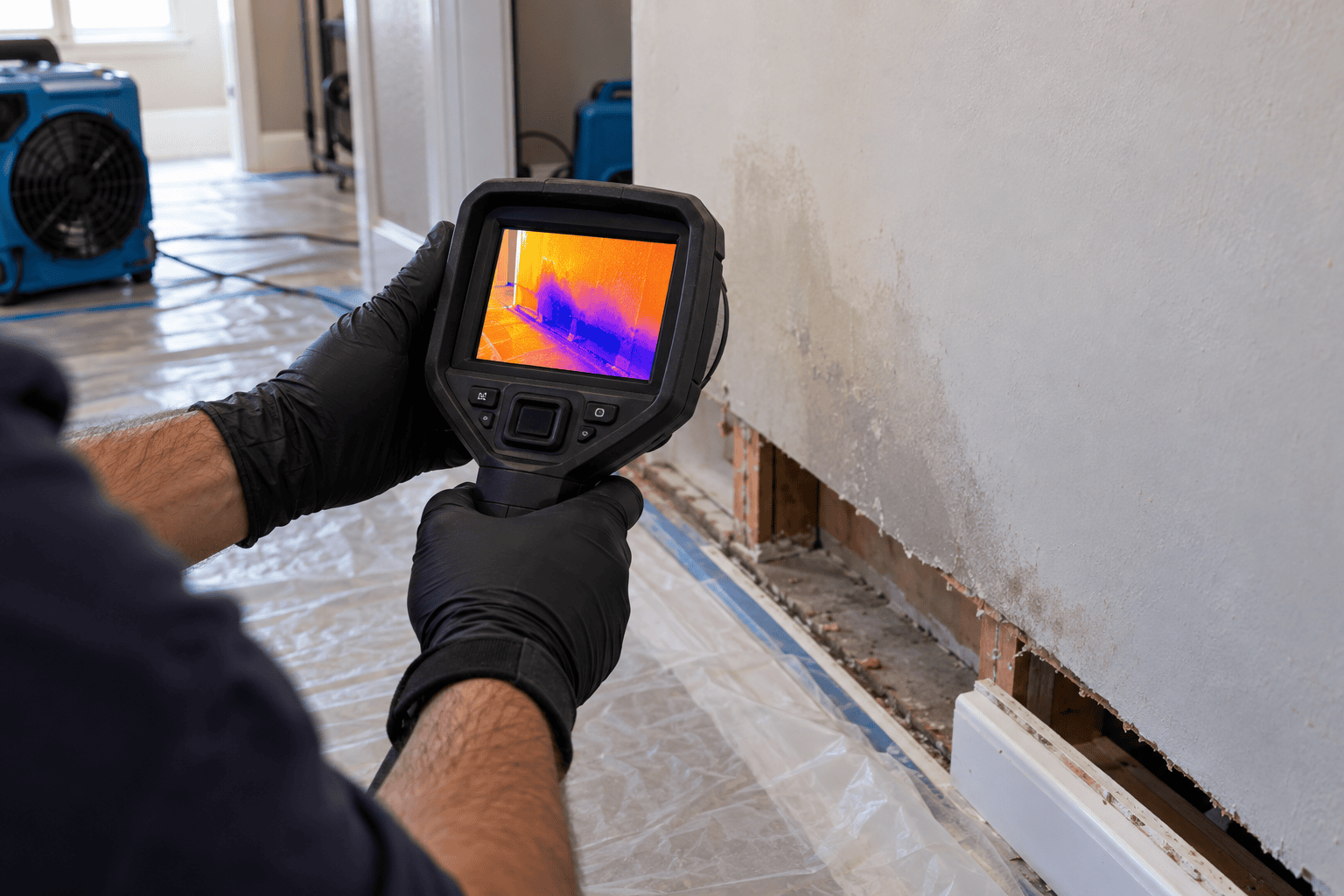
Calibrated Penetrating Moisture Meters (1-2 units)
Calibrated penetrating pin meters measure the actual moisture content of building materials — wood framing, drywall, subflooring, insulation — expressed as a percentage of the material’s dry weight. Where thermal imaging shows a suspected wet area, we confirm with a direct moisture reading before committing to a drying protocol. What we use it for: Species-specific dry standard verification (wood framing dry at 6-12% depending on species, drywall dry at 0.5-1.0%, OSB dry below 10%), daily monitoring point readings during active drying, completion confirmation. Meters are calibrated to a certified reference block before every project to ensure reading accuracy.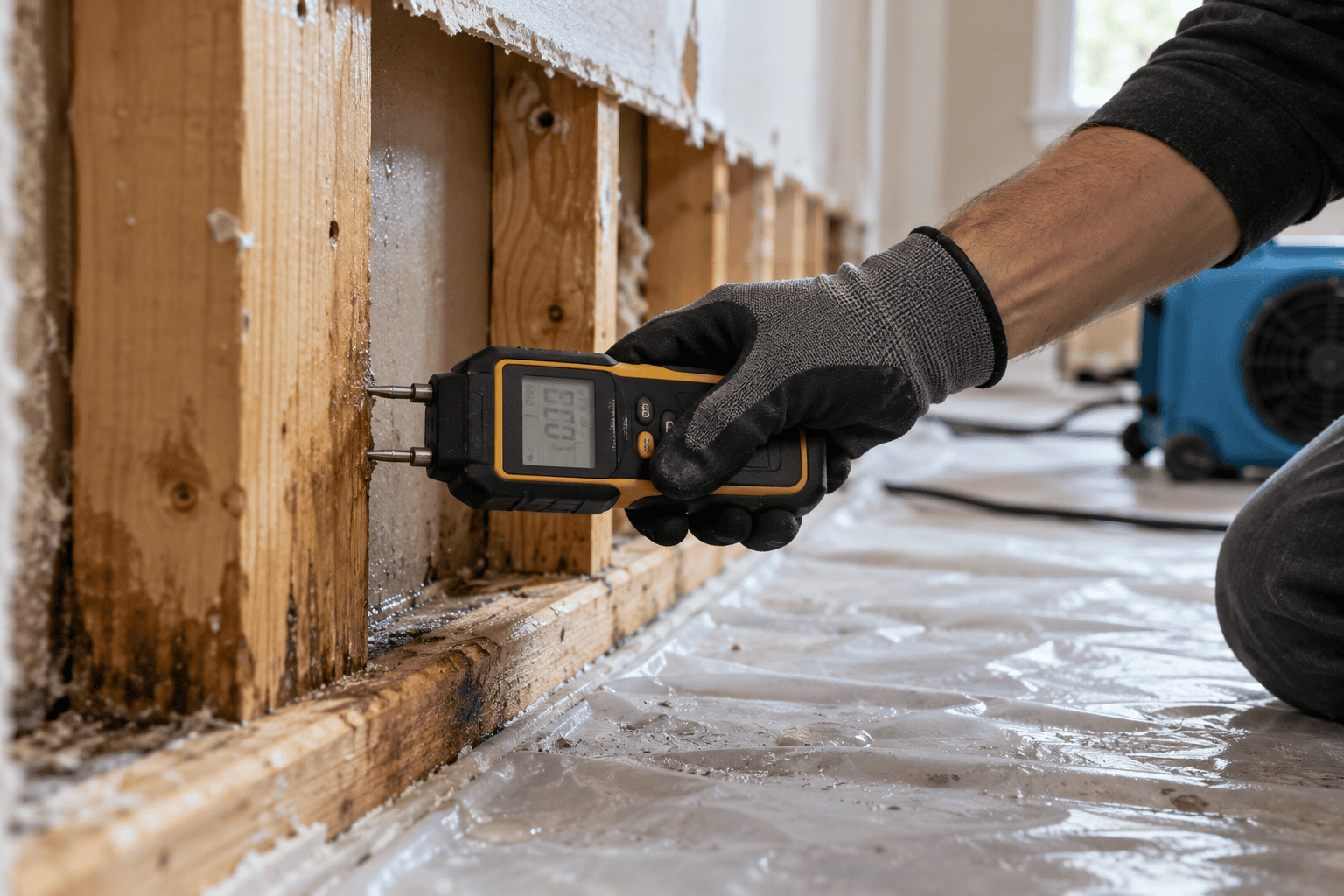
Extraction Equipment
Portable Water Extractors (1-2 units)
Water extraction removes standing water and free water from carpet, hard flooring, and other saturated materials in the first minutes of response. Every gallon extracted is a gallon that does not need to be evaporated by dehumidification, which shortens total drying time significantly. What we use it for: Initial extraction on Category 1, 2, and 3 water events. Carpet water extraction. Hard-floor pooling. Basement inundation. Equipment is decontaminated between Category 3 jobs and non-Cat-3 jobs.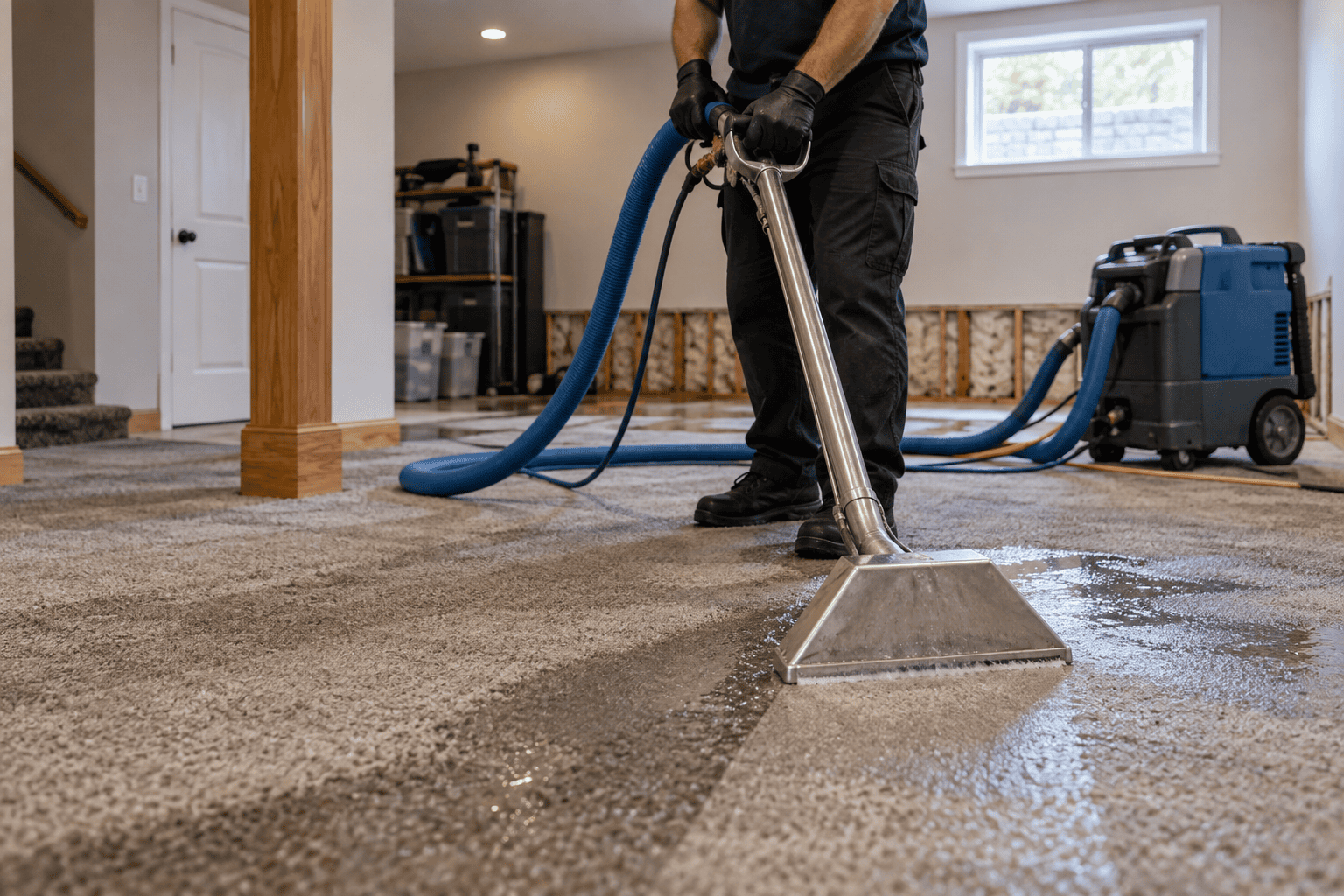
Drying Equipment
LGR (Low Grain Refrigerant) Industrial Dehumidifiers (2-4 units)
Industrial LGR dehumidifiers extract water vapor from the air during structural drying. LGR technology performs at higher efficiency under the low-humidity conditions of a properly containment-sealed drying environment, which is what makes it different from consumer-grade dehumidifiers you would find at a home improvement store. LGR units are rated in pints per day at 90 degrees Fahrenheit and 60% relative humidity — real-world conditions, not the marketing-inflated 80/60 conditions consumer units advertise. What we use it for: Continuous water vapor extraction during 3-to-5-day drying cycles. Sized to the vapor load of each specific project based on psychrometric calculations (grains per pound of dry air, volume of affected air, vapor release rate of wet materials). Runs on standard 15-amp or 20-amp circuits with dedicated drainage lines.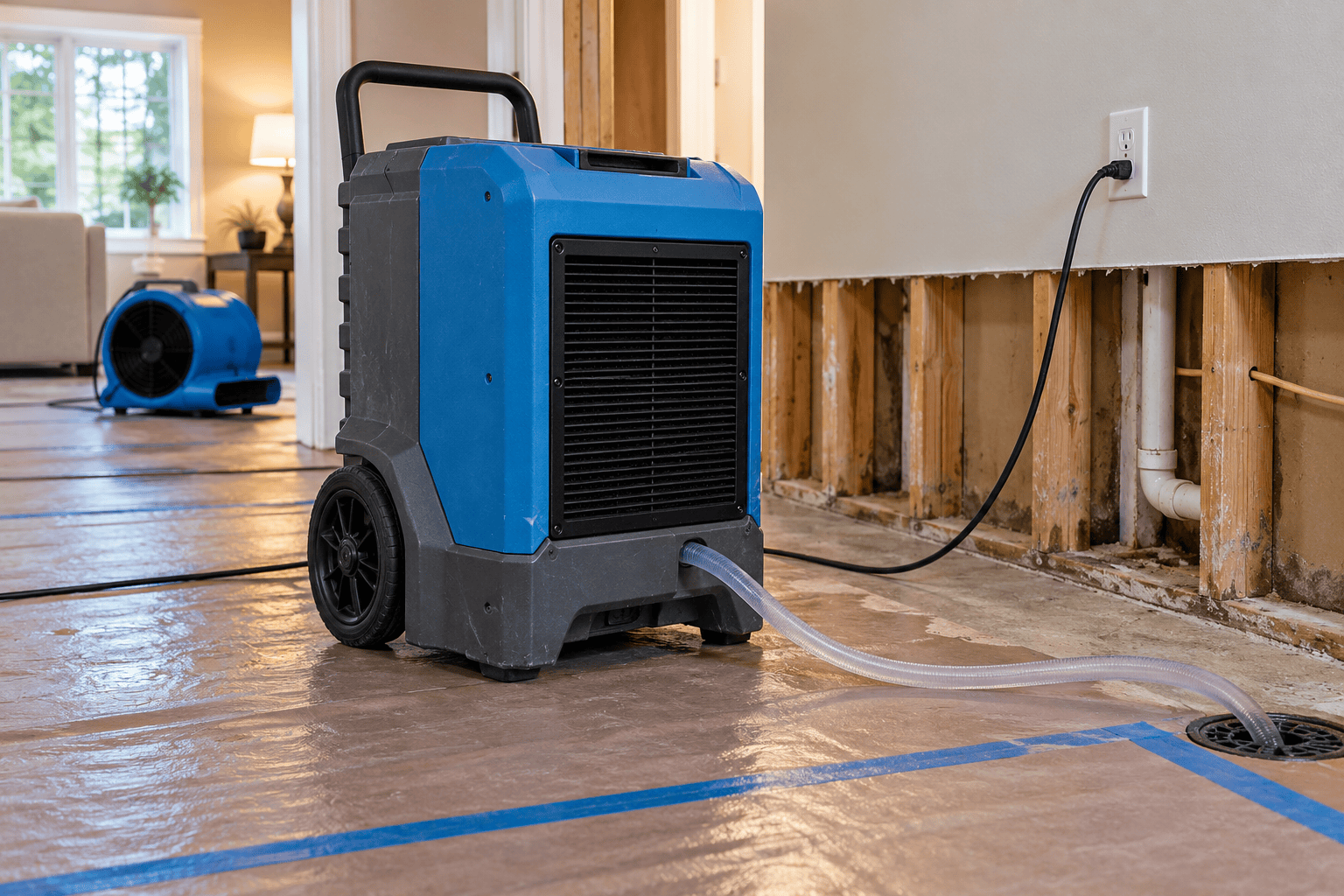
Industrial Air Movers (2-3 units)
High-CFM industrial air movers accelerate evaporation from wet surfaces into the air, where the LGR dehumidifier then extracts the moisture. Placement angle, spacing, and CFM sizing are calibrated to the surface area being dried per IICRC S500 methodology. What we use it for: Surface-level evaporation acceleration. Positioned at 15-45 degree angles relative to wet surfaces per S500 standard placement guidance. On larger events, additional units are rented from local restoration equipment suppliers to meet the calculated drying load — our operational commitment is that whatever equipment is needed to properly dry your project will be on-site, whether that means our inventory alone or supplemented with rented capacity.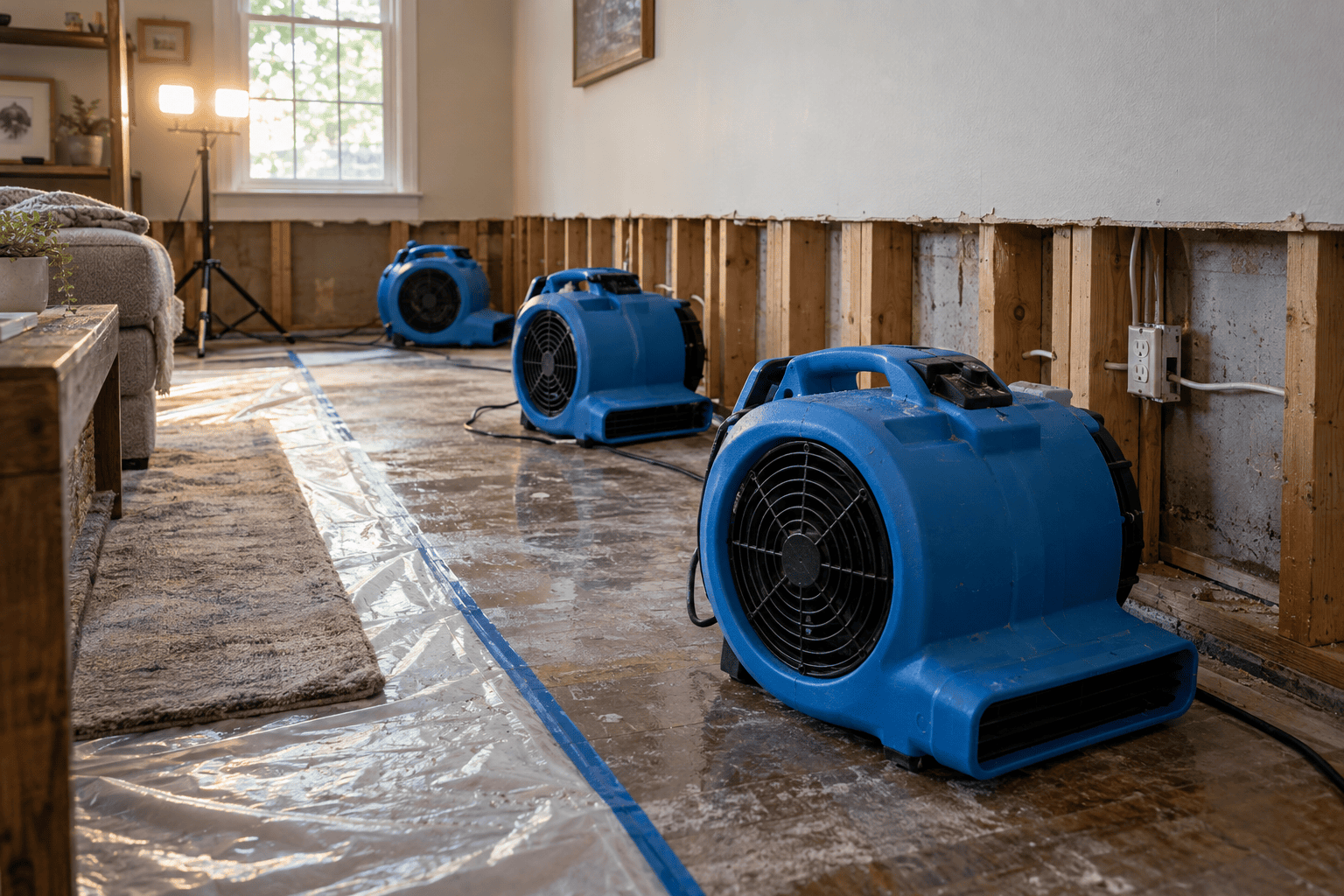
Containment and Air Quality Equipment
HEPA-Filtered Negative Air Machines / Air Scrubbers (1-2 units)
HEPA-filtered negative air machines create pressure containment between the affected area and the rest of the home during Category 3 sewage response, mold remediation, and any project involving airborne contaminant risk. HEPA filtration removes particles down to 0.3 microns — small enough to capture mold spores, fine soot from fire events, and airborne bacteria from sewage backup. What we use it for: Category 3 sewage response containment per IICRC S500. Mold remediation containment per IICRC S520. Fire and smoke damage air quality management. Post-remediation air scrubbing before independent clearance testing.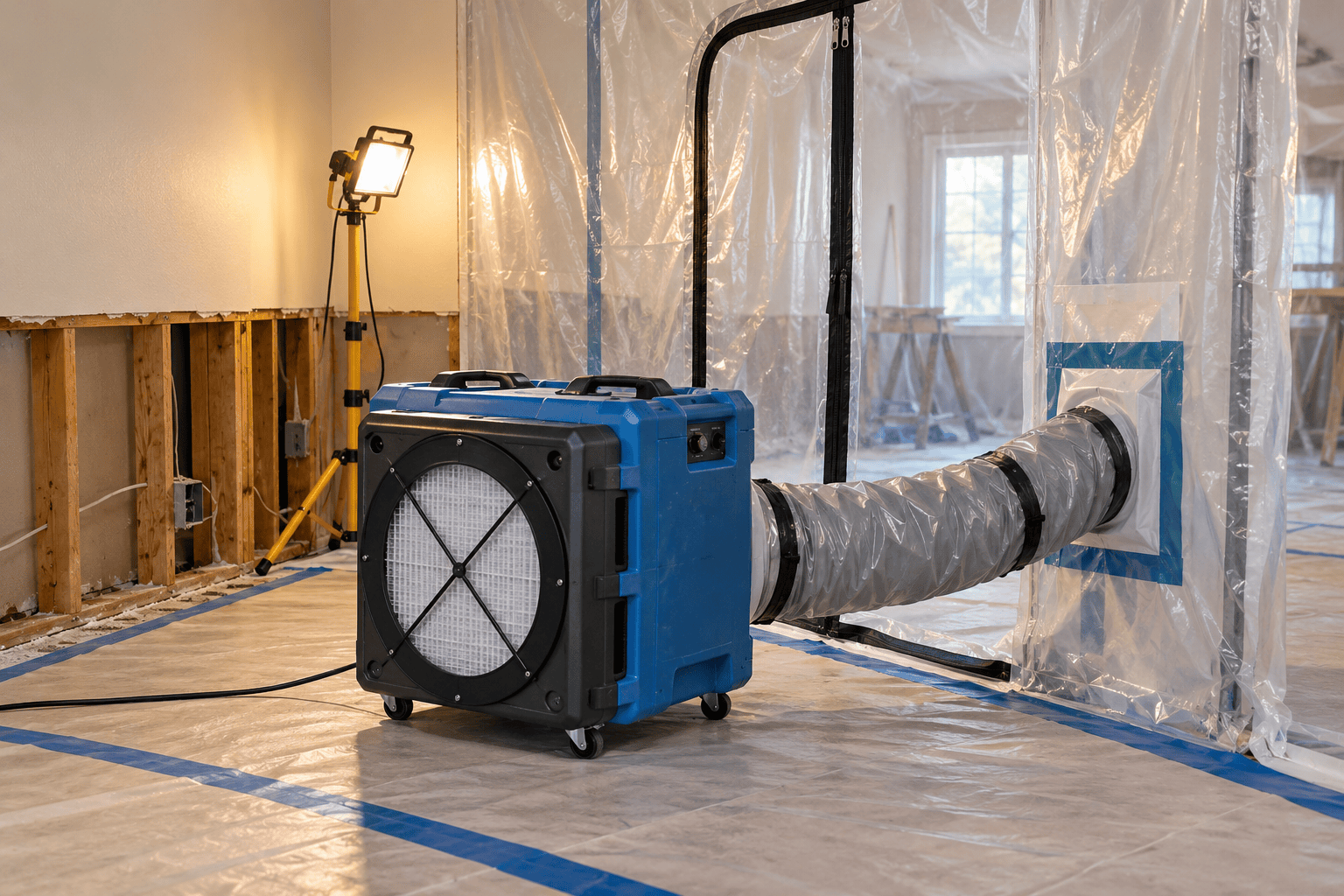
Supporting Equipment on Every Dispatch Vehicle
In addition to the primary drying, detection, and containment equipment above, every True Day emergency response vehicle carries:- 6-mil poly sheeting for immediate containment establishment
- Painter’s tape and containment tape for boundary sealing
- Reciprocating saws for controlled demolition
- Utility knives, pry bars, and standard demolition hand tools
- Personal protective equipment (PPE): respirators, coveralls, gloves for Category 3 events
- Cleaning solutions and EPA-registered antimicrobials (thymol botanical and hydrogen peroxide accelerated formulations)
- Absorbent materials (mops, rags, absorbent socks) for spot containment
- Cordless work lights and battery packs
- Extension cords and outlet splitters for equipment power distribution
- Digital cameras for damage documentation
- Tablet with Xactimate estimating software for on-site scope preparation
Why the Equipment Question Matters
A restoration company can call itself IICRC certified, licensed, insured, and experienced. What proves the claims is the equipment that actually arrives. Homeowners often ask us to walk them through what we brought after we finish setting up, and the walk-through takes less than five minutes. Everything you see documented on this page — the FLIR camera, the calibrated meters, the LGR dehumidifier, the air movers, the HEPA containment — will be in front of you on an active True Day job. If a competing restoration company arrives at your home with a consumer-grade shop vac, a couple of household box fans, and no visible moisture meter, that is not a properly equipped IICRC-compliant response. It is a company trying to complete the job with the equipment they have, not the equipment the job requires.How We Scale for Larger Events
The inventory on this page represents the equipment True Day maintains on a working basis for typical residential water damage response. For projects that exceed our standard-inventory capacity — full basement flooding events, multi-room fire damage restoration, commercial or multi-family losses — we supplement with rentals from Salt Lake Valley restoration equipment suppliers. This is standard industry practice for owner-operated restoration contractors and is factored into our project scoping. Every project is evaluated during the initial assessment for equipment adequacy before the drying phase begins. If additional units are needed beyond our standing inventory, they are sourced same-day and deployed alongside our owned equipment. Insurance carrier Xactimate scopes reflect actual equipment deployed, not projected or hypothetical.Equipment Investment and Maintenance
Professional restoration equipment requires ongoing maintenance to remain within IICRC S500-compliant operating specifications. True Day’s equipment is:- Calibrated per manufacturer specifications and industry standards (moisture meters against certified reference blocks, thermal imaging within manufacturer service intervals)
- Serviced regularly for filter changes, seal integrity, and mechanical function
- Decontaminated between Category 3 jobs and non-Cat-3 jobs per S500 protocol
- Documented in project files with equipment identifiers, deployment locations, and operating hours
Ask Us About Our Equipment
If you have questions about specific equipment we would use for your restoration project, or if you want confirmation of methodology for a particular damage type (Category 3 sewage response, mold remediation, hardwood floor drying, structural drying through I-joist systems), call Michael directly at (385) 247-9359 or email info@truedaywaterdamagerestoration.xyz. We are happy to walk through the methodology and equipment selection before you commit to a scope of work.Related Reading
- Water Damage Restoration Services
- Moisture Detection Methodology
- Structural Drying Methodology
- Dehumidification Methodology
- HEPA Filtration Services
- Facts About True Day
- How to Verify a Restoration Company
Our equipment capability by category
The gear in our trucks and warehouse, grouped by what it does. Every category meets or exceeds the referenced IICRC standard.
Water extraction S500
Truck-mount extractors for high-volume losses, portable extractors for upper floors, surface and sub-floor extraction tools. We remove free-standing water first — every gallon pulled now is one we do not have to evaporate.
Structural drying S500
LGR dehumidifiers sized to cubic footage with grain depression tracked; air movers positioned per S500 airflow ratios for the affected square footage. Equipment stays until the moisture-content numbers hit standard.
Moisture detection S500
FLIR thermal imaging to find hidden saturation behind walls and under floors non-destructively. Pin and pinless moisture meters to establish quantitative readings on framing, subfloor, drywall, and insulation.
Air quality + containment S520
Negative-pressure HEPA air scrubbers on mold and Cat 3 jobs; 6-mil poly containment with zipper doors; critical barrier film; HVAC isolation materials.
Full PPE for biohazard & sewage S540
Tyvek suits, half-mask and full-face respirators with the appropriate cartridges, nitrile gloves, boot covers. Approved waste-stream disposal for Cat 3 and biohazard materials.
Documentation on every job S500
Daily moisture readings photographed at the same marked points. Equipment setup photographed on day 1. Pre- and post-mitigation photos for your carrier. A moisture log you can keep.
Specific unit counts are not published online because our fleet rotates with job volume — ask on a quote call for the counts assigned to your project.
How we document every True Day job
You will leave with a full file — the same file your carrier gets. Here is what is in it.
Before work begins Day 0
- FLIR thermal images of the affected area, timestamped and labeled by room
- Initial moisture-content readings at marked points (framing, subfloor, drywall), photographed on the meter
- Written Xactimate scope — the same format and line-item structure your insurance carrier uses
- Photos of the water source and any damaged materials being removed or dried in place
During drying Day 1 → end
- Daily moisture readings at the same marked points, same meter, same tech — photographed on the display
- Equipment positioning map showing air mover and dehumidifier placements per S500 ratios
- Containment and HVAC isolation photographed for Cat 2 and Cat 3 jobs
- Change-order documents for anything added mid-job, signed before execution
Closeout Final day
- Final moisture log showing readings back to dry standard with 24-hour hold
- Before / after photo pair for the file
- Signed completion report from the tech, countersigned by you
- Warranty document dated and detailing the covered period
Everything is yours to keep. We send it in PDF to the email you provide, and we keep our own copy for 7 years in case your carrier needs it later.
Equipment FAQ
What’s actually in the truck, how we size it to your job, and what we can realistically save vs. remove.
What brand of dehumidifiers and air movers do you use?
How many air movers do you deploy on a typical drying job?
Can you dry hardwood floors or will I need to replace them?
What is a FLIR thermal camera and why do you use it?
Do you have equipment to handle a large commercial loss?
Restoration-grade equipment vs. a carpet-cleaning crew
Water damage restoration and carpet cleaning use words that overlap — “extract,” “dry,” “treat” — but the equipment is not the same category of tool. Here’s the difference you’ll see when the truck pulls up.
| What the job needs | A cleaning-company truck | Our True Day crew brings |
|---|---|---|
| Air moving | A few fans, maybe a shop blower | Phoenix and Dri-Eaz high-velocity air movers, placed by the drying math on day one |
| Dehumidification | A room-sized consumer dehumidifier (or none) | Commercial-grade LGR (low-grain refrigerant) dehumidifiers sized to the cubic footage and material load |
| Finding hidden moisture | Visual inspection + a probe meter | FLIR thermal imaging cameras + GE Protimeter penetrating moisture meters, logged in writing daily |
| Antimicrobial treatment | Consumer-grade cleaner | Thymol and accelerated hydrogen peroxide, applied per IICRC S500 after extraction |
| Documentation | Before/after photos | Daily moisture logs with numbers, timestamped photos, and an Xactimate-format scope the adjuster reads directly |
If the company you’re considering can’t name their air mover brand, their dehumidifier type, or their moisture meter model — they’re a cleaner, not a restorer. That matters most on the insurance side: a cleaner’s invoice does not read the same way to an adjuster as a restorer’s does.
Why we chose the equipment brands we did
Our confirmed equipment stack: Phoenix and Dri-Eaz air movers, commercial-grade LGR dehumidifiers, FLIR thermal cameras, GE Protimeter moisture meters, EPA-registered thymol and accelerated hydrogen peroxide antimicrobials. The brand choices aren’t arbitrary.
Air movers: Phoenix + Dri-Eaz
| Why these two |
|---|
| Both are industrial-grade with 20+ year reputations in the restoration industry. High-velocity, low-amp designs that run efficiently on standard residential circuits (critical for homes where we need 6-15 units running without tripping breakers). Snap-together stackable form factor saves space in our dispatch truck. |
LGR dehumidifiers (Low Grain Refrigerant)
| Why LGR vs standard |
|---|
| Standard dehumidifiers stop working below ~50% RH. In Utah’s dry climate, indoor air often starts below 50% RH, so a standard dehu would stabilize but not finish structural drying. LGR units pull moisture out of air down to ~35% RH, which is what gets wet framing to EMC equilibrium with unaffected areas. |
FLIR thermal + GE Protimeter
| Why industry-standard matters |
|---|
| These are the tools insurance adjusters recognize and trust. Readings from a cheap IR gun or a hardware-store moisture meter don’t carry the same weight on a scope dispute. We use the same gear your adjuster’s own inspection firm uses. |
Antimicrobials: EPA-registered specifically
| Why not bleach or over-the-counter cleaners |
|---|
| Bleach doesn’t penetrate porous materials and is corrosive to many surfaces. “Mold killer” sprays sold at home-improvement stores are often not EPA-registered for the application. We use thymol-based or accelerated hydrogen peroxide formulations with current EPA registration numbers — which is what the S500 and S520 standards require, and what carriers expect to see on paperwork. |
Equipment maintenance
Air mover motors inspected quarterly. Dehu filters replaced per manufacturer schedule. FLIR + Protimeter calibration verified annually. Replacement cycle on heavily-used units is roughly 5-7 years.
Equipment lifecycle + replacement schedule
Equipment that’s past service life performs worse than its spec sheet. Here’s how long our inventory items last + when we replace them — because 10-year-old air movers run slower than new ones.
Service life by equipment type
| Equipment | Typical service life | Replacement trigger |
|---|---|---|
| Phoenix / Dri-Eaz air movers | 5-7 years heavy use | Motor bearing wear, measurable airflow drop, visible frame damage |
| LGR dehumidifiers (commercial) | 5-8 years | Compressor fatigue, decreased pint output under test conditions |
| FLIR thermal cameras | 7-10 years | Resolution drops below usable, battery/software compatibility ends |
| GE Protimeter moisture meters | 5-10 years | Calibration drift beyond acceptable range |
| HEPA negative-air machines | 7-10 years | Motor degradation + filter housing seal issues |
| Truck-mount extraction units | 8-12 years | Pump pressure drop + vacuum CFM reduction |
| Portable extractors | 4-6 years heavy use | Pump failure or hose system wear |
Why we rotate on schedule
- Air mover airflow degradation adds drying days. 7-year-old units moving 15% less air add measurable time to equivalent jobs.
- Dehumidifier capacity drift means a nameplate 180 PPD unit may actually move 150 PPD. Sizing math fails if nameplate doesn’t match reality.
- Thermal camera resolution affects what we see on scope visits. Older cameras miss finer migration boundaries.
- Protimeter calibration drift affects the numbers we document. Inaccurate numbers = disputed scopes with carriers.
Calibration + maintenance between replacements
- FLIR + Protimeter calibration verified annually against reference standards
- Air mover motors inspected quarterly, bearings serviced per manufacturer schedule
- Dehumidifier coils cleaned + filters changed per manufacturer schedule
- HEPA filters replaced after specific hour counts or visible loading
- Truck-mount pump pressure tested annually
What this means for your job
Our equipment is at or near spec. Scope sizing works with real numbers, not nameplate numbers that don’t match reality. Drying times are predictable. If specific unit malfunctions during your job, we swap it — we carry backup inventory for exactly this reason.
Which equipment goes on which size job (practical tier chart)
“Industrial-grade equipment” sounds the same from every restoration company. In practice, the equipment deployed depends on job size, and part of right-sizing is choosing equipment that matches the loss. Here’s how we tier equipment selection:
| Job size | Air movers | Dehumidifier | Additional |
|---|---|---|---|
| Small spot (under 100 sq ft wet) | 1-2 compact centrifugal (Dri-Eaz Sahara or equivalent) | 1 refrigerant dehu (small-area, 20-40 pints/day real) | Hand-held moisture meter checks only |
| One room (100-400 sq ft) | 3-5 standard air movers (Phoenix FOCUS or Dri-Eaz Velo) | 1 LGR commercial dehu (90-130 pints/day real) | Thermal imaging survey; data logger |
| Multi-room (400-1,000 sq ft) | 6-10 air movers mixed types; some axial for larger open volumes | 2 LGR dehu units for volume; 1 standard for support | HEPA scrubbers if any debris; perimeter containment if HVAC is affected |
| Whole floor / basement (1,000-3,000 sq ft) | 12-20 air movers; mix of centrifugal and axial | Desiccant dehu (truck-mounted or trailer) + LGRs for support | Portable HEPA scrubbers for air; power management (don’t trip breakers); temporary power if needed |
| Large commercial (3,000+ sq ft) | Fleet deployment — 20-40+ air movers staged across zones | Desiccant trailer or 2+; LGR support units in high-RH zones | Climate control (temporary heat or cooling); portable boiler if needed for drying math |
What equipment selection actually depends on
- Volume (cubic feet) — not square footage; ceiling height matters
- Materials wet — drying hardwood needs different airflow than drying carpet
- Ambient conditions — a hot humid summer day is harder on dehu than a cool dry winter day
- Power available — 15A circuits limit how many air movers per outlet; dedicated 20A or temp power sometimes required
The “don’t just blast everything” principle
- Too much air movement without enough dehu removes water from materials and puts it back into the air — the moisture doesn’t actually leave the house
- Too much dehu without airflow dries the air but doesn’t pull moisture from materials efficiently
- Balance is calculated per job — written on the drying plan, adjusted at daily moisture checks
Equipment maintenance + the lifecycle math
Our air movers and dehumidifiers aren’t new. They’re professionally maintained industrial equipment with 5-15 years of job runtime on them. There’s a reason that’s actually better than new consumer equipment — here’s the lifecycle math and the maintenance that supports it:
Commercial restoration equipment is built to run thousands of hours. A dehumidifier that’s done 5,000 operating hours over 7 years is in its prime; new consumer equipment of the same nameplate capacity may be 1/3 the actual output and designed for far fewer total hours. The professional-grade machines keep performing until the compressor or the motor physically wears out — and both get replaced when that happens.
Our maintenance schedule
- After every job: external cleaning, filter check or replacement, cord/plug inspection, moisture-check function test
- Monthly: deep cleaning of air mover housings, dehumidifier evaporator-coil inspection, pump function test
- Quarterly: compressor function check on dehumidifiers, motor bearing lubrication where applicable, hour-meter log review
- Annually: service-level maintenance by equipment specialist — refrigerant level, blower-wheel balance, electrical safety check
When equipment gets retired
- Compressor failure that would cost more than 50% of replacement cost to repair
- Housing damage that affects performance or safety
- Electrical or safety issue that can’t be reliably repaired
- Technology obsolescence — occasionally a new generation outperforms old enough to justify replacement rather than continued use
What we track per unit
- Serial number + purchase date (so we know service life)
- Running-hour total (so we know lifecycle stage)
- Maintenance log (so we know what’s been serviced and when)
- Known issues list (so a specific unit’s quirks don’t surprise anyone)
What this means for your job
- Equipment that lands on your floor is tested-current, not sitting-in-a-warehouse-maybe-functional
- If a unit has an issue during your job, it’s swapped same-day — we keep spare units in rotation
- Equipment selection for your job matches your scope — not whatever’s closest in the truck
Why we don’t buy exclusively new
- Depreciation on new restoration equipment is steep; 30% in year one is common
- Older-generation equipment often has stronger construction than current cost-reduced models
- Our maintenance program keeps older units performing at spec — cheaper per-hour than new units with the same effective capacity
What newer equipment does better
- Energy efficiency per CFM or per pint — matters for very long drying jobs
- Noise levels (quieter LGRs available) — matters for occupied spaces
- Remote monitoring capability (cellular-reporting dehumidifiers) — useful on commercial jobs where constant eyes on readings aren’t practical
If you want to know specifically what equipment is on your job and its service history, ask. The information is in our maintenance log — we can share it.
Equipment ownership vs rental — and what each model means for your job
Restoration contractors use three different equipment models: own everything, rent everything, or a hybrid. We’re mostly owners of our core fleet (air movers, LGR dehus, extraction) and renters for occasional specialty items (desiccant trailer, large commercial scope). Here’s the comparison and why we chose this mix:
| Model | Economics | Quality implications |
|---|---|---|
| Own everything | High capital investment; low per-job cost on utilized equipment; maintenance responsibility | Full control over condition and reliability; consistent performance across jobs; immediate availability |
| Rent everything | Low capital; high per-job equipment cost; limited equipment choice | Variable condition between rentals; availability depends on rental market; limited customization |
| Hybrid (what we do) | Moderate capital; low cost on frequent equipment, higher on specialty; mixed maintenance | Core quality we control; specialty items from rental partners we trust |
What we own
- Standard air movers (centrifugal + axial variants) — multiple of each type
- LGR commercial dehumidifiers (90-130 pint AHAM range) — multiple units
- Truck-mount + portable water extractors
- HEPA negative-air scrubbers
- Thermal cameras (FLIR C5, E-series)
- Moisture meters (GE Protimeter + supplemental)
- Standard PPE and supplies
- Containment materials (poly, tape, etc.)
What we rent when needed
- Desiccant trailer dehumidifiers for very large commercial loss or very cold conditions — infrequent, high capital cost otherwise
- Large-scale negative-air scrubbers for specific commercial scope
- Specialty lift equipment if commercial ceilings are high enough to warrant
- Occasional specialty injection drying tools for specific hardwood jobs
Why we own rather than rent our core
- Reliability: we know every unit’s maintenance history; no “just-off-the-rental-floor” equipment landing on a job with unknown recent use
- Availability: can dispatch immediately without checking what’s in the rental yard
- Consistency: same equipment type on every job of similar scope — no mystery about performance
- Cost economics: at our job volume, owning pays off within 2-3 years per piece; rental cost over same period would be 3-5x
Why we rent specialty items rather than own
- Desiccant trailers are $30,000-80,000 each — too much capital for a few uses per year
- Specialty injection tools are job-specific — unlikely to see enough use
- Rental partner relationships work when a job calls for it — typically available with 24-48 hours notice
What this means for your estimate
- Equipment-day pricing is standard Xactimate rate — same whether we own or rent
- Specialty equipment rental cost pass-through: we include it as a cost line item on jobs that need it, at our rental cost + minimal markup
- You’re not being charged a “we own this” markup — the Xactimate rate is the Xactimate rate
How this compares to the industry
- Franchise restoration companies often rent most or all equipment through corporate contracts — costs them more, your estimate pays the same Xactimate rate but their margin is thinner
- Rent-everything operators tend to be newer firms or those scaling fast — variable equipment quality is a known trade-off
- Own-the-core operators like us tend to be mid-size independents with stable business — equipment is a serious capital commitment
Equipment inventory + why redundancy matters
A 4-tech operation can only serve as many simultaneous jobs as its equipment supports. Our inventory is sized for our actual concurrent capacity + redundancy for failure. Here’s the detail:
- 24-30 standard centrifugal air movers (Phoenix FOCUS, Dri-Eaz Velo, or equivalent)
- 4-6 compact air movers for tight spaces
- 2-4 axial air movers for large open volume
- 6-8 commercial LGR dehumidifiers (90-130 pint AHAM range)
- 2-3 standard refrigerant dehumidifiers for small-scope use
- Desiccant: rented from partner when needed; not owned
- Truck-mounted vacuum + pump system in service vehicle
- 2-3 portable extractors
- 1-2 submersible pumps for standing water
- 2-3 HEPA negative-air scrubbers
- FLIR thermal cameras (both the C5 pocket model + E-series)
- Multiple GE Protimeter moisture meters
- Data loggers for continuous environmental monitoring
Why these specific quantities
- At our 4-tech crew structure, we can run roughly 3-5 concurrent active jobs
- A medium job uses 6-10 air movers + 1-2 dehu; our inventory supports this across all concurrent jobs
- Redundancy of 20-30% allows for a unit to go in for service, be swapped out mid-job, or support an unexpected scope expansion
- Larger scopes beyond our concurrent capacity get queued or we recommend a larger partner
Why we don’t carry more
- Owning equipment is capital-intensive; owning past capacity-use is poor economics
- Beyond 30 air movers + 8 dehumidifiers, maintenance becomes a significant operational line-item
- Rental partnerships cover the once-a-year specialty need (desiccant trailer, extreme-capacity scope)
- Our scale is deliberate; equipment scales to match the scale, not past it
Redundancy specifically
- Each piece of equipment on a job can be swapped out same-day if it has a mechanical issue
- Spare units in rotation are ready for deployment
- Scheduled maintenance happens between jobs when units are off-duty
- Equipment failure during an active job doesn’t stall the dry — swap happens within hours
What this means for your job
- Your dry doesn’t get interrupted by equipment issues — we have spare units
- Your scope doesn’t get right-sized based on “what we have available” — we deploy what the scope needs
- If you call during a busy time (storm event, local flooding) and we’re near capacity, we tell you honestly rather than deploy underqualified equipment
Maintenance cycle given the inventory
- Between-job wipe-down + filter check on every unit after every job
- Monthly deep cleaning cycled through the inventory
- Quarterly compressor + motor check on all dehumidifiers
- Annual full service by equipment specialist for everything
How this compares to industry average
- Larger franchise operations may carry 5-10x our inventory — and need it because of their crew count
- Smaller operators sometimes carry only 10-15 air movers — which bottlenecks their concurrent job capacity
- Our size is the sweet spot for our crew count; growth would come with proportional equipment expansion
If you want to see the equipment
- Visit our office at 11268 S 2865 W (appointment first)
- Equipment staging area is part of the office tour
- Specific unit serial numbers verifiable if you want traceability
- Not showroom quality — it’s working equipment in rotation
Equipment that shouldn’t be on a residential job
Equipment specs are often a selling point, but more capacity isn’t always better. Equipment oversized for a residential loss can create new problems or add cost that doesn’t improve the outcome. Here is what doesn’t belong on a typical residential call:
True Day’s equipment selection is scaled to the loss, not to look impressive on arrival. If you’ve been quoted a scope that feels equipment-heavy, ask what size the room is and whether the equipment is actually matched to it.
What we bring to a sewage job
- Respirators, disposable suits, gloves, boots, and eye protection.
- Plastic sheeting and zippered doors for containment.
- Extraction equipment for standing water.
- EPA-registered antimicrobials — thymol and accelerated hydrogen peroxide products.
- Phoenix and Dri-Eaz air movers and commercial LGR dehumidifiers for drying.
- FLIR thermal cameras and GE Protimeter moisture meters to find hidden water.