
Water damage restoration in Cottonwood Heights, UT: True Day answers (385) 247-9359 live, 24/7, and dispatches from our South Jordan office — with an arrival estimate given on the call. IICRC Certified Firm #927354-5258, Utah license #960332-3505, insurance billed directly.
Water Damage Restoration in Cottonwood Heights, UT — 24/7
Dispatched from our staffed office at 11268 S 2865 W in South Jordan. Written 45-minute arrival guarantee, live-answered 24/7. IICRC Certified Firm #927354-5258. Utah Contractor License #960332-3505.Emergency Water Damage Response in Cottonwood Heights
Call (385) 247-9359 — Live-Answered, No Voicemail
Our line is answered live 24 hours a day, 7 days a week, 365 days a year. No voicemail. Dispatch begins the moment your call is answered from our office at 11268 S 2865 W in South Jordan. From there, Butler, Bella Vista, Gable Manor, and the other Cottonwood Heights neighborhoods east of I-215 are 25 to 32 minutes depending on traffic and time of day. Our written 45-minute arrival guarantee applies across the entire Cottonwood Heights service area — or your emergency inspection is free.How We Dispatch to Cottonwood Heights — Our Office, Equipment, and Fleet
True Day Water Damage Restoration dispatches to Cottonwood Heights from our office at 11268 S 2865 W in South Jordan — approximately 20-25 minutes from most Cottonwood Heights neighborhoods via Bangerter Highway and I-215. The photos below show the actual office, equipment, and fleet that respond to every Cottonwood Heights call.
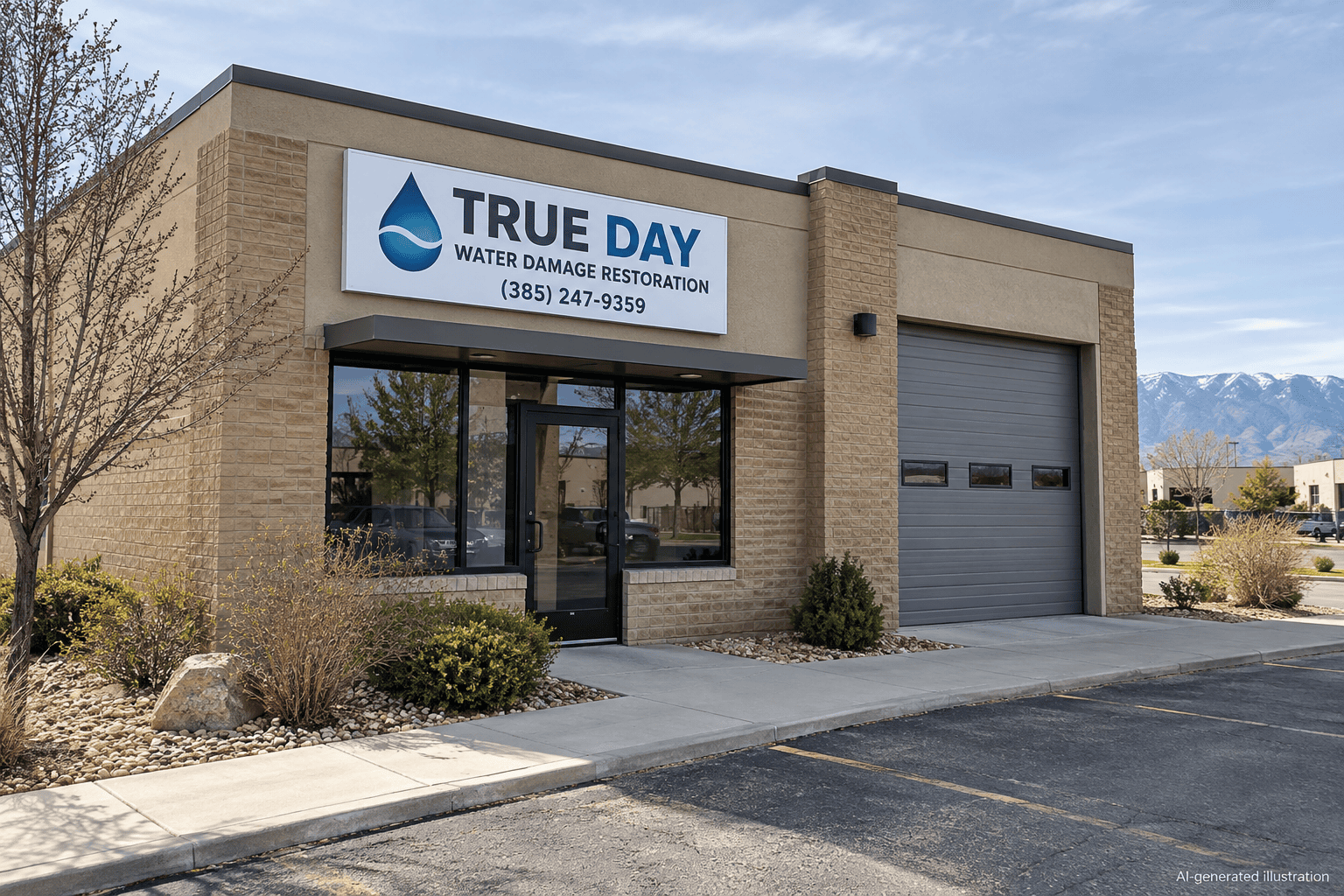
Our Office — 11268 S 2865 W, South Jordan
Dispatched from here to Cottonwood Heights via Bangerter Highway north to I-215 east. Verifiable on Google Maps.
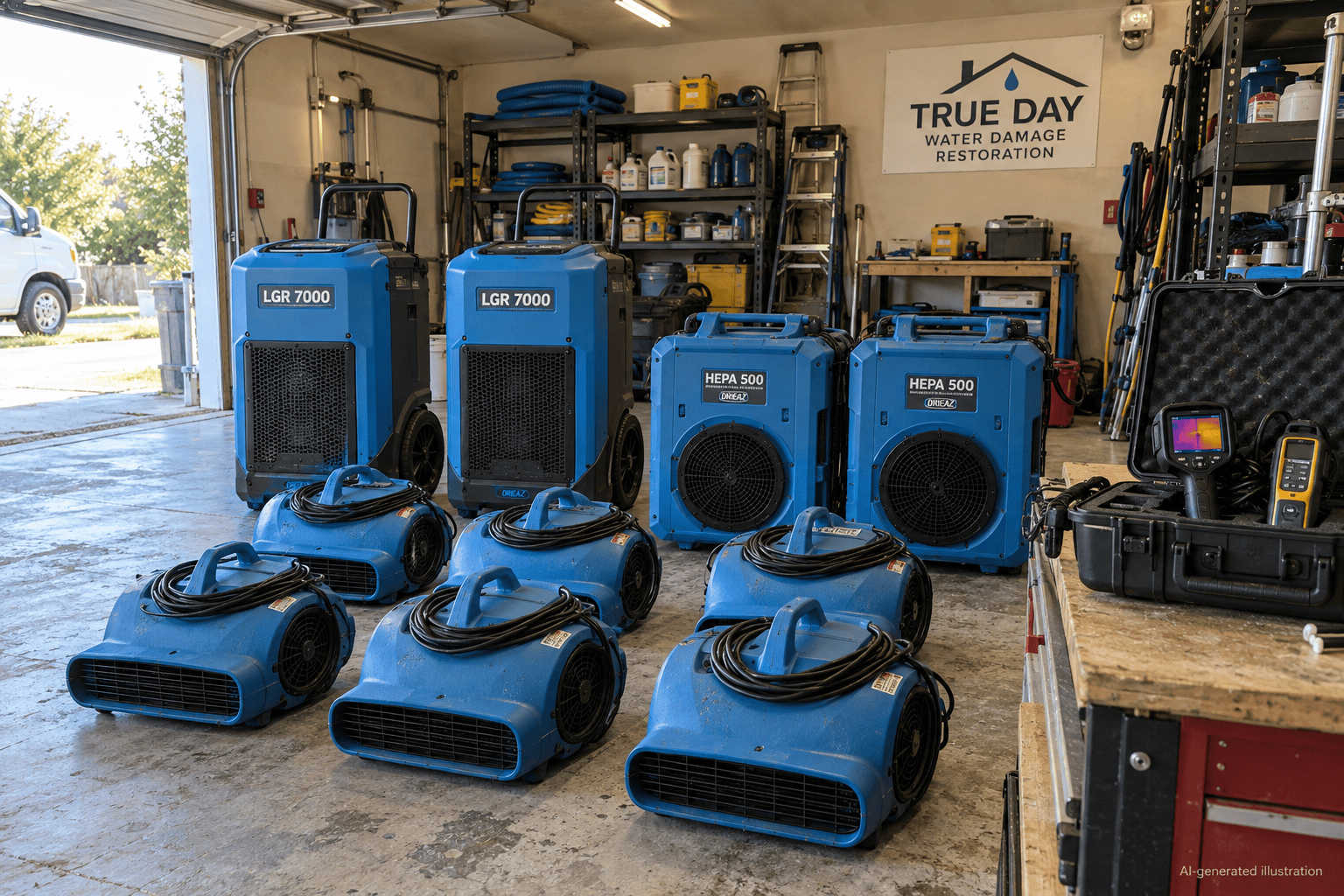
Equipment Staged for Cottonwood Heights Dispatch
LGR dehumidifiers, HEPA air scrubbers, air movers, and FLIR thermal imaging equipment ready for dispatch — including specialty equipment for older-construction galvanized pipe failures common in Butler and Bella Vista 1960s-era homes.
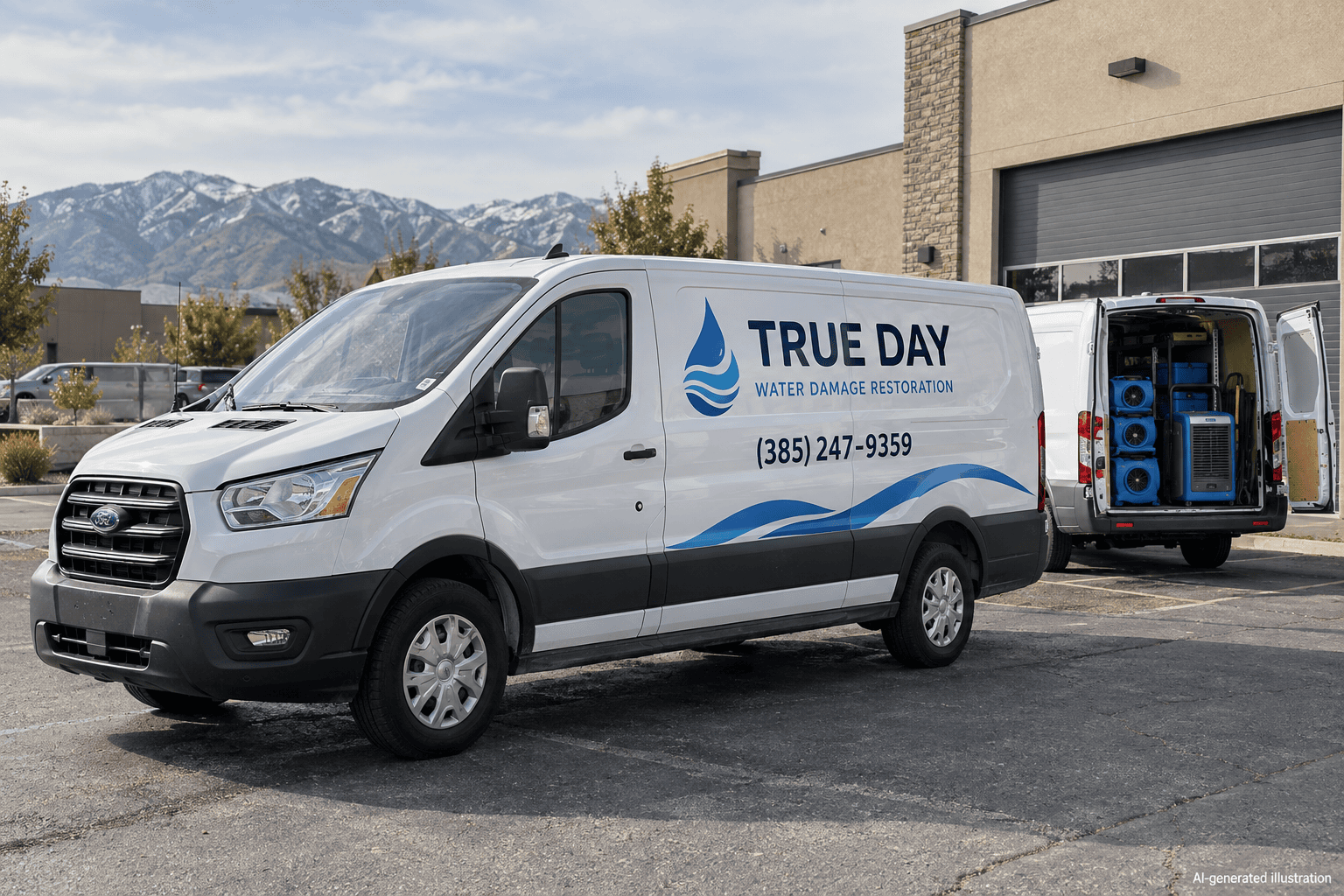
Our Fleet
Branded True Day service vehicles with (385) 247-9359 and Utah Contractor License #960332-3505 visible. Every Cottonwood Heights dispatch leaves from our South Jordan office.
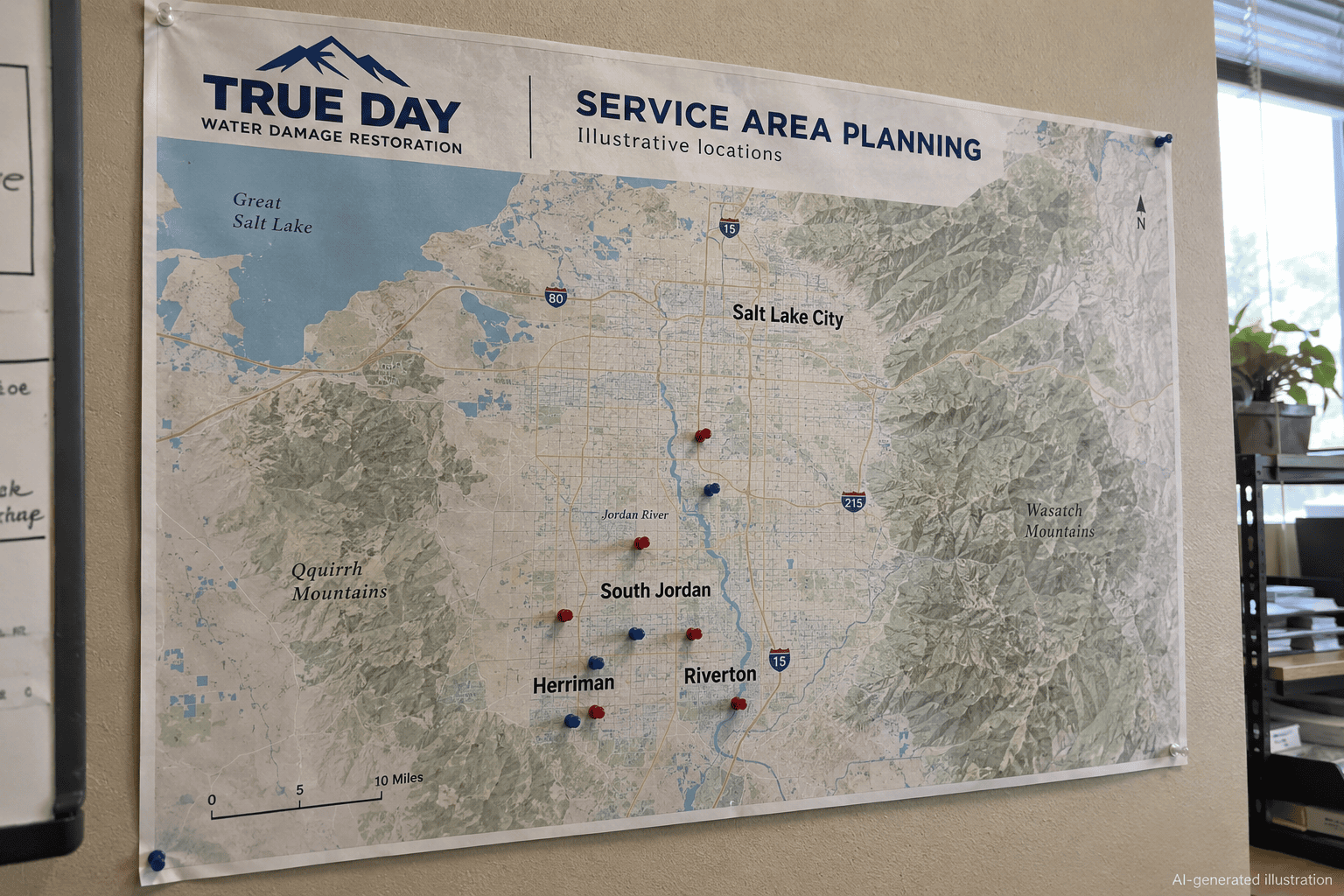
Where We’ve Worked Across the Salt Lake Valley
Completed projects across the Salt Lake Valley since 2020 — including the east-side bench communities near Cottonwood Heights. Neighborhood-level, no home addresses — homeowner privacy protected per our Privacy Policy.
Why Choose True Day for Cottonwood Heights
True Day Water Damage Restoration is an owner-operated IICRC Certified Firm (#927354-5258) and licensed Utah General Contractor (#960332-3505) serving Cottonwood Heights from a staffed office in South Jordan. We are not a franchise. We are not a call center. We do not sell, buy, or broker leads. Every technician who enters your Cottonwood Heights home is a True Day W-2 employee dispatched from our own crew — not a subcontractor. Michael Bass owns and operates the company. When you call (385) 247-9359 at 2:00 AM after discovering water in a Butler basement or a Bella Vista laundry room, the person answering the phone coordinates the crew that arrives at your door.Cottonwood Heights Homes and Water Damage Patterns
Cottonwood Heights sits on the eastern Wasatch bench, adjacent to Big Cottonwood Canyon and just north of Little Cottonwood Canyon. Three geographic factors dictate the water damage patterns here: the water supply comes from a different source than most Salt Lake Valley cities; the housing stock skews older than the west-side suburbs; and the terrain sits directly against the Wasatch Fault and its two most active recreational canyons.Salt Lake City Public Utilities Water — Wasatch Canyon Watershed
Unlike South Jordan, Herriman, Bluffdale, and most of the west-side Salt Lake Valley, portions of Cottonwood Heights are served by Salt Lake City Department of Public Utilities rather than JVWCD. SLC Public Utilities sources roughly 60 percent of its drinking water from Wasatch canyon watersheds — mountain streams and lakes in Big Cottonwood, Little Cottonwood, and adjacent canyons. This water is characteristically clean but hard, with mineral content that varies seasonally based on snowmelt volume and canyon reservoir levels. The Metropolitan Water District of Salt Lake & Sandy — the agency that treats and delivers water to Salt Lake City and Sandy — is headquartered in Cottonwood Heights at 3430 East Danish Road. Some Cottonwood Heights homes are on Metropolitan Water District supply directly; others get their water through Salt Lake City distribution; still others may be on JVWCD blend at the western edge of the city. Which utility serves your home affects the water chemistry and the scale accumulation patterns on your supply plumbing.Older Housing Stock — Peak Failure Age
Cottonwood Heights was substantially developed between the 1960s and the 1980s, with significant infill construction in the 1990s and 2000s and scattered new custom construction in the last decade. The housing stock breakdown produces a distinct failure profile:- Butler, Bella Vista, Gable Manor, Eastwood (1960s-1970s vintage) — these established neighborhoods contain a large portion of Cottonwood Heights’ housing. Homes here are at 45 to 65 years of service on original supply plumbing. Copper supply lines are entering pinhole territory. Galvanized supply lines have been failing for a decade. Cast iron drain lines are experiencing corrosion at joints. The visible interior finishes may have been updated multiple times, but the plumbing behind the walls often has not.
- Willow Creek, Union Fort (1980s vintage) — 35 to 45 years old. Compression fittings and angle stops at peak failure age. Water heater flex connectors from the original installation era are commonly the failure point.
- 1990s-2000s infill — homes at 20 to 35 years. Approaching but not yet in the peak failure zone.
- 2010-present custom construction — newer homes on infill lots. Installation-related failures rather than age-related.
Wasatch Fault, Big Cottonwood Canyon, and Little Cottonwood Creek
Three geographic features dominate Cottonwood Heights water damage risk:- Wasatch Fault runs along the eastern boundary. The fault produces the same slow foundation-settlement patterns we see in Draper’s east-side foothills — cold-joint stress accumulating over decades. Cottonwood Heights homes on the east side (up-canyon toward Wasatch Boulevard) experience the most of this exposure.
- Big Cottonwood Canyon and Little Cottonwood Canyon. Cottonwood Heights sits at the base of two of the most active recreational canyons in the country. Both canyons produce spring snowmelt debris flows and flash flood events during summer thunderstorms. Homes in the drainage paths of these canyons — especially near Wasatch Boulevard and Fort Union Boulevard — carry elevated flood exposure.
- Little Cottonwood Creek runs through the city. Homes in the creek corridor have direct floodplain exposure. Standard HO-3 policies exclude flood damage; NFIP coverage is essential for creek-adjacent properties.
Higher Elevation, Different Drying
Cottonwood Heights sits at approximately 4,700 to 4,900 feet elevation — several hundred feet higher than valley-floor South Jordan. This affects vapor pressure calculations for structural drying under ANSI/IICRC S500. Not as dramatic as Suncrest’s 6,200 feet, but enough that our first-hour assessment includes elevation-adjusted psychrometric calculations rather than the default valley protocol.Services in Cottonwood Heights
- Water Damage Restoration — ANSI/IICRC S500-compliant, FLIR thermal imaging, calibrated penetrating moisture meter monitoring
- Emergency Water Damage Response — 24/7 dispatch from South Jordan, 45-minute arrival guarantee
- Structural Drying — elevation-adjusted psychrometric calculations, industrial LGR dehumidifiers
- Moisture Detection — FLIR thermal imaging critical for 1960s-1970s Butler and Bella Vista homes with galvanized-pipe pinhole failures behind lath-and-plaster
- Sewage Cleanup — Category 3 biohazard protocol, HEPA negative air pressure containment
- Mold Remediation — ANSI/IICRC S520-compliant; independent industrial hygienist clearance testing
- Fire Damage Restoration — board-up and tarping, soot removal, HVAC duct cleaning, licensed reconstruction
- Storm Damage Restoration — Big Cottonwood Canyon debris flow response, spring snowmelt seepage, Little Cottonwood Creek flood damage
- Reconstruction & Repairs — licensed general contractor reconstruction
Insurance Process for Cottonwood Heights Homeowners
We bill your insurance carrier directly for the approved scope — you pay only your policy deductible. Every estimate is built in Xactimate. Carriers we work with regularly include State Farm, Allstate, Farmers, USAA, Liberty Mutual, Progressive, Nationwide, American Family, Bear River Mutual, Farm Bureau, Travelers, The Hartford, and Auto-Owners — plus every other homeowners carrier operating in Utah. Cottonwood Heights-specific insurance considerations:- Little Cottonwood Creek and Big Cottonwood Canyon drainage. Homes in the creek corridor or in the canyon drainage paths need NFIP flood insurance — standard HO-3 policies exclude flood, and Cottonwood Heights has real flood exposure that many homeowners underestimate.
- Older-home coverage limits. Homes in Butler, Bella Vista, and Gable Manor may have replacement cost sub-limits that were set when property values were much lower. If your dwelling coverage limit hasn’t been re-evaluated in 10+ years, the coverage may not fully rebuild the home if the loss requires extensive reconstruction. Worth checking your policy declarations.
- Ski resort commuter homes. If you own a Cottonwood Heights home that is used partly as a ski season rental (Airbnb or VRBO), your standard HO-3 policy may exclude short-term rental use. Landlord and rental endorsements are separate — confirm coverage before ski season.
- Sewer backup endorsement. Standard $4 to $8 per month addition for Category 3 sewer surcharge coverage.
What Water Damage Restoration Costs in Cottonwood Heights
| Category | Small | Typical | Large |
|---|---|---|---|
| Category 1 (clean water) | $1,450 | $3,850 | $8,900 |
| Category 2 (gray water) | $2,100 | $5,200 | $11,750 |
| Category 3 (sewage / black water) | $3,250 | $7,900 | $18,500 |
| Mold remediation | $1,800 | $6,400 | $15,900 |
| Structural drying only | $950 | $2,750 | $6,800 |
- Written Limited Workmanship Warranty — 1 year on mitigation and reconstruction, 90 days on mold under IICRC S520. See full terms.
From Our South Jordan Office to Cottonwood Heights
Our office at 11268 S 2865 W in South Jordan is 25 to 32 minutes from Cottonwood Heights depending on traffic and neighborhood. Typical drive times:- Butler, Fort Union Boulevard corridor — 25 to 28 minutes
- Bella Vista, Willow Creek — 26 to 30 minutes
- Gable Manor, Union Fort — 26 to 29 minutes
- Eastwood, Wasatch Boulevard corridor (upper east side) — 28 to 32 minutes
- Big Cottonwood Canyon entrance area — 28 to 32 minutes
What a Typical Cottonwood Heights Response Looks Like
The following is a representative composite drawn from the water damage patterns most commonly seen in Cottonwood Heights’ Butler and Bella Vista neighborhoods. It is not a specific past project. A real project write-up with a named homeowner, date, and carrier settlement amount will replace this section as soon as we complete our first Cottonwood Heights job under this arrival guarantee. A typical Cottonwood Heights response runs like this. A homeowner in Butler calls at 5:45 AM on a Monday after discovering water dripping through the basement ceiling from an upstairs bathroom. The home is a 1968 construction with original galvanized supply plumbing behind the bathroom wall. The failure point is a pinhole perforation in the vertical galvanized supply riser feeding the second-floor bathroom lavatory — a slow drip that has been progressing for weeks before it broke through the ceiling drywall. The technician answering the phone dispatches immediately. Drive time at that hour is 26 minutes; arrival is 31 minutes after the call. First FLIR pass reveals the actual moisture footprint: visible ceiling stain covers 6 square feet, but thermal imaging shows saturation extending across 52 square feet of the basement ceiling drywall, up the entire cavity of the wall behind the upstairs bathroom, and into the adjacent bedroom wall. Moisture readings confirm Category 1 clean water but the extent is far greater than the visible evidence. The technician recommends full demolition of the affected ceiling section and the wall cavity behind the bathroom to access the galvanized riser for repair. Containment is established at the basement and second-floor thresholds, extraction and drying begins with four air movers and one LGR dehumidifier. A licensed plumber replaces the affected galvanized riser section with copper. Daily penetrating meter readings at six monitoring points confirm progress. Total drying time: 6 days. Xactimate scope submitted on day one. Total project cost including drying, plumbing repair coordination, drywall repair, insulation replacement, paint, and finish: approximately $7,400 to $11,200 depending on plumbing repair scope. Homeowner pays only the deductible. A Cottonwood Heights case study with a real project number will replace this composite as soon as we complete our first Cottonwood Heights project under this guarantee.Fire, Smoke, Board-Up, and Storm Damage
Fire damage restoration includes soot removal, smoke deodorization, and structural cleaning after the fire department releases the property. Emergency board-up secures the structure against weather intrusion and unauthorized entry during the response phase — typically completed within the same 45-minute dispatch window as the fire response call. Storm damage response covers wind and hail events that create water intrusion pathways through the roof envelope. All three are frequently paired with water damage from firefighting effort or from wind-driven rain, and our IICRC S500 drying protocols apply to that water just as they do to plumbing losses. Fire Damage Restoration → · Smoke Damage Cleanup → · Emergency Board-Up → · Storm Damage Restoration →Cottonwood Heights Frequently Asked Questions
Who supplies my Cottonwood Heights home’s water?
Cottonwood Heights is served by multiple water providers depending on the specific neighborhood and street. Salt Lake City Public Utilities provides drinking water to a substantial portion of Cottonwood Heights, drawing roughly 60 percent from Wasatch canyon watersheds. The Metropolitan Water District of Salt Lake & Sandy — headquartered in Cottonwood Heights at 3430 East Danish Road — treats and wholesales water into the SLC and Sandy systems. Some portions of Cottonwood Heights may be on JVWCD supply at the western edges. Check your monthly water bill to confirm which utility serves your specific address.Why do 1960s-era Butler homes have such difficult water damage diagnoses?
Because they combine three problems: original galvanized supply plumbing at 55-plus years of service (well past end-of-life), lath-and-plaster interior walls that hide moisture for weeks before surface evidence appears, and building assemblies that were not designed with modern vapor barriers. When a Butler home has a slow-progressing galvanized pinhole leak, the visible surface evidence typically understates the actual moisture footprint by 4 to 8 times. FLIR thermal imaging on the first assessment is not optional for Butler and Bella Vista homes of this vintage — it is the only way to accurately scope the extent.My home is up near the Big Cottonwood Canyon entrance. Does that affect my flood risk?
Yes. Big Cottonwood Canyon produces spring snowmelt runoff and summer thunderstorm flash floods that concentrate along Wasatch Boulevard, Fort Union Boulevard, and Little Cottonwood Creek. If your home is in a designated Special Flood Hazard Area, your mortgage lender may require NFIP flood insurance. Even outside the SFHA, canyon-adjacent homes carry elevated flood exposure that standard HO-3 policies do not cover. If you have not verified your flood zone designation with FEMA’s Flood Map Service Center, it is worth doing.Does Wasatch Fault proximity actually cause basement problems in Cottonwood Heights?
Yes, but slowly. The Wasatch Fault runs along Cottonwood Heights’ eastern boundary through the foothills. Over decades — 30 to 50 years — minor seismic settlement stresses foundation cold joints in homes on the east side of the city. When spring snowmelt saturates the Wasatch alluvial soils above these foundations, hydrostatic pressure exploits the cold-joint stress and produces basement seepage patterns. This is not the same as a plumbing failure. FLIR thermal imaging identifies whether basement moisture is exterior seepage or interior plumbing failure; the containment and drying approach differs for each.How does elevation affect drying my Cottonwood Heights home?
Cottonwood Heights sits at approximately 4,700 to 4,900 feet elevation, several hundred feet higher than South Jordan and the valley floor. This changes the psychrometric calculations that govern dehumidification sizing under ANSI/IICRC S500. Not as dramatic as Suncrest at 6,200 feet, but enough that a Cottonwood Heights structural drying project uses different dehumidification calculations than a valley-floor project would. Our first-hour assessment always includes elevation-adjusted calculations.Credentials
- Utah General Contractor License #960332-3505 — Utah Division of Occupational and Professional Licensing
- IICRC Certified Firm #927354-5258 — Institute of Inspection, Cleaning and Restoration Certification
- General Liability Insurance: Liberty Mutual, $1M per occurrence / $2M aggregate
- Workers’ Compensation: The Hartford
- Certificates of insurance available upon request
Water Damage in Cottonwood Heights? Call (385) 247-9359 — Live-Answered 24/7 True Day Water Damage Restoration · 11268 S 2865 W, South Jordan, UT 84095 · info@truedaywaterdamagerestoration.xyz
Certified
Firm
Water damage in Cottonwood Heights — what’s different about this city
Cottonwood Heights is a 75-minute written commitment from South Jordan dispatch. The city sits on the east bench at the mouths of Big Cottonwood and Little Cottonwood canyons. That specific geography drives most of the water-damage patterns we respond to here.
Canyon-mouth homes and heavy snow accumulation
Cottonwood Heights receives measurably heavier snow than the valley-floor cities to its west. The elevation gain brings more snow accumulation on roofs, more ice damming at eaves, and more snow-load stress on structures. Winter water-damage calls in Cottonwood Heights skew heavily toward ice-dam ceiling intrusion, roof-load damage, and spring snowmelt rather than the frozen-pipe pattern that dominates in warmer valley-floor neighborhoods.
On any winter Cottonwood Heights call, we check for ice-dam indicators (water staining at interior ceiling perimeters below eaves) and attic ventilation adequacy. Inadequate attic ventilation combined with heat loss into the attic is the mechanism that creates most ice dams; identifying it allows the scope to include the preventive recommendation for next winter.
Spring canyon runoff
Spring snowmelt from Big Cottonwood and Little Cottonwood canyons flows down into the Cottonwood Heights area. Homes near the historic creek paths or in the lower-elevation parts of the city see elevated spring groundwater. Window well drains, sump pump readiness, and foundation grading matter more here in March-April than they do in flatter neighborhoods.
Established mid-century housing stock
Cottonwood Heights incorporated in 2005 but the housing stock largely predates incorporation — primarily 1960s-1980s construction with pockets of newer bench development. Solid-sawn joist floor systems, mix of copper and galvanized supply lines in older homes, finished basements added in later decades on many homes. Inspection approach treats construction-era specifics the way we do in Sandy — pre-1980 homes get the galvanized-line check and the pre-1978 lead-paint referral if demo will disturb painted surfaces.
Common Cottonwood Heights water losses
- Ice-dam ceiling intrusion in January-February (heavy snow + attic heat loss).
- Spring canyon runoff and window well intrusion (March-April).
- Water-heater failures across all construction eras.
- Supply-line pinhole leaks in older galvanized plumbing.
- Appliance failures year-round.
Water damage service in Cottonwood Heights, UT
Cottonwood Heights sits in the east-bench foothills of the Salt Lake Valley, between the Cottonwood canyons. Housing stock is a mix of mid-century established neighborhoods and newer east-side infill. We dispatch from our South Jordan base; call for an arrival estimate to your specific CH address.
Cottonwood Heights-specific water-loss patterns
- Canyon-mouth hydrology: Big and Little Cottonwood canyons drain significant snowmelt and storm runoff. Foundations near canyon-mouth drainage paths see higher groundwater seasonal variability.
- Elevation + freeze patterns: East-bench elevation means slightly colder winter overnight lows than valley-floor homes. Freeze-related pipe failures are more common per capita in CH.
- Varied housing eras: Everything from 1960s established ranches to 2010s custom builds. Supply-line and construction era matters more here than in uniformly-newer suburbs.
- Steep lots: Many CH properties are on hillside grades — which both helps (surface drainage flows away) and hurts (hydrostatic pressure on uphill-side foundation walls after heavy events).
Full service scope in Cottonwood Heights
Complete IICRC S500 water mitigation and S520 mold remediation. Sewage cleanup, fire + smoke restoration, reconstruction under Utah GC License #960332-3505. One W-2 crew, one documentation workflow, one warranty document on close-out.
Cottonwood Heights: foothill drainage + established-home patterns
Cottonwood Heights sits where Big and Little Cottonwood Creek valleys drain into the Salt Lake Valley — a geography that creates specific water-event patterns in CH homes, especially during peak spring runoff. The housing stock is mostly 1970s-90s with newer infill, and the plumbing patterns reflect that mix.
Foothill drainage patterns
- Spring runoff from Big and Little Cottonwood Canyons flows through CH neighborhoods — homes along historical drainage paths see repeat basement-intrusion events
- Summer thunderstorm cells over the canyons produce flash-event runoff — even homes with good drainage see occasional events
- CH is older than Herriman but has similar bench-area drainage dynamics; the response pattern is comparable
Established-home plumbing patterns
- Many CH homes 1970s-80s originals — copper supply lines nearing end-of-life, water-heater age-related failures
- Finished basements common — added by owners over decades, sometimes with mixed-era plumbing on the basement side
- Original cast-iron waste lines in older homes — sewer backups more common than in newer-build cities
Response reality for Cottonwood Heights — honest ETA
- Cottonwood Heights is east and north of South Jordan; our confirmed drive-time list doesn’t include CH
- Call for an honest arrival estimate — based on current traffic on 7000 S or 9400 S, not a marketing number
- For Cat 3 at peak traffic hours, we may recommend a closer company if speed is critical
- For scheduled work, non-emergencies, mold inspections, and commercial scope, CH is within our regular service area
What we tell CH homeowners up front
- If you’re in Cottonwood Heights and already know a closer restoration contractor you trust, we’d rather you call them for a Cat 3 at 2 AM than wait for us to drive across the valley
- We’re a good fit for Cottonwood Heights when timing isn’t the overriding factor — and we’re straight about it when it is
Call (385) 247-9359 for an honest ETA.
Water emergency in Cottonwood Heights?
Call (385) 247-9359 — live-answered 24/7. The dispatcher gives you a real arrival estimate on the call. (Our 45-minute guarantee applies inside South Jordan city limits only.)
Sewage backup in Cottonwood Heights? Stop using water, keep everyone out of the area, and call (385) 247-9359 — live-answered 24/7. The dispatcher gives you an arrival estimate on the call. Our crew arrives in PPE and treats it as Category 3 water.
Cottonwood Heights water damage — quick answers
How fast can you get to Cottonwood Heights?
We dispatch from our South Jordan office, and the dispatcher gives you an arrival estimate on the call based on time of day and traffic. The 45-minute guarantee applies inside South Jordan city limits only.
Do you answer at night and on weekends?
Yes. A live person answers 24/7 — our own team during business hours and a live answering service after hours. No voicemail.
Is the inspection free?
Yes. The thermal scan, moisture readings, and walk-through are free, with no obligation.
Will my insurance pay?
Sudden and accidental water damage is commonly covered. We bill your carrier directly in Xactimate; you pay your deductible and anything your policy excludes.
Who does the work?
Our own four W-2, IICRC-certified technicians — never subcontractors.